Wood stain is drying on my Sutton Hoo. I will not be surprised if the tuning pegs don't hold or the tailpiece snaps when I put it under tension, but no biggie. I have proper zither pins arriving Monday. The only reason I went with the brass pins is I wanted to see if it made a sound before I wasted a lot of time doing the finish work.
So I guess it makes sense I've started a Reaper file for "Uncharted Worlds" (the music that plays in the galaxy map and planet probe screen of all the Mass Effect games). The process is a little different on this one; found a MIDI file that seems close enough. Spent the afternoon finding voicing for it that matched the capabilities of my available instruments. And tried the top one (the ukulele part). Not too bad.
(Toughest part is my violin-trained instinct is to fret each upcoming note as soon as possible. For a guitar or uke part you may want to stay fretted in order to let the note sustain.)
Yes, there's a link. I started thinking about baby harps and similar when I realized "Uncharted Worlds" would need more and distinct voices than I currently own. And that got me thinking about instrument kits and one thing led to another...and there will be a fully detailed post on my new instrument when it is done and functional and I've had a chance to record a sample off it.
Bass practice is ongoing for the Hellboy cover. My thumb finally listened to me (I think it was changing my position; took off the neck strap and propped the bass on a leg instead. That freed my plucking hand from a support role.) So anyhow the thumb slide method is working for me now. Still some issues damping the D string but it is much less problematic than that A.
Yeah; on listen through playback other than headphones the test bass part I recorded really wasn't working for me. I need that finger plucked sound and I need to control the excess resonance. And that means learning proper bass technique.
And speaking of a Link:
While I was looking at various people's DIY harps and lyres I ran across builds of the "Goddess Harp" from Zelda: Skyward Sword. It is a nice-looking piece but I'm not sure how to make a functional harp from it.
Here's the sitch. The definition of "harp" is strings running perpendicular to the soundboard: in fact, they terminate in the soundboard. The lyre family -- as well as lutes and zithers -- have strings that run parallel to the soundboard and they acoustically couple to it via the bridge. (Think of a lyre as a guitar without a fretboard, and a zither as a guitar without a fretboard or a neck).
All of these work -- aka, project with volume and a good tone -- because there is a resonant cavity under the soundboard. For a guitar, that's the body of the instrument; try playing an electric guitar unplugged and you'll see exactly what that body does.
So the shape of the upper part of the Zelda harp is like a Kithara, the early Greek lyre. The strings terminate on a crosspiece which is suspended between two horns. However, in a Kithara the horns project from a soundbox -- the lower body -- with a bridge and tailpiece.. The Zelda harp is basically a croissant shape and the strings terminate along the inner curve as if it were a harp.
This would have lousy acoustics. Best I can think of is hide a soundboard inside, and then provide an opening for the sound to get out. There's also the issue of the crosspiece but builders have flattened that and added traditional tuning pegs to it without seriously harming the aesthetics of the instrument.
One alternative would be to make it an electric harp. Trouble is, you have to stick a pickup on every single string, unless they terminate in a single resonating piece (like, say...a soundboard).
Or go completely out of physical acoustics and make a laser harp. You could even stick a laser smoke generator in the body and even 5mW lasers would become visible. I think green lasers would look nice with the gold finish. Of course once you've started adding lights...why not make the harp body glow (gold, of course) as well?
But that gets into a completely different kind of project. One I could do. It is rather annoying, really; I've spent several decades collecting an eclectic set of skills from sculpture to fabrication to electronics and I would be entirely comfortable in approaching such a project. But I'm really more interested in learning the basics of acoustic instruments right now.
(Which also leaves out the Vulcan Lyre; although you could build an archtop, both the body shape and the canonical sound produced argues for it to be heavily electronic. Also, it is even more popular than the Zelda harp and there are at least two really excellent ones made by professional luthiers already.)
Say, I wonder if there are other fictional instruments of the string family? (Yes, there's the Skyrim lute, but I've watched a build of it and it is basically a shallow guitar with a lot of extra gingerbread.) I might be tempted to do that one but only as an electric and with full CNC.
Which is also a direction I'm going of late. Sure, it is fun to putter around a woodshop hand-shaping little bits of hardwood, but these days I'd just as soon leverage every labor-saving, time-saving, technological enhancement available. That's the thing I'm proudest about my Mini-Hoo, at least so far; that it took two afternoons to build (and one of them was mostly the sanding).
Sunday, October 7, 2018


Saturday, October 6, 2018
Who is a liar
Stay tuned...new project reaching the final stages. Assuming nothing goes wrong I'll be writing it up as an Instructable.


Friday, October 5, 2018
Coming to blows
Spent a whole practice session doing nothing but playing the same note over and over. With a tuner in front of me.
And it worked. Felt an immediate improvement. Seems that the burbling I'd been getting was me hitting the edge of the slot. Once I was focused on the pitch center, I could also start playing with tone; I'm finding the shifts in mouth shape and tongue position that give a darker, softer tone, or a more focused, brighter tone.
Oh, yeah. And like with the violin, when you hit the pitch center dead on there's a sympathetic resonance you can hear and feel.
But it's silly to wait until I'm "good enough" to record parts, because I'll never be satisfied. I'll learn more, and have more fun doing it, if I record now.
Above is a proof-of-concept draft: I recorded the horn part "wild"; over a portable mic, in the woodshop, without even a metronome. Once I put it in the working file I immediately realized the straight-up bass didn't work; what blended was the fake upright technique (thumb pluck and damping the strings near the bridge with the heel of the plucking hand).
And I had a bad moment when the piano didn't work at all. And I'd already tried organ and even guitar. But electric piano -- especially when I shifted from brushed snare to a brush hi-hat figure -- made a blend I liked.
So now I can work on solving the rest of the arrangement. And continue rehearsing the parts (the bass needs the most practice).

Picture from Ukulele Underground
The Hellboy cover is a very different direction. It is pushing instruments I don't know yet how to blend properly, or how to play properly. I want to get back to the "Bardic Covers" (game and movie themes done with Early instruments). Of course the direction I want to go there is a lot more authentic Early Music voicings, and there's a lot of theory to learn there as well. Plus my guitar--err, ukulele-- playing is really not up for the kind of parts I hear in my mind.
And stop with the instrument longings. More or less. I can justify the instrument above as my latest wish because my old uke just isn't up for what I'm demanding of it.
But as I've been thinking ahead towards the most likely next cover (the "Galaxy Map" backing track from Mass Effect) I can't help but notice there are multiple lines on different plucked or pitched percussion instruments. And wouldn't it be great to have a baby harp for this? Or...if for no other reason than harps are hard to play and building a lyre would be fun...
A "Sutton Hoo" style lyre.

And it worked. Felt an immediate improvement. Seems that the burbling I'd been getting was me hitting the edge of the slot. Once I was focused on the pitch center, I could also start playing with tone; I'm finding the shifts in mouth shape and tongue position that give a darker, softer tone, or a more focused, brighter tone.
Oh, yeah. And like with the violin, when you hit the pitch center dead on there's a sympathetic resonance you can hear and feel.
Above is a proof-of-concept draft: I recorded the horn part "wild"; over a portable mic, in the woodshop, without even a metronome. Once I put it in the working file I immediately realized the straight-up bass didn't work; what blended was the fake upright technique (thumb pluck and damping the strings near the bridge with the heel of the plucking hand).
And I had a bad moment when the piano didn't work at all. And I'd already tried organ and even guitar. But electric piano -- especially when I shifted from brushed snare to a brush hi-hat figure -- made a blend I liked.
So now I can work on solving the rest of the arrangement. And continue rehearsing the parts (the bass needs the most practice).

Picture from Ukulele Underground
The Hellboy cover is a very different direction. It is pushing instruments I don't know yet how to blend properly, or how to play properly. I want to get back to the "Bardic Covers" (game and movie themes done with Early instruments). Of course the direction I want to go there is a lot more authentic Early Music voicings, and there's a lot of theory to learn there as well. Plus my guitar--err, ukulele-- playing is really not up for the kind of parts I hear in my mind.
And stop with the instrument longings. More or less. I can justify the instrument above as my latest wish because my old uke just isn't up for what I'm demanding of it.
But as I've been thinking ahead towards the most likely next cover (the "Galaxy Map" backing track from Mass Effect) I can't help but notice there are multiple lines on different plucked or pitched percussion instruments. And wouldn't it be great to have a baby harp for this? Or...if for no other reason than harps are hard to play and building a lyre would be fun...
A "Sutton Hoo" style lyre.

Saturday, September 29, 2018
Jade
A jade necklace showed up in Tomb Raider 2013, the first game of a new reboot of the venerable series. I made a copy myself working from a file on Thingiverse, but now that the new Tomb Raider movie is out WETA Workshop has weighed in, making it canon that (despite in-game appearance to the contrary), it is actually a pounamu necklace from New Zealand.

The 2013 game is all about the lost kingdom of Yamatai and its (undead) Queen Himiko. Well, the archaeological news of the day is that more indications have been found that the real Yamataikoku (mentioned in Chinese texts as flourishing somewhere around the 3rd and 2nd centuries) may have been located in Nara Prefecture, at the present-day archaeological site of Makimuku.
Yeah, I like that necklace (so does my sister...she borrowed it and I've never gotten around to making another). So I put it in my 100,000 word Tomb Raider fanfic (the story that got me really hooked on historical research). Since I was mostly using the earlier, "Crystal Dynamics/Tomb Raider Trilogy" canon, I made up my own back story for the necklace.
I pretty much threw a dart at a map, and in my fanfic, Lara had found the jade necklace at....Makimuku.
(I also came this close to name-dropping the lost city of Kitezh in the fanfic. That was a year before any details were released about Rise of the Tomb Raider. The plot of which includes....Kitezh.)

This is mine, not WETA's
The 2013 game is all about the lost kingdom of Yamatai and its (undead) Queen Himiko. Well, the archaeological news of the day is that more indications have been found that the real Yamataikoku (mentioned in Chinese texts as flourishing somewhere around the 3rd and 2nd centuries) may have been located in Nara Prefecture, at the present-day archaeological site of Makimuku.
Yeah, I like that necklace (so does my sister...she borrowed it and I've never gotten around to making another). So I put it in my 100,000 word Tomb Raider fanfic (the story that got me really hooked on historical research). Since I was mostly using the earlier, "Crystal Dynamics/Tomb Raider Trilogy" canon, I made up my own back story for the necklace.
I pretty much threw a dart at a map, and in my fanfic, Lara had found the jade necklace at....Makimuku.
(I also came this close to name-dropping the lost city of Kitezh in the fanfic. That was a year before any details were released about Rise of the Tomb Raider. The plot of which includes....Kitezh.)
Wednesday, September 26, 2018
Pushing peanuts up Pike's Peak
That's progress: I've reached a point where I can't play any of the parts in the piece I'm trying to record.
That is to say, I can't play them the way I now want to. Welcome to the uncomfortable intersection between expressiveness, artistic intent, technical proficiency, and standard practice.
I wish I had a better term for "Standard Practice." Almost all instrumental practice has a school-trained version. It may be recent, it may take place out of the classroom, but it is there. There are accepted, known ways to do things for every instrument out there and lots of people who will advise you learn to do it that way.
And I don't disagree. For starters, there's idiom. I was just reading a blog post from a cornet player who is learning the shofar (Hebrew ritual rams-horn trumpet). The mouthpiece is small and painful to use. So...change it? The sacred tradition says don't do it. So that's standard practice. Or, in this case, a liturgical tradition. But, hey, if you change that mouthpiece...it doesn't sound like a shofar anymore. So that's idiom.
And that's the point for me. Sounds can come from anything and if it meets your musical needs to pound on the side of a saxophone with a ball-peen hammer then so be it. But if you are coming to that instrument with the desire of a sax riff, well then, you need to play it like a sax is usually played. You need to learn standard practice.
The instruments of the symphony have their long traditions. Instruments like electric guitar are often learned by ear, self-taught. But even then there were players that were respected, a repertoire that was known and quoted, approaches to plucking and fretting that could be gleaned from interviews and videos and discussions long before School of Rock and video lessons and friendly YouTubers showed on the scene. The vibe is different, but the idea is the same; there's a Standard Practice and the beginner is strongly advised to learn it.
And that's the other side of it. Standard Practice got there because it works. There are unique ways of approaching every instrument, and players who have applied them to great success (the story is Harpo Marx fired his classically-trained harp teacher because the teacher kept wanting to learn from the (self-taught) Harpo). In any case, these are approaches that have been hammered out over decades and work for most people.
And yeah -- there is such a thing as outsider art, but the idea that learning the standard way will somehow stifle your creativity and cut off your chance of developing a unique voice is nonsense. Especially since very few of us are really in a place where we want to be totally unique and individual. We want to be in a place where we can speak to an existing audience with existing tastes, and where we can find work among people who speak the language of and expect a proficiency in the standards. Branching off from a position of knowledge is vastly superior to fumbling around trying to discover what has in most cases already been discovered.
All that said, some of us aren't on the Julliard path. Some are making music in our spare time, not in all of our waking hours. And for that the Hacker mentality is worth considering. I'm Theatre, myself, but Theatre, Maker, and Hacker share an emphasis on efficiency. Theatre people will use anything that's cheap and fast as long as it looks good from forty feet away. Hackers will never waste time inventing a wheel when there's a perfectly good wheel.lib for C++. And Makers will leverage new technologies in search of a better, faster....or, to be perfectly honest, more amusing...way to get it done.
And yes that's my general aim as a musician. I'm never going to be great at any instrument, or music in general. I'm unlikely to even be good. I'm too fascinated by the total picture to want to spend all my time polishing my chops on a single instrument, no matter how versatile it is. So my goal is to find every shortcut possible, find ways to get the energy and verite of a real instrument in as little time and money as possible and put it into a recording.
And the piece I'm working on now is where those two ideas collide. I'm trying to write idiomatically; I'm writing not just for the sounds of bass, trumpet, and piano, but something that sounds like it would be played by bass, trumpet, and piano. So it isn't a bass sound. It isn't even a physical instrument making a bass sound. It is an instrumental line using the style and techniques of an (upright) bass.
The trumpet line comes closer to being something I can cheat. The aim -- the idiom -- is a vocal, raspy, dirty sound with a lot of english, a lot of slurs, plunger work and growling and so on. To some extent, the overall artistic intent is achieved regardless of what control I have or don't have over the nuances. (Basically, I can miss a lot of notes and it will probably come across that I intended it that way.)
But only mostly. It can be as dirty as I'd like but to sound like an actual horn part played by a real (experienced) player I also have to -- sometimes -- hit the pitches. Get a clean tone. Be in time. Which is to say, I can fake it 90% of the time but I have to have the technical proficiency to get it right at least some of the time.
And now the piano part is in a similar place. I originally was going to comp some chords, or noodle around doing the kind of improv I used to do back at the common room in the dorms. But the higher artistic goal asks a recognizable style to the piano part -- I'm currently thinking Gospel -- and that takes chops I don't currently have. I can, just barely, write the parts, but I can't get my hands to perform them.
So in the sense that Standard Practice is a good tool to have, this is a good piece for me to be working on. I've reached a point in harmonic development where I'm using chord shorthand instead of dots on a line. I'm back to basics and doing exercises on bass and trumpet.
But I still wish I was recording. Other obligations are crowding up fast and it's getting hard to find that hour of instrument practice every day.
Wednesday, September 19, 2018
Frog in a well
The books do warn about developing bad habits. I disagree, though, that they take as long to unlearn as they do to learn.
 My experiments with less pressure, soft blowing, and other changes to my embouchure that permitted falls and slurs meant I basically lost my old embouchure. But that's okay; it wasn't right and it needed to be changed. Now I have the makings of a new embouchure and I'm practicing a lot this week to climb back to where I was before.
Well, sort of. For a few days there I couldn't play a line without burbling. Now the line is coming back, but with better tone and control, less fatigue, and more flexibility.
 The bass is at a similar place. I had never practiced muting. I hadn't been walking fingers and my fretting hand was curled. But since I have so much less time on the bass (really, it is more I have a lot of time building fretting and plucking habits on other instruments) it is more a matter of learning some fundamentals of stroke and fret before I can actually practice in earnest.
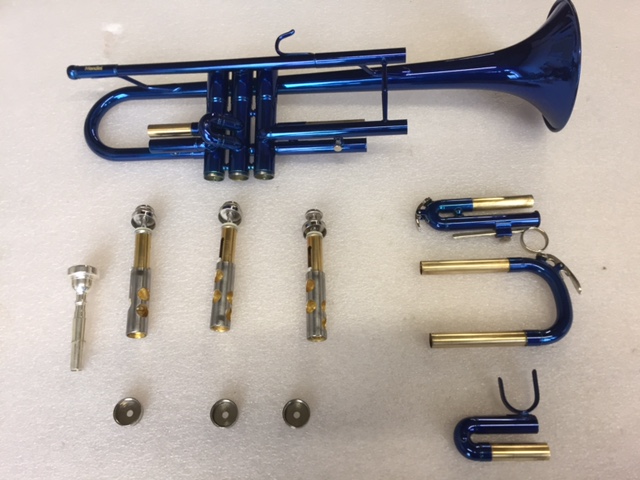
Which means most of my practice time lately has not been tunes or parts. On the horn, for instance, I'm spending a significant time blowing into the mouthpiece...without the horn even connected to it.
(The image to the right is from when I cut into my Kala Ubass to change the pickup. Among the things I had to do this week was rub the strings -- original Road Toad Pahoehoe "gummi worm" strings -- with talcum powder to tack down the stick, and replace the battery. I used a LiPo from the Holocron project, which means I have the only bass in town that can only be recharged from a Jedi Holocron.)
Oh, yes. And I'm delving deeper into music theory. Let me put it this way; I'd gotten the idea into my head that a dominant seven was built on the seventh degree of a scale (it's actually a V chord with a flat 5th. More or less.) Okay, blame inconsistent shorthand in some of the material I was reading. There's a lot of places where Roman Numerals aren't used for chords; like describing a Gospel style ending cadence as a "2-5-1" (since Gospel rarely uses simple triads, preferring four fingers or more per chord, that 5 is almost inevitably a dominant 7.)
So I'm not actually slipping down any on this one. I'm just spending most of my keyboard time scribbling on staff paper and not tickling ivories...err...acrylics...
 My experiments with less pressure, soft blowing, and other changes to my embouchure that permitted falls and slurs meant I basically lost my old embouchure. But that's okay; it wasn't right and it needed to be changed. Now I have the makings of a new embouchure and I'm practicing a lot this week to climb back to where I was before.
Well, sort of. For a few days there I couldn't play a line without burbling. Now the line is coming back, but with better tone and control, less fatigue, and more flexibility.
 The bass is at a similar place. I had never practiced muting. I hadn't been walking fingers and my fretting hand was curled. But since I have so much less time on the bass (really, it is more I have a lot of time building fretting and plucking habits on other instruments) it is more a matter of learning some fundamentals of stroke and fret before I can actually practice in earnest.
Which means most of my practice time lately has not been tunes or parts. On the horn, for instance, I'm spending a significant time blowing into the mouthpiece...without the horn even connected to it.
(The image to the right is from when I cut into my Kala Ubass to change the pickup. Among the things I had to do this week was rub the strings -- original Road Toad Pahoehoe "gummi worm" strings -- with talcum powder to tack down the stick, and replace the battery. I used a LiPo from the Holocron project, which means I have the only bass in town that can only be recharged from a Jedi Holocron.)
Oh, yes. And I'm delving deeper into music theory. Let me put it this way; I'd gotten the idea into my head that a dominant seven was built on the seventh degree of a scale (it's actually a V chord with a flat 5th. More or less.) Okay, blame inconsistent shorthand in some of the material I was reading. There's a lot of places where Roman Numerals aren't used for chords; like describing a Gospel style ending cadence as a "2-5-1" (since Gospel rarely uses simple triads, preferring four fingers or more per chord, that 5 is almost inevitably a dominant 7.)
So I'm not actually slipping down any on this one. I'm just spending most of my keyboard time scribbling on staff paper and not tickling ivories...err...acrylics...
Atlantis keeps popping up like a cork
I'm committed to the Crete story, and following it a bunch of fun stuff in New Kingdom Egypt. On paper sounds amusing enough; the coming of the Sea Peoples and the beginnings of the end for the Mycenaean civilization in the Aegean at the end of the Bronze Age, through the eyes of a young woman. And for Egypt, an extended musing on the process of understanding history and immortality set in the worker camps of the Valley of Kings and the ruins of the royal city of Akhenaton.
But I can't help think of things that are easier to write.
My trouble with Atlantis is that it isn't possible, not as given. This is true for pretty much all the popular conspiracy fodder, from Lemuria to Hollow Earth to the Bermuda Triangle. (Which is to say, the ideas that are well-known enough to attract a casual reader's eye, detailed enough to be easy to write about, and "big" enough to spin some epic about.)
Re the latter, archaeologists get excited about whether overshot flaking was developed earlier than supposed, but its hard to imagine chase scenes and gunfights erupting over that secret.
So, yeah. You could come up with an original mystery that isn't as badly contravened by the evidence as is Atlantis. Say, that Great Zimbabwe had steam power, electrification and sent explorers as far as Wisconsin. (One has to assume the Rhodesian Government did a hell of a lot more covering up than they are even historically blamed for). Or if hard tech isn't to your taste, that the real source of the Mayan mathematic genius was the Norte-Chico civilization, who had moved far beyond Set Theory into multi-dimensional manifolds and chaos math. Or if biological advances are your go-to, that the Sumerian King List is actually factual, that they had somehow managed to bred for extreme longevity, and aside from some of the Noachian patriarchs and odd hanger's on like Lazarus the line died with them.
All bunnies above are free for the taking, by the by.
Atlantis just doesn't work, not in the real world. There's three major ways around it. One is to change Atlantis, but by the time you've made it a town in the Italian Alps in around 200 AD there's hardly a point in claiming any connection is left to Plato.
The next is to assume it is, indeed, fake. You can go an Eco-ish route with this; either people who can't accept it is fake and build their own conspiracy around it, or it is indeed balderdash but in the process of looking into it anyway some totally unrelated thing is discovered. ("Look, guys, it isn't a Deep One after all -- it's just old Mr. British Petroleum trying to hide his fracking operation!")
Or, you change the world. (Actually, you pretty much have to change Atlantis a little anyhow. Continent filling the ocean and diving beneath the waves in a day? Not going to happen on this globe). I rather like the possibilities of this one. Plato wrote, then other writers added to, commented, criticized. There is archaeological evidence. Basically, it was a real place that left a real impact on the historical and archaeological and, yes, geological record.
And that brings me around -- Atlantis not necessarily included or wanted -- to two very different books I might prefer to be writing.
The first is the Fake Real. A story set either in a period of historical archaeology or in a couple of periods, with the discoveries made in one era being amplified on by another. The later would allow you to put both Carter and Ventris in the same story. So in this one, the past is stranger than it is in our world, and so is the present. Not only do some of the hidden technologies of the Atlanteans (or whatever) start showing up in the shops of London or as weapons in the wars, the historical characters themselves become para-historical; younger, stronger, prettier, more accomplished.
The other is the Real Fake. A story set in modern day or, better yet, somewhere between the 70's and the 90's (between the rise of Von Daniken and the rise of the cable TV pseudo-history channels.) Not only are the Lemurians as fake as they are in the real world, so is the archaeologist; a Remington Steele type created by a television show to be the world-famous discoverer of a new secret every week. Except that their patsy develops a conscience. Hence tension...and story.
Subscribe to:
Posts (Atom)