Showing posts with label andromeda. Show all posts

Friday, April 12, 2019

Read Ryder

I was musing on the thirty-minute walk back from work what a Mass Effect: Andromeda story would look like. Here's the thing; I like Ryder as a character and I like idea of the situation she finds herself in, but I hate the execution. Similarly, there are some fun ideas in the world building but it all falls very flat (and well before the end).


There is potential, though. With the death of the Pathfinder, the only man who seemed able to inspire the shell-shocked colonists and lead them to a new home, his daughter is in a unique position; potentially able to save the expedition if she is only good enough...and if she can only get others to trust her. In the game, though, there's almost no question and she really doesn't have to earn that trust. It just happens. No tension, like I said. I want to read the story where she has to fight for this, both against those who doubt her and against her own internal demons.

The expedition is desperate because their selected "Garden worlds" turned out to be anything but. They need to find fertile ground before they can even afford to thaw out the rest of the colonists. Let's leave aside any thoughts of hydroponics and space industry for the moment and accept this as a challenge. Except the game immediately undercuts this by showing; 1) Kadara, the requisite hive of scum and villainy where deserters from the expedition are surviving quite nicely, thank you. 2) Aya, the verdant homeworld of the Angara, an alien civilization that is open to diplomatic approach. 3) The Krogan colony, who look at the scorching sands and dangerous wildlife and say, "Hey, this is our kind of world!"

Instead Ryder spends the game running around solving Sudoku puzzles so some handy alien machines can magically fix the radioactive deserts and acid lakes. To which there is so little in-game effect most players stop bothering after the first few.

So...where is the option to colonize the Angaran homeworld by force? Or at least have some Milky Way faction strongly considering it. Or where is the option to recognize novel approaches (and needs, and physiologies) and recognize that the Krogan can colonize where humans can't, or that the shattered airless moon is actually just great for some nice big pressure domes, or that the rebels have figured out something useful and the colony leaders are either total idiots or there was a lot more to the attempted mutiny than anyone is saying.

And then there's the Kett. Who are sort of an organic version of The Borg; they've perfected a mutagenic virus that turns other humanoid life forms into more of them. They approach this with a religious fervor, truly believing that this is a gift they bring to other races. Well, where is a real philosophical exploration of whether they are right? Especially if it turns out the Kett form is an adaptation that can better survive the mysterious conditions of the Heleus Cluster than most of the Milky Way species can.

So, yeah, the problem is that one might, just might, be able to write a decent story with this material, but really you want to just trash half the world-building and do the damn thing right (or, at least, better.)


The first sequence of the game is Ryder awakes on her colony ship, the ship runs into some sort of negative space wedgie Mysterious Energy, takes severe damage, and is on the point of having to abandon ship. Ryder, her Pathfinder father, and a small select team take one of the surviving shuttles down to the very scary looking planet which is in the process of being ravaged by the Mysterious Energy in hopes of finding a way to save the ship.

Long story short, they run into an alien species who shoots at them, check out the Ancient Building of Alien Technology the other aliens were trying to get into, Ryder Senior throws a switch turning off the lighting storms and then falls to his death. Everyone else goes back to the colony ship which is mysteriously not damaged nearly so badly now and they all fly off...never to return to that planet again.

I say, fie on this! Ryder's dad is killed much, much earlier. The ship remains in danger. The planet is potentially viable. Ryder and the remains of the Pathfinder team have to survive and understand what is going on and struggle all the while to get the panicking people on the critically damaged colony ship to trust her, with the big turning point where they abandon ship and land on the planet she has staked all their chances on.


And then they have to deal with the Angara, and there are diplomatic overtures with the Kett, and a struggle of competing philosophies both of which seem to offer clues to the puzzle of what the Mysterious Energy is, what connection it has to the Ancient Aliens, how physics itself is different in the Heleus cluster and how the Milky Way immigrants can survive and adapt.

Oh yeah, and Sam, the talkative AI that was illegally placed in Sara's brain by her own father, is looked on with a lot more suspicion, including by Sara herself, and those suspicions are partly born out when Something Goes Wrong.


Tuesday, January 1, 2019

My face is tired: Mass Effect Andromeda

Yes, the environments look nice.

In every other way, though, moving to the Frostbite engine failed the game. If for no other reason than it took too long to adjust to the new engine and construct the tools the engine doesn't include. Various insiders opine that what actually shipped was completed in less than a year, and that after many of the team had left.

The game shows over and over that there just wasn't time for the polishing steps. And this goes deeper than the bugs. Take the janky animations the interwebs treated with such derision. Those are partially the fault of an inadequate toolset and inadequate test time, but they expose something else specific.

Which is that they are canned. Sure, this is an open world, and it makes sense that the necessary interactions of the tens of sidequests are handled in-engine, but...there are key interactions, major story interactions, interactions happening early enough in the game to shape the player's perception of the experience, which never saw the touch of an animator.

In ninety five percent of the conversations my Ryder had, the camera snapped to a single over-the-shoulder two-shot and locked there while Mimic or whatever lipsynch engine they were using tried to match facial movements to recorded dialog. Poorly. So poorly does this automatic in-engine system work, my Ryder went through several conversations unable to see any of the people involved in it!

(There were also times the dialog wheel itself popped in and out, and even moments when Ryder would suddenly blurt out her reply five minutes later and five km down the road in the Nomad, but that's the kind of bugs the game is still saddled with despite multiple patches).

(And just to add insult to injury, every single conversation would exit with the cursor floating in the middle of my screen, in the way of everything. What kind of lame coding is it when you can't even keep a stray cursor from being left lying around?)

Doesn't help that this isn't the strongest writing or voice acting of the series, either. Or for the company, either; Fallout 4 uses a similar lock-camera plant-and-bellow approach, leading to what reviewer Yahtzee calls "The Bioware Stare," but at least there are hand-tweaks to the animation when the conversation is important.

Contrast this to Mass Effect 2 or 3. Conversations are hand-animated, with multiple camera angles, shot reverse shot, push-ins, props; each performance is carefully constructed and staged and will have unique actions. This is also true of The Witcher, of even the later Wolfenstien games -- which aren't even RPGs!

The point of this is not that this is bad, per se. Or that it is unforgivable, given that the toolset they were working with wasn't accommodating. There are plenty of games and not just older games where this kind of cinematic mini-cutscene conversation isn't in use or wouldn't even be appropriate. The point is that this is a Mass Effect game. Which have given us this kind of close-up of the people we are interacting with and given them a chance to be distinct characters not just in their voices but in the ways their bodies move.

As another reviewer points out, Mass Effect isn't a driving game (although Andromeda brings back the vehicle and the large explorable terrains). It isn't really a shooter (although the combat in ME3 and Andromeda is so good that in the later is is almost the best part of the game). What it is, is role-playing. About interacting with people, changing the world through your choices and defining yourself in the way you make them.

And it is not to say full metal cinematography and a full Serkis mocap is necessary to have this kind of interaction. Players were deeply moved when conversing with a sixteen-pixel sprite through a text window, back in the day.

No, what's really the issue (besides the failures of story, dialog, design, and acting that make few of the Mass Effect Andromeda conversations memorable) is that, particularly after the kind of intimacy you got in the previous games, there is a real lack of emotional connect here. This isn't interactive dialog, this is walking through the animatronic Hall of Presidents.

##

The scenery is lovely. It is also static. I will give kudos for tire tracks being persistent, but there's a similar lack of connection that makes it into more like watching an IMAX movie of the Mojave then actually feeling like you are in the Mojave.

The approach used in Skyrim (actually, in most of the Elder Scrolls series -- and as well in many of the Fallout series) is to make as much of the litter as possible into physics objects. This was brought out in interviews with the lead designer for Skyrim. They absolutely intended to forge that closer connection to the game world by making it possible to knock over stuff (the fact that Skyrim's physics model makes it nearly impossible for the player to actually pick up a cup and place it on a table is disappointing, but the idea is there.)

The reboot Tomb Raider games have, as a part of their hidden-rails philosophy, no such moveable objects. Instead they give this interaction to the avatar; Lara will noticeably push small branches aside if you send her through the shrubbery, feel along the wall of a cave, and otherwise react to the scenery around her. Which animates somewhat in response. It may seem a small thing, but it helps so very much.

The outdoor scenery in Mass Effect Andromeda is lovely, though some of it is a little busy. The interiors are ridiculously busy, every square inch of wall covered with boxes and consoles and pipes and blinkenlights -- it looks like the ISS in there -- and the floors are so cluttered her teammates are constantly struggling with their pathfinding. And, yes, there is a chair or two you can knock over, but for the most part it is not just a static environment, but it is an unnecessarily cluttered one. There's no sense to it, no aesthetic, no overall pattern. No flow. Just stuff, so much stuff you stop looking at it. Instead of actually enjoying the insides of buildings I got into the habit of just pressing the forward key and hoping Ryder would eventually stumble on a path through the clutter, while looking at nothing other than my HUD for the pop-up that would indicate there was something for me to interact with.

(Another failure -- though far from unique to Andromeda -- is that the "interact" popup is persistent. In Andromeda, even quest markers were persistent; as in, they'd continue to clutter up the map and HUD even after I'd finished the quest. And while we're on the subject, both the journey and the map are garbage, and the navigator part of the HUD is the worst I have seen in decades.)

I've talked about this before. I don't like the way we put a mass of detail that doesn't matter, and then put a giant glowing label on the only things we can actually get game points off of. It is just like the Quick-Time Event problem; the screen image and sound design might be showing something wonderful, but the game progresses when you press the right button in the right time or place. This kind of clutter-plus-HUD doesn't give you the feeling of searching a room for a weapon, it gives you a feeling of playing Simon Says while a movie is playing in the background.

Would it be possible to disconnect, or rather, reconnect? I've tried Skyrim with the HUD turned off. I found I could still locate medicinal plants and mineable ores. It just became more annoying trying to find the sweet spot where the "gather" animation would actually play. I bet this could be solved just by increasing the size of the interact area, though. Incidentally, every single conversation in Mass Effect Andromeda started with a clumsy dance of trying to get Ryder close enough to the NPC and facing in exactly the right direction to unlock the "interact" button with them.

Once again, you spend all your time looking at a glowing glyph on your HUD and not with the depicted world the game is pretending to simulate your immersion in.

##

These are just two aspects of the failure of Andromeda. They are in part philosophical. The team spoke of concentrating on making a better combat system and they succeeded. They prioritized free exploration in an open world knowing that this would harm the thrust and pacing of the more story-driven trilogy. And it has never really been a physics object world where you can pick up things like Skyrim or destroy scenery like Just Cause. And they made many, many changes and compromises in order to support multiplayer.

The real failure here is the adoption of a game engine that can't do many of the things that were strengths of the series. Worse, the limitations of the game engine impose its own aesthetic; one of a non-interactive landscape and equally conversations.

They dreamed of making a game where you seek out new lands and meet new peoples. What was shipped was a game where you look at static landscapes and are shown talking dolls.

Sunday, December 30, 2018

White Human's Burden: Mass Effect Andromeda


It is probably too early for me to review Mass Effect Andromeda. There is quite a bit of story I have yet to encounter, nor have I drilled that deeply into some of the less obvious mechanics. However, I've landed on half the available worlds already and done the big plot thing on most of those so...

I can't help but be thinking of protagonist effect. Especially in games, there's a terrible tendency for nothing to get done unless the player avatar does it. This doesn't always mean they are recognized as The Chosen One in-story; in several of the Medal of Honor types the player avatar is at best a buck private -- what happens instead in these is that anytime a sniper needs to be taken out or a door opened all the sergeants can think of is demand that he be the one to do it.


(In other places this is a gameplay/story segregation fail. For instance, the player avatar might be just one of a squad trying to move through an area. The thing of it is, they win through -- or don't -- the moment the player avatar hits the invisible checkpoint. In many, many other cases, the story may treat the player avatar as being just one of many, but in actual play they might have done most of the fighting while the AI friendlies were still milling around.)

The original Mass Effect trilogy didn't do too badly at making the centrality of Shepard organic to the plot. First, the Commander starts as an "N7"; a top 99th percentile soldier. Then the Commander is hand-selected for elite Spectre status (a reports-only-to-the-Council special agent) and due to various events political and otherwise achieves it. So Shepard believably has both the prowess and the freedom to go to places with a problem and solve it for them. (Presuming, of course, that said problem can be solved by emptying magazines in its direction. Fortunately, the game largely delivers same.)
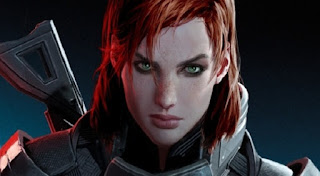

Later events up the Chosen One status; first Shepard stumbles across a broken Beacon left by the extinct Prothean precursor race, meaning he had first-hand knowledge about the World Threatening Problem. His success in trying to stop this threat are visible enough (eventually) that various people continue to give him the freedom to go about it his own way. Even the ending is a recap of the start; due to his abilities his squad is in the vanguard, and thus when someone breaks through to the final McGuffin it isn't that much of a stretch that it's Shepard again.

Mass Effect Andromeda is somewhat less elegant about this. In the game, another former N7 -- who also has a unique link with an extremely helpful AI -- has more-or-less created the idea of The Pathfinder, a single individual who leads the way for the colonization effort, doing the primary exploring and making many of the tough choices about when and where to attempt a settlement. Helps that he was a key organizer of the whole "colonize the Andromeda Galaxy" plan. Means he could credibly write his own job description, and largely sell people on it.

Unfortunately he dies on his first mission. Perhaps because there is no time to make a different choice, he invests that trust in one of his children, along with the special link to the AI that gives him some of his abilities.


The somewhat less believable part of this is that essentially all of the Andromeda Initiative survivors appear so shell-shocked by a series of terrible setbacks they've become unable to make decisions. Well, to be fair, the people who could make decisions did...they chose to leave (becoming yet another faction you meet later in the game). They pin all their hopes on The Pathfinder when he finally shows up -- and then, although rather less enthusiastically -- on his hand-chosen successor when he dies.

Sure, Sarah/Jack has a lot of training, and has the special set of AI codes, but even he or she is quite forthright about this being a ridiculous amount of responsibility. Still, this awkwardness is overcome by the game, both with the very probationary way they are treated early on, and their own professed worries, and, eventually, enough things that go right to win them a slow and grudging increase in confidence. It is still ridiculous just how many things The Pathfinder turns out to be responsible for.

The place where the game really falls down is with the Angarans. Long story short, they also had a cavalcade of disaster. First The Scourge, a Negative Space Wedgie that turns all the planets in easy reach down to only marginally habitable. Then the Kett arrive, slaughtering and enslaving. The first thing Ryder does is -- thanks again to the Magical AI -- start turning back on the forerunner magitech atmosphere machine-thingies that start reversing the effects of The Scourge. This is something the Angarans had been trying to do, but despite studying the stuff for hundreds of years they never made much headway in figuring out how it worked. Apparently they never had Sudoku on their planet.

(There's a gamification aspect to this. Most of what Ryder does is wave an Omni-Tool at the stuff, which is presented as letting the magitech AI do its thing. But a key part to turning on the towers is through the player playing a mini-game of Complete the Rows.)

If that wasn't bad enough, to earn the trust of the Angarans Ryder agrees to help fight the Kett. And single-handedly takes out a key fortress the Angarans had been throwing themselves against since the Kett arrived. Okay, sure; they got a rare chance at it because a code was intercepted, but how is it Ryder is in strike distance and no-one else?


In the television show Stargate Atlantis the protagonists go around doing things and shaking things up but this works for several reasons. For one, they are outsiders. That doesn't, however, give them a gift of insight to help solve other people's intractable problems. What it does, is make the Milky Way people dangerously naive. Most of the peoples they have run into have found ways to survive the Wraith incursions. Within days, however, the Atlantis crew shot the wrong Wraith and permanently upset the status quo. Now all the old ways of coping are failing.

More importantly for this comparison (the Pegasus Galaxy situation is unique) is that the Atlantis crew have...Atlantis. As in, the most advanced tech around. And this gets mercilessly pointed out by most of the people they meet. The Atlantis crew wins in places where no-one else could -- and at the end of it, the people they helped go, "Hey, if we had those cool toys we would have done it ourselves. And done it a lot better, too."

I find I can suspend a certain amount of disbelief for a the right kind one-man army. People do have a wide variety of skills and genetic aptitudes, after all. Bruce Lee's hands really were that fast. Especially in a less realistic game I haven't a huge problem going along with the player avatar being just that much better than anyone else. It does help, though, if there's an in-game reason. Otherwise you start feeling like the Only Sane Man. I had that experience in later play throughs of Tomb Raider 2013. "She's just one girl!" shout the Solarii as you mow them down. Yeah. One girl that can hit the side of a barn...unlike you lot.


This is pretty much where I was with Ryder. Her stated background in-game isn't super-soldier. She's defended an archaeological camp against pirates and slavers, she says at one point. And went hunting with her dad, I think. And okay, there's the AI boost that for various reasons only she and dad got. But past that, she's using the same weapons the Kett are using and she and her two friends are typically mopping the floor with squad to platoon strength adversaries. For all intents and purposes, it really is a world of cardboard for her. It makes you, through your avatar, feel less like you are skilled or lucky, and more like the rest of the world is incompetent.

(This is not something you could help by setting the game on "hard" mode. You'll still have to overcome the same ridiculous numbers. You'll just fail at it more often and spend more time in loading screens.)

I'm left on the fence whether it is worse to have a hero of clearly ordinary skill who wins despite the outrageous odds against it, or a hero who is so clearly superior it is hard to feel for them. Between, that is, the ludicrously lucky schmo or the unlikeable Superman. I've been reading a lot of Greek myth and particularly the Homeric "heroes" are rather notable in that theirs is a heroism of doing, not of trying. They are almost inevitably part god, and given godly gifts, and sometimes infused with even more power. Theirs is not a struggle, but a demonstration of superiority. I find this difficult to laud.

Still, one has to remember that the bulk of The Odyssey is about a man who struggles to overcome hardship. It reminds one that one of the great Spider-Man moments was not when he beat up Galactus or something, but a moment he was nearly crushed under a great weight...and refused to give in, taking an entire page to finally struggle free.

But back to the problem. Besides the way Ryder plows through opposition, and the way the alien tech proves so easy to manipulate, the number of steps and the overall effort is so very very little. This is a problem of gamification, of course. But it is also one of trying to make a game with a hundred-plus hours of play around too little plot to support it.

You can finish the Mass Effect trilogy in as little as forty hours, if you don't mind losing most of the galaxy on the way to your pyrrhic conclusion. But this is made up of one overall story arc, split into three distinct acts, each of which falls into four to six major episodes each. Mass Effect Andromeda doesn't give the same sense of overarching story and theme. It just feels like a bunch of fetch quests. If you do three similar ones, then suddenly there's a great victory and an entire alien race is calling you a hero from the stars.

You can pretty much sleep-walk through a couple of easy fights, drive or walk blindly from one pop-up quest marker to another, make no decision tougher than whether to answer a question in a manner that's funny and warm or professional but quirky, and come back to the Nexus to hear people singing the praises of the new Pathfinder who can do what they couldn't do over a decade of work.


There's even quests on the Nexus where you slide by on either the ridiculous latitude you get as Pathfinder or the magic AI. In the latter, there's a saboteur you catch because no-one else has the crypto-key to everything and a magic scanner to boot. In the former, you get to judge a murder case because you just arrived and are presumed impartial and because you are (deep breath) Dah Pathfinder no-one is going to question it.

(The Nexus is the big space station that's in-world supposed to be the meeting place and support facility for the colonization effort, and in-game functions as a hub that you actually don't need as ninety percent of the game functionality is available on your ship. And even then, I have yet to bother climbing around the ship to use the crafting stations. I just grab one at whatever alien I'm visiting at the moment. They all work the same.)

Now, this could be made workable. The big flaw is not that desperate confused and scared people -- who just got their asses kicked in what was essentially a civil war as everyone with a strong opinion went and left in a huff -- would turn to a newcomer who still has idealism, who comes in with fresh supplies and new hope, and has been vested with a reputation of being able to accomplish the impossible (a borrowed vest, but still). It is the way it is carried out in game.

The stories are awful, the underlying mechanics far too obvious ("A quest giver will appear and ask you to go to a point on the map and return. Bad guys will attack at least once.") It makes the rest of the Andromeda Initiative look stupid. But worse, it makes the local inhabitants -- indigenes that the Initiative really should have predicted when they planned this massive colonialist effort -- look worse.

You can make your Ryder any color you like (in an interesting mechanic, your choices for the kid reflect back to parent as well as sibling). The point is not that (the default) Sarah is white, or even that she's human. It is that she as the protagonist is functionally the same as the white dude in those unfortunate movies and books where apparently the natives had never figured out irrigation, or making peace with their enemies, or how to play basketball until the hero came along.


(Image from a Polygon article, showing how natural dad Alec can look even when taken far from the default appearance).