I've been reading pages of "ko-no-si-ja ki-re-te-we-ja-i LUNA 1 GRA 100..." for a week now. Well, actually mostly the excellent analysis Barbara Olsen makes of two collections of Linear B tablets (at Knossos and Pylos.)
Of course there wasn't a work group described in detail, with a couple names included. That would be a pipe dream. And I already knew my picture was probably inaccurate. Well....
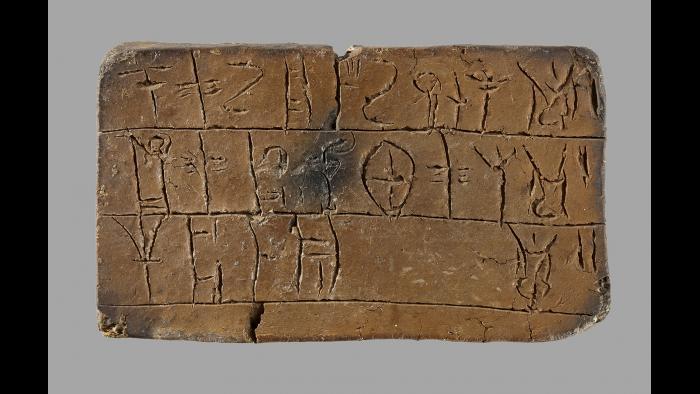
So. In some ways the model at Pylos is what I expected. This is sweat-shop industry; women and underaged children in groups of ten to thirty under a handful of supervisors work at one single element of textile production (usually spinning or weaving). For a stipend of grain and figs.
The older children are recorded as being trained in to the job. Or, if they are male, sent out to "the rowers" or other appropriately gendered tasks. There is no record of the women's names, or any economic activity except for the stipends, strongly suggesting an extremely servile status. In one of those tantalizing but telling glimpses, one tablet set appears to record how more than one group conveniently married en masse a corresponding male workgroup. Others, as I said, suggest the grown male children are separated and sent to other work. The recognized Linear B word for "slave" does not appear in these contexts but other than that...
So if my weaver protagonist was within one of these groups (as I had first imagined her) her life would be extremely circumscribed. It is unclear how a worker would ever advance from this drudge work, for instance.
The Knossos tablets, which although more numerous are also heavily damaged and thus harder to draw conclusions from, seem to record a very different world. Rations are not listed in any tablet series known to exist; instead, quotas are given. Analysis of the quotas suggest a given year's production could be achieved in as little as three months; this, and other details, strongly suggest a corveé labor system.
These are mixed groups. The meticulous documentation of children by age and gender in the Pylos tablets is absent; the presence of children could be inferred but the work group is essentially treated as a whole, under a single personal name who can be assumed to be the manager. The groups appear to be agile, assigned to different tasks as needed, and also as against the assembly line style of the Pylos work a single workgroup is capable of processing an entire garment from raw wool to finished cloak.
So these are obviously a better match for my character. But they are also not an isolated group of weavers ensconced in the palace; they appear to be, in fact, a group selected from the surrounding community, who spend the rest of their year working their own farms and whose social circumstances are otherwise ordinary.
There is suggestion of a live-in palace staff on some tablets, but Olsen makes convincing argument that the textile workers stationed at the palace (well, at Pylos, at least) are basically taking care of the domestic needs. They are not creating material for export.
But then, there is a lot of discussion in the field about whether export is the primary, or even an important, purpose of the centrally controlled textile industry. It is just as reasonably the utilitarian needs of a state, and the expensive luxury goods that sometimes find themselves traded to far-away countries are produced in independent...well, call them Merchant Houses.
Why all the bother about this?
See, I'm not writing about free agents, about people who can trod the empires of the LBA into the dust beneath their sandals (well, at least not at first). The details of the "Weavers Hall" are not a paragraph of background before the characters set out from their Bronze Age Shire on an epic journey. They are the story (for at least a good part of this novel.
Funny. My last novel was also very much about a strongly hierarchal society and, although my protagonist was technically a free agent (granted power she didn't want) she had already internalized her society, its structure and values. Her hardest fight was not any of the external enemies (and there were many) but trying to resolve within her the competing expectations, roles, and obligations.
Tricks of the trade, discussion of design principles, and musings and rants about theater from a working theater technician/designer.
Showing posts with label linear b. Show all posts
Sunday, September 2, 2018
Sunday, August 19, 2018
Equipotential Point
On the good side, I'm largely finished with general research. On the bad side, I've barely started focused research.
Hopefully, if the outline holds together as I flesh it out, it will generate mostly specific questions. But, oh, so very many questions. I've been putting off worrying about stuff like what do people wear, what do people eat, because there are things I need to know that have a greater influence on my characters. Is Kes freeborn, a bondservant, a slave? I assume she's non-Greek but what does she think she is and how does that change her position in society? Is she a corvée worker who lives in a village when not called to the palace, or is she of an isolated group kept in a dormitory?*
I'm not to the point of describing pots yet. I'm watching the establishing shot come into focus. The palace...where I seem to be going is that the labyrinth (aka almost everything but the central court) was destroyed long ago, the Mycenae put up a few walls here and there (Evans tore most of these down, but at least he spared the griffons), but the Mycenae use it as an administrative center only. The royalty, whatever they are at Knossos, may be next door at the "Little Palace."
And that cascades in a number of directions. The red tide is back in the picture (an invention of mine, totally unmentioned in any actual history). It is harbinger and what causes at least some of my cast to go into motion. Oh and yeah...if the Egyptian noble is going to be able to do half the things I want him to do, he has to be pretty awesome. Speak and write a dozen languages for a starter. Which means my etocretan weaver needs to step up her game, too, reaching that larger-than-life status of genre protagonists and other heroes before she leaves Crete.
And either that, or some other recent surfing through the blogs of Classics folks and ancient language nuts** and historical fiction writers has made me think that the Hittite Empire is not off the table. Nor is Cyprus, but boy is that place complicated. Even explaining the situation in Enkomi would be a massive info-dump. And I still need to leave room for some Sea People.
Hopefully, if the outline holds together as I flesh it out, it will generate mostly specific questions. But, oh, so very many questions. I've been putting off worrying about stuff like what do people wear, what do people eat, because there are things I need to know that have a greater influence on my characters. Is Kes freeborn, a bondservant, a slave? I assume she's non-Greek but what does she think she is and how does that change her position in society? Is she a corvée worker who lives in a village when not called to the palace, or is she of an isolated group kept in a dormitory?*
I'm not to the point of describing pots yet. I'm watching the establishing shot come into focus. The palace...where I seem to be going is that the labyrinth (aka almost everything but the central court) was destroyed long ago, the Mycenae put up a few walls here and there (Evans tore most of these down, but at least he spared the griffons), but the Mycenae use it as an administrative center only. The royalty, whatever they are at Knossos, may be next door at the "Little Palace."
Phillip Boyes posted this wonderful LEGO Minoan Temple on his site Ancient Words
In an only slightly related question, I'm going to accept the isotope analysis of a sectioned stalactite that was done a few years back and say there was a previous drought -- this is the one that caused those, err, floods of letters back and forth between Ugarit and Hattusha and Egypt asking for grain to help their starving peoples. Then a period of recovery which very roughly corresponds with the cyclopean wall building in some of the Mycenaean cities. And then the real bad news; this is the year where the drought comes back, the drought the Navarino Environmental Observatory believes stretches a hundred years through the heart of the Greek Dark Ages.And that cascades in a number of directions. The red tide is back in the picture (an invention of mine, totally unmentioned in any actual history). It is harbinger and what causes at least some of my cast to go into motion. Oh and yeah...if the Egyptian noble is going to be able to do half the things I want him to do, he has to be pretty awesome. Speak and write a dozen languages for a starter. Which means my etocretan weaver needs to step up her game, too, reaching that larger-than-life status of genre protagonists and other heroes before she leaves Crete.
And either that, or some other recent surfing through the blogs of Classics folks and ancient language nuts** and historical fiction writers has made me think that the Hittite Empire is not off the table. Nor is Cyprus, but boy is that place complicated. Even explaining the situation in Enkomi would be a massive info-dump. And I still need to leave room for some Sea People.
Frowsivitch, at DeviantArt. I dunno which I like most; the authentic armor and helmets, or the cats fighting lobsters.
*I've got a book that may answer those questions, but it is seven hundred pages long and I'm only in the first chapters. On the plus side, I'm beginning to read (transliterated) Linear B. "pu-ro ri-ne-ja MU 9 ko-wo 3 ko-wa 3 TA" would be typical of a "PY Aa" series tablet, a documentation of personnel describing a work group of 9 adult women and 6 children of both sexes at Pylos or the Hither Provinces.
(MU is the ideogram for "woman," named as are all Linear B ideograms in an abbreviation for a Latin descriptor. TA is an ideogram that is inferred in context to mean some sort of supervisor. Pu-ro is how you have to transliterate Pylos to get it into Linear B -- see why we hate the stuff?)
And as for "ri-ne-ja," Olson calls this "etymologically transparent," with that dry academic humor I'm getting so accustomed to. It means "Linen Workers"; from the Greek lineiai of course, plus the -ja worker suffix.
** I've found the blogs of two different people who do ancient scripts baked goods, like Phaistos Biscuits or cakes with cuneiform frosting decorations.
Labels:
archaeology,
history,
language,
linear b,
sea peoples,
writing
Friday, August 17, 2018
e-ni-jo-te
I just realized I've been here before.
I've been reading an exhaustive analysis and comparison of the Linear B archives of Knossos and Pylos. Also reading a series of papers by John Younger which attempt to infer something of the lives of Minoan and Mycenaean women through surviving art.
And then I remembered. Way back when, I was reading a ton about contemporary (or at least post-war) Japan. At some point I wrote a novel set in a pastiche version of that world. You could cast that as anthropological research, especially as the material was about a living culture (a big chunk was oral histories, even). And I'd cast the stuff I'm reading now as primarily archaeological and epigraphic. But it comes down to the same things; trying to understand a society, its material culture, and the way individuals within it experience it.
For the Mycenae, the depths of time are so great and our windows so narrow and strangely-shaped. It is like trying to reconstruct the economic functions of the poultry farm through Foghorn Leghorn cartoons. We just don't have the deep cultural understanding to be able to detect biases in the material.
(I think the primary difference between my study of post-war Japan and my study of pre-collapse Mycenae is I'm in much closer proximity to the primary materials. To properly understand the conclusions based on the available epigraphics you have to understand a little of how those actually work, and the majority of scholarly writers make sure to aid this understanding. Plus, the Linear B tablets are not just documentation of the world of the novel, they are props within the novel. So I'm making some smallish efforts to understand how you read it).
Every day I discover new resources. I had to start a new Scrivener doc to start actually organizing the research. Thing is, I can't just collect data. This isn't like writing something in a well-documented period where you can just add to your notes; "Made in Detroit, introduced in 1937, seats four." Especially within papers (which is half of what I'm reading now) the presentation is more, "Based on this one specific data set that is the focus of this study, a potential conclusion is that the object came from somewhere outside the empire and was larger than the better-documented one that is known to only seat two. And a pen case marked with the serekh of Seti I was found in the same archaeological context giving it a tentative dating of in or after the latter part of the 19th Dynasty..."*
So I've been typing out quotes from the material, with full citations so I can look back at the full context if need be. Not the easiest way to document research. I haven't figured out how to cross-link within Scrivener, either. (Worse, half the stuff I'm reading is in scanned form only so I can't cut-and-paste. Unless I learn and am prepared to go through the whole OCR stage as well.)
And I'm still dealing with the word count problem. As close as I can estimate, the Crete material is going to hit around 60,000 words. That's too short for a novel and too long for anything else. If it was under a third of the page count it would let me collect it with other material, but you can't go over half way with one plot then spend the remainder of the book doing something completely different.
I do mean to decompress. I've been aware over several of my recent efforts in fiction I'm overloading my paragraphs, right down to the sentence level. Yes, every paragraph should accomplish more than one thing, but I've been trying to stick too much detail and too much nuance, and doing it badly; doing it with comma splices and stacks upon stacks of adjectives. I need to give each concept, and each moment, each "beat" of dialog the room to breathe.
But that's not going to get me to 90K. Sure, it seems easy to add material (it certainly was for the Tomb Raider/SG1 fanfic. Too easy; I'd dream up two or three interesting things for each chapter and discover that between them they'd bloat the word count over 10K). You can pad description. You can pad dialog. You can even add incident. But none of these are story. And it is story that I need.
* "...although Evans argues convincingly that the Seti I pen case had slipped from a higher level during the original excavation and can not be used to date that particular horizon..."
I've been reading an exhaustive analysis and comparison of the Linear B archives of Knossos and Pylos. Also reading a series of papers by John Younger which attempt to infer something of the lives of Minoan and Mycenaean women through surviving art.
And then I remembered. Way back when, I was reading a ton about contemporary (or at least post-war) Japan. At some point I wrote a novel set in a pastiche version of that world. You could cast that as anthropological research, especially as the material was about a living culture (a big chunk was oral histories, even). And I'd cast the stuff I'm reading now as primarily archaeological and epigraphic. But it comes down to the same things; trying to understand a society, its material culture, and the way individuals within it experience it.
For the Mycenae, the depths of time are so great and our windows so narrow and strangely-shaped. It is like trying to reconstruct the economic functions of the poultry farm through Foghorn Leghorn cartoons. We just don't have the deep cultural understanding to be able to detect biases in the material.
(I think the primary difference between my study of post-war Japan and my study of pre-collapse Mycenae is I'm in much closer proximity to the primary materials. To properly understand the conclusions based on the available epigraphics you have to understand a little of how those actually work, and the majority of scholarly writers make sure to aid this understanding. Plus, the Linear B tablets are not just documentation of the world of the novel, they are props within the novel. So I'm making some smallish efforts to understand how you read it).
Every day I discover new resources. I had to start a new Scrivener doc to start actually organizing the research. Thing is, I can't just collect data. This isn't like writing something in a well-documented period where you can just add to your notes; "Made in Detroit, introduced in 1937, seats four." Especially within papers (which is half of what I'm reading now) the presentation is more, "Based on this one specific data set that is the focus of this study, a potential conclusion is that the object came from somewhere outside the empire and was larger than the better-documented one that is known to only seat two. And a pen case marked with the serekh of Seti I was found in the same archaeological context giving it a tentative dating of in or after the latter part of the 19th Dynasty..."*
So I've been typing out quotes from the material, with full citations so I can look back at the full context if need be. Not the easiest way to document research. I haven't figured out how to cross-link within Scrivener, either. (Worse, half the stuff I'm reading is in scanned form only so I can't cut-and-paste. Unless I learn and am prepared to go through the whole OCR stage as well.)
And I'm still dealing with the word count problem. As close as I can estimate, the Crete material is going to hit around 60,000 words. That's too short for a novel and too long for anything else. If it was under a third of the page count it would let me collect it with other material, but you can't go over half way with one plot then spend the remainder of the book doing something completely different.
I do mean to decompress. I've been aware over several of my recent efforts in fiction I'm overloading my paragraphs, right down to the sentence level. Yes, every paragraph should accomplish more than one thing, but I've been trying to stick too much detail and too much nuance, and doing it badly; doing it with comma splices and stacks upon stacks of adjectives. I need to give each concept, and each moment, each "beat" of dialog the room to breathe.
But that's not going to get me to 90K. Sure, it seems easy to add material (it certainly was for the Tomb Raider/SG1 fanfic. Too easy; I'd dream up two or three interesting things for each chapter and discover that between them they'd bloat the word count over 10K). You can pad description. You can pad dialog. You can even add incident. But none of these are story. And it is story that I need.
* "...although Evans argues convincingly that the Seti I pen case had slipped from a higher level during the original excavation and can not be used to date that particular horizon..."
Subscribe to:
Posts (Atom)


