aka "We're doomed, doomed." c.f. "Kids these days..."
In my previous essay I emphasized how real-world physical acoustics leaves fingerprints in recorded sound. For instance; record in your living room, and unless you smother it with excessive post-processing, anyone listening will know it was recorded in a living room. Which is fine, unless you meant for it to sound like it was recorded on a wind-swept moor.
The corollary is that acoustic physics can be the easiest way to load desired information into a recorded sound. Want a cue to sound like it is coming from an iPod speaker? Play it back on an iPod speaker. Or play it back on that speaker, record the result, and play that back! (Leaving aside whether placement in space is also desired for that particular effect).
However.
Your audience is increasingly not getting that necessary reference to the real acoustic world. They are increasingly surrounded by processed sound. By amplified sound, by reinforced sound, by manipulated sound, and more than anything else by recorded sound.
This is the latest serve in the volley between audience and sound designer. First one could be said to start back in the Mystery Plays. By the time of Opera and Vaudeville, a whole symbolic language had been built of artificial sounds, standing in for elements of the desired environment; mechanical effects from the slapstick to the thunder run and the wind machine.
This is a trend developed through the golden age of the radio play and the early sound films, advanced by creative directors like Hitchcock and Wells, and reaching fruition sometime in the 70's when film sound became a fully designed element; no longer thought of in terms of mere reproduction, but a canvas of substitution. Film sound has become akin to film editing in being a language the must be learned by the audience, until they accept without thinking that the cry of a red-tailed hawk means the mountain on screen (whether it is meant to be in Peru or on Barsoom) is tall and majestic.
A Hollywood gunshot or fist no longer sounds much like any "real" gun or fist, to the point at which the sound designer takes a risk in putting out a sound that goes against that programmed expectation. The otherwise unmemorable action film Blown Away went through expensive effort to record the actual sounds of explosives before test screenings forced them back into the stock, expected, "blowing on a microphone" effect that was itself a relic of earlier and more primitive microphone techniques.
The next volley is amplified music on stage and ADR dialog on film; an audience raised to expect the kind of pristine vocals and instrument reproduction possible in a studio (or with studio techniques laboriously introduced into every available cranny of production audio and married as seamlessly as possible with studio re-takes). The audience of 1940 heard mostly unreinforced voices on stage, even on the musical or in opera, from the pulpit and even from the podium and bandwagon. Now, reinforcement is omnipresent. And the vast majority of story and song that is delivered to the theater audience is outside of that still-acoustic space.
In short, the audience is used to hearing every syllable clearly, every finger pluck clearly. They don't have to pay attention, much less strain, when listening at home to radio or television or recording, and they aren't listening to unassisted voices in an acoustical environment in the movie house or concert stage. With rare exceptions.
And they have brought those expectations to live theater. They expect to hear dialog as crisply, and with as little effort on their own part, in that still-acoustic space. So the poor theatrical -- and even operatic -- sound designer is forced into ever more technologically sophisticated (and expensive) systems to reinforce and amplify and (usually less successfully) clarify.
So now we come to the last salvo. And that is an audience who spends a significant part of their waking life with earbuds in. They no longer have any first-hand experience with a physical acoustic environment. To them, the sonic cues that tell how far away a sound is, or how big a room is, are those created by designers -- by film and television sound designers, but even more frequently by game programmers.
Just as we can no longer trust our audience to understand an actual recorded gunshot -- how we need to present them with the fake, wrong, ersatz gunshot they expect -- we can no longer trust them to pick up environmental or physical acoustic clues that mimic or are taken from the real world. To them, increasingly, distance is reverb and a shout is merely volume.
We may, as designers, have to learn this new and artificial language instead if we wish to communicate with our younger audience.
But then, the way some trends are going, we might just put aside the microphones entirely and put the whole thing in the form of tweets.
Monday, August 15, 2016


Sunday, August 14, 2016
Yamatai II (fanfic thoughts)
I've written before about my issues with the reboot "Tomb Raider" (2013). I'm left with no firm idea of how one could have made it a better game. However -- and topical in that a movie is apparently about to enter production -- one can put aside questions of playability and game balance and ask only what would make a better narrative.
And this is another rambling ranting essay, so the rest is below the fold.
And this is another rambling ranting essay, so the rest is below the fold.
Essay: Worldization
The human brain is very good at picking up subtle audio cues; the little changes in phase and frequency content and direction that between them reveal the size and distance of an emitter and the size and surfaces of any enclosure around it.
These elements are difficult to fake, and nearly impossible to remove. If you record a voice-over session in a room, it will sound like it was recorded in a room. There is almost nothing you can do to remove those tell-tale clues.
Physicality matters. And physicality also sells. So as a sound designer, you can leverage that same physics.
One of the old tricks used in cinema was Worldizing. Basically, this meant taking pre-recorded material and playing it back in the same or similar acoustic space that was being shown on screen. Then record that. A similar trick has been used in record production; the most obvious being the "transistor radio" effect, achieved by -- yes -- playing back the track through a small speaker and picking that up on a mic.
You can perform this same trick live in the theater environment. If you have a sound effect that is pretending to be from an on-stage radio, then play it back through a small speaker. And place it as close as you can to where the prop is; again, that human audio processing system is uncannily good at figuring out where a sound is coming from in 3d space.
Of course, there are ways to fool that mechanism. One very useful trick for theater is the Precedence Effect. Simply put, the brain localizes on the first source heard (and/or, within a graph of intensity versus precedence, the loudest). So you can reinforce the sound of that small speaker to make it louder and fill in more of the low end content with other speakers, and as long as you stay within certain constraints of volume and time the sound will still "appear" where you physically placed the small speaker.
It isn't just speaker size. Placement matters. And so does the environment. If you place a speaker behind the set it will reverberate around the off-stage spaces and carry with it an aural "map" of that space. Put it on stage, within a defined space there (say, the couple of set walls that represent what the audience can see of a connected anteroom or bathroom, or inside a cabinet or coffin) and those acoustic spacial cues will be aded to the sound.
The simplest recording process is to record dry and add the appropriate ambiance later. However, there are times it makes sense to record within a specific acoustic space to begin with. Record in a stairwell and it will sound like a stairwell (or, at least, sound like a tall enclosed space). Interestingly, you can record on the actual stage and, if you've placed your microphone well (either in the audience, or near the speakers) on playback you will get phantom sources that seem to exist right there in the space with you. I did this once for Rosencranz and it was most effective.
On the flip side, you don't want every VO session to sound like the lobby, or every instrument you record at home to sound like your living room. Dampen those give-away reflections. I often record VO in costume shop storage, because all those hanging fabrics provides an acoustically dead space.
Physics appears in sound in other places. The vibration modes of any object -- not just a musical instrument -- change over various intensities. You can not record speaking and make it sound like shouting, or record a light tap and make it sound like a hard crunch. Or even record a piano played softly and make it sound like a piano being played vigorously. Physics doesn't allow it.
Again for voice-over work, if you want a voice to sound like it is twenty feet away, record from twenty feet away. Conversely, if you want it to sound like it is on a phone or a headset, then get that mic that close (or, better yet, find a phone or headset and record through that).
The latter is better because, once again, physics. You can simulate what a carbon element sitting in a phenolic handset sounds like, but you get a more accurate simulation with less work if you just record through that actual technology to begin with.
And this blends into sound effects. There is much more to be said on sound effects; about how audiences have been trained to expect things to sound a certain way (which they do not in real life), about how you need to focus in and strip down real sounds in order to "sell" them in the limited sonic window you have available in a play, and how distorting the real and creating the unreal are part of the art of sound design. But the best starting point is with real sounds. Not necessarily the sounds of that exact thing, mind you -- see above! -- but with real sounds. A microphone pointed at an actual mechanical object be it a snapping twig or a wind-up clock delivers multitudes of detail that is difficult to synthesize.
And real sounds have, well, reality. A gravitas, even. They carry that verisimilitude of real objects operating under the real physics we've instinctively absorbed through living in that physical environment. Even when you use a sound out of context, or use it to sell something quite different from its actual origin, those tiny cues of vibration nodes and damping and the little bits of noise of clattering and chattering and slithering and scraping are all there making it feel more real -- as well as more complex and more engaging.
Lastly, microphones have response curves and pick-up patterns. Equalization after the fact introduces phase shifts (as well as other artifacts); the better way to get a "bright" sound is to start with a "bright" mic. Real objects -- this is particularly obvious in musical instruments -- radiate from multiple sources in multiple directions. A microphone a few inches from a violin will hear a distinctly different sound picture if over the bridge, the neck, the back, or over an f-hole. And that same microphone a foot away will get yet another set of pictures depending on what part of the violin you aim for.
This is why placing microphones properly is so essential to getting the desired sound from a musical instrument that is being recorded (or reinforced in a live sound situation). The right mic, the right position, the right distance; these are all things that are difficult but not impossible to correct at the console or with plug-ins in the DAW. Which is not the same as saying post-processing never happens. There are instruments that are almost defined by artificial processing of the original acoustics, primary among them being the rock drum kit.
This matters for voice-over recording to. Or for foley work. It is essential in both to put on headphones and find out what is actually going to the recorder. Search out the sound field, move the mic and change the angle, to find the sound you are searching for.
Progress Post
Lots of progress this weekend. Finally!


Reserved another slot at the laser and cut out a complete set of diffuse panels for the new prototype Holocron. Also cut a few test shell pieces and confirmed the file was good; it was a laser focus issue that was giving me a poor fit-up.
It still requires a bit of sanding and Bondo Spot Putty to get a seamless shape.
The new scheme for attaching the circuitry layer appears to be working as well. I vector-engraved small circles where a glue bead would be hidden by the outer shell. Just had to touch each with acrylic glue with a Q-tip and the circuit layer is glued down -- hopefully without any glue streaks showing on the final assembled Holocron.
Final coat of base paint is drying now. I'm eager to do the final assembly (the test-fit went well) but I may hold off and do some weathering first.
I also have shell pieces for at least two other Holocrons, in two other shell designs; the "Temple" design and an "Imperial" design. So I'll be able to illustrate sone options. Looking at re-doing the "Temple" (or a second "Stolen" that I have most of the pieces for) in chrome, and the "Imperial" in gunmetal.
 And it took only two hours of laser time to essentially cut the pieces for one Holocron. But that laser session also brought home just what kind of labor is involved. And how many pieces that have to be carefully collected and wrapped and shipped (the pieces from yesterday basically filled a small Fixed-Rate postage box). I might say I'm rapidly losing enthusiasm for running off a lot of these even as kits. I was going to release the files after a certain amount of time had passed, and that time has just shrunk considerably.
Well, one thing I can do is take the SBU for the "Trotec" lasers, which are more powerful and thus faster, and for a small fee can be reserved for longer blocks of time. That would make for a more efficient day in getting a bunch of pieces cut.
For now, though, a few more steps and I'll have a new prototype for pictures...and I'll be able to see what kind of interest there really is in the kit.


Reserved another slot at the laser and cut out a complete set of diffuse panels for the new prototype Holocron. Also cut a few test shell pieces and confirmed the file was good; it was a laser focus issue that was giving me a poor fit-up.
It still requires a bit of sanding and Bondo Spot Putty to get a seamless shape.
The new scheme for attaching the circuitry layer appears to be working as well. I vector-engraved small circles where a glue bead would be hidden by the outer shell. Just had to touch each with acrylic glue with a Q-tip and the circuit layer is glued down -- hopefully without any glue streaks showing on the final assembled Holocron.
Final coat of base paint is drying now. I'm eager to do the final assembly (the test-fit went well) but I may hold off and do some weathering first.
I also have shell pieces for at least two other Holocrons, in two other shell designs; the "Temple" design and an "Imperial" design. So I'll be able to illustrate sone options. Looking at re-doing the "Temple" (or a second "Stolen" that I have most of the pieces for) in chrome, and the "Imperial" in gunmetal.

Well, one thing I can do is take the SBU for the "Trotec" lasers, which are more powerful and thus faster, and for a small fee can be reserved for longer blocks of time. That would make for a more efficient day in getting a bunch of pieces cut.
For now, though, a few more steps and I'll have a new prototype for pictures...and I'll be able to see what kind of interest there really is in the kit.
Friday, August 12, 2016
Laser Burn and Holo...Price
I've not been feeling well all week. Took a half day off Monday, took all day Thursday. In addition to flu-like symptoms I've an unexplained collection of cuts on my right thumb that have not been healing the way I'm used to. So I'm trying to get through the next few days without a right thumb.
Took the holocron files to the laser last night. Illustrator and Inkscape now agree on scale (no more scale conversion step!) but still loses the layer names. And for some reason some layers just won't print. So I wasted a good hour of my reservation wrestling with the software.
So while I hoped I could leave without large sheets of acrylic in my hands to maneuver through BART, I was only able to cut one shell set and a single face of the diffusion layer.
Worse, the tight snap-fit I'd obtained after much file tweaking is gone now. May be a laser focus issue; that particular laser was not behaving well overall. At this point, tho, I'll assemble what I have as a prototype, put it out for orders, and test-and-tweak on the first production run. (I have enough half-built holos from my various test runs already...I'm going to assemble as many of them as I can to use as samples).
The Holocron project is nearing completion at last. Sure, there's been a lot of interruptions, and a lot of pauses while I try to come up with a way around a seeming impossible technical hurdle. But it is I think a good benchmark for just what I can achieve while working full time. The Imperial Highway project took three months of documentable work (and a month or two of planning before that, I can safely assume. The only other prop I did all year was the Caninja Throwing Star; that was a mere week or so of work but it took me about a month to get the opportunity to work on it.
Which also means pricing will probably have to be adjusted. If you count forty available work hours in each week at the day job, the opportunity cost is $10-13 for each hour of labor I spend on a prop. The standard is to multiply all easily-factored costs by three to reach the minimum profitability point (that is, include all materials costs, but don't try to factor in costs of tool maintenance, correspondence, bookkeeping, etc.)
I don't have good numbers on the Holocron yet. But I'm not going to build ten on spec just to get numbers. From what I do have, materials cost is about $20 each, and with 2-3 hours of labor involved in the lasering alone, "at cost" would be upwards of sixty bucks.
But what I'm going to do -- assuming I get enough orders for it to matter -- is price at cost or below for the kit (and mostly ignore the labor). Even then I can't get below $30 and still cover transport and materials, so I'll probably have to go $40-45. I made promises to the community, and I'm willing to take a small loss in order to fulfill them.
Fully assembled (which I'm disinclined to anyhow) I'd price at scale. Which means it would start at $200, and that's without even the lighting package. Assuming some people will just have to have it this way, this is where I'll make back some of the development cost.
The circuit board is a little harder to figure. Materials looks to be fifteen bucks or so (most of the parts are surface mount and nickels a part, but the lithium polymer battery is a large line item, as is fabrication of the PCB itself in small run numbers). Offering a kit option is attractive but doesn't make a lot of sense; the through-hole parts would take very little more time to solder than the time to sort them into little individual bags, and the surface-mount is not really kit-desirable.
And once the holocron is properly sorted, I can move on to the next project. Which isn't a prop. It's some serious apartment cleaning.
Thursday, August 11, 2016
Box of Plot Bunnies
I've been reading Mass Effect fanfiction and thinking again about all the missed opportunities of the Tomb Raider (2013) game.
Had some trivial thoughts about the Harry Potter universe as well. Main one; the story is hermetic. It is about magic versus magic. Neither the magic system nor the entire Magical World as presented are ever intended to interact with anything outside of magic and the magical world. Thus to my mind cross-overs and most fixfics are non-starters; magic is an out-of-context problem to any other setting, and the muggle world (be it our world or the world of Darth Vader) is an out-of-context problem for the magic world. It makes as much sense as asking whether a Checker can put a King in check, or how many spaces a domino advances in Monopoly.
The other is that the magical world is Britain between the wars. They lost so many in the first Wizarding War against Voldemort, they simply can't deal with the threat of a second one. They don't want to believe it possible, and they can't bring themselves to commit to planning against it, they don't even want to talk about it. Thus the ineffectual and even counter-productive actions by so many of the adult characters, and the willful ignorance they impose on the young characters.
And that led to the first thought; perhaps the best way to break the pattern of what happens to Lara Croft on Yamatai is to pick a character who comes to their interactions with the world from an entirely different context. Say, Sherlock Holmes. First Bunny here; Holmes and Watson on Yamatai, with the Endurance expedition taking place in the late Victorian age. A lot more deduction, a lot less shooting (well, unless you cast the Robert Downey version).
Flipping that, though, since the story of Lara on Yamatai is about growing from a scared kid into a survivor...switch up and put Lara in Shepard's shoes. In the Mindoir origin. Given the way the events of Yamatai unfolded, I'd say it would be a bad day to be a Batarian.
(There's another Bunny lurking here; given that the archaeology of Liara T'soni is what gives the first good clues to the nature of the Reapers, some of the tools used to defeat Sovereign, and in one of the outcomes of the third game leads to the only really decent resolution, one could make an argument that an adventure archaeologist makes as much a fitting protagonist for the story as does the universe's most persuasive soldier-hero since Darth Revan.)
From a completely un-quantified survey of Fanfiction.net, about a third of the Lara Croft stories are set in the 2013 reboot continuity (almost another third are in the original continuity, post Angel of Darkness, and include Kurtis as a character), and of those the majority are post-Yamatai and of that number the majority are Lara/Sam fics. There's also a sizable contingent of Amanda fics, and just enough of a sampling to be statistically significant of Lara/Natla fics.
Of the Harry Potter fics that have attracted my eye, most have turned out to be fixfics. Either crossovers or introduction of out-of-context elements like dragonriders or unexplained new powers or just plain Harry-gets-a-clue, they almost inevitably reveal the rest of the magical world as a bunch of dopes. To my mind, it never really works (as much fun as a snarky bit of "take that!" can be).
What few Mass Effect fics I've looked show the following trends; generally through all three games or set post, inevitably femshep (aka Commander Shepard is female), and she most often romances Garrus (I agree -- I was happy enough to leave Kaiden on Virmire.)
The vast majority of SG1 fics are Jack/Sam. But there's a statistically significant trend for builder fics, in which the Stargate Program is managed differently, with different methods, gear, etc. The best of which so far is one set in the late 40's, with an Ernest Littlefield who remembers to take a radio along.
And mostly unrelated: the title music to Tomb Raider: Angel of Darkness (which opens with Lara's old mentor Werner von Croy getting killed in Paris) reprises the main theme from Tomb Raider: Revelations (in which that character was strongly featured.) So I'll definitely see if I can work a reference to that theme in the Tomb Raider: Legacy title track I'm tinkering up!
(Which will be multi-tracked with a little pennywhistle and violin from your's truly. The violin is I'm afraid going to have to track itself into string sections, though. I am years from being able to do a soulful solo on that instrument.)
Saturday, August 6, 2016
Removing a comma *
One of the comments made on my Instructable for a holocron was that it would be nicer with an external USB jack. I've been struggling to fit one for many months, trying both "raw" jacks and surface-mount ones on breakout boards.
Today, I'm removing those attempts from the laser files, and going back to a slot for USB cable. This simplifies construction and wiring and cuts the parts cost by up to five bucks per holocron.
 I still have to finish the magnets. Unfortunately acrylic is sold in millimeter thicknesses and supermagnets are available in fractional inch sizes. So I can't just laser out a simple slot in one piece of acrylic and use the other piece to hold it in place. Making things more complicated is that the "Stolen" design has a very narrow rim that only barely covers the inner acrylic seam in the first place. So I'm struggling now with fitting in the magnets so that they are both secure and not visually distracting.
(The former was an issue with the Imperial Highway kit I made a few months back; the magnets used to hold the deck to the arches are themselves merely secured by superglue, and at least one of them has pulled off in use.)
Another experiment from today was to try an array of surface-mount LEDs to see if I could solder WS2812's directly to the circuit board and save on expense and assembly time of Neopixels. Unfortunately, no. Two planes of surface-mount LEDs cast a nasty boundary shadow that four discrete LEDs manage to erase. And I haven't been able to dream up economical ways of either pointing circuit boards in four directions or encasing the circuit board in a primary diffusor/scattering lens.
 So the circuit board needs to be redone anyhow. I need to add a USB jack for recharge and "to computer" functions, fix a resistor I put in the wrong place (the only actual error in this board!) and I'd like to shrink the dimensions. Oh, and change out the indicator LEDs for ones a lot less bright (I had to cover the one with a bit of tape for this photograph).
But the laser files are almost done (laser files...hey, if River can have a Sonic Trowel, then what's wrong with a Laser File...?) and once I've slapped some paint on the latest prototype I'll be ready to start taking orders. Finally.
* It's an Oscar Wilde story. Oscar meets a friend for lunch. Said friend considers writing a less-than-serious occupation anyhow and asks in a facetious manner if Oscar has been busy. Yes, indeed, a most productive morning; he inserted a comma. The two friends meet again for dinner that evening. More productive activity, asks the friend. Indeed, Oscar refuses to be baited; after intense deliberation he removed the comma he had inserted that morning.
(Well, if said comma was punctuating a phrase like, "Eats shoots and leaves...")
Today, I'm removing those attempts from the laser files, and going back to a slot for USB cable. This simplifies construction and wiring and cuts the parts cost by up to five bucks per holocron.

(The former was an issue with the Imperial Highway kit I made a few months back; the magnets used to hold the deck to the arches are themselves merely secured by superglue, and at least one of them has pulled off in use.)
Another experiment from today was to try an array of surface-mount LEDs to see if I could solder WS2812's directly to the circuit board and save on expense and assembly time of Neopixels. Unfortunately, no. Two planes of surface-mount LEDs cast a nasty boundary shadow that four discrete LEDs manage to erase. And I haven't been able to dream up economical ways of either pointing circuit boards in four directions or encasing the circuit board in a primary diffusor/scattering lens.
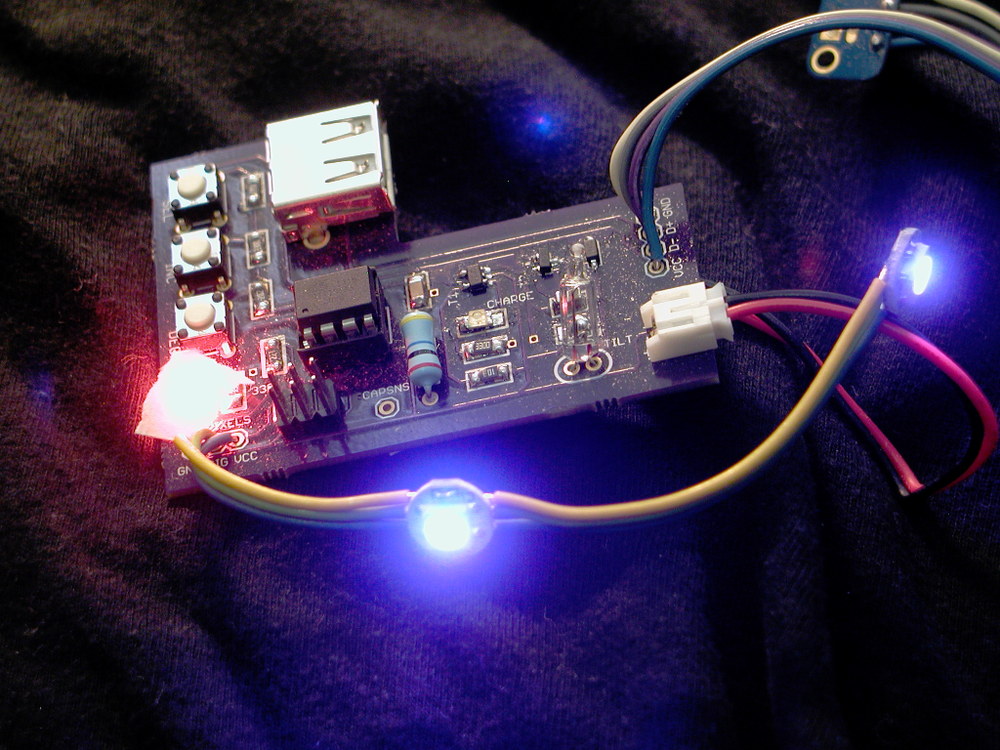 So the circuit board needs to be redone anyhow. I need to add a USB jack for recharge and "to computer" functions, fix a resistor I put in the wrong place (the only actual error in this board!) and I'd like to shrink the dimensions. Oh, and change out the indicator LEDs for ones a lot less bright (I had to cover the one with a bit of tape for this photograph).
But the laser files are almost done (laser files...hey, if River can have a Sonic Trowel, then what's wrong with a Laser File...?) and once I've slapped some paint on the latest prototype I'll be ready to start taking orders. Finally.
* It's an Oscar Wilde story. Oscar meets a friend for lunch. Said friend considers writing a less-than-serious occupation anyhow and asks in a facetious manner if Oscar has been busy. Yes, indeed, a most productive morning; he inserted a comma. The two friends meet again for dinner that evening. More productive activity, asks the friend. Indeed, Oscar refuses to be baited; after intense deliberation he removed the comma he had inserted that morning.
(Well, if said comma was punctuating a phrase like, "Eats shoots and leaves...")
Subscribe to:
Posts (Atom)