Monday, June 26, 2023

Kraa! Kraa!


The Rodin scene is almost done. I had to work on the weekend. Not sure it actually made things worse, but I sure do feel more tired.

The Hux-cam sequence is over. I didn't do this one in period voice; instead it is just Penny describing it, including a few quotes from memory. So it is left to just having to describe Rodin's art. Through the voice of a North Carolina-born comic book fan on vacation in Paris. In the cheap mezzanine "cafe" of the Pompidou center, overlooking the Herge exhibit.

In the context of a clue that may or may not be about The Gates of Hell. Or something about flowers, which is a clear quote from the "Birds of the Air" from the Sermon on the Mount -- KJV translation -- and for a moment they think it might be about Van Gogh, but Penny eventually realizes it is actually Degas. Via the grawlixes of Captain Haddock...


I don't know when I'm finally going to get the Pompidou sequence finished. There's an argument with Amelia, and then there's some parkour addicts outside. But one tiny advantage to working like this is I've already thought ahead to ways to make that scene richer. I'm going for a Mutt-and-Jeff. There's this particular depiction where one person is giving the running translation for the other person who is doing all the talking. The "He says... he says..." format.

I am going to broach some of the weirdness of parkour philosophy here. But actually Jeff is having her on. He doesn't care much for the dedicated ascetic school himself. He just likes to do the thing.

And, as usual, Penny escapes the instant expert, just add montage. She picks up just a little, but she fails more than she succeeds because, seriously, things like this take time to learn (in the Japan book, she did actually end up studying martial arts. Kind of. And she used it in the climax...she'd learned how to fall properly.)


Monday, June 19, 2023

Bodies in Motion

Writing the Rodin scene now. I decided not to go for a direct except from Jonathan Huxley's memoirs for this one, and instead have Penny try to make a synopsis (and choice quotes) from memory. Which is also her demonstrating some of the methods of doing history, which is one of the underlying themes of this book.

Each book sort of explores some aspect of archaeology. In the London book, it was CRM; rescue archaeology done as part of commercial construction projects. In this one, it is history; how to read and interpret texts.

But there are of course other things going on in this scene. I'm still struggling to find the character of Amelia, my art fanatic and STEAM student from North Carolina. My latest take is that she is enthralled by what she calls the Creatives -- and doesn't consider herself one.

So I'm right now at the point in the scene where she is talking about the tragic romance of Rodin and Camille Claudel. And she is going into the ways they diverged as artists. And this is where I realize it needs to move beyond the dry facts of history, or the dry matter of technique.

There is a lot of conversation about both. If for no other reason, it is sort of expected by the reader that if I'm going to name-drop Rodin or Picasso, there's going to be a quick sketch of their career somewhere. Whether it is a road map for those readers without the inclination to open a search engine in the middle of the book, or just reminders for those who are already familiar with the artists in question, it is part of the game.

And the next level is getting that sense of behind the scenes. Of things you might not have learned somewhere else (or had forgotten). Satie playing piano in a bar, say. In an environment surrounded by arts and with working artists ("The Bohemians") as part of my cast, there's an expectation also of something about how it works. Paint coming in tubes, clay drying out, why Herge chose ligne claire, that sort of thing (combination of move to color, and paper shortages, but it also worked well for what he was trying to say.)

But there's yet another level beyond that. And that's the human meaning, the philosophy. Why did Rodin admire Michelangelo, what were Herge's politics. It is the balancing of these three elements that is part of the fun in writing these scenes.

Well, that and the similar balancing act of naming and describing; trying not to make it just a cloud of names of artwork (and artists), but also not letting the narrative drag too long -- especially to be avoided are descriptions of art that try to paint the entire picture. It is the two poles of the mood and theme, and the techniques and the telling details, that should get the detail.

And then there's a parkour chase.

The conclusion of the Pompidou Centre scene is Penny seeing some parkour people stunting outside the building, and learning from them about a meet at La Defense (which won't be happening for her until Part III.)

***

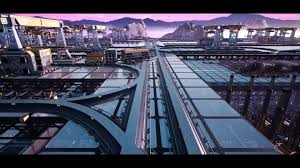
Outside in the rest of the world, work is still busy crazy, I did a long walk through the botanical gardens Saturday...and I've started added hypertube boosters to my hypertube station network to help me get around the map better in Satisfactory. Update 8, the migration to Unreal 5, and the new Lumen lighting model are in and look spectacular, but the interiors of some of my factories are really, really dark now...

I think I'm blown out on creative work for the day after a long morning working on Rodin. So back to game land. I've a new sulfuric acid plant to build -- because sulfur is another of those annoying resources that is never near where you want to actually use it -- and then I can work on a new battery plant and my first uranium processing facility.

I'm getting, slowly, more experimental with my building designs. Hopefully I won't end up spending a whole play session just trying out some new architectural fancy for one of those new facilities. I have to save some design brain...Tuesday I'm back to creating stuff for work in Fusion 360.

Wednesday, June 7, 2023

Spiders spiders SPIDERS!


 Satisfactory is an addictive game. Probably because it is so completely open-ended. Like Minecraft, there is no clear end game, no victory condition. The original gameplay loop sort of fades into the background as you spend more and more time building for the sake of building.

I mentioned how Subnautica had an almost perfect gameplay loop. To solve the mystery and escape from the planet, you had to dive deeper and deeper. To dive deeper you needed better gear. At each stage, you are building better equipment and diving deeper to retrieve the materials and information you need to build the next round of even better submersibles.

The base building sort of hung off it like the proverbial cart, though. Not as bad as Fallout 4, where the base building is effectively pointless. Unless you take it as a longer, more open-ended campaign; to "retake the Commonwealth." Except as much as it gets across the emotional beats of living the life, starting farms and fighting off Raiders, you actually don't change the game world at all.

Subnautica has a similar issue. There isn't much point in building more than a primitive habitat. Sure, there are some deep dives where it helps to stick a shelter down there, and -- like Skyrim, like so many other games -- you eventually need a place to stash all your stuff. But there really is no point in making elaborate undersea habitats.

Except for the fun factor. And that brings us back to Satisfactory. It has the factory game game play loop; build things that allows you to build better things. In this case, the main mechanism is you have to turn in so-and-so-many of whatever thing is currently wanted to your off-planet superiors, who then download blueprints for more complicated and exciting things.

Some of this is quality of life, like Subnautica. Having even a rudimentary habitat really saves on swimming back to the surface to get air. In Satisfactory, the most fungible resource is player time. You don't want to spend time hammering when you could automate it (and go on to do something else) and more than anything else, travel time is a huge challenge.

Well, here's the first thing that Satisfactory does:

First, it isn't a top-down.


Satisfactory does that part right; you are planning layouts and doing math, you are in the loop of researching better technologies, or building the parts you need to build a new machine that will build even better parts. But you aren't up here.


The game not only puts you on the ground, the design of interaction; the animation, sound design, and of course all that Unreal Engine splendor, make the experience of these machines and the building process itself visceral. You aren't plopping another refinery on the grid. You are climbing this hulking, belching monster as it makes sub-base rumbles at you. The game makes you feel like you have sore muscles and grease on your cheek and you earned every bit of what you built.

And there's a human instinct. To arrange, to neaten. Every player (well, almost every player!) goes out of their way to find out how to make conveyor belts make clean turns. There is a certain summer Shakespeare, working on the car in the yard splendor about machines littering a grassy field, but pretty soon you put them up on foundations and start trying to optimize.

Optimized factories run better, get you to the next goal fast, and are easier to fix when something was hooked up wrong.

But that still doesn't explain why people go sideways. At some point, it stops being about making the goals, and starts being about trying to achieve aesthetics. A machine for living in; structural elegance not just for what it achieves in game play terms, but for its own sake.


Because honestly, all the function is achieved if you never add walls. You can lay stuff out on platforms on the ground and it works just fine. Walls are...an excess. The only thing they do is make you happier.


Well, I did find a new reason. Spiders! This isn't a base defense game but there are some annoying creatures. The spiders...those things are the most horrifying thing I've ever met in a video game, and I've played Alien Isolation and Dead Space.

And they are around some of the advanced resources. So I started building hermetic; throwing up walls, putting in doors and even airlock-style anterooms, running long enclosed corridors instead of just a catwalk.

There's a whole play style of building platforms high in the air, and going down just low enough to drop a mining rig, at which point you bring the goodies back up into the safe, safe sky. Like everything in this game, the environment is very present. Even when things aren't trying to kill you, it can be wet and miserable and the dripping jungle (depending on which biome you are in!) is filled with strange and disturbing sounds.

Having a roof over your head is satisfying on a deep visceral level. Having a nice habitat with doors and lights and viewing all that through the safety of a window is wonderful. So base building, too, becomes enjoyable.

And also. It is a game that is always changing the paradigm. Not just adding new challenges. At various points in the game the entire feel of the loop shifts. In early game it is all about finding resources. But then power becomes a problem, and more and more the machines are easy, but getting power for them isn't. In the later parts of the game the resources are spread further and further across the map, meaning you have to invest in transportation infrastructure; both to move the resources, but also to move you.

Every solution has by design things that keep it from being fully optimal. Trucks run out of gas. Trains get their AI locked up over complicated crossings. Conveyor belts are relatively slow. And the human transport is also full of compromise.

At the moment, I've been staying away from trains and using roads. Downside is building roads is much harder and slower than building rail lines. (Although a nice looking rail line is at least the same effort). Hypertubes are slightly slower than driving but have the advantage of being the only real "public transit" option where you don't have to keep going back to where you parked.

And in the very small scale, I've started putting moving walkways in some of my buildings. Those are a hack of the conveyor belts and only speed up the process of getting across a factory floor by a little.

A last thing. I've tried a couple times to make a clean start of things. I hate that I have abandoned factories littering the landscape, cobbled-up solutions standing in for a dedicated factory, and so on. But the progressive unlocking of builds makes this necessary. You do have to strew equipment across the grass in early game, because as much as you might know you want to arrange them neatly on a grid, you have to do a bunch of building before you get that grid.

Saturday, June 3, 2023

Continuity

Writing a new chapter, finally. I've been adding more pages from Jonathan Huxley as part of the whole rewrite and re-work. What a pity I've been studying Picasso, because the next one is the one at Rodin's studio.

So in the revised chapters, Penny meets some bouquinistes, loses a parkour chase after a book thief, goes to the steampunk cabaret which she has to sit out after her injury during the chase, Huxley talks about the Bateau-Lavoir. A talk about comic books, Nathan drops by to taunt her about the stolen book, they go to the Beaubourg and get talking about Rodin, Penny opens the book again to...

Yeah. The book that got stolen out of her hands three chapters ago. Whoops!

I'm juggling so many threads in this book, and I'm not really sure where the beats are going to fall. I might or might not have a whole scene in one of the pedestrian passages/shopping arcades that is also a rematch with the parkour book thief -- so even the chapter scheme for Part II is a bit up for grabs. 

I'm also hating just how many scenes are nothing but people sitting around in cafes discussing art. So much, it is hard to remember that this was my entire scheme for this book; that there wasn't going to be the heavy action of the first, or the lavish descriptions of the third, but...people sitting around in cafes talking about art.

Monday, May 29, 2023

Two Monitors


The twin monitor setup is finally doing something for me. I have the basic structure of Sometimes a Fox nailed down now, and even more importantly, figured out how I am telling the story. I dropped Drea almost completely out of the picture, for instance, meaning the only out-of-chronology material of the main narrative is Penny's flashbacks on her first night in Paris.

Jonathan Huxley still has his memoirs, of course, and today I heavily expanded the Bateau-Lavoir scene. I am even more strongly tempted to watch a couple of documentaries on Picasso, especially the young Picasso, in addition to at least something on Rodin (something other than a whole bunch of short subjects on the Gates of Hell, which I have watched.)

In any case, I had the text open on one monitor, and two different mind maps open on the other as I flipped back and forth nailing down more of the mid-scale structure. There was a lot more of that to be planned than I thought there was -- and there's still more to go. Heck, I haven't entirely decided on the chapters to finish up the part I'm writing on now!

But I've been diving back and forth anyhow, mostly taking out big chunks of text (something I'm going to pay for later, as I try to make up my page count) and progressively cleaning up after the various surgeries. It more-or-less is contiguous manuscript up to the Pompidou and the 22K mark now.

That is to say, I'm back up to where I was four months ago. And barely a third of the way through a novel I started well over a year ago.

***

At least I've had some mild success with my "quick Jollof rice" recipe. Tomato paste does not work in the rice cooker; tomato sauce or, even better, petite diced tomatoes. Funny, how all the recipes I turn to most often these days are a crazy mixture of spices. I can't help thinking jollof rice came together as a "throw everything spicy you have into the pot because otherwise it isn't hot enough." But the recipes generally call for chillies, garlic, ginger, pepper, and curry. Plus butter, oil, onion, bell pepper, tomato, beef stock, beef boullion...

Sunday, May 28, 2023

Call in the Librarian

I've been watching a television series, also a set of direct-to-cable movies, which are basically another variation on the Warehouse 13 scheme. I think they miss a bet, though. The titular warehouse was filled with artifacts that had been associated with historical figures or events and had absorbed really, really specific magical properties generally relating to the Trivial Pursuit synopsis of the thing. Like, a life preserver off the Titanic causes icebergs to appear sort of thing.

In the case of the New York Metropolitan Library, the artifacts are rather more generic, and largely have whatever powers would make the plot work. In fact, "make magic sparks that cause things to blow up" might cover at least half of them.

Excalibur, for instance, flies around and has a personality. Not exactly what you'd think of a sword most known for being stuck in a stone (and I know, I know, but the show oddly has some justification; as much as it is one of those nerd cred things to know that the Sword in the Stone is another, un-named sword, Mallory collected -- and used -- both versions.)

On the other hand, the surrounding material is hyper-detailed. Whereas Warehouse 13 gave the lead to two ex-cops, leaving one side character to do all the babbling about inscriptions in Babylonian, The Librarian has the book-guy as the lead. "The Librarians" (the television series) ups this by having three as stars. Aside from the one ex-cop bodyguard type, there isn't a Watson in the place.

But I noticed something there. Most of the details are side details and don't matter (and generally don't get explained to the cop, either). Those are the dense geekery about art, literature, and history. The stuff that actually plays in the plot is much, much more simplified, often in fact wrong, and is spelled out carefully so the audience can follow along.

It is subtly enough done I don't think you notice it most of the time. Somehow, though, the show signals when it is just "look, they are talking smart again" and when it is "here's the big clue."

Another thing that makes this possible is that the protagonists are always ahead of the viewer. You aren't expected to have guessed before they did. Not most of the time. So that also means the show really doesn't have to explain all this stuff to the viewer. They can just take it on trust.

Apropos of that, the matter of scripts for Star Trek, the Next Generation came up on a forum I am on. It is pretty well known that the writers were never asked to come up with the technobabble. They'd just write; "Geordie techs the tech and saves the Enterprise." The showrunners would fill in the appropriate "reverse the polarity on the main deflector array" or whatever themselves.

***

I've been plowing through the Paris book. Almost up to the chapter I left off on. But there are several places where I haven't closed up the incisions yet. I just moved one of Huxley's excerpts from where it was throwing off the pacing of the Parkour sequence, stuck it in the middle of the steampunk cabaret scene, and that means I need to pretty much rewrite it. Which I was going to do anyhow; it is going to be longer, and I'm taking the camera inside the "laundry boat" this time.

I have a half-dozen books on Paris which I've read, but I can't remember nearly enough. I was crawling along, nearly stalled out, for so long on this book I've forgotten far too much. That, and the sources I had for the really detailed depictions of the lives of the artists are rather rambling. No way to flip to the exact page and refresh my memory.

With luck that won't happen again, though. Most of the big research left I hope to do just as I hit the scenes in question. There's another book excerpt at Rodin's studio. There's a visit to the Van Gogh Experience. And to finish out Part II, a midnight break-in to the Paris Opera House (the old one, which is now, oddly, just ballet.)

And there's a bit more on the Gates of Hell, and on Herge and Tintin, the Pompidou center...I've already essentially written those scenes, though, so with luck I won't need to do anything beyond a few quick checks.

Friday, May 26, 2023

Plume Fever

Solved another issue with Sometimes a Fox. An entire chapter cut now. It was throwing off the pacing and getting in the way of the flow. So just a simple job to take a few snippets from that chapter and paste them on to a revised opening of the next chapter...

Monday we were cleaning up after a fire at work. Even the respirator I was wearing wasn't quite enough; picked up a headache...went to bed early.

Tuesday hard labor moving all the water-damaged crap. Fully recovered, though; felt great. Worked late to make up any time card shortage I might have picked up over Monday's fun. Took a long shower and the quick recipe I tried turned out not quick and writing time didn't happen then, either.

More heavy lifting Wednesday. That and not getting enough sleep Tuesday night and...you guessed it; another early night.

Thursday was a family thing.

So here it is Friday, and I've done shit for writing all week. Welcome to my world.

***

I am strongly committed that the next project after Sometimes a Fox will be Blackdamp; the stand-alone steampunk fantasy. The Athena Fox series isn't selling. I still like the character concept. Could do a million stories with someone who sits right between naive everyman and experienced hero, beginning student and trained archaeologist, experienced traveller and neophyte.

Only three ideas have gotten to the "yeah, I want to write that" stage. And unfortunately they all have issues.

First is White Sands. She needs to be a legit archaeologist again, so that should be the next book. And it is a good opportunity to get into some detail about what a working dig looks like. The archaeological subject might seem to be the ancient peopling of the Americas -- pre-Clovis stuff -- which comes with a bit of controversy these days (and not just the Solutrean nonsense).

But, really, the archaeological lesson on this one needs to be NAGPRA. And that means I need native voices, because it is their story and they need to be there. Which is a lot of work to try to research it and be respectful and get it right.

(And, oddly, it falls into the Regency trap. That is; it is dangerous to write Regency era because there are so many very, very experienced fans. Well, since Tony Hillerman the "native American detective" has become a significant genre with multiple authors working in it. So again you risk running into an audience who really, really knows this stuff and will catch any shoddy research.)

(I've talked about this in regards to things like writing military SF; many sub-genres are basically part of a dialog. Writers have grown up reading the stuff and reacted to it with their own works. And fans and critics are also part of that conversation. So a new writer trying to break into MilSF had better read a bunch of the stuff first. Because there are well-established tropes, minefields, flame wars, shibboleths; all the aspects of a long, sometimes-heated discussion that's been going on well before you entered the room.)

Apropos of that; it is still a little nebulous, but I want her to be doing some museum restoration/preservation stuff involving relics of the Space Age. And the other direction this could spin off to is futurism, particularly the "lost futures" utopian visions of the L5 Society, undersea colonies, all that jazz. Which basically makes the archaeological lesson about museums; about preservation but also about how you present to the public, balancing between getting history right, and tarting things up to get tickets sold.

And speaking of preservation: the major risk of doing the other big preservation story is it starts to make Penny specialize in a very narrow band of relatively modern history. In this case, warbirds. So the problem of living history; as argued by warbird collectors and restorers (as with vintage cars and firearms) they exist to be flown; sitting in a museum with engine removed is like a bad taxidermy job instead of a proper zoo. But flying them means, well, they crash.

But the other half of the fun is to delve into W.W.II re-creation activities, dress-up and dancing to swing music and some military history.

And a bit of flying, which is the main stumbling block. It wouldn't be fair not to have a bit about flying but I don't want to research it and I don't want the stewardess to be flying the plane (although there is the idea of an experimental jetpack, code-named Icarus before Penny could show up and tell them what a bad idea that name is...)

But that actually isn't one of the three. The last one of that particular list, is archaeological tourism. In Central America. And ends up with Penny having to cross the Darien Gap...