Sunday, July 16, 2023

A flower of precocious depravity


CCO, donated to Wikimedia Commons

One month now I've been working on the Rodin scene.

Almost not a scene, now. I'm at 3,500 words (my scenes average 1.5K)  But two fortunate things have happened; I've reached the end of the material I planned for the scene. And I looked up the details on Degas' ballerina sculpture.

Is there a lot going on with this sculpture, and even more, behind the scenes of this sculpture? Can we say, enough material for a ballet, a novel, a two-hour documentary and a stage musical?

Yeah. I thought Japan was bad. Doing a book in Paris alone is bad enough. Every street corner has history, and it is the kind of history that a lot of people know and care about. But doing one that is focused on the artist's colony of Montmartre in 1900? Ye gads.

The fortunate thing is that it became completely clear I can't go into the petit rats in this scene, not even in this part of the book. And that means the grisettes are off the table as well. Particularly for this scene, because Penny's new friend Amelia is being drawn into a romantic triangle between two artists of modern Montmartre, and half the Montmartre scenes are at a cafe named "La Boheme." So I'd rather not make it any more obvious than I have to what I am up to there.

I am still up in the air whether one of the chapter pull quotes in Part II is going to talk about the meat market at the foyer de la dance of the Paris Opera Ballet. Pretty much, I'm trying to push all that stuff into Part III, although I did have to talk about the "models and girlfriends" around the scene at Rodin's small country estate and studio in Meudon.


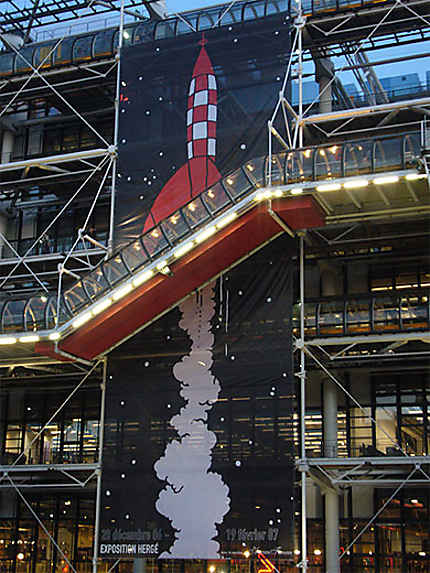
After finally getting off the phone and on the home computer, and seeing just how long that scene really was, I also figured out how to shift half a K of text about comic books out of the big Rodin scene and into the previous one on the grawlix-covered floor of the Pompidou center. A detail (from the 2006 Herge exhibition, not the later one) that I haven't seen mentioned or found photographs of so it remains a clue to the particularly well-informed reader.

I might go back and fill in later. I am planning to go back around after I've got a complete draft, to add more personal reactions to the art, some more philosophizing about art that isn't the somewhat cool and remote anthropological stuff I have now, and to dress up most of the "ate a croissant" stuff into a proper Symphony of Cheese. But for now, this scene does what it is supposed to.

Unfortunately, the final scene of this chapter -- and some key bits in the next -- is parkour.

Which means stopping again while I refresh my links on what turns out to be some pretty wacky philosophy that underlies this "jumping from roof to roof with a big flip in the middle" stuff.

Friday, July 14, 2023

Lasers, 8:00, day one


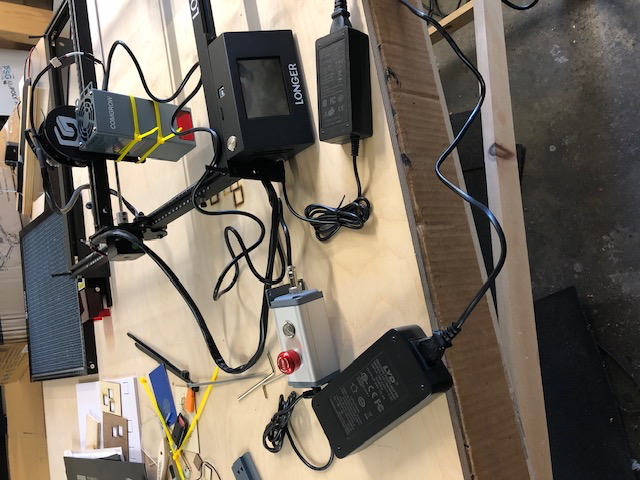
I got my own laser. A Longer diode laser (it isn't longer --although it is a nice 400mm x 400mm-- the company name is Longer). Diode laser is actually something to adjust to. I know lasers, but I was using CO2 (and one fiber). And it ain't just power that matters here, but frequency. Acrylic stops infrared so CO2 lasers plow right through the stuff. Diode lasers, however, are visible light. And wouldn't you know; the only pieces I had lying around were clear...and blue (several nanometers off from the diode frequency but still...)

And I've already went in a few hundred more for a Comgrow laser module. I wanted more power.


The air assist is coming next week (basically an aquarium pump -- 30 L/m and the Comgrow already has a blower head.) Unfortunately the base plate doesn't fit, so (possibly today) I'm machining a new one. The Longer is 12V, the Comgrow is 24V, but fortunately PWM is usually a 5V line. It works; I did a test fit just to see if everything was electrically compatible.


But what I really want is an eye-safe enclosure for it because eyeballs and twenty watts of visible-range light (well, any laser light) is a bad combination. The eye-safe limit is under 20mW. This laser is 20 watts.

I've put it through basic paces, and even on the original head I could cut 1/8" hardwood and 1/4" balsa, EVA foam, and black acrylic. And after a bit of work, engrave clear acrylic to make those edge-lit signs. When you see those things listed, the honest merchants call them "Engraving" lasers, not cutting lasers, because basically you want to go with CO2 (infrared range) or fiber and a bit more power to be serious about cutting.

And really, I got this thing to engrave. Specifically, to blast the anodizing off aluminium to make some signage for work. I was contemplating that or a baby CNC router just capable of cutting through the top layer of dual-color acrylic (the common thing for low-end awards plaques and the like). Just started reading up on lasers, saw how affordable they were, and got caught in the Jeff Goldblum trap.


Monday, July 10, 2023

Tubes, Rubes, and Automobiles

Satisfactory does a wonderful job of keeping you hooked by balancing various challenges. One thing is that (with the exception of the shrubbery, which doesn't grow back) the actual resources are inexhaustible. What makes them challenging is getting to them, transporting them...and transporting yourself while you work on that transport infrastructure.

In the early game, you run conveyor belts along the ground. And you run, too, back and forth between the machines you are hooking up. This doesn't work as well, though, when you need some bauxite and it is two kilometers away from home base, in a festering swamp, filled with poison gas clouds and swarming with giant killer spiders.

As you get deeper in the game, the resources become spread across more and more physical space, and you need them in larger quantities, too -- too large for "stuff it in your pockets" to be the best option.

This is an absolutely built-in progression. The game is designed to confront you with paradigm change as the resources move out beyond easy conveyor belt range. The game starts with that technology unavailable -- you are hand-carrying buckets of raw ore from portable digging machines to your smelters. Conveyor belts themselves are the first change you adapt to.


And it is what I like to call Newtonian; you get belts and pipes, then you get trucks, then you get a monorail cargo train. But at every stage, there are places where you are still stuffing your interdimensional pockets (yes, the game states this explicitly) with the twenty sheets of copper that really need to be over there. All the previous technologies still have their part to play.

They also feed off each other. You pretty much need a work train in order to carry all the stuff you need to build the rails. Even if most of the time the train is idling and you are out there hauling bags of concrete manually!

***

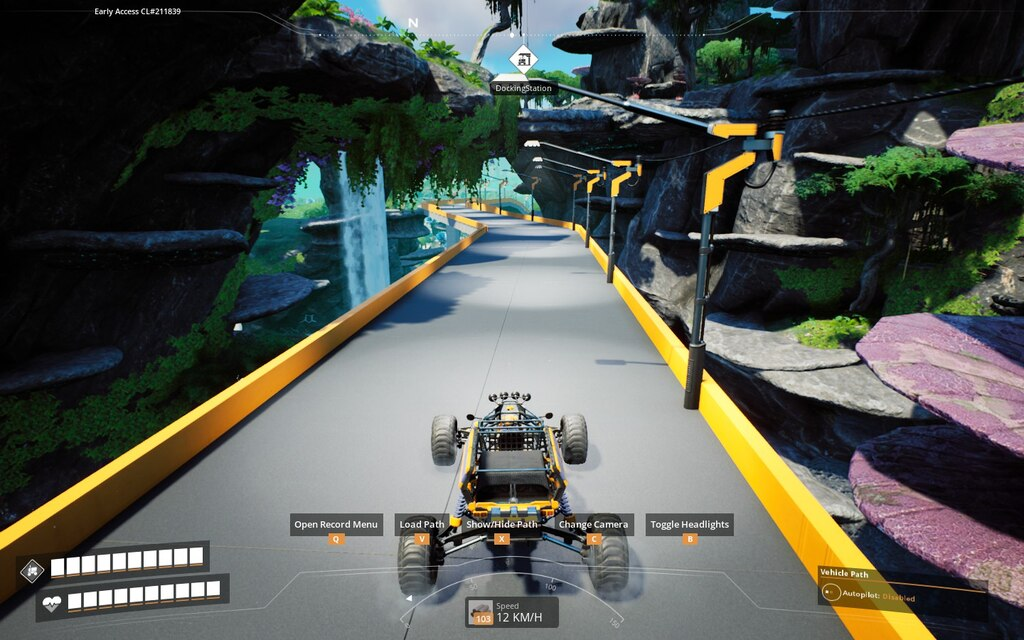
For some reason I wanted to try to really, really prioritize trucks. A good road network gives you both personal and cargo access across a decent-sized area. Besides, it can be a cool aesthetic.


Roads are easy enough to build. Curves or anything other than right-angles are a pain. The least painful and best-looking method is the twelve-foundation snap; run twelve foundations at right angles to where you want the curve to start. Use option to snap another foundation on top of #12, rotate it one tick, then zoop back twelve spaces to your starting point. Keep rotating and zooping, five degrees of road turn at a time.

Ramps, I personally feel, look even less elegant. And dressing the road is a challenge because almost nothing in the game wants to follow those curves and angles properly. Find the right thing, and it can look okay. A little simple, but okay.


Two things went wrong with this big plan of all roads, all the time. The first was blueprints. Blueprints are an automation of building itself, unlocked in mid-game. With a blueprint, you can construct something more complicated than you would want to do by hand. Well, certainly not mile after mile.

The way I chose to make my blueprinted roads, though, was by baking in the option for pipelines, conveyor belts, and even hypertubes.

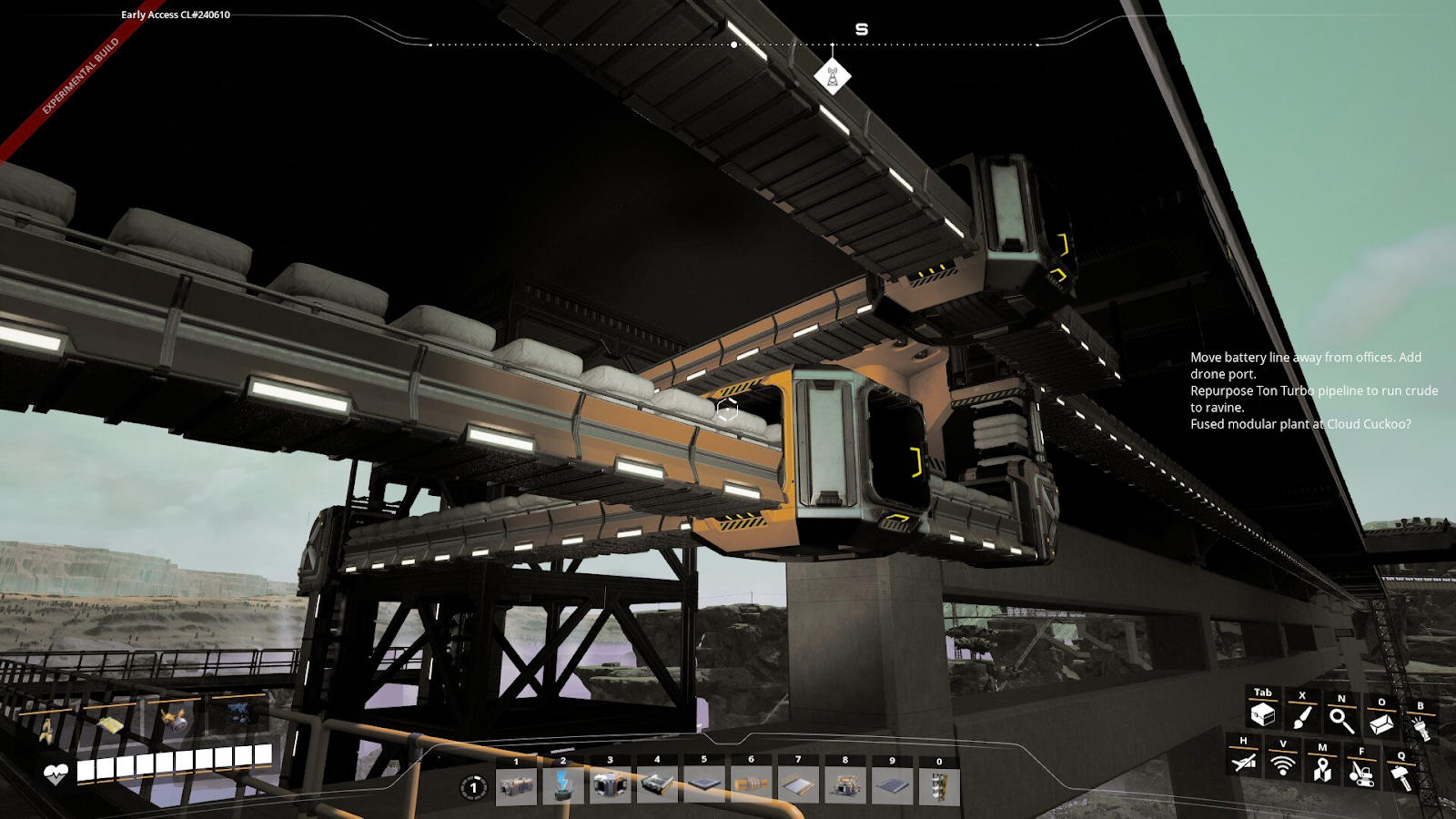
Version one was to hang everything under the roadway, with an elaborate catwalk network to access it. Well, that didn't work great. The catwalks were inconvenient and I still spent a lot of time trying to jetpack around under my roads and falling to my respawn more than once. They also looked really ugly around curves and cluttered up the top of the road with railings and access stairs.


The next versions I moved the stuff on top. Then I started stripping them down, simplifying the roads...mostly taking out all the stuff that really didn't want to go around curves.


Slowly, it started to work. Having a solid base for conveyors can help. Pipes are even more flexible when set up this way. It did end up getting a bit elaborate routing the stuff on and off the roadway, though:


And blueprints? You can't blueprint a curve. Level changes are hard to line up. And none of the connections actually connect, meaning you still have to climb around under hooking up pipes and wires.

Wires? Yeah; I was using the roadways as my grid as well. That is, until Update 8 added nifty-looking power towers that could be run long distances, and Priority Power Switches so you don't actually have to track down where exactly a remote facility is getting power so you can take it off line.

***

But I never did quite get to the truck phase. I am still under-utilizing that. Finally set up a power plant dependent on the trucks getting there. My first big truck experiment was my "Army Base" facility in the desert:


There's something to be said for that aesthetic, too. The turbo-fuel power plant was a little more gussied up:


And of course in keeping with my "spider-free" play mode, the remote sulfur pickup is in a safety-locked tunnel decorated with warning signs:


But the thing that was getting increasingly annoying was not moving industrial lots of material around (that will come: I have the last, huge, Space Elevator delivery to make). What was annoying was personally getting around. Trucks just weren't fast enough for my taste (the fastest thing in the game, without exploits that is, is the monorail train.)

And finding the stuff I was looking for when I got there. Too much wasted time running up and down factory aisles grabbing loose parts off the conveyor belts. I've finally started setting up proper "malls," where stuff a factory is making that is otherwise rare around the map is dropped into display bins for easy pickup. Every Satisfactory player gets into these, and they can get elaborate indeed.

This is as crazy as I've got so far:


Design-wise, that is! That's at Plastics My Boy, a factory that only makes bulk plastic to feed the big semiconductor plant in the swamp nearby. Gasoline is a by-product (most of it gets burned off so it doesn't clog the pipes, but I sent some to a bin for easy pickup. And the quickwire is there because that resource node was in the same direction...so the stuff is just running on the same bank of conveyor belts as the plastic.

Below is one of three pick-up points at Elcor, my combined every-thing electronics plant. Which is why the mad scramble. The smart build for container farms is making a sushi belt with smart splitters. But this is also the "belt-straightening room" that re-routes the spaghetti from the lower production floors so the top bring-it-all-together supercomputer floor is a little less crazy.

Electronics are late-game so by the time you get up to the radio control modules and the electromagnetic control rods you need copper, steel, plastic, aluminium, quartz...


The Fort Hood setup is sushi belt, "show-off" slow belt lifters, and so on. But the only thing that's going in there is ammunition. Come to think, I should set up some supply depots on the edge of explored territory and run the excess production out that way.


(It isn't really a combat game. Making ammo is mostly an excuse for another fun factory. The reason for the rad hazard warnings is that the best answer to those damned spiders is thermonuclear hand grenades!)

***

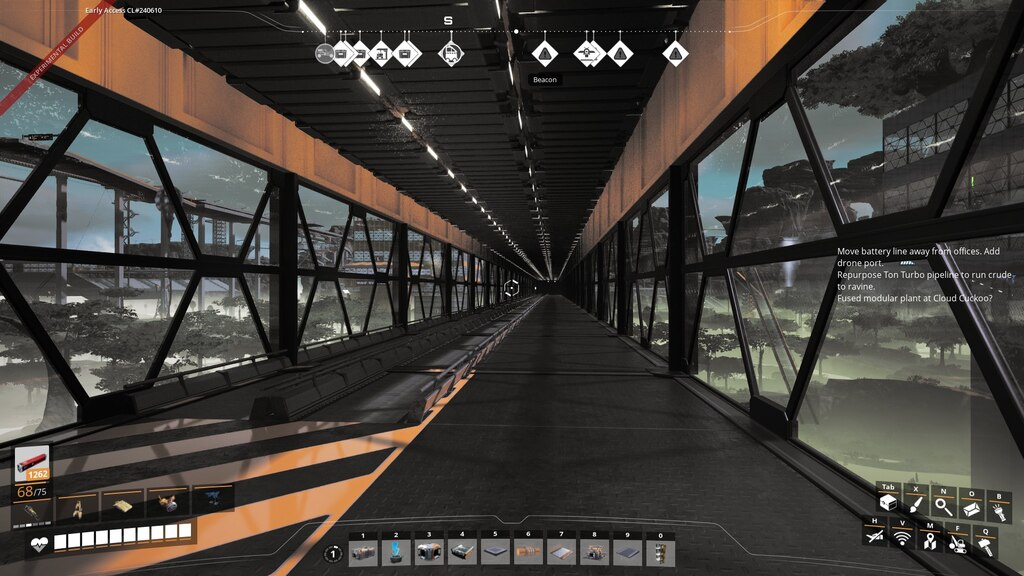
The other half of the equation is getting myself around. There's actually a wee trick of using conveyors as a moving pedway. With Mark V belts and a sprint start it can get up to pretty good speeds to get down those long factory corridors.


Since Update 8 and Lumen, though, corridors like that can be rather dark. Time to dress them up with lights and signage:


But that's really a stop-gap. Only good for short haul. I had been generally avoiding the hypertubes, but then I learned about hypertube accelerators. Basically, speedy thing goes in, speedy thing goes out. You maintain your entrance velocity, and the hypertube entrance gives you an extra kick.

So stack them. This is the Booster Gold blueprint; a simple LINAC of three inline tubes...and a carefully calculated airgap so you can crawl out of the tube to do maintenance.


 My revised hypertube stations, meanwhile, have a double-kick on the main trunk line. This is one of the last of the "open air" stations -- it actually works better to have the main trunk as close to inline as possible. If you aim right as you fly through a station, you'll get a triple-kick to your speed. I can cross the part of the map I'm exploiting in a short enough time it doesn't feel like such a terrible chore anymore.


Slowly, I'm filling in stations, adding boosters where wanted, and making a proper public transit network. And decorating the stations:


Haven't come up with a design for the spur destinations, though. The turbo fuel demo plant has a cute landing zone outside the main doors and down a path:


I am still working on finishing the building (the plant itself is no longer in active use). This is the one I've been experimenting with architecture on:


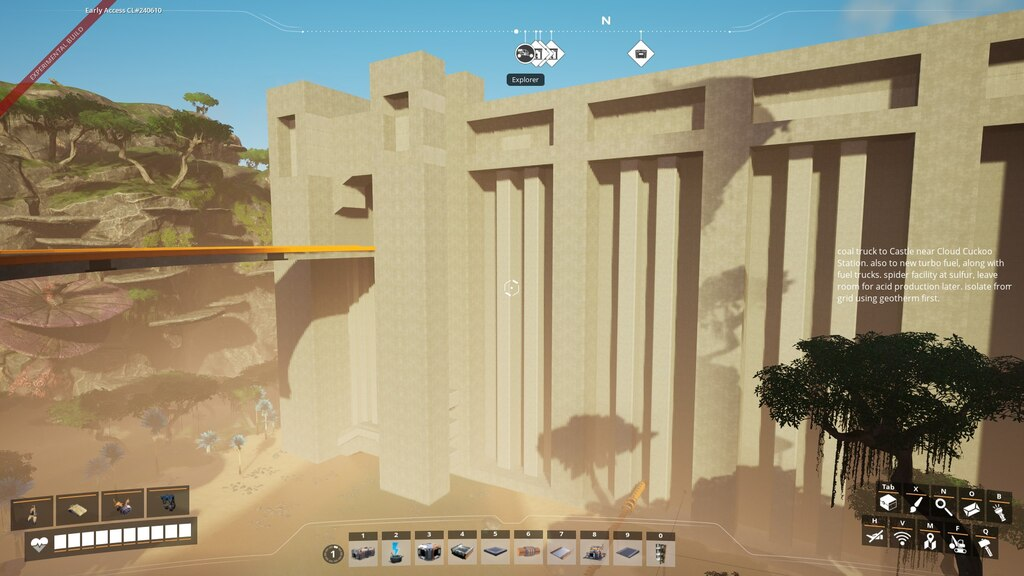
And the new massive turbo fuel/generator farm plant went for brutalist/brick cathedral style. Just starting on the exterior decorations, of course. Spent way too long putting a viaduct over the local creek...


I am still learning and experimenting and hope to get some actually nice buildings some day. At least now I've got the stuff I need to build properly sorted, and a decent transportation infrastructure to move it around.

Monday, June 26, 2023

Kraa! Kraa!


The Rodin scene is almost done. I had to work on the weekend. Not sure it actually made things worse, but I sure do feel more tired.

The Hux-cam sequence is over. I didn't do this one in period voice; instead it is just Penny describing it, including a few quotes from memory. So it is left to just having to describe Rodin's art. Through the voice of a North Carolina-born comic book fan on vacation in Paris. In the cheap mezzanine "cafe" of the Pompidou center, overlooking the Herge exhibit.

In the context of a clue that may or may not be about The Gates of Hell. Or something about flowers, which is a clear quote from the "Birds of the Air" from the Sermon on the Mount -- KJV translation -- and for a moment they think it might be about Van Gogh, but Penny eventually realizes it is actually Degas. Via the grawlixes of Captain Haddock...


I don't know when I'm finally going to get the Pompidou sequence finished. There's an argument with Amelia, and then there's some parkour addicts outside. But one tiny advantage to working like this is I've already thought ahead to ways to make that scene richer. I'm going for a Mutt-and-Jeff. There's this particular depiction where one person is giving the running translation for the other person who is doing all the talking. The "He says... he says..." format.

I am going to broach some of the weirdness of parkour philosophy here. But actually Jeff is having her on. He doesn't care much for the dedicated ascetic school himself. He just likes to do the thing.

And, as usual, Penny escapes the instant expert, just add montage. She picks up just a little, but she fails more than she succeeds because, seriously, things like this take time to learn (in the Japan book, she did actually end up studying martial arts. Kind of. And she used it in the climax...she'd learned how to fall properly.)


Monday, June 19, 2023

Bodies in Motion

Writing the Rodin scene now. I decided not to go for a direct except from Jonathan Huxley's memoirs for this one, and instead have Penny try to make a synopsis (and choice quotes) from memory. Which is also her demonstrating some of the methods of doing history, which is one of the underlying themes of this book.

Each book sort of explores some aspect of archaeology. In the London book, it was CRM; rescue archaeology done as part of commercial construction projects. In this one, it is history; how to read and interpret texts.

But there are of course other things going on in this scene. I'm still struggling to find the character of Amelia, my art fanatic and STEAM student from North Carolina. My latest take is that she is enthralled by what she calls the Creatives -- and doesn't consider herself one.

So I'm right now at the point in the scene where she is talking about the tragic romance of Rodin and Camille Claudel. And she is going into the ways they diverged as artists. And this is where I realize it needs to move beyond the dry facts of history, or the dry matter of technique.

There is a lot of conversation about both. If for no other reason, it is sort of expected by the reader that if I'm going to name-drop Rodin or Picasso, there's going to be a quick sketch of their career somewhere. Whether it is a road map for those readers without the inclination to open a search engine in the middle of the book, or just reminders for those who are already familiar with the artists in question, it is part of the game.

And the next level is getting that sense of behind the scenes. Of things you might not have learned somewhere else (or had forgotten). Satie playing piano in a bar, say. In an environment surrounded by arts and with working artists ("The Bohemians") as part of my cast, there's an expectation also of something about how it works. Paint coming in tubes, clay drying out, why Herge chose ligne claire, that sort of thing (combination of move to color, and paper shortages, but it also worked well for what he was trying to say.)

But there's yet another level beyond that. And that's the human meaning, the philosophy. Why did Rodin admire Michelangelo, what were Herge's politics. It is the balancing of these three elements that is part of the fun in writing these scenes.

Well, that and the similar balancing act of naming and describing; trying not to make it just a cloud of names of artwork (and artists), but also not letting the narrative drag too long -- especially to be avoided are descriptions of art that try to paint the entire picture. It is the two poles of the mood and theme, and the techniques and the telling details, that should get the detail.

And then there's a parkour chase.

The conclusion of the Pompidou Centre scene is Penny seeing some parkour people stunting outside the building, and learning from them about a meet at La Defense (which won't be happening for her until Part III.)

***

Outside in the rest of the world, work is still busy crazy, I did a long walk through the botanical gardens Saturday...and I've started added hypertube boosters to my hypertube station network to help me get around the map better in Satisfactory. Update 8, the migration to Unreal 5, and the new Lumen lighting model are in and look spectacular, but the interiors of some of my factories are really, really dark now...

I think I'm blown out on creative work for the day after a long morning working on Rodin. So back to game land. I've a new sulfuric acid plant to build -- because sulfur is another of those annoying resources that is never near where you want to actually use it -- and then I can work on a new battery plant and my first uranium processing facility.

I'm getting, slowly, more experimental with my building designs. Hopefully I won't end up spending a whole play session just trying out some new architectural fancy for one of those new facilities. I have to save some design brain...Tuesday I'm back to creating stuff for work in Fusion 360.

Wednesday, June 7, 2023

Spiders spiders SPIDERS!


 Satisfactory is an addictive game. Probably because it is so completely open-ended. Like Minecraft, there is no clear end game, no victory condition. The original gameplay loop sort of fades into the background as you spend more and more time building for the sake of building.

I mentioned how Subnautica had an almost perfect gameplay loop. To solve the mystery and escape from the planet, you had to dive deeper and deeper. To dive deeper you needed better gear. At each stage, you are building better equipment and diving deeper to retrieve the materials and information you need to build the next round of even better submersibles.

The base building sort of hung off it like the proverbial cart, though. Not as bad as Fallout 4, where the base building is effectively pointless. Unless you take it as a longer, more open-ended campaign; to "retake the Commonwealth." Except as much as it gets across the emotional beats of living the life, starting farms and fighting off Raiders, you actually don't change the game world at all.

Subnautica has a similar issue. There isn't much point in building more than a primitive habitat. Sure, there are some deep dives where it helps to stick a shelter down there, and -- like Skyrim, like so many other games -- you eventually need a place to stash all your stuff. But there really is no point in making elaborate undersea habitats.

Except for the fun factor. And that brings us back to Satisfactory. It has the factory game game play loop; build things that allows you to build better things. In this case, the main mechanism is you have to turn in so-and-so-many of whatever thing is currently wanted to your off-planet superiors, who then download blueprints for more complicated and exciting things.

Some of this is quality of life, like Subnautica. Having even a rudimentary habitat really saves on swimming back to the surface to get air. In Satisfactory, the most fungible resource is player time. You don't want to spend time hammering when you could automate it (and go on to do something else) and more than anything else, travel time is a huge challenge.

Well, here's the first thing that Satisfactory does:

First, it isn't a top-down.


Satisfactory does that part right; you are planning layouts and doing math, you are in the loop of researching better technologies, or building the parts you need to build a new machine that will build even better parts. But you aren't up here.


The game not only puts you on the ground, the design of interaction; the animation, sound design, and of course all that Unreal Engine splendor, make the experience of these machines and the building process itself visceral. You aren't plopping another refinery on the grid. You are climbing this hulking, belching monster as it makes sub-base rumbles at you. The game makes you feel like you have sore muscles and grease on your cheek and you earned every bit of what you built.

And there's a human instinct. To arrange, to neaten. Every player (well, almost every player!) goes out of their way to find out how to make conveyor belts make clean turns. There is a certain summer Shakespeare, working on the car in the yard splendor about machines littering a grassy field, but pretty soon you put them up on foundations and start trying to optimize.

Optimized factories run better, get you to the next goal fast, and are easier to fix when something was hooked up wrong.

But that still doesn't explain why people go sideways. At some point, it stops being about making the goals, and starts being about trying to achieve aesthetics. A machine for living in; structural elegance not just for what it achieves in game play terms, but for its own sake.


Because honestly, all the function is achieved if you never add walls. You can lay stuff out on platforms on the ground and it works just fine. Walls are...an excess. The only thing they do is make you happier.


Well, I did find a new reason. Spiders! This isn't a base defense game but there are some annoying creatures. The spiders...those things are the most horrifying thing I've ever met in a video game, and I've played Alien Isolation and Dead Space.

And they are around some of the advanced resources. So I started building hermetic; throwing up walls, putting in doors and even airlock-style anterooms, running long enclosed corridors instead of just a catwalk.

There's a whole play style of building platforms high in the air, and going down just low enough to drop a mining rig, at which point you bring the goodies back up into the safe, safe sky. Like everything in this game, the environment is very present. Even when things aren't trying to kill you, it can be wet and miserable and the dripping jungle (depending on which biome you are in!) is filled with strange and disturbing sounds.

Having a roof over your head is satisfying on a deep visceral level. Having a nice habitat with doors and lights and viewing all that through the safety of a window is wonderful. So base building, too, becomes enjoyable.

And also. It is a game that is always changing the paradigm. Not just adding new challenges. At various points in the game the entire feel of the loop shifts. In early game it is all about finding resources. But then power becomes a problem, and more and more the machines are easy, but getting power for them isn't. In the later parts of the game the resources are spread further and further across the map, meaning you have to invest in transportation infrastructure; both to move the resources, but also to move you.

Every solution has by design things that keep it from being fully optimal. Trucks run out of gas. Trains get their AI locked up over complicated crossings. Conveyor belts are relatively slow. And the human transport is also full of compromise.

At the moment, I've been staying away from trains and using roads. Downside is building roads is much harder and slower than building rail lines. (Although a nice looking rail line is at least the same effort). Hypertubes are slightly slower than driving but have the advantage of being the only real "public transit" option where you don't have to keep going back to where you parked.

And in the very small scale, I've started putting moving walkways in some of my buildings. Those are a hack of the conveyor belts and only speed up the process of getting across a factory floor by a little.

A last thing. I've tried a couple times to make a clean start of things. I hate that I have abandoned factories littering the landscape, cobbled-up solutions standing in for a dedicated factory, and so on. But the progressive unlocking of builds makes this necessary. You do have to strew equipment across the grass in early game, because as much as you might know you want to arrange them neatly on a grid, you have to do a bunch of building before you get that grid.

Saturday, June 3, 2023

Continuity

Writing a new chapter, finally. I've been adding more pages from Jonathan Huxley as part of the whole rewrite and re-work. What a pity I've been studying Picasso, because the next one is the one at Rodin's studio.

So in the revised chapters, Penny meets some bouquinistes, loses a parkour chase after a book thief, goes to the steampunk cabaret which she has to sit out after her injury during the chase, Huxley talks about the Bateau-Lavoir. A talk about comic books, Nathan drops by to taunt her about the stolen book, they go to the Beaubourg and get talking about Rodin, Penny opens the book again to...

Yeah. The book that got stolen out of her hands three chapters ago. Whoops!

I'm juggling so many threads in this book, and I'm not really sure where the beats are going to fall. I might or might not have a whole scene in one of the pedestrian passages/shopping arcades that is also a rematch with the parkour book thief -- so even the chapter scheme for Part II is a bit up for grabs. 

I'm also hating just how many scenes are nothing but people sitting around in cafes discussing art. So much, it is hard to remember that this was my entire scheme for this book; that there wasn't going to be the heavy action of the first, or the lavish descriptions of the third, but...people sitting around in cafes talking about art.