I'm in a bad place on a design now. I have too much information, and much of it is contradictory. So I need to find a couple of days to sit down with more material than I can display simultaneously -- or even print out -- and try to generate a consensus version that won't entirely suck.
I have the notes from a two-hour meeting with the director. I have notes in a script from an actual rehearsal, plus recordings of same (in which the actors are, of course, not doing quite what the notes in the script say they should be doing.) I have the original script, I have the conductor's score, I have an orchestration for some of the numbers, and I have the Disney recording (which also does not match the written cues -- quelle surprise!)
Overarching all of that, I have three at the moment incompatible concepts; the desire of the director to add a bunch of material, the desire of the music director not to monkey with the written score, and trailing way behind all of this, my original design impulse.
I'm feeling a little harried. Following that last rehearsal I took an early dinner then slept for almost twelve hours.
Although a large part of the original application has been superseded, I'm not unhappy with my new sound library purchases. If all I end up with on this design is a couple of percussion hits, they still complement each other nicely; the Garritan library adds some range, but surprisingly leaves out some of the most characteristic sounds of the Beijing Opera style percussion. And the Peking Opera library has in addition some potentially useful riffs and loops -- which if nothing else, are extremely informative as to performance styles.
I haven't had a chance to look into those parts of the Garritan library that won't be useful on this particular show. At first glance, it has the usual conundrum of most "world" libraries; too many instruments, leading to a lot of variety but shallow coverage to each particular. One forgets that each of the cultures represented has musical traditions as long and varied as the more familiar Western ones, and you largely miss the point by saying that, say, the dizi is a flute with a slight buzzing sound. The tradition and the kinds of lines played are intimately connected with the physics of the instrument.
The Garritan libraries have always been far on the side of the curve where the "Live Steam" enthusiasts live; emphasis on nuancing performance with a multitude of controllers, and as a result losing in instant playability. The souna -- the instrument I largely got the library for -- being a case in point. It didn't initially impress. I was looking for that blatting, tweeting, lively sound of the folk instrument, and the raw Garritan patch was giving me a dry performance with nothing of the real instrument but the characteristic timbre.
Except of course Garritan means for you to perform the thing. The bent notes are to be triggered from keyswitches or done manually with riding the bend knob, the buzzing blatting sound is of course flutter tongue, which is both keyswitch and added to taste via controller.
And yet...to truly be idiomatic, the suona family has several distinct members, which can be largely classed into the large and small; one has a softer, more lyrical tone, the other is more martial and is used for wedding processions and funerals as well. And one "Suona" patch does injustice to the tonal variety of the instrument.
Which is why some later libraries specialize in smaller and smaller families; instead of trying to cover "World," or even a region, they cover a single instrument, or perhaps just the instruments of carnatic music...or just the percussion commonly found in the Beijing Opera.
Monday, May 12, 2014


Saturday, May 10, 2014
Ask Not for Whom the Gong...
I junked the first attempt at a jacket mold.
The last can of Rebound 25 in town was at Blick, in one of those over-priced starter packs. So after laying up three coats of brushable silicone, I used the included "Plasti-Paste" to make a jacket.
I like the Plasti-Paste. Easy to work with, sets up quick. The Rebound, less so. It didn't capture the details that well, and without thinning was extremely hard to "brush on." Certainly with my fragile master it was. I might do better with Oomoo and thixatropic additive.
I came very close to dropping some chunks of recycled mold into the thing as registration keys, until I realized that one was tin-cure, the other silicone. Oops!
I made a sandwich of jacket mold, mother mold, and a backing board, and did three pours -- one cup at a time -- of Smooth-Cast 300. Unfortunately more seemed to slop up on the backing board than actually went on to the rim, but otherwise it was a successful open-mold slush cast.
Sort of. The Rebound layer was thin, and the registration keys small, and it seems to have peeled away from the mother mold during the first pour. So the final cast is a little warped. Which works okay for what it is simulating, but is annoying. All in all, this turns out not to be a great shape for a jacket mold. I would have saved time and money by just box-molding it with Oomoo in the first place.
But then, half the reason for the exercise was to learn jacket molds, and I got to try out latex while I was at it.
Little of the surface detail made it on to the final cast so to make it look more like a hammered metal gong I got out my Dremel and carved some divots. That was a mistake; now it looks like a really poor attempt at a golf ball. So I'm filling in the divots with putty, and hoping a lot that when I do the final paint job it will look half-way acceptable. I have given up hope on achieving a really nice-looking gong -- at least, not one I can have finished and in the actor's hands by Sunday.
The divots are mostly filled now, and the effect isn't bad at all; they sort of extend the depth and scale of the hammered finish. Meanwhile I prepped the mold for a possible second pull, and discovered you may be able to glue down a mother mold to a too-thin silicone jacket, but not with Superglue; it caused the silicone to shrink in the places where I applied it.
It might be vaguely possible to slip a thin print coat of Oomoo between the damaged mold and the original master, but I wouldn't count on that working.
The last can of Rebound 25 in town was at Blick, in one of those over-priced starter packs. So after laying up three coats of brushable silicone, I used the included "Plasti-Paste" to make a jacket.
I like the Plasti-Paste. Easy to work with, sets up quick. The Rebound, less so. It didn't capture the details that well, and without thinning was extremely hard to "brush on." Certainly with my fragile master it was. I might do better with Oomoo and thixatropic additive.
I came very close to dropping some chunks of recycled mold into the thing as registration keys, until I realized that one was tin-cure, the other silicone. Oops!
I made a sandwich of jacket mold, mother mold, and a backing board, and did three pours -- one cup at a time -- of Smooth-Cast 300. Unfortunately more seemed to slop up on the backing board than actually went on to the rim, but otherwise it was a successful open-mold slush cast.
Sort of. The Rebound layer was thin, and the registration keys small, and it seems to have peeled away from the mother mold during the first pour. So the final cast is a little warped. Which works okay for what it is simulating, but is annoying. All in all, this turns out not to be a great shape for a jacket mold. I would have saved time and money by just box-molding it with Oomoo in the first place.
But then, half the reason for the exercise was to learn jacket molds, and I got to try out latex while I was at it.
Little of the surface detail made it on to the final cast so to make it look more like a hammered metal gong I got out my Dremel and carved some divots. That was a mistake; now it looks like a really poor attempt at a golf ball. So I'm filling in the divots with putty, and hoping a lot that when I do the final paint job it will look half-way acceptable. I have given up hope on achieving a really nice-looking gong -- at least, not one I can have finished and in the actor's hands by Sunday.
The divots are mostly filled now, and the effect isn't bad at all; they sort of extend the depth and scale of the hammered finish. Meanwhile I prepped the mold for a possible second pull, and discovered you may be able to glue down a mother mold to a too-thin silicone jacket, but not with Superglue; it caused the silicone to shrink in the places where I applied it.
It might be vaguely possible to slip a thin print coat of Oomoo between the damaged mold and the original master, but I wouldn't count on that working.
End of an Epic Era
I just bought another virtual instrument collection. Which it turns out I maybe don't need for the work next week but that's another story.
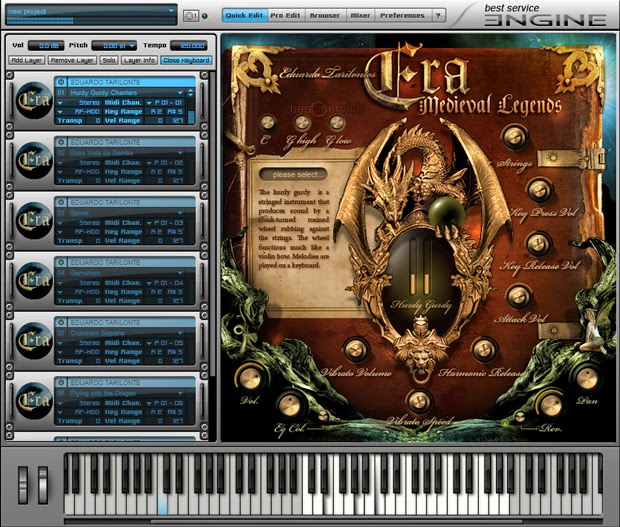
No, not this one. (Although I wouldn't mind having this one). Instead I got Garritan's world instrument collection, which is one of the few cheap options that includes a suona.
But faceplates like the above make me wonder if we are finally coming to the close of an era.
Using electronics to generate musical notes was not a new idea. Theramin saw his invention as a possible replacement for the violin. Classical composers were incorporating the Ondes Martenot (and the experimenters like Stockhausen were experimenting with non-traditional sound sources like untuned radios and vacuum cleaners). And something as venerable and established as the Hammond B3 is of course an electronic version of a traditional pipe organ.
By the late 60's electronica had made it out to the pop world, although pioneers like Wendy Carlos were still working laboriously, often note-by-note, with hand-soldered circuits (Delia Derbyshire created the first version of the Doctor Who theme by recording on to audio tape and physically cutting the tape to make the individual notes).
Then came disco and the various flavors of electronic pop; Kraftwerk, Tangerine Dream, and a great many bands with sound driven by a keyboard wizard like Keith Emerson. Electronic sounds were out there, and just like the fate that befell the Theramin, these sounds were celebrated for their novelty, even as their inventors continued to work tirelessly to achieve half-way realistic simulations of "real" instruments.
(Take as example the Mellotron. Which, technically, could reproduce a realistic orchestral flute sound. But as employed by George Martin, the technical limitations of the tape-drive mechanism was exploited to cut an unusual and fresh flute-like track into the album. Much as the artificialities of a device originally intended to clean up the pitch of an inexperienced singer -- auto-tune -- has become a performance tool and a style all of its own.)
Realistic synthesis has always been there as some Shangri-La of the tireless engineers and experimenters, even as the music-makers have been out there using the tone provided in whatever way they see fit.
I started playing with electronic keyboards at the height of FM synthesis, that Yamaha creation that was at the heart of their DX line, and allowed the first generation of General MIDI chips that gave the term "MIDI Music" such a bad name. When I started, samplers were cumbersome, expensive, and limited. But when I went out and purchased my first sound module, LAS had hit the scene.
LAS was really an elaborated way to stretch the limited number of samples forced by the size of memories those days into enough octaves to be playable. In the Roland sample-based synthesizers, several different looping samples and one or two initial transients were layered together to provide a tone that more-or-less disguised the looping nature and more-or-less changed timbre as you moved up and down the instrument range. With good programming, you could even simulate to some degree the changes in timbre around the chalumeau register.
But of course Moore's Law marches on. And each manufacturer -- and soon, a whole new industry selling sample libraries -- touted the sheer size of their library as compared to their competitors, or to last year's model.
Soon enough the personal computer outstripped the pace of improvement in rack-mount samplers, and the sheer size of sample libraries had forced them out of ROM cards and floppies and on to dedicated hard drives. Rack-mount samplers moved out, and virtual instrument libraries moved in.
Meanwhile the tireless elves were experimenting with physical synthesis, trying to achieve those same characteristic instrument colors by modeling the physics of the instrument itself. With some interesting results, but rarely ones that were both affordable and playable.
I of course spent most of this era one step behind. Barely able to afford used sound modules, then hanging on to them when the world had moved on. Barely able to afford a computer that would run the latest libraries, and generally unable to afford things like Kontakt (nee...well, lots of name changes over its history); the software that is like an operating system for the vast majority of modern libraries. As in you are assumed to have bought it if you are doing anything in computer-based music, and that way the libraries don't have to bundle a sampler with their sound collections.
For the usual reasons -- among them, getting tired of having all their work tied to someone else's ever-changing standard -- the big library makers did eventually start distributing their own playback engines, free with their libraries.
Which only highlights the growing insanity of copy protection. During the boom, these big libraries, and the flagship software like Kontakt, were priced in the thousands of dollars. And inevitably onerous copy-protection schemes -- including dongles that hogged your USB ports, challenge-response that required an active internet connection, MAC checkers that shut down your software if you dared repair or replace any of the hardware on your computer, and even root kits were all employed.
To protect, in many cases, an engine that was given away anyhow, and file libraries based around samples (the majority of the work) that were in plain unencrypted format.
Hand in hand with this, seemingly; the efforts to protect their work, and the desire not to be dependent on another manufacturer's playback engine, the tendency of libraries moved swiftly away from being editable sounds, to being presets. All the limitations of the old rack-mount was still there, except the patches took a lot longer to load and had a habit of turning off mysteriously in the middle of a recording session (because some line of deep-buried code had just decided your registration had expired).
And the nature of the libraries began to change.
Always, there has been a small subset of users that, like the academics mentioned previously, were only interested in simulating existing acoustic instruments. These are the people who write orchestral material one part at a time, as if they were writing for a real orchestra (no-one named "String Ensemble" sits in a real orchestra. Instead you have first violins, second violins, violas, etc., etc.)
These users have always to the rest of the users of virtual instrument libraries a bit like Live Steam enthusiasts are to the Model Railroad community; admired for their technical perseverance, but rarely emulated. The vast majority of patches then and today are more likely to be labeled "Fanfare Brass" than "Eb Flugelhorn with straight mute," more likely to be properly characterized as "Psycho Strings" than "4 vlns spicc. con sordino."
There was a time during the golden age of sample libraries where a computer-mocked up orchestral score might be used in a television show, or a Hollywood movie. But that is changing. There are fewer symphony orchestras, more musicians looking for work, and the total price of properties (like big name games) has gone up to the point where it makes more sense to hire a real orchestra instead of paying someone to spend months tweaking synth patches.
As far as I can tell, the major commercial use of these things now is in mocking up score that will later be performed by actual musicians, or in overdubbing and padding out scores that are largely realized with real musicians. Which has implications as to how they are being used.
You can get half-assed "realistic" results with fairly basic work. You can add a few more percentile by going into hand-editing of expression curves and attacks and portamento rates and adding slurs and doits and grace notes...but it isn't worth it to the working users.
So the majority users aren't doing this kind of extensive editing. There is no call for it. And if there is no real call in most modern applications for extensively hand-editing a flute line, there is no real call for writing out each chair of a string section independently. Not unless you are testing a mock-up that you mean to have a string section perform, or unless you are working in a style that really requires all that internal movement.
And for the casual users, it is an even stronger impetus away from the most realistic simulation of individual instruments possible, and towards sections, pre-made swells and crescendos, and even entire canned phrases.
Back in the day one of the options was Band in a Box. Think of it a bit like a MIDI version of loops. The flexibility lay in the way the material was created, and that you were in the MIDI domain; you could assign the parts to the patches of your choice, as well as alter the root and tempo however you needed.
What is lost of course is the realism a player imparts on a performance. I tinkered a bit with an idea that I was going to include in a story I was writing; something I called "Intellisynth." The idea was a virtual instrument with software intelligence and a library of abstracted performance capture. Say you had an Intellisynth violin. You'd play the part from the keyboard. The Intellisynth would determine where to use up-bow or down-bow, which string made the most sense for each note in a sequence (obviously this is not done in real time, as it requires look-ahead), and attempts to detect phrases and lines to give each phrase an overall contour.
This is being done a bit; I have a freeware VSTi called "Spicy Guitar" that auto-detects when a chord is played and executes a strum. I believe it also detects the intervals being played and choses to throw in some fret noise as appropriate, but I could be mistaken!
The direction the real world went, though, is in canned loops. In entire sampled performances (or MIDI-sampled; akin to the old player piano performance capture rolls). Which are presented to the modern player as complete material -- which includes as is the nature of the beast those elements of tonic and harmonic development and even motive that the classically-trained composer would want to have under their control.
But the nature of the beast has changed. There are still music schools, there are still people composing and still sometimes even sponsored to write a concerto or two. But the vast majority of the people making music are now coming back much closer to a 19th century performance model; creating for their small circle of friends (that is, to whatever segment of the intertwined social media outlets they are presenting music within).
For these, loops are nothing; even remixes are completely acceptable. And that, I think, is one of the factors leading to what seems like an increasing desperation on the part of the big sample-based library producers.
We saw prices already falling before the crash. They have not recovered, although the price of libraries seems to have finally stabilized. The engines have also gone into Ballmer mode where they keep bringing out new and different versions in hopes of recapturing some sales. Of course the driver is also a move away from the laptop and MIDI keyboard controller, and into iOs. Because when most of your market is plugging loops together, or performing sections or pads, they don't need an 88-key semi-weighted controller and a DSP box capable of playing back all the parts of a symphony orchestra in real time.
And the picture above would make a nice poster boy for that kind of flailing. Except that the library in question is actually quite decent. It is marketed like some "cash in quick" collection of random synth pads and Lord of the Rings-sounding sections, but it is actually an honest and very playable library of medieval and renaissance instruments.
And that's another thing. The heyday of the giant sample libraries was also a nadir in playability. I am of the opinion that the stretching and smoothing of LAS -- that was forced by the relative sparsity of RAM in those days -- traded realism and character for playability. An 8-gig sampled library can give you a fairly realistic flute, but the sound is thinner and it is more awkward to make a lilting line with it. As soon as you realize that realistic simulation is not the only goal, you realize you could make a piece of listenable music faster with the older libraries.
This, at least, seems to be finally changing. Stretch synthesis, better legato smoothing, and sample libraries that depart from realism to make up for some of the deficiencies in the real instrument (do you want a lute sound, or do you really want a lute that is as likely to slip out of tune, and has the same limited range, as the original?)
And this essay is way too long.
No, not this one. (Although I wouldn't mind having this one). Instead I got Garritan's world instrument collection, which is one of the few cheap options that includes a suona.
But faceplates like the above make me wonder if we are finally coming to the close of an era.
Using electronics to generate musical notes was not a new idea. Theramin saw his invention as a possible replacement for the violin. Classical composers were incorporating the Ondes Martenot (and the experimenters like Stockhausen were experimenting with non-traditional sound sources like untuned radios and vacuum cleaners). And something as venerable and established as the Hammond B3 is of course an electronic version of a traditional pipe organ.
By the late 60's electronica had made it out to the pop world, although pioneers like Wendy Carlos were still working laboriously, often note-by-note, with hand-soldered circuits (Delia Derbyshire created the first version of the Doctor Who theme by recording on to audio tape and physically cutting the tape to make the individual notes).
Then came disco and the various flavors of electronic pop; Kraftwerk, Tangerine Dream, and a great many bands with sound driven by a keyboard wizard like Keith Emerson. Electronic sounds were out there, and just like the fate that befell the Theramin, these sounds were celebrated for their novelty, even as their inventors continued to work tirelessly to achieve half-way realistic simulations of "real" instruments.
(Take as example the Mellotron. Which, technically, could reproduce a realistic orchestral flute sound. But as employed by George Martin, the technical limitations of the tape-drive mechanism was exploited to cut an unusual and fresh flute-like track into the album. Much as the artificialities of a device originally intended to clean up the pitch of an inexperienced singer -- auto-tune -- has become a performance tool and a style all of its own.)
Realistic synthesis has always been there as some Shangri-La of the tireless engineers and experimenters, even as the music-makers have been out there using the tone provided in whatever way they see fit.
I started playing with electronic keyboards at the height of FM synthesis, that Yamaha creation that was at the heart of their DX line, and allowed the first generation of General MIDI chips that gave the term "MIDI Music" such a bad name. When I started, samplers were cumbersome, expensive, and limited. But when I went out and purchased my first sound module, LAS had hit the scene.
LAS was really an elaborated way to stretch the limited number of samples forced by the size of memories those days into enough octaves to be playable. In the Roland sample-based synthesizers, several different looping samples and one or two initial transients were layered together to provide a tone that more-or-less disguised the looping nature and more-or-less changed timbre as you moved up and down the instrument range. With good programming, you could even simulate to some degree the changes in timbre around the chalumeau register.
But of course Moore's Law marches on. And each manufacturer -- and soon, a whole new industry selling sample libraries -- touted the sheer size of their library as compared to their competitors, or to last year's model.
Soon enough the personal computer outstripped the pace of improvement in rack-mount samplers, and the sheer size of sample libraries had forced them out of ROM cards and floppies and on to dedicated hard drives. Rack-mount samplers moved out, and virtual instrument libraries moved in.
Meanwhile the tireless elves were experimenting with physical synthesis, trying to achieve those same characteristic instrument colors by modeling the physics of the instrument itself. With some interesting results, but rarely ones that were both affordable and playable.
I of course spent most of this era one step behind. Barely able to afford used sound modules, then hanging on to them when the world had moved on. Barely able to afford a computer that would run the latest libraries, and generally unable to afford things like Kontakt (nee...well, lots of name changes over its history); the software that is like an operating system for the vast majority of modern libraries. As in you are assumed to have bought it if you are doing anything in computer-based music, and that way the libraries don't have to bundle a sampler with their sound collections.
For the usual reasons -- among them, getting tired of having all their work tied to someone else's ever-changing standard -- the big library makers did eventually start distributing their own playback engines, free with their libraries.
Which only highlights the growing insanity of copy protection. During the boom, these big libraries, and the flagship software like Kontakt, were priced in the thousands of dollars. And inevitably onerous copy-protection schemes -- including dongles that hogged your USB ports, challenge-response that required an active internet connection, MAC checkers that shut down your software if you dared repair or replace any of the hardware on your computer, and even root kits were all employed.
To protect, in many cases, an engine that was given away anyhow, and file libraries based around samples (the majority of the work) that were in plain unencrypted format.
Hand in hand with this, seemingly; the efforts to protect their work, and the desire not to be dependent on another manufacturer's playback engine, the tendency of libraries moved swiftly away from being editable sounds, to being presets. All the limitations of the old rack-mount was still there, except the patches took a lot longer to load and had a habit of turning off mysteriously in the middle of a recording session (because some line of deep-buried code had just decided your registration had expired).
And the nature of the libraries began to change.
Always, there has been a small subset of users that, like the academics mentioned previously, were only interested in simulating existing acoustic instruments. These are the people who write orchestral material one part at a time, as if they were writing for a real orchestra (no-one named "String Ensemble" sits in a real orchestra. Instead you have first violins, second violins, violas, etc., etc.)
These users have always to the rest of the users of virtual instrument libraries a bit like Live Steam enthusiasts are to the Model Railroad community; admired for their technical perseverance, but rarely emulated. The vast majority of patches then and today are more likely to be labeled "Fanfare Brass" than "Eb Flugelhorn with straight mute," more likely to be properly characterized as "Psycho Strings" than "4 vlns spicc. con sordino."
There was a time during the golden age of sample libraries where a computer-mocked up orchestral score might be used in a television show, or a Hollywood movie. But that is changing. There are fewer symphony orchestras, more musicians looking for work, and the total price of properties (like big name games) has gone up to the point where it makes more sense to hire a real orchestra instead of paying someone to spend months tweaking synth patches.
As far as I can tell, the major commercial use of these things now is in mocking up score that will later be performed by actual musicians, or in overdubbing and padding out scores that are largely realized with real musicians. Which has implications as to how they are being used.
You can get half-assed "realistic" results with fairly basic work. You can add a few more percentile by going into hand-editing of expression curves and attacks and portamento rates and adding slurs and doits and grace notes...but it isn't worth it to the working users.
So the majority users aren't doing this kind of extensive editing. There is no call for it. And if there is no real call in most modern applications for extensively hand-editing a flute line, there is no real call for writing out each chair of a string section independently. Not unless you are testing a mock-up that you mean to have a string section perform, or unless you are working in a style that really requires all that internal movement.
And for the casual users, it is an even stronger impetus away from the most realistic simulation of individual instruments possible, and towards sections, pre-made swells and crescendos, and even entire canned phrases.
Back in the day one of the options was Band in a Box. Think of it a bit like a MIDI version of loops. The flexibility lay in the way the material was created, and that you were in the MIDI domain; you could assign the parts to the patches of your choice, as well as alter the root and tempo however you needed.
What is lost of course is the realism a player imparts on a performance. I tinkered a bit with an idea that I was going to include in a story I was writing; something I called "Intellisynth." The idea was a virtual instrument with software intelligence and a library of abstracted performance capture. Say you had an Intellisynth violin. You'd play the part from the keyboard. The Intellisynth would determine where to use up-bow or down-bow, which string made the most sense for each note in a sequence (obviously this is not done in real time, as it requires look-ahead), and attempts to detect phrases and lines to give each phrase an overall contour.
This is being done a bit; I have a freeware VSTi called "Spicy Guitar" that auto-detects when a chord is played and executes a strum. I believe it also detects the intervals being played and choses to throw in some fret noise as appropriate, but I could be mistaken!
The direction the real world went, though, is in canned loops. In entire sampled performances (or MIDI-sampled; akin to the old player piano performance capture rolls). Which are presented to the modern player as complete material -- which includes as is the nature of the beast those elements of tonic and harmonic development and even motive that the classically-trained composer would want to have under their control.
But the nature of the beast has changed. There are still music schools, there are still people composing and still sometimes even sponsored to write a concerto or two. But the vast majority of the people making music are now coming back much closer to a 19th century performance model; creating for their small circle of friends (that is, to whatever segment of the intertwined social media outlets they are presenting music within).
For these, loops are nothing; even remixes are completely acceptable. And that, I think, is one of the factors leading to what seems like an increasing desperation on the part of the big sample-based library producers.
We saw prices already falling before the crash. They have not recovered, although the price of libraries seems to have finally stabilized. The engines have also gone into Ballmer mode where they keep bringing out new and different versions in hopes of recapturing some sales. Of course the driver is also a move away from the laptop and MIDI keyboard controller, and into iOs. Because when most of your market is plugging loops together, or performing sections or pads, they don't need an 88-key semi-weighted controller and a DSP box capable of playing back all the parts of a symphony orchestra in real time.
And the picture above would make a nice poster boy for that kind of flailing. Except that the library in question is actually quite decent. It is marketed like some "cash in quick" collection of random synth pads and Lord of the Rings-sounding sections, but it is actually an honest and very playable library of medieval and renaissance instruments.
And that's another thing. The heyday of the giant sample libraries was also a nadir in playability. I am of the opinion that the stretching and smoothing of LAS -- that was forced by the relative sparsity of RAM in those days -- traded realism and character for playability. An 8-gig sampled library can give you a fairly realistic flute, but the sound is thinner and it is more awkward to make a lilting line with it. As soon as you realize that realistic simulation is not the only goal, you realize you could make a piece of listenable music faster with the older libraries.
This, at least, seems to be finally changing. Stretch synthesis, better legato smoothing, and sample libraries that depart from realism to make up for some of the deficiencies in the real instrument (do you want a lute sound, or do you really want a lute that is as likely to slip out of tune, and has the same limited range, as the original?)
And this essay is way too long.
Wednesday, May 7, 2014
Full Moldy Jacket
After all that data mining, he created a cave-in.
I read up a lot on mold-making. Followed several blogs and watched videos. Bought a book and read it several times. So of course when I go out to make my first jacket mold, I accidentally get latex instead of silicone.
It took three days to lay down enough coats of Casting Craft "Mold Builder" latex to be comfortable moving on to the mother mold. Then the resin I used with the fiberglas matting didn't set up properly. After a long struggle I got the master de-molded, but the mother isn't supporting the latex properly, the latex didn't capture sufficient detail, and the fiberglas is still sticky and really annoying to be around.
So three days and fifty bucks of material wasted, and a nasty clean-up job with acetone to boot. The only thing that prevents it from being a complete failure is that the master survived with only a few dings.
So it will be back again with Rebound 25, and if I mother mold, I'll lay up plaster bandages or even paper-mache. I have no interest in having more resin to mess with.
But time is getting to be a real problem. I just got yanked into yet another show to help set lights (I can't say "design" because it was literally last-minute -- not even enough time to read the script, much less get familiar with the show).
And there's a new director on one of the upcoming shows I have.
And I've finally got a lead on what to do at the venue I'm trying to improve, thanks to one of my commenters here, but I haven't got approval yet and time is getting very, very short before the big end-of-season musical there.
The next two sound designs are going to need a lot. New libraries, new effects. I need to build stuff into sampler in order to properly construct some of these effects. Which means I need to get my software organized. Figure out which samplers, which libraries actually work, and which are dead wood.
Because not only is there the ongoing problem of system upgrades breaking all the installed software, sound libraries are rampant with horrible copy-protection schemes. If you look at them sideways they de-authorize. And then you are left with a bunch of broken stuff cluttering up the menus of your DAW and sequencers. (And of course de-installing is also a vast pain for most of these libraries).
Yeesh. Something as simple as two libraries from the same damned company. One only opens in a proprietary VST host from the same company, the other only opens in Kontakt. Which keeps changing their authorization and support so one can never tell which version of Kontakt one is actually able to use at any moment.
It makes me really, really miss the rack-mount synths. When I never had to deal with passwords and having to be online just to play a flute patch. And where I could work up the patch libraries and have one single method of access across all the hosted sounds that was searchable and organized.
Sure, it is fun having another dozen random synth pads with every library you purchase. But you can't remember all of them, and you can't search them, and even when the libraries/engines still work (instead of being broken or deciding you need to renew a password at a site that requires a membership) you have to go through loading each new engine one at a time and squinting at their tiny displays in order to try to navigate through their poorly-labeled selection of patches.
I just went through a couple of hours of this just trying to track down a brushed cymbal sound. Eventually gave up and purchased a sample from SoundDogs.
But somehow, I need to sort out the stuff that actually works and is useful, and get my pallet organized to where I can roll out the effects I need for the next couple of shows.
And maybe then I can find a spare minute or two to write some music again.
To add a couple more percentile points on to "almost complete failure" I threw the dregs of my previous bottle of Smooth-Cast into the latex mold. And it reacted with some impurity and boiled up in an unpleasant way. But now at least I have some sense how those materials behave and what kind of mold I can get out of them if I ever need to use it again.
I read up a lot on mold-making. Followed several blogs and watched videos. Bought a book and read it several times. So of course when I go out to make my first jacket mold, I accidentally get latex instead of silicone.
It took three days to lay down enough coats of Casting Craft "Mold Builder" latex to be comfortable moving on to the mother mold. Then the resin I used with the fiberglas matting didn't set up properly. After a long struggle I got the master de-molded, but the mother isn't supporting the latex properly, the latex didn't capture sufficient detail, and the fiberglas is still sticky and really annoying to be around.
So three days and fifty bucks of material wasted, and a nasty clean-up job with acetone to boot. The only thing that prevents it from being a complete failure is that the master survived with only a few dings.
So it will be back again with Rebound 25, and if I mother mold, I'll lay up plaster bandages or even paper-mache. I have no interest in having more resin to mess with.
But time is getting to be a real problem. I just got yanked into yet another show to help set lights (I can't say "design" because it was literally last-minute -- not even enough time to read the script, much less get familiar with the show).
And there's a new director on one of the upcoming shows I have.
And I've finally got a lead on what to do at the venue I'm trying to improve, thanks to one of my commenters here, but I haven't got approval yet and time is getting very, very short before the big end-of-season musical there.
The next two sound designs are going to need a lot. New libraries, new effects. I need to build stuff into sampler in order to properly construct some of these effects. Which means I need to get my software organized. Figure out which samplers, which libraries actually work, and which are dead wood.
Because not only is there the ongoing problem of system upgrades breaking all the installed software, sound libraries are rampant with horrible copy-protection schemes. If you look at them sideways they de-authorize. And then you are left with a bunch of broken stuff cluttering up the menus of your DAW and sequencers. (And of course de-installing is also a vast pain for most of these libraries).
Yeesh. Something as simple as two libraries from the same damned company. One only opens in a proprietary VST host from the same company, the other only opens in Kontakt. Which keeps changing their authorization and support so one can never tell which version of Kontakt one is actually able to use at any moment.
It makes me really, really miss the rack-mount synths. When I never had to deal with passwords and having to be online just to play a flute patch. And where I could work up the patch libraries and have one single method of access across all the hosted sounds that was searchable and organized.
Sure, it is fun having another dozen random synth pads with every library you purchase. But you can't remember all of them, and you can't search them, and even when the libraries/engines still work (instead of being broken or deciding you need to renew a password at a site that requires a membership) you have to go through loading each new engine one at a time and squinting at their tiny displays in order to try to navigate through their poorly-labeled selection of patches.
I just went through a couple of hours of this just trying to track down a brushed cymbal sound. Eventually gave up and purchased a sample from SoundDogs.
But somehow, I need to sort out the stuff that actually works and is useful, and get my pallet organized to where I can roll out the effects I need for the next couple of shows.
And maybe then I can find a spare minute or two to write some music again.
To add a couple more percentile points on to "almost complete failure" I threw the dregs of my previous bottle of Smooth-Cast into the latex mold. And it reacted with some impurity and boiled up in an unpleasant way. But now at least I have some sense how those materials behave and what kind of mold I can get out of them if I ever need to use it again.
Saturday, May 3, 2014
Hero Props
It doesn't literally mean "property of the hero." Although it often works out that way. A "hero" prop, in motion picture parlance, is a high-detail, nice-finish version suitable for holding close to the camera.
These are costly, often fragile items, and get swapped out for cast replicas when in the hands of background characters, or when the actor is rolling around in the dirt and would rather have foam rubber whacking them in the face instead of machined aluminium.
(A similar constraint exists with cosplayers and re-creationists such as the 501st; they may own a beautifully detailed real-steel DL-44, but they "troop" with something a lot lighter. Having foam rubber instead of metal also makes you more friends at the admissions gate to a convention.)
In theater, there are no close-ups. There is also rarely a budget to speak of. So all props are background props. The range in theater is not between stunt props and hero props; it is between well-made props and cheap props. It still doesn't have to look good in close-up, but a good prop is safe and strong and will survive multiple productions. A cheap one squeaks through until closing night because the running crew is pouring fresh hot glue on it every night.
I am deeply respectful of the skill set that allows creation of every bizarre thing requested by a director with no time, no money, and practically nothing in the way of tools, either. But it isn't something that personally interests me. Although it fits badly into the schema of theater, what I like to build are things that look nice from close up.

So the Lewis Gun magazines are done. And they took longer than they needed (they are basically a background prop). And although I'm getting better at getting a decent surface and finish, I'm falling down in getting a finished prop that is sturdy.
The gong I'm working on now will hopefully improve on that.
For the purposes of the show, a picnic plate spray-painted brass would be good enough. No-one is going to be caring if the props are realistic. But I want to do this for myself. I want to see if I can fabricate something that is light and strong and looks good at stage distance, but also satisfies me for close-up appeal.
Another of those lovely trade-offs is shop access. A good set of tools and supplies and a nice work space means you can dash off the "good enough" style of prop much, much faster. And since the shop itself is a significant sunk cost, the actual props you build are cheaper.
On the flip side, when you are growing your shop and your own skills, each prop is a significant investment in new tools and new methods.
This was always going to be such. I was originally going to resin the finished master for strength. But for weight, looks, and additional strength, I'm going to go back to slush-casting. With, however, an as-yet untried technique to add to my collection; RTV and a mother mold instead of a box mold and Oomoo.
I had some recycled expanded foam lying around so I cut the master out of that. Cutting the rough (on my also-recovered-from-the-trash scroll saw) was quick, but smoothing the surface has taken me the better part of two days. Of course a lot of that time was spent waiting on primer to dry.
I am about to spray the hammered finish (because I want that hammered look for the final gong, and it makes sense for it to be in the finished casting, not painted on to the surface). Which is always scary, because I don't think I can strip it if it goes wrong. But not that scary, because I'm not really happy with the shape I have. The center circle is too large, the bevel isn't tall enough, and the whole thing is maybe a bit small.
And, okay, this is why we say we work iteratively. I should have stopped earlier, before doing the final smoothing. But I went back, added an MDF disk to the center and Bondo'd out from it to increase the relief and make the proportions a little closer. And now I'm back to sanding and priming, hoping to get to the point where I can start casting this weekend.
These are costly, often fragile items, and get swapped out for cast replicas when in the hands of background characters, or when the actor is rolling around in the dirt and would rather have foam rubber whacking them in the face instead of machined aluminium.
(A similar constraint exists with cosplayers and re-creationists such as the 501st; they may own a beautifully detailed real-steel DL-44, but they "troop" with something a lot lighter. Having foam rubber instead of metal also makes you more friends at the admissions gate to a convention.)
In theater, there are no close-ups. There is also rarely a budget to speak of. So all props are background props. The range in theater is not between stunt props and hero props; it is between well-made props and cheap props. It still doesn't have to look good in close-up, but a good prop is safe and strong and will survive multiple productions. A cheap one squeaks through until closing night because the running crew is pouring fresh hot glue on it every night.
I am deeply respectful of the skill set that allows creation of every bizarre thing requested by a director with no time, no money, and practically nothing in the way of tools, either. But it isn't something that personally interests me. Although it fits badly into the schema of theater, what I like to build are things that look nice from close up.
So the Lewis Gun magazines are done. And they took longer than they needed (they are basically a background prop). And although I'm getting better at getting a decent surface and finish, I'm falling down in getting a finished prop that is sturdy.
The gong I'm working on now will hopefully improve on that.
For the purposes of the show, a picnic plate spray-painted brass would be good enough. No-one is going to be caring if the props are realistic. But I want to do this for myself. I want to see if I can fabricate something that is light and strong and looks good at stage distance, but also satisfies me for close-up appeal.
Another of those lovely trade-offs is shop access. A good set of tools and supplies and a nice work space means you can dash off the "good enough" style of prop much, much faster. And since the shop itself is a significant sunk cost, the actual props you build are cheaper.
On the flip side, when you are growing your shop and your own skills, each prop is a significant investment in new tools and new methods.
This was always going to be such. I was originally going to resin the finished master for strength. But for weight, looks, and additional strength, I'm going to go back to slush-casting. With, however, an as-yet untried technique to add to my collection; RTV and a mother mold instead of a box mold and Oomoo.
I had some recycled expanded foam lying around so I cut the master out of that. Cutting the rough (on my also-recovered-from-the-trash scroll saw) was quick, but smoothing the surface has taken me the better part of two days. Of course a lot of that time was spent waiting on primer to dry.
I am about to spray the hammered finish (because I want that hammered look for the final gong, and it makes sense for it to be in the finished casting, not painted on to the surface). Which is always scary, because I don't think I can strip it if it goes wrong. But not that scary, because I'm not really happy with the shape I have. The center circle is too large, the bevel isn't tall enough, and the whole thing is maybe a bit small.
And, okay, this is why we say we work iteratively. I should have stopped earlier, before doing the final smoothing. But I went back, added an MDF disk to the center and Bondo'd out from it to increase the relief and make the proportions a little closer. And now I'm back to sanding and priming, hoping to get to the point where I can start casting this weekend.
Wednesday, April 30, 2014
The Gong Show
I'm looking at making a hand gong for the upcoming production. They may not use it -- I may not even complete it -- but it provides an excuse to talk about the process of doing a "hero" prop.

The sequence is something like:
Brief
Research
Plans
(Iterative) Materials and Methods research and experimentation
(Iterative) Construction/Testing
The Brief is the most top-down of the steps; this is where you take a hard look at the whole project and parameterize it; define how much you are willing to invest in time and money, whether it will involve new methods and materials, etc.
For this prop, the Brief is as follows:
There's another pair of goals that belong in the brief as well, even though they are super-goals of the entire project:
The latter is because this gong is a key part of the direction I want to take the sound design, and if I don't do something like put a gong into their hands, they may not give me the physical action on stage I want to pin my sound effects into stage reality.
In any case, always include the super-goals when you brief a project. You need to understand why you are doing it and how it fits into your life and work before you can properly plan the assets to accomplish it.
Research: the intent here is to refer to the gongs of the Peking Opera orchestras. Which have specific types and names but at least one resembles marginally a common hand or hanging gong that is widely exported as an "ethnic artifact." According to research, it is just acceptable enough to pretend that a hand gong with the particular shape and pattern shown above is actually part of an operatic percussion ensemble.
Of course, in the operatic mode that particular gong is small -- for the styles I'll be representing most often in the sound picture, 8". They sell them up to 30", and 20" is seen in the pit -- but as accompaniment for quieter scenes, usually.
(One basic distinction that can be made is between "domestic" and "military" percussion, with the latter being used for all scenes of fighting and armies and so forth, and the other for basically everything else.)
(But we are talking about a variety of forms that evolved over 500 years of performance in many more disparate communities than there are nations in Europe with their own operatic traditions. And if you recognize the difference between Puccini, Mozart, and Wagner, you can definitely see that any blanket statement about "Chinese Opera" is bound to be incomplete!)
As per the draft stages above, research would usually end with a Plan. Often, a scale drawing. You will always research; even something created from scratch may be referring to artistic trends or functional forms. And much of what you learn is hard to commit to paper...but it helps tremendously if you can collate into one place (aka a drawing) all the key lines and dimensions of the thing.
In this case I'm not worried about it. The way in which the truncated-cone shape interacts with the painted ring is clear enough to be self-documenting. Instead this falls closer to being a formula; if I have one fixed dimension, I can derive the others from it.
I like to have two different minds during a project. I start with describing what the thing should be (if I had infinite time and resources), before I move on to what the thing will be (aka, what is practical to build.) I think it is a mistake to short-circuit the process by going immediately to how you can fake up some approximation, because it closes you off from discovering ways to make a better prop. Or whatever it is you are designing.
(I did this to myself as a lighting designer too; I would draw up a plot as if I wasn't the poor soul who would have to hang it).
The Materials and Methods is where you move across this divide. I describe it as iterative because you will have an idea, hit the stores or bend some metal or something, realize you can't find that material or that it doesn't look right, and move on to an alternate -- quite possibly, an alternate you stumbled upon while you were looking for the first thing.
For cheap props with flexible dimensions, the first stop is usually to see if there is anything already in the world that will fit the bill. You have to be exquisitely sensitive to real shapes, and not be mislead by simplified approximations of them. Far too often, real-world objects will have inconvenient details that are too labor-intensive to be worth attempting to alter or remove.
As a specific, I discovered some bamboo disposable plates that are close to the right shape for the face. They lack the thickness, however. So they would work pretty well if I wanted a lot of semi-acceptable gongs cheap. But the labor in adding a thick edge with the right curve may be enough that it is worth hand-carving the entire shape -- especially as the latter gets a more accurate profile overall.
I also looked at frisbees, which have the incorrect curve on the edge, and inevitably surface ridges that would be difficult to remove or hide. I could do a more generic sort of gong from one, but it doesn't have the specific shape of the Peking Gong.
The twin constraints of weight and strength are leading me away from MDF/bondo, and the constraint of cost leads me away from casting as an option. At the moment my best consideration is carved expanded foam that after being sealed will be coated in resin for strength.
Which leads into the final stage; where I start actually carving into some material and see if I am getting the shapes and the surface quality I want with an acceptable amount of labor.
The sequence is something like:
Brief
Research
Plans
(Iterative) Materials and Methods research and experimentation
(Iterative) Construction/Testing
The Brief is the most top-down of the steps; this is where you take a hard look at the whole project and parameterize it; define how much you are willing to invest in time and money, whether it will involve new methods and materials, etc.
For this prop, the Brief is as follows:
Make a Chinese Hand Gong for use in upcoming production
* Must be light enough for young actor to hold comfortably, but tough enough to withstand the rigors of stage use.
* Does not need to make sound.
* Should be realistic, not toy-like or obviously prop-like.
* And yet, should be oversized and bold enough in design to read from stage distance.
There's another pair of goals that belong in the brief as well, even though they are super-goals of the entire project:
* Should be fun and look good so I can have another prop build to my name.
* Should be good-looking enough -- and practical enough -- to sway the director into finding a way to use it.
The latter is because this gong is a key part of the direction I want to take the sound design, and if I don't do something like put a gong into their hands, they may not give me the physical action on stage I want to pin my sound effects into stage reality.
In any case, always include the super-goals when you brief a project. You need to understand why you are doing it and how it fits into your life and work before you can properly plan the assets to accomplish it.
Research: the intent here is to refer to the gongs of the Peking Opera orchestras. Which have specific types and names but at least one resembles marginally a common hand or hanging gong that is widely exported as an "ethnic artifact." According to research, it is just acceptable enough to pretend that a hand gong with the particular shape and pattern shown above is actually part of an operatic percussion ensemble.
Of course, in the operatic mode that particular gong is small -- for the styles I'll be representing most often in the sound picture, 8". They sell them up to 30", and 20" is seen in the pit -- but as accompaniment for quieter scenes, usually.
(One basic distinction that can be made is between "domestic" and "military" percussion, with the latter being used for all scenes of fighting and armies and so forth, and the other for basically everything else.)
(But we are talking about a variety of forms that evolved over 500 years of performance in many more disparate communities than there are nations in Europe with their own operatic traditions. And if you recognize the difference between Puccini, Mozart, and Wagner, you can definitely see that any blanket statement about "Chinese Opera" is bound to be incomplete!)
As per the draft stages above, research would usually end with a Plan. Often, a scale drawing. You will always research; even something created from scratch may be referring to artistic trends or functional forms. And much of what you learn is hard to commit to paper...but it helps tremendously if you can collate into one place (aka a drawing) all the key lines and dimensions of the thing.
In this case I'm not worried about it. The way in which the truncated-cone shape interacts with the painted ring is clear enough to be self-documenting. Instead this falls closer to being a formula; if I have one fixed dimension, I can derive the others from it.
I like to have two different minds during a project. I start with describing what the thing should be (if I had infinite time and resources), before I move on to what the thing will be (aka, what is practical to build.) I think it is a mistake to short-circuit the process by going immediately to how you can fake up some approximation, because it closes you off from discovering ways to make a better prop. Or whatever it is you are designing.
(I did this to myself as a lighting designer too; I would draw up a plot as if I wasn't the poor soul who would have to hang it).
The Materials and Methods is where you move across this divide. I describe it as iterative because you will have an idea, hit the stores or bend some metal or something, realize you can't find that material or that it doesn't look right, and move on to an alternate -- quite possibly, an alternate you stumbled upon while you were looking for the first thing.
For cheap props with flexible dimensions, the first stop is usually to see if there is anything already in the world that will fit the bill. You have to be exquisitely sensitive to real shapes, and not be mislead by simplified approximations of them. Far too often, real-world objects will have inconvenient details that are too labor-intensive to be worth attempting to alter or remove.
As a specific, I discovered some bamboo disposable plates that are close to the right shape for the face. They lack the thickness, however. So they would work pretty well if I wanted a lot of semi-acceptable gongs cheap. But the labor in adding a thick edge with the right curve may be enough that it is worth hand-carving the entire shape -- especially as the latter gets a more accurate profile overall.
I also looked at frisbees, which have the incorrect curve on the edge, and inevitably surface ridges that would be difficult to remove or hide. I could do a more generic sort of gong from one, but it doesn't have the specific shape of the Peking Gong.
The twin constraints of weight and strength are leading me away from MDF/bondo, and the constraint of cost leads me away from casting as an option. At the moment my best consideration is carved expanded foam that after being sealed will be coated in resin for strength.
Which leads into the final stage; where I start actually carving into some material and see if I am getting the shapes and the surface quality I want with an acceptable amount of labor.
Wednesday, April 23, 2014
All This and World War II
I finally got around to seeing Miyazaki's "The Wind Rises." Been watching an anime oriented around pre-war to World War II tanks. The past couple of days, I've been assembling models of Lewis Gun magazines. So of course this morning when I turn the radio to a random station, I get Big Band, Glenn Miller stuff. All of a sudden I'm swimming in period military nostalgia.
 '
'
This week was also my CAD-CAM class. Which turned out less useful than I thought, but it is one of those things that is a lot harder to know going in. Basically, it covered a couple of entry-level commercial packages that create G-code from a file (2d or 3d).
The packages themselves are simple and nearly intuitive. The usefulness of the class was finding out that is how it is done, plus which parts of the process you need to know now and which parts you can safely skim over for the nonce.
So I didn't learn a lot, but I am now in a position where I can translate a computer-made design into something the ShopBot or the Tormach CNC mill can utilize. Which will be the next class. And my last free class; after that, I start paying real money.
A lad over at Instructables has been asking me to build a Holocron for him. I hate to disappoint anyone, but I have way too many obligations already due or past due. I very carefully am not taking any money for "Aliens" M40 grenades until I officially re-open that run (waiting on my new radius bit from McMaster-Carr now). But I did take money to revamp a sound system, and there's work I should be doing over there. Oh, plus two upcoming shows with elaborate sound designs, and I'm weeks late for my first one-on-one with the director of one.
Plus I need to fit in gym time, and find time to hassle the VA about my health care options with them, and Makers Fair is just around the corner...
This week was also my CAD-CAM class. Which turned out less useful than I thought, but it is one of those things that is a lot harder to know going in. Basically, it covered a couple of entry-level commercial packages that create G-code from a file (2d or 3d).
The packages themselves are simple and nearly intuitive. The usefulness of the class was finding out that is how it is done, plus which parts of the process you need to know now and which parts you can safely skim over for the nonce.
So I didn't learn a lot, but I am now in a position where I can translate a computer-made design into something the ShopBot or the Tormach CNC mill can utilize. Which will be the next class. And my last free class; after that, I start paying real money.
A lad over at Instructables has been asking me to build a Holocron for him. I hate to disappoint anyone, but I have way too many obligations already due or past due. I very carefully am not taking any money for "Aliens" M40 grenades until I officially re-open that run (waiting on my new radius bit from McMaster-Carr now). But I did take money to revamp a sound system, and there's work I should be doing over there. Oh, plus two upcoming shows with elaborate sound designs, and I'm weeks late for my first one-on-one with the director of one.
Plus I need to fit in gym time, and find time to hassle the VA about my health care options with them, and Makers Fair is just around the corner...
Subscribe to:
Posts (Atom)