Wednesday, November 30, 2022

Mice are bowling

 It was back doing summer stock. Several of the crew had come off a particularly hated production of Evita and the most printable of their filk versions was a take-off on "Dice are Rolling" (which has the clever lyric, "...overweight to a man; they have that lean and hungry look.") They particularly hated the actor playing Juan Perone, but anyhow.

Might have been the same group and the same conversation but someone said that after yet another merger, Warner might have the rights to do another Evita -- but this time, casting from the stable of Warner Brothers animation.

Such as, the role of the self-important, womanizing tango singer Augustin Magaldi would go to -- Foghorn Leghorn. But who, you ask, would be cast as the all-important Eva Perone herself? There's not a lot of good women's roles in that period of Warner animation.

Ah, but you miss the obvious. There is only one character who could carry that off; Bugs Bunny.

Which makes the obvious casting of Eva's critic Che -- Daffy Duck. Besides, Daffy looks darling in a Che cap. Since this crowd wasn't exactly a Juan Perone fan anyhow, that role goes to Porky Pig. I think there was more to that conversation, but we've already strayed far from the original subject.

Mice.

Or to be precise, M.I.C.E. That's a coinage by Orson Scott-Card:


The idea is, a story may contain all these elements, but not in the same proportion. One story will be largely about exploring a new world. Another will be about fighting a war on that new world. Yet another will be about how the characters are changed by that new world. And so on.

Another interesting idea for the MICE is that these elements are usually introduced and closed out in nesting order. Jumanji: Welcome to the Jungle demonstrates this well (and if you haven't watched it, go ahead; it is a competent action-comedy made extremely watchable by the fine comic acting of Karen, The Rock, and Jack Black as ordinary teens finding themselves in very different bodies. Duane getting distracted by his own muscles remains hilarious.)

Anyhow. We start by introducing the teens. They are sucked into Jumanji. They find the land is under threat. Then, unfolding, they save Jumanji from the evil infesting it. There is a distinct pause, a moment, between them finishing the internal adventure (the Event) and leaving the world (the Milieu). And then...there is a postscript scene back to the original cast to see how they have been changed by the experience (Character.)

But why am I thinking about MICE right now?

I am fairly committed to the Venus story now. I have done enough research to have the bones of what kinds of things will work there. But instead of haring off into the sinkhole of world-building a hundred civilizations the story will never visit, I am going to shift gears (appropriately) into roughing out a story line I'm likely to follow.

And that brings up the question. How much is this a character-driven story? How much is about some big Event, and how much is just exploring the world as a (mostly) static place? Presumably it is going to be a mix of all of them but what leads?

I have an image of the Swift, a sort of space (well, air) Beagle, out on a voyage of discovery for the honor and prestige of the Crown. I also have an image of a massive and aged floating city that is rather Dickensian in the class society, abject poverty, and colorful gangs. One could easily spend quite a lot of time Oliver Twisting around the heights to the bowels of such a city.

And then there's the possibility of a slightly higher-tech and much more energetically machine-oriented diesel-punk sort of city which is rapidly gobbling up territory both through some advanced exploitation of mineral resources and some actual military expansionism. Hey, if I can't have Hornblower in Space, what about a few fleet battles between air-battleships?

And with the polar sargasso, there's potential for sword-and-planet adventures on something that vaguely resembles land. For "really, really watch your step" values of land. Even full-on jungle adventures.

Did I mention Venus climate is weird? 

And I've pretty much decided I am just going to bend the rubber science in two and copy the idea of some of the real elements of Venus, such as the mid-latitude jet streams or the nightly shift in the height of the cloud layer, but change the numbers all over the place until they have reached the proper levels of interesting; big enough to be dangerous, but still survivable without my cast having to go around in oxygen masks...and hazmat suits.

Oh, yeah. Paris isn't stalled, but I'm having to rework that book. What I had for a structure isn't working and although I have some good ideas I haven't quite narrowed it down to the right fixes. But that adventure with revising the Kyoto book was very much worth it. The biggest change was giving Penny more agency, more of a goal, and more visible progress through Part I. And that actually went fairly quickly. The places I had to stop for a week or two were places where I wasn't quite as sure where the theme and feel and character arcs wanted to go.

That's the trick, really. Once I know what I'm trying to write, it goes quick. It is figuring that out that takes all the time.

Sunday, November 27, 2022

Something in my I

The last chapter in my grammar pass, and I've finally figured out what I've been doing wrong.

I thought it was because I was using too many "tee up" clauses; "After leaving the tunnel, we saw the dirigible landing," or "Because the dirigible was on fire, we decided not to board."

(And, oops, I just solved one of my world-building problems. How could I do a steampunk story and not have dirigibles? So no magic/liftwood/ninth ray floating stuff. Just brute force and hydrogen gas.)

Anyhow, I was making a simpler and subtler mistake. Which is also a different mistake; when writing in First Person one is tempted to put the "I filter" in front of descriptions; "I heard a noise," "I saw over the ridge," etc. Just as all description is assumed to be through the eyes and ears and nose and procioreceptors of the narrator, a very large number of the actions taken can also be assumed to be those of that same person.

And I was making that mistake. Especially with "and" forms; "I kicked down the door and I ran into the burning building." And that would get flagged by the grammar checker because those are technically independent clauses and a comma should precede that "and."

Or...leave out the second "I." Now both verbs are attached to the same actor and they are no longer independent clauses soldered together with a comma, or strung together, breathlessly, without one.

"I kicked down the door and ran into..."

Done.

Do I want to go back through the entire damned thing and find all of these? Maybe I do. On the other hand, I was striving for a certain amount of run-on...


Nitrous

Down to the last few scenes in the post-revisions grammar check of A Fox's Wedding. I go back and forth on how many times I'll let the software argue me into putting commas in.

I suppose I should do a check for italics consistency but that is a thorny problem. It was probably a mistake italicizing Japanese in this book. The only consistent solutions are either to never italicize it (which leaves weirdness like Penny's alea iacta est at the top of the adventure), or to always italicize it.

The latter is a choice I have seen other authors make. It means that ninja and sushi get italicized as well, which is a bit weird. On the gripping hand, there's a sort-of-reasoning that "ninja" and "sushi" are being used -- and pronounced -- correctly, thus in this Japanese context they are properly italicized.

But as a footnote (ran out of hands), there are at least two characters who are using Japanese wrong. Aki is an American fangirl of the type that throws bad Japanese into her speech, and Penny is...Penny. She's throwing around "ganbatte!" at every excuse until someone finally explains she's using the wrong verb form.

***

I found time to review all the finished chapters of the Paris book (Sometimes a Fox). It isn't working. I am beginning to think this concept, at least how I put it together, can't work.

I am making one big change, though. Huxley's cryptic couplet clues, I'm going to set out as epigraphs. Not all chapters are about solving one of Huxley's puzzles, though, so I may not always be able to do this. In places I can quote from Huxley's text instead; that might work.

What I don't know is how to do this within my current software...and be able to see it while I am writing. Because this is really something I want to see what it looks like on the page before I go for it.

And that's another problem; I think Amazon KDP, after years of pushing us all to submit only as MOBI, now wants submissions in ePub. So I have to re-do all my work there, too.

***

And Venus ran into an interesting problem. Nitrogen. There are ways to hand-wave that there is enough oxygen above the cloud layer for humans to breathe. But there's only 4-5% nitrogen, according to the latest probe data. The rest is CO2. 

The entire chemistry of the situation, and the greenhouse gas effect that creates the Venus we know and love, is all about that CO2. Anything that would put a ton of nitrogen in the upper atmosphere would 1) destabilize all that chemistry until Venus looked very different, and 2) if you could do that, why wouldn't you fix the surface while you were at it?

The fun with playing with Venus is playing with Venus as we know it; the sulphuric acid clouds, the 200 MPH winds, the molten-lead temperatures down on the surface.

It's a lot like the alternate history problem; people really want to make some deep-time change so the American Revolution is actually a border conflict between the Colonies and the Iroquois Confederation-- except that we still get Washington, Jefferson, and Ben Franklin.

There is one slim out, however. Apparently there is a as-yet-unexplained chemistry gradient in the real Venusian atmosphere. Nitrogen is almost absent at the surface, and the proportions increase as you climb into the upper atmosphere, being possibly most concentrated at the magic 50km level.

Just, like, not seventy percent.

Saturday, November 26, 2022

He didn't use

Plugging through my grammar and gremlin check. Will probably finish this weekend and be back to "writing" writing. Still tempted to hire a proofreader but that's another thousand bucks in red ink on a book that barely sold twenty copies. No, I really don't think a few misplaced commas are what is killing my sales.

Decided against a sensitivity reader. I haven't the heart for another round of revisions. May toss the Paris book to one, though. Do it before primary revisions and clean-up...

***

Speaking of commas. So this series is told in First-Person Immersive. Meaning the narrative has the flavor of the character's natural speech. Not entirely; narrative is generally more structured and formal.

But here is a place it falls down; as speech, I am using punctuation for the sound. Just like writing words phonetically to capture an accent. One of the ways I have been showing Penny's motor-mouth approach is by leaving off commas, in particular, the comma between an introductory subordinate clause and the rest of the sentence.

Things like, "When I left the station there was a motorbike parked outside." The grammar books really want a comma to follow that "station." There is a good Strunkian reason for it; without the comma one might be tempted to lump "station" in with the following word or words; "When I left the (station there was) a motorbike parked outside." Which is confusing, and that is the supposed point here.

Thing is, the way it is spoken -- by this character, that is -- that implied pause isn't there. So I am caught between using punctuation for the sound and using punctuation for its primary task of clarifying structure and meaning.

For this edit pass, I'm putting most of those commas in. In almost all narrative but in somewhat less dialogue. I hope that will do.

***

And last night I hit a "You didn't used to." Oh, boy. The commas above are, mostly, not an edge case. It is pretty clear when they are grammatically needed and when they are needed to clarify the sentence. "Use to" is another thing entirely.

Pages and pages everywhere, language forums, academic and publishing forums. Here's how I break down the various levels of argument:

The first is the simplistic Prescriptivist approach. I have sympathy for Prescriptivists; there are nuances of meaning that would be useful to preserve and some of them do seem worth fighting for. This is none of them; this is more of a reflexive hyper-correction that takes the simplest form of the rules for "use" and applies them. As such, the Prescriptivist guides are unclear and possibly contradictory as to whether it is "use" or "used" across varieties of construction; "I U to," "I never U to," "I didn't U to," "I U never to," etc.

A probably correct approach that is, unfortunately, not as useful in an editing context is to understand how spoken usage leads and the written recording of it sometimes struggles to follow. Because of that immediately-following "to," the typical pronunciation becomes "I didn't useta..."

It feels natural to separate at the "to" but leave that tongue stop there; "...didn't used to..."

And this approach still -- despite the Prescriptivists -- marks a slim majority of all citations in the wild, including professional publication by style-leaders; newspapers and the like.

But "habitual colloquialism" is not the permission slip you want to be waving under the nose of a hardened editor. Fortunately, there is analysis, analysis that uses terms my understanding of language is far too primitive to understand. So it can be understood if this phrase is not the grammar one might assume it is, but instead a rather different bit of speech.

And, actually, what it appears to be is an idiom. "Use" is one of those words that creeps into all sorts of corners and has far too many different roles. It is probably standing in here for some word or phrase that would be easier to understand, and has been given a specific declension because that is how it was habitually used in speech.

It still doesn't help that it gets marked as "colloquial, not for business use." Fortunately I only have it once in the book, and it is in dialogue by someone who hardly speaks Oxford English, so no problem there.

But it is the annoyance of editing. The computer flags something. I spend hours reading up and I discover that the only "authorities" who speak with assurance as to the underlying rule are those who are trying to sell their simplified (and too often, entirely incorrect) version of the rules so that they can sell their service of helping you use those rules.

***

And now the computer has flagged '80s. Because the decade is the '80s -- a trailing apostrophe is incorrect for numbers, but a leading apostrophe is used to indicate the truncation of "1980s." Unless you are talking of 80's music...oops. Because now it is possessive...or is this one of those possessive cases (like the infamous "its") where the apostrophe is omitted?


Tuesday, November 22, 2022

Makoto

I'm finally at the epilogue. I'd almost forgotten that one of the things I was trying to do with my (original and wrong) understanding of makoto was the idea of a character archetype; the sort of foolishly truthful, pure-hearted naivete of Sir Gawain, or Parsifal, the "pure fool." I'd even referenced the impetuous and prideful Susunoo in that context.

Probably a mistake, as I hadn't really explained anything from the Kojiki other than the story of Amaterasu in the Cave of Heaven.

In any case, the true sense of makoto seems to be "the real truth." It works well in a context of "the truth revealed." And that phrase about "even a lie may hold the truth" fits in just so well with the idea of Penny playing with, and often wanting to discard, the various masks she puts on during this adventure, and finally coming to accept that she really is, under everything, a badass adventurer.

It did mean rather artificially cramming that saying in there. I'd been a lot more cunning in sneaking in things like "Yuki no Shingun" or even "Hotaru no Hikari." For less payoff, too (pity, though; the reader never got the full translation of the former and so when Penny, fleeing into the national park, says "anyhow, they never intended us to return" the reader isn't going to get the effect I'd intended.)

So that took a bit of work but now I'm finally revising the very last scene of the book. That one involves what I call "The God Game." That is, the original conceit of the series was that Penny, playing a character named Athena and visiting the temple of the goddess Athena, manages to catch the attention of said goddess.

So each story so far has, intentionally, some element of the ineffable. In the Kyoto book, Penny sees lights up above Fushimi Inari Taisha that are strongly implied to be the kitsune no yomeiri -- A Fox's Wedding. And during her yuki-onna stratagem up on the slopes of Haku-san, there are briefly heard mysterious noises from the mist; as if the yokai are real and have come out to help her chase away the punks pursuing her.

There's not going to be one in the Paris book, by the way. Nothing mystical at all.

But that leaves me with not being sure in the epilogue how much Penny is going to pick up on some of the dropped hints in this and previous stories. So I'm going back and forth a lot on this. If for no other reason than that this is an epilogue and should really be focused on closing out this story. Not setting up a new one.

Friday, November 18, 2022

Picking a Theme

Watched an article on the design of Disney's "Star Wars Experience." Interesting stuff.

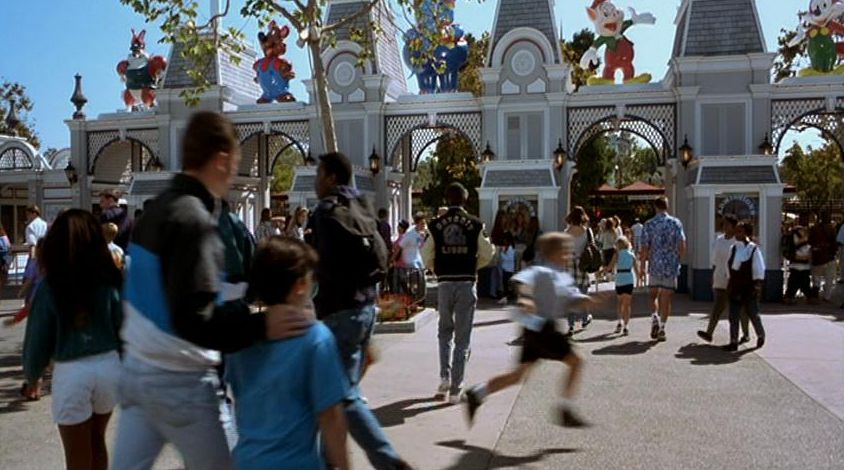
Also makes me think about the various stories -- at least three books and one movie I can think of off the bat -- that take place in a theme park and try to bring together that Fear and Loathing in Las Vegas combination of rides and fun and cotton candy with murder and mayhem and so on.


Most of these chose Don't Mess with the Mouse and set the story in an imagined park. But whether it is Lincoln Child's Utopia in the thriller of the same name, or Lowryland in one book of the urban fantasy Incryptid series, or Wonder World in a buddy-cop action comedy, there is something missing.

For whatever reason, none of these writers brought the kinds of details to the mythology of the worlds these parks are based on that would give them the resonance we get with the famous parks in the real world. I'm not talking of stories set around traveling carnivals or circus tents or amusement parks that are nothing but rides, but ones that, like Disney or Universal, involves the audience with shared lore about the characters and worlds.

Like Universal's Wizarding World of Harry Potter; you go into this experience knowing something of the world and its lore and already invested in the idea of drinking butterbeer and picking out your own wand at Olivander's.

It is sort of strange and even a bit off-putting that Utopia and Tricks for Free both give the characters of the book, major and minor, investment in the inner fictional worlds, crying out in glad recognition at well-loved characters and referencing known lore. But the authors haven't given us, the audience, that same familiarity or the same lore.

Doctorow's Down and Out in the Magic Kingdom does take on the Mouse. I am actually not sure how. But then, Ready Player One also name-checks about a million intellectual properties.

I do say "name checks" because Ready Player One may have the resonance, but it isn't followed through. It is largely on a level of "And hey, here's the DeLorean time machine from that movie you liked!" At least in the movie, all the emotional effect is just seeing the thing. At least at a Star Wars Experience, you can talk with the Stormtroopers.

Just a weird side thought. Almost done with revisions. Back to working on Paris soon. I hope.

Saturday, November 12, 2022

Calling Anton


I'm finishing up on revisions for A Fox's Wedding and I'm at a scene I really should have realized would be difficult.

It's supposed to be one of the minor revisions. Instead I've been at it all week and I'm still not sure how I'm going to work my way through it.

In the last book, Penny had to stab a guy. She's been dealing with it since, almost not going on the Japan adventure at all. This scene is late in the book and this is the place where she finally accepts that the path she is on is worth it, even if it does lead to violence again.

And I set it up at a gun range. Which was probably a mistake. It makes it far too obvious what is going to happen at the Crisis Point. It also puts the focus in the wrong place. So I'm trying to find a way through to the story beats I really want.

Without changing the chapter count, because I don't want to have to apply for a new ISBN.

This isn't about guns. The problem is, putting guns on the page makes it look like it is.


Incidentally, the Part headings are now "Tatemae, Ganbatte, Kitsune, Honne." I liked the rhythm of "...Makoto" much better but my Japanese translator talked me out of it. "Makoto" is truth, but the sense is more of "the real thing, the true thing" rather than "the hidden facts, discovering the truth." And I didn't really have a good space to explain another word to the reader, not and make it feel familiar and right to the reader by the time they hit the end. Whereas Honne (my translator hit on it at the same moment I did) has been taught and should have been expected...and equally applies to what is happening at the end.


Or maybe not. Because I just ran into the proverb "uso kara de ta makoto" -- which is colloquially translated as "Many a true word was spoken in jest." Because, really, this gets a lot closer to the heart of what is going on. "Honne" is true feelings, and Penny has never had any problem being open with those! As a proxy for the center of the home, the hearth, the privacy of the family spaces, it isn't very good. Native speakers wouldn't think of that first, and that is the audience I care about in doing these language revisions.