The image of Londoners sleeping in the subways is one of the emblematic images of the Blitz. That, and the ruins of London (although all of England was hit and the city of Coventry wracked worse), and a picture of firemen struggling against a blazing building that is as likely as not from a film made in the 50's and not a "real" footage.
When you dig deeper --as it were -- you run into references of the Deep Underground Shelters, which are largely still there. More footage has been shot in those shelters for a number of movies than was ever taken in period. Because here is where it starts getting interesting.
The possibility of needing shelters had been discussed between the wars. The government expressed doubts, though. More publicly stated was that they didn't want the people to develop a shelter mentality, to hide instead of doing the necessary work to support their society. Less publicly said but very much there was the fear that people left to congregate underground might start to talk to each other. Might get certain ideas. Might organize.
It is hard to understand at this time that the great fear was not Germany, but Communism. And even the Aux Units were less concerned with Paratroopers than they were with Fifth Columnists.
And they were right to fear this.
This is why Anderson shelters, and public shelters such as the one at Kennington Park. Shallow, poorly protected, and little protection for the poor for that matter; corrugated iron was hard to come by and many of the poor lacked gardens to dig into. When the bombs began dropping, the doors were locked at the tube stations. There was barbed wire around Oval (in the Kennington area). The public shelter was flooded and stinky and too small and the last was perhaps to the good because it collapsed when a fifty-pound bomb hit it, killing almost everyone inside.
This started a growing movement -- and, yes, local Communists take credit for some of it -- to squat in protected basements of the big store. To charge into the really, really nice shelter under the Savoy. And to force their way into the tubes.
And the government may have expressed their desire not to see a troglodyte life (their words) spring up, but they hadn't counted on just how widespread the destruction was of homes. And how little the poor, already stressed enough, could afford to rebuild. Of course the poor had taken the brunt already. The rich were often in the country. The poor were right where there was industry. So they went to the tube and they camped there not just for shelter from the bombs but because they had nowhere else to go.
It wasn't until almost a year after the Blitz that any of the deep shelters were completed. Some, like Kennington, never were. Basically, they never got used.
Showing posts with label history. Show all posts
Showing posts with label history. Show all posts
Sunday, May 3, 2020


Tuesday, August 27, 2019
From a certain point of view
Got through the last rethink and back to writing the last act.
Was good timing to stop and think right then. There's stuff that's going to be moved to the third act and emphasized, so is nicer to be able to have it in the draft instead of trying to put it in later. The Dorians are back. It ain't a great archaeological mystery but it is the one I have so I'm not putting it to bed until the last scene.
I'm a little disheartened by how much editing I'm looking at now.
On the other hand I am starting to feel like I'm really getting a grip on what a novel looks like and how to build one. This is my third go-around so that's about right. The first I abandoned a few chapters from the end. It just didn't feel "enough." The second I think has the minimum elements. There is little character development but there is still some internalized conflict stuff that plays out properly. The world building is also simplistic but sufficient.
Oh, yes, and there were two epic-length fanfics in there. They helped a lot with scene-level and chapter-level work and were great experiences in juggling large ensemble casts.
What I'm dealing with now is the large-scale structural forms and how to hold them in your head and work with them and maintain flow and consistency across the length of a novel.
So third person might have been a better choice. I went first person largely because there are a lot of solo scenes and it makes it easier to keep an internal narrative voice going. Of course in my current round of re-writes I'm adding characters to as many of those solo sequences as I can because it just reads better.
There's two places third person would have really helped. There's a character who is a foil and goad through the first two thirds. He's the one that pushes my protagonist to change. Why he is doing so is unclear up until his last scene. And that's weak. He would be a stronger antagonist if he didn't appear magically and do things for incomprehensible reasons. And the best way to do this would be to have the ability to go inside his head once or twice, or at least look at the world from over his shoulder.
Changing first person is more awkward and less done than changing third person. In the ultimate case, third person omniscient dips into every head it wants to, moment by moment (and is rarely used in genre fiction these days).
The other thing is, well, it is tough to objectify a character from first person. Conan can stride into battle, sweat gleaming from his mighty thews, but he can't describe himself doing it (well, not without sounding like Den (as voiced by John Candy in 1981's Heavy Metal). As I discovered earlier, it is harder to look heroic from inside, especially for a character who doesn't think of herself as being that hero and from her perspective is faking it like mad.
And, yes, this is mirror territory, where you really shouldn't be writing in deep immersion but letting the character admire their long raven locks. In the first novel I actually finished, Shirato, I played around with starting with a shallow immersion and external description when the character had yet to break away as an independent person standing slightly outside of her own society. And I could certainly play that game here, with Penny being described from behind her eyes but even she views Athena Fox from outside her skin.
Of course you can always pick up a POV if you need that external shot. On my last fanfic I even created a one-scene walk-on just to be able to observe the Jack-Daniel-Lara dynamic from the outside for a few paragraphs.
Yes, I certainly played with the idea of having Penny narrate in first person but describe the character she plays in third. But something I've realized as I'm closing in on the final chapters; Penny doesn't want to be this character. She wants to be this person. She doesn't want to be a a genre hero who has adventures, she wants to be the globe-trotting, confident, skilled academic who knows history deeply and can speak a dozen languages living and dead. For this novel, at least, it isn't appropriate for her to ever describe her own actions from outside.
There's an amusing discussion going on in a couple corners of the interwebs about how so many fantasy worlds (especially in games) are littered with the ruins of a past civilization and whether we should be calling them post-apocalyptic. (The other part of the argument is the banditry and the rule of the sword and the easy access to loot seems to imply a breakdown of society).
The view has some merit, I think, but only as in describing the settings of games as borderlands. Places that for whatever reason (past cataclysm or current war) are lawless and in flux and are in short the perfect habitat for the kind of character sometimes described as a "murder-hobo."
As for the ruins? You can certainly argue for there to have been a lost age, but I don't see it as singular. I see it more as deep history. Peoples have come and gone, and some of them had pretty crazy building programs.
Was good timing to stop and think right then. There's stuff that's going to be moved to the third act and emphasized, so is nicer to be able to have it in the draft instead of trying to put it in later. The Dorians are back. It ain't a great archaeological mystery but it is the one I have so I'm not putting it to bed until the last scene.
I'm a little disheartened by how much editing I'm looking at now.
On the other hand I am starting to feel like I'm really getting a grip on what a novel looks like and how to build one. This is my third go-around so that's about right. The first I abandoned a few chapters from the end. It just didn't feel "enough." The second I think has the minimum elements. There is little character development but there is still some internalized conflict stuff that plays out properly. The world building is also simplistic but sufficient.
Oh, yes, and there were two epic-length fanfics in there. They helped a lot with scene-level and chapter-level work and were great experiences in juggling large ensemble casts.
What I'm dealing with now is the large-scale structural forms and how to hold them in your head and work with them and maintain flow and consistency across the length of a novel.
So third person might have been a better choice. I went first person largely because there are a lot of solo scenes and it makes it easier to keep an internal narrative voice going. Of course in my current round of re-writes I'm adding characters to as many of those solo sequences as I can because it just reads better.
There's two places third person would have really helped. There's a character who is a foil and goad through the first two thirds. He's the one that pushes my protagonist to change. Why he is doing so is unclear up until his last scene. And that's weak. He would be a stronger antagonist if he didn't appear magically and do things for incomprehensible reasons. And the best way to do this would be to have the ability to go inside his head once or twice, or at least look at the world from over his shoulder.
Changing first person is more awkward and less done than changing third person. In the ultimate case, third person omniscient dips into every head it wants to, moment by moment (and is rarely used in genre fiction these days).
The other thing is, well, it is tough to objectify a character from first person. Conan can stride into battle, sweat gleaming from his mighty thews, but he can't describe himself doing it (well, not without sounding like Den (as voiced by John Candy in 1981's Heavy Metal). As I discovered earlier, it is harder to look heroic from inside, especially for a character who doesn't think of herself as being that hero and from her perspective is faking it like mad.
And, yes, this is mirror territory, where you really shouldn't be writing in deep immersion but letting the character admire their long raven locks. In the first novel I actually finished, Shirato, I played around with starting with a shallow immersion and external description when the character had yet to break away as an independent person standing slightly outside of her own society. And I could certainly play that game here, with Penny being described from behind her eyes but even she views Athena Fox from outside her skin.
Of course you can always pick up a POV if you need that external shot. On my last fanfic I even created a one-scene walk-on just to be able to observe the Jack-Daniel-Lara dynamic from the outside for a few paragraphs.
Yes, I certainly played with the idea of having Penny narrate in first person but describe the character she plays in third. But something I've realized as I'm closing in on the final chapters; Penny doesn't want to be this character. She wants to be this person. She doesn't want to be a a genre hero who has adventures, she wants to be the globe-trotting, confident, skilled academic who knows history deeply and can speak a dozen languages living and dead. For this novel, at least, it isn't appropriate for her to ever describe her own actions from outside.
There's an amusing discussion going on in a couple corners of the interwebs about how so many fantasy worlds (especially in games) are littered with the ruins of a past civilization and whether we should be calling them post-apocalyptic. (The other part of the argument is the banditry and the rule of the sword and the easy access to loot seems to imply a breakdown of society).
The view has some merit, I think, but only as in describing the settings of games as borderlands. Places that for whatever reason (past cataclysm or current war) are lawless and in flux and are in short the perfect habitat for the kind of character sometimes described as a "murder-hobo."
As for the ruins? You can certainly argue for there to have been a lost age, but I don't see it as singular. I see it more as deep history. Peoples have come and gone, and some of them had pretty crazy building programs.
Thursday, July 11, 2019
Making a splash
I want to change history.
Of course I do. The last "novel" was set nebulously in the vicinity of 2001. This one is in 2018, which is a lot easier to research; unless there is good reason to go otherwise I can use current information for rail lines and so forth.
So I got lucky with some early numbers. The medieval street fair I went to in Rhineland/Palatinate is still ongoing as of 2018, and it happens the same weekend that Oktoberfest opens in München. Unfortunately that means by the time I get to Verona, the Arena has closed their last performance for the season (it was an Italian pop singer, if you want to know).
But Venice. So there was the Regata Storica on Sept 2nd. That's a bunch of races preceded by a parade of historical boats. Then there's a big film festival. And then there's the Acqua alta of 2018; the biggest and nastiest flood tide since 1966. But it didn't happen, historically, until Oct 29.
I mentioned wasting some time trying to figure out when you got a good snow cover along the route of the rail connection from München to Verona. Well, I found a video taken in Brenner Pass in early September of 2018 that showed snow, so that's good enough for me. Because the point isn't getting it exact, it is getting it within the ballpark of what is reasonable and expected for that place, that season, etc.
The precise timing of the acqua alta is up to the vagaries of (large-scale) weather and tides. There is no strong hydrologic reason why it couldn't happen in September. In fact, my protagonist arrives in Venice on or just after the Full Moon. So as in the Brenner Pass example above I'd be entirely justified to have puddles in the Piazza San Marco.
What I can't do -- at least, not lightly -- is move the historically significant October event. Not unless it was really, really key to the plot of the story.
There's a last point here. It strains coincidence when your characters just happen to arrive in Rio in time for Carnaval and at Houston just in time for a launch. The real travel experience is that the great exhibit was last week and you can't wait long enough for the duck season to start and you are always somehow in the wrong town at the wrong time. But this story takes place in a not completely realistic universe. My protagonist will happen on more than her fair share of interesting things, from a film festival to a riot.
And, yeah, at the climax the Olympias will row in, despite being a full ten years too late.
But all is not lost. The very much real-world medicane "Xenephon" swept into Athens the very weekend my protagonist will be concluding her adventure. I hadn't planned anything to do with a storm. But I'm sure not going to turn one down...
Of course I do. The last "novel" was set nebulously in the vicinity of 2001. This one is in 2018, which is a lot easier to research; unless there is good reason to go otherwise I can use current information for rail lines and so forth.
So I got lucky with some early numbers. The medieval street fair I went to in Rhineland/Palatinate is still ongoing as of 2018, and it happens the same weekend that Oktoberfest opens in München. Unfortunately that means by the time I get to Verona, the Arena has closed their last performance for the season (it was an Italian pop singer, if you want to know).
But Venice. So there was the Regata Storica on Sept 2nd. That's a bunch of races preceded by a parade of historical boats. Then there's a big film festival. And then there's the Acqua alta of 2018; the biggest and nastiest flood tide since 1966. But it didn't happen, historically, until Oct 29.
I mentioned wasting some time trying to figure out when you got a good snow cover along the route of the rail connection from München to Verona. Well, I found a video taken in Brenner Pass in early September of 2018 that showed snow, so that's good enough for me. Because the point isn't getting it exact, it is getting it within the ballpark of what is reasonable and expected for that place, that season, etc.
The precise timing of the acqua alta is up to the vagaries of (large-scale) weather and tides. There is no strong hydrologic reason why it couldn't happen in September. In fact, my protagonist arrives in Venice on or just after the Full Moon. So as in the Brenner Pass example above I'd be entirely justified to have puddles in the Piazza San Marco.
What I can't do -- at least, not lightly -- is move the historically significant October event. Not unless it was really, really key to the plot of the story.
There's a last point here. It strains coincidence when your characters just happen to arrive in Rio in time for Carnaval and at Houston just in time for a launch. The real travel experience is that the great exhibit was last week and you can't wait long enough for the duck season to start and you are always somehow in the wrong town at the wrong time. But this story takes place in a not completely realistic universe. My protagonist will happen on more than her fair share of interesting things, from a film festival to a riot.
And, yeah, at the climax the Olympias will row in, despite being a full ten years too late.
But all is not lost. The very much real-world medicane "Xenephon" swept into Athens the very weekend my protagonist will be concluding her adventure. I hadn't planned anything to do with a storm. But I'm sure not going to turn one down...
Sunday, June 9, 2019
The Ken Burns Cinematic Universe
Unlike Disney, who gets to chose what is and isn't officially part of the Star Wars universe, documentaries are constrained to come as close as possible to the real world.
I had a whole scenelet planned out around the current archaeological excavations of the Stoa Poilike in the Athenian Agora. I've got a pdf from excavations in 2011, links to the American School of Classical Studies at Athens (who have been there since 1931) and drawings and pictures of ostrakon with the name of Alkibiades, electrum coins stamped with the head of a bull (possibly from the time of Theseus, or so says Plutarch), and a cute black-figure lekythoi painted with a scene depicting the apobates, an "unusual event in the Panathenaic Games" involving a fully-armed hoplite jumping out of, then back into, a moving chariot.
And best yet for my purposes, a section that forms a neat palimpsest as Byzantine trenching cut down far enough to expose the original foundations, with a nearby well (used and/or expanded as late as the 19th century) that does a similar job of going through multiple horizons.
I drafted the scene last night. It didn't work. I put in my notes to re-arrange so there's more banter, more character stuff, and the Diogenes story comes at the end.
This morning I started work by reviewing the geography of the setting. And, whoops.

Turns out the actual site isn't directly (or publicly) accessible from the agora. It is not just across Adrianou Street (named after the Emperor Hadrian, of course), but across the railway as well. Pity, because it is a very typical example of how modern Athens lives with the history under it. A Greek restaurant that wouldn't be moved juts out into the space on an island of dirt and stone, as you can see in the picture above.
But this may be to the good. This scene really isn't about the history; it is about having fun with the kind of friends you make when being a tourist.
When the maps showed me the geography of Frankfurt am Main didn't support the scene I was planning, I recast it for the Bad Münster a Stein banhof. And that led me to what seemed to be a better approach; instead of physical action, to play to the strengths of my protagonist; have her have to talk her way out of it.
But after three attempts and a deep dive into the character arcs and themes planning folders, I realized this undercut what I wanted to do with my antagonist. I could not afford to have him speak in this scene. So rewrote it once again and I'm basically back to physical action. But I did get a good character moment out of it. Maybe in re-writes I'll even be able to punch it up and make it really pivot.
So this weekend is all about filling in some gaps. There's one scene with big holes in it and three that I skipped over entirely to get into the "chase" section of the book.
There are advantages in writing draft and seeing how all the pieces work before laboring on the scenes in detail. Well, at least there are now. When I wrote my first novel I found it far too difficult to lift and move big sections or re-cast the entire thrust of a chapter.
Well, I also have better software now. So I'm about to put it to the acid test and take my phone to the cafe for brunch and writing. (I suffer from the opposite of agoraphobia. I need those crowds and those potentially uncomfortable social situations and those uncontrolled elements of the wide outside world, otherwise I crawl into my head...and I don't get any writing done.)
I had a whole scenelet planned out around the current archaeological excavations of the Stoa Poilike in the Athenian Agora. I've got a pdf from excavations in 2011, links to the American School of Classical Studies at Athens (who have been there since 1931) and drawings and pictures of ostrakon with the name of Alkibiades, electrum coins stamped with the head of a bull (possibly from the time of Theseus, or so says Plutarch), and a cute black-figure lekythoi painted with a scene depicting the apobates, an "unusual event in the Panathenaic Games" involving a fully-armed hoplite jumping out of, then back into, a moving chariot.
And best yet for my purposes, a section that forms a neat palimpsest as Byzantine trenching cut down far enough to expose the original foundations, with a nearby well (used and/or expanded as late as the 19th century) that does a similar job of going through multiple horizons.
I drafted the scene last night. It didn't work. I put in my notes to re-arrange so there's more banter, more character stuff, and the Diogenes story comes at the end.
This morning I started work by reviewing the geography of the setting. And, whoops.

Turns out the actual site isn't directly (or publicly) accessible from the agora. It is not just across Adrianou Street (named after the Emperor Hadrian, of course), but across the railway as well. Pity, because it is a very typical example of how modern Athens lives with the history under it. A Greek restaurant that wouldn't be moved juts out into the space on an island of dirt and stone, as you can see in the picture above.
But this may be to the good. This scene really isn't about the history; it is about having fun with the kind of friends you make when being a tourist.
When the maps showed me the geography of Frankfurt am Main didn't support the scene I was planning, I recast it for the Bad Münster a Stein banhof. And that led me to what seemed to be a better approach; instead of physical action, to play to the strengths of my protagonist; have her have to talk her way out of it.
But after three attempts and a deep dive into the character arcs and themes planning folders, I realized this undercut what I wanted to do with my antagonist. I could not afford to have him speak in this scene. So rewrote it once again and I'm basically back to physical action. But I did get a good character moment out of it. Maybe in re-writes I'll even be able to punch it up and make it really pivot.
So this weekend is all about filling in some gaps. There's one scene with big holes in it and three that I skipped over entirely to get into the "chase" section of the book.
There are advantages in writing draft and seeing how all the pieces work before laboring on the scenes in detail. Well, at least there are now. When I wrote my first novel I found it far too difficult to lift and move big sections or re-cast the entire thrust of a chapter.
Well, I also have better software now. So I'm about to put it to the acid test and take my phone to the cafe for brunch and writing. (I suffer from the opposite of agoraphobia. I need those crowds and those potentially uncomfortable social situations and those uncontrolled elements of the wide outside world, otherwise I crawl into my head...and I don't get any writing done.)
Sunday, June 2, 2019
"Mousie...! Mousie...!"
This is why I got into history.
In the chapter under construction my protagonist is fleeing from Bad Münster. To throw off pursuit she's abandoning the original plan of a midnight flight from Frankfurt to Athens via...Istanbul (long flight). So there's a short scene in possibly Mainz (which more-or-less was a major Roman city) or...Bingen.
Of "Hildegard von..." fame. And what else does Bingen have? Well, there's the Mäuseturm, the Mouse Tower; a watchtower in the middle of the Rhein. (Built by Romans, rebuilt by Franks, destroyed by French, rebuilt by Prussians...you know the drill). Attached to it is an almost Japanese tale of thematically appropriate revenge on the historical Hatto II, Archbishop of Mainz. Which tale is referenced in "The Children's Hour," the Poem by Longfellow!
(And, yes, I did visit Bingen. Can't remember much. There was a museum, I know.)
In the chapter under construction my protagonist is fleeing from Bad Münster. To throw off pursuit she's abandoning the original plan of a midnight flight from Frankfurt to Athens via...Istanbul (long flight). So there's a short scene in possibly Mainz (which more-or-less was a major Roman city) or...Bingen.
Of "Hildegard von..." fame. And what else does Bingen have? Well, there's the Mäuseturm, the Mouse Tower; a watchtower in the middle of the Rhein. (Built by Romans, rebuilt by Franks, destroyed by French, rebuilt by Prussians...you know the drill). Attached to it is an almost Japanese tale of thematically appropriate revenge on the historical Hatto II, Archbishop of Mainz. Which tale is referenced in "The Children's Hour," the Poem by Longfellow!
(And, yes, I did visit Bingen. Can't remember much. There was a museum, I know.)
Sunday, May 19, 2019
The Concession
Yeah, so that thing about how you can make one big concession at the start of an SF story? It sort of works for pseudo-history based stories too.
I just read a book that did it and it seemed to work. Then made it not work. And both choices are informative.
Right at the start of the story, it is presented that the Sphinx is older than the Pyramids. Okay, fine. For the purposes of this story, we are in a world where this is true. And where the secret library buried under the Sphinx is a thing, too.
There's no pressing need to argue that the whole library thing is clearly a fabrication as it didn't start being talked up until the Christian era. Because this is the beginning; this is the place where you can say, "For the purposes of this story, light has mass. For the purposes of this story, India doesn't exist. For the purpose of this story, Elves." Whatever.
Okay...I do still have a small problem with it. I think that to really be fair to actual science you need to do as they did a scene fairly close in to the start of The Core. Which is to have someone point out just how absolutely stupid the idea is. And then go and do it anyhow because that's the story. "Elves? Are you insane? There's no way...oh, look. There they are."
You don't need to defend it, not really. The audience is totally willing to accept this as a premise so they can get on with the story. You don't have to give them some convincing story about how Michelson-Morely should really be interpreted or how Google Maps lies or how pointed ears can easily be hidden by hats. Sure, you can, but that is for entirely different reasons than convincing the reader.
One is because it is useful in-story; say, you want to do a big scene at the Explorer's Club where your hero explains how he is going to launch himself in a giant cannon and therefore launches into similarly ballistic arguments. One character convincing another. One character demonstrating their character (the physicist demonstrating how they are smarter than anyone since Einstein).
The other is because its fun. It is a nod and a wink to the audience, a spoof explanation given because it is funny. It is a chance to trot out your research. And I have to remind you again; because this is while the Contract With the Reader is still in the process of being signed and ratified, this farcical "explanation" is done in full view, the merest sop of a top hat and a cheap sparkly wand while the writer does it. The reader knows they are being spoofed and they are enjoying the ride.
So here's where the book I read made a big mistake. It made arguments later in. After the author already had the audience on his side, he created situations where someone could bring up the erosion theory, or...since the Sphinx was part of a parcel of Ancient Alien stuff...the Bagdad Battery, the lack-of-soot argument...all the horribly familiar and long-debunked trash of the Von Danieken brigade.
The only reader this isn't going to annoy is the reader who is gullible enough to either fall for or (more likely) already fallen for the pseudo-history in question. The average reader is going to be increasingly annoyed.
Not saying you couldn't make this kind of delayed argument work in the right context, but basically this is where you've moved from making one clear concession for the purposes of the story to trying to argue for a clearly counterfactual when there's a perfectly good story you could get back to telling.
So...if this is how it works, does it make it harder to write an adventure archaeologist story? Perhaps. What seems to me is that the process remains familiar. If on page three you introduce the anti-gravity paint, the only things you are allowed to do from then on are either science as we know it, or extrapolations that follow logically from that first concession.
Follow logically. Science as we know it. If you've set up the 25,000 year old Sphinx in the first chapter, if you later want to talk about Battle of Kadesh you can indeed explore the implications of an ancient Sphinx. But you can't also unveil that the Hittites are, for completely unrelated reasons, riding against the Egyptian chariots on their trained velociraptors.
Depending on the type of book, of course. It all does have to do with the contract with the reader. If you've introduced a traditional mystery, you can't have Miss Marple give up on ever making sense of the clues and in the last act, gun everyone down with a war surplus Thompson. World-building a fantasy world means you can't suddenly have dragons appear in the third act -- not unless you've been planting the proper portents all along. Magic users can't develop new powers on demand.
It all comes from the original premise you've asked the reader to accept. So if you want to add Atlantis and Crystal Skulls and Pakal's Spaceship to your Sphinx story, the opening premise has to be not that this one thing is different, but that lots and lots of things are going to be different.
But I still think that premise needs to have structure. Saying, in a Science Fiction story; "A lot of the physics you know is plain wrong" gives the writer too much license. It is hard to concentrate on the dangers faced by the heroes if you aren't sure if inertia works in this universe, or even oxygen. You kind of need some ground rules in order to be emotionally involved. And for anything that is a scientific technological or historical puzzle, to be intellectually involved.
"Lots of history is wrong" is a poor premise because it doesn't constrain the possible. At any moment Elvis and Bigfoot could pop out to take down the bad guys. "Some history is wrong because this thing here" is a better premise. There is a race of immortals. A long-lived conspiracy. A crash-landed spacecraft. A really, really weird Pope. Or some other schema that regulates what sorts of para-historical things are liable to pop up in the manuscript; "Welcome to the monster hunter club," "Your mission is to go to critical battles across time and make sure they come out the right way," "This book of your grandfather's explains all the things he discovered."
I just read a book that did it and it seemed to work. Then made it not work. And both choices are informative.
Right at the start of the story, it is presented that the Sphinx is older than the Pyramids. Okay, fine. For the purposes of this story, we are in a world where this is true. And where the secret library buried under the Sphinx is a thing, too.
There's no pressing need to argue that the whole library thing is clearly a fabrication as it didn't start being talked up until the Christian era. Because this is the beginning; this is the place where you can say, "For the purposes of this story, light has mass. For the purposes of this story, India doesn't exist. For the purpose of this story, Elves." Whatever.
Okay...I do still have a small problem with it. I think that to really be fair to actual science you need to do as they did a scene fairly close in to the start of The Core. Which is to have someone point out just how absolutely stupid the idea is. And then go and do it anyhow because that's the story. "Elves? Are you insane? There's no way...oh, look. There they are."
You don't need to defend it, not really. The audience is totally willing to accept this as a premise so they can get on with the story. You don't have to give them some convincing story about how Michelson-Morely should really be interpreted or how Google Maps lies or how pointed ears can easily be hidden by hats. Sure, you can, but that is for entirely different reasons than convincing the reader.
One is because it is useful in-story; say, you want to do a big scene at the Explorer's Club where your hero explains how he is going to launch himself in a giant cannon and therefore launches into similarly ballistic arguments. One character convincing another. One character demonstrating their character (the physicist demonstrating how they are smarter than anyone since Einstein).
The other is because its fun. It is a nod and a wink to the audience, a spoof explanation given because it is funny. It is a chance to trot out your research. And I have to remind you again; because this is while the Contract With the Reader is still in the process of being signed and ratified, this farcical "explanation" is done in full view, the merest sop of a top hat and a cheap sparkly wand while the writer does it. The reader knows they are being spoofed and they are enjoying the ride.
So here's where the book I read made a big mistake. It made arguments later in. After the author already had the audience on his side, he created situations where someone could bring up the erosion theory, or...since the Sphinx was part of a parcel of Ancient Alien stuff...the Bagdad Battery, the lack-of-soot argument...all the horribly familiar and long-debunked trash of the Von Danieken brigade.
The only reader this isn't going to annoy is the reader who is gullible enough to either fall for or (more likely) already fallen for the pseudo-history in question. The average reader is going to be increasingly annoyed.
Not saying you couldn't make this kind of delayed argument work in the right context, but basically this is where you've moved from making one clear concession for the purposes of the story to trying to argue for a clearly counterfactual when there's a perfectly good story you could get back to telling.
So...if this is how it works, does it make it harder to write an adventure archaeologist story? Perhaps. What seems to me is that the process remains familiar. If on page three you introduce the anti-gravity paint, the only things you are allowed to do from then on are either science as we know it, or extrapolations that follow logically from that first concession.
Follow logically. Science as we know it. If you've set up the 25,000 year old Sphinx in the first chapter, if you later want to talk about Battle of Kadesh you can indeed explore the implications of an ancient Sphinx. But you can't also unveil that the Hittites are, for completely unrelated reasons, riding against the Egyptian chariots on their trained velociraptors.
Depending on the type of book, of course. It all does have to do with the contract with the reader. If you've introduced a traditional mystery, you can't have Miss Marple give up on ever making sense of the clues and in the last act, gun everyone down with a war surplus Thompson. World-building a fantasy world means you can't suddenly have dragons appear in the third act -- not unless you've been planting the proper portents all along. Magic users can't develop new powers on demand.
It all comes from the original premise you've asked the reader to accept. So if you want to add Atlantis and Crystal Skulls and Pakal's Spaceship to your Sphinx story, the opening premise has to be not that this one thing is different, but that lots and lots of things are going to be different.
But I still think that premise needs to have structure. Saying, in a Science Fiction story; "A lot of the physics you know is plain wrong" gives the writer too much license. It is hard to concentrate on the dangers faced by the heroes if you aren't sure if inertia works in this universe, or even oxygen. You kind of need some ground rules in order to be emotionally involved. And for anything that is a scientific technological or historical puzzle, to be intellectually involved.
"Lots of history is wrong" is a poor premise because it doesn't constrain the possible. At any moment Elvis and Bigfoot could pop out to take down the bad guys. "Some history is wrong because this thing here" is a better premise. There is a race of immortals. A long-lived conspiracy. A crash-landed spacecraft. A really, really weird Pope. Or some other schema that regulates what sorts of para-historical things are liable to pop up in the manuscript; "Welcome to the monster hunter club," "Your mission is to go to critical battles across time and make sure they come out the right way," "This book of your grandfather's explains all the things he discovered."
Sunday, May 12, 2019
Romani ite domun
I really didn't want to get into the Romans. I think, actually, it isn't that I dislike Roman history -- no indeed, there's so much fun stuff there. Nor that I'm afraid of it per se -- although there is terrifyingly too much of it. No, it is that there are a lot of people out there who are really, really crazy about the Romans, and no matter how carefully you try to do your research one of them is going to pop up and say "Actually, the Hairy Nose Legion wasn't posted to Argylia until the reformations of Claudius the Indigestible, and their Campaign Knot was actually called a Bidireta Unuctava and was worn on the right shoulder of odd-numbered Dodecaturians..."
Anyhow I'm trying to get through the big scene in Germany now so I can get the actual plot started. But there's so much to deal with; the actual location, the history of that location, the archaeology of it...and figuring out what the Romans were actually up to in a specific part of Germany is not one of those things you can do a simple Google search for. Much less doing comparisons with Iron Age activity. Figuring out what kind of a dig this is...plus I really don't know my archaeology that well and I really want to do a little geeking out about soil horizons and baseline datum and whatever.
Oh, and the theories that caused this dig to happen. I spent the morning at the cafe working and by the time my laptop battery died I'd worked out that basically a classics scholar with some, let us say, non-mainstream views did a lot of close reading of Tacitus et al and decided he would find something interesting near this one town. He may or may not have dug, but if he did was 1960's style and not good. Decades later his protégé comes out there with fancy MGR equipment he isn't experienced enough to get good data out of, convinces himself and his backers he's got something, and after a few months of frustration salts the pit.
Which has left open the question of who funded this. Which opens up a whole new rabbit hole of ever-shifting organizations on several different (and, one would think, opposing) fringes.
Which, since I'm also in the middle of trying to build more plot and more action into the thing, opens up all sorts of questions about whether these various anti-social societies are going to play a larger part in the story.
Which is another whole issue. I'm not taking anything off the table yet...but does seem a wee bit too far to have terrorists planting a bomb on the Acropolis. But, heck, I have enough trouble believing in, say, my protagonist fleeing from German cops. So maybe there's a happy medium. Because having the high point of the action being a fake gun and an inconclusive slap-fight between two amateurs...
Anyhow I'm trying to get through the big scene in Germany now so I can get the actual plot started. But there's so much to deal with; the actual location, the history of that location, the archaeology of it...and figuring out what the Romans were actually up to in a specific part of Germany is not one of those things you can do a simple Google search for. Much less doing comparisons with Iron Age activity. Figuring out what kind of a dig this is...plus I really don't know my archaeology that well and I really want to do a little geeking out about soil horizons and baseline datum and whatever.
Oh, and the theories that caused this dig to happen. I spent the morning at the cafe working and by the time my laptop battery died I'd worked out that basically a classics scholar with some, let us say, non-mainstream views did a lot of close reading of Tacitus et al and decided he would find something interesting near this one town. He may or may not have dug, but if he did was 1960's style and not good. Decades later his protégé comes out there with fancy MGR equipment he isn't experienced enough to get good data out of, convinces himself and his backers he's got something, and after a few months of frustration salts the pit.
Which has left open the question of who funded this. Which opens up a whole new rabbit hole of ever-shifting organizations on several different (and, one would think, opposing) fringes.
Which, since I'm also in the middle of trying to build more plot and more action into the thing, opens up all sorts of questions about whether these various anti-social societies are going to play a larger part in the story.
Which is another whole issue. I'm not taking anything off the table yet...but does seem a wee bit too far to have terrorists planting a bomb on the Acropolis. But, heck, I have enough trouble believing in, say, my protagonist fleeing from German cops. So maybe there's a happy medium. Because having the high point of the action being a fake gun and an inconclusive slap-fight between two amateurs...
Thursday, November 29, 2018
Disclaimer
Authors writing historical or history-themed fiction cover a spectrum of research ability. Oddly, though, they don't seem to plot in a bell curve. Instead the numbers cluster nearer two ends. On one, there are writers with a frighteningly good grasp of their subject. (They do vary in how well they can carry along the reader; some bring the reader in painlessly and some overwhelm the reader: reaching some sort of uncanny valley with Umberto Eco, where being overwhelmed and confused by the wealth of detail is actually a large part of the draw in reading him.)
On the other peak, there are writers who are indirectly frightening. As in, it is frightening that they managed to get published (and get positive reviews!) Now I've said before that accuracy isn't everything and there is more to good historical fiction than getting the date of Caesar's assassination right.
Still, it is somewhat comforting that few people are writing straight historical fiction from this kind of poor grasp of the material. This is more a tendency of what I've been calling "Artifact Stories," where some Lost Ancient Object of Power drives what is otherwise a standard thriller/adventure/mystery. (I'm going to give a pass to historical romances, first because there's no blanket statement, but second because their goals are generally different.)
In any case the middle ground is less occupied. I have a special fondness for those authors who inhabit it. I suspect it is a transient position; a writer might assay one book set in 44 AD Rome, but by the time they've written two or three they've probably became rather informed about the era.
That's just random musings and has no bearing on where I am now with my own attempts at historical fiction. As I develop the current book, I've been discovering what it is I'd like to do if it were a series. A bit late for this one, though. For instance; I think it would be a nice pattern to always feature two eras of history and/or two distinct cultures. My plot, however, is pretty much centered on Greece, although there's bits from both Classical and Pre-Classical eras.
And oh yeah. And maybe the answer to one of my research woes is to just put in a disclaimer. I want to use my own travel experience both for the time it saves and for that intangible authenticity of actual lived experience. But I don't want to strand some poor traveler by gushing over a shop that was there twenty years ago and was in another town anyhow.
So what the hell. Go right ahead and spell it out in the front matter. "The scenes in Town X are based on my own experience in Town Y in the summer of 2011..."
On the other peak, there are writers who are indirectly frightening. As in, it is frightening that they managed to get published (and get positive reviews!) Now I've said before that accuracy isn't everything and there is more to good historical fiction than getting the date of Caesar's assassination right.
Still, it is somewhat comforting that few people are writing straight historical fiction from this kind of poor grasp of the material. This is more a tendency of what I've been calling "Artifact Stories," where some Lost Ancient Object of Power drives what is otherwise a standard thriller/adventure/mystery. (I'm going to give a pass to historical romances, first because there's no blanket statement, but second because their goals are generally different.)
In any case the middle ground is less occupied. I have a special fondness for those authors who inhabit it. I suspect it is a transient position; a writer might assay one book set in 44 AD Rome, but by the time they've written two or three they've probably became rather informed about the era.
That's just random musings and has no bearing on where I am now with my own attempts at historical fiction. As I develop the current book, I've been discovering what it is I'd like to do if it were a series. A bit late for this one, though. For instance; I think it would be a nice pattern to always feature two eras of history and/or two distinct cultures. My plot, however, is pretty much centered on Greece, although there's bits from both Classical and Pre-Classical eras.
And oh yeah. And maybe the answer to one of my research woes is to just put in a disclaimer. I want to use my own travel experience both for the time it saves and for that intangible authenticity of actual lived experience. But I don't want to strand some poor traveler by gushing over a shop that was there twenty years ago and was in another town anyhow.
So what the hell. Go right ahead and spell it out in the front matter. "The scenes in Town X are based on my own experience in Town Y in the summer of 2011..."
Saturday, November 10, 2018
wait just a minotaur...
I'm watching a TV show that is not known for its historical accuracy. After "Athens, 3000 BC" flashes up we see some guys in ragged tunics underground, fleeing from what appears to be a minotaur. Present day, the characters discuss the well-known myth of the roll of golden thread (the what?) and the less well-known myth (yes, they got that part right!) of the "key to the labyrinth."
But it is when they bring out a medallion and confidently identify it as being made of a white marble only found on Crete that I couldn't take any more. Labyrinth in neolithic Athens, no problem. But the only distinctly Cretan marble I've been able to turn up in my own research is a silvery grey. If you are looking for a famous white marble, you want Paros, in the Cyclades. Well, at least the minotaur carving looked vaguely appropriate to neolithic cycladic art.
Yeah, for someone who is in the middle of plotting a book that is actually designed to be under-researched, I sure do get hung up on details that don't matter.
(Speaking of: my core reading list for THIS project is Emily Wilson's translation of The Odyssey, The Medici Conspiracy (about antiquities trafficking), and -- as soon as I can stomach the $17 price tag -- Donna Zuckerberg's Not All Dead White Men.)
Later on they claim Daedalus was scared of water and so wouldn't have gone to Crete. So at least they remembered something of the traditional myths. No explanation as to how Minos ended up in the wrong town, or why Daedalus could apparently write decent modern Greek (3,000 BC being a wee bit early for the Phoenician alphabet to take hold, much less the miniscule!) Or why the show just can not say the word "labyrinth." It is always referred to as a maze.
But it is when they bring out a medallion and confidently identify it as being made of a white marble only found on Crete that I couldn't take any more. Labyrinth in neolithic Athens, no problem. But the only distinctly Cretan marble I've been able to turn up in my own research is a silvery grey. If you are looking for a famous white marble, you want Paros, in the Cyclades. Well, at least the minotaur carving looked vaguely appropriate to neolithic cycladic art.
Yeah, for someone who is in the middle of plotting a book that is actually designed to be under-researched, I sure do get hung up on details that don't matter.
(Speaking of: my core reading list for THIS project is Emily Wilson's translation of The Odyssey, The Medici Conspiracy (about antiquities trafficking), and -- as soon as I can stomach the $17 price tag -- Donna Zuckerberg's Not All Dead White Men.)
Later on they claim Daedalus was scared of water and so wouldn't have gone to Crete. So at least they remembered something of the traditional myths. No explanation as to how Minos ended up in the wrong town, or why Daedalus could apparently write decent modern Greek (3,000 BC being a wee bit early for the Phoenician alphabet to take hold, much less the miniscule!) Or why the show just can not say the word "labyrinth." It is always referred to as a maze.
Thursday, November 1, 2018
Always coming home
Odysseus had the right of it. Hang out with the swineherd for a while. Scope out the place and see what your friends and co-workers are up to safe behind the anonymity of a disguise. It is tough re-shifting your priorities back to job and friends, especially when you've been out on your own adventuring.
Travel gives you perspective. Hell of it is, the first thing I noticed is how filthy my place is at the moment. That's now shot up to the top of the priority list, and not just dusting but the big repairs I've been putting off, like re-doing some plaster, hanging new blinds, etc.
And the novel? Yes I learned things. I could say I am ready now...I gathered enough of what was important to me so I could start writing actual scenes.
But I have new perspective there, too. I saw a lot, I thought a lot. I crossed the Aegean with a copy of The Odyssey in my hand. I strolled the hills and listened to the goats and walked the stones of Minoan buildings.
It has become oddly much less clear where the demarkations are between Minoan, Mycenaean, Iron Age and Classical Greece are. Seeing so many of the artifacts close-up this way illuminates the similarities and connections as much as it illuminates the differences and changes. There are continuities of language and religion and material culture.
It is these continuities archaeologists are forced to use to expand upon the material they are able to gather. We don't know anything of Mycenaean religious practices, for instance, but there are familiar names which appear and we do know something of how the later Greeks worshipped the gods with those appellations.
And this is particularly true for the writer of fiction, who can not just turn the camera away from those parts of the scene that are inconvenient, inconclusive, or entirely impossible to verify with ground data.
More, there is a dark reflection of this; just as the historian has to borrow from the better-known to fill in the gaps of our knowledge, the writer is moved to borrow from what is better known to the reader in order to smooth their entry into the world of the story.
The place where this has currently become an impossible snarl for me is that many people have written many kinds of stories within this setting. Within the past few days I've been reading a vigorous and insightful new translation of Homer, browsing (with the filter of yet another language to bear with, as it is in French) a children's book of The Odyssey with the cutest illustrations, and sample chapters of a book that re-tells The Illiad from the point of view of the women of Troy (Euripides got there first), and of yet another Lara Croft clone that purports to be about an artifact from late Bronze Age Crete. Oh, yes; and reading way too many attempts by way too many museums to batter a public-friendly description into two hundred words or less.
And it should be obvious to everybody but getting it right (even if it were possible to get it all right) has little to do with making it readable. Or getting it to sell.
I made this argument myself before I set off. As I alluded to above, if look and feel is important to me, then I am ready, now, to reproduce the smells and sounds of the landscape of modern Crete (and only a few academics will know or care that not all the fauna I describe is properly contemporary). If getting that gut punch of five-senses description and strong characters and conflict and a little action is what is important (as I believe it is) then being sloppy with the research is okay. Being intentionally "sloppy" with the research is even better (that is, borrowing from what we can know, such as worship practices of 1st century Greece and Rome, or horticulture of the Christian age, but using details that came from life and thus carry that ineffable aura of veracity).
And so, yeah, research generated new questions. And some of those have sent me back to the top of the stack; what am I trying to write, and who for?
Travel gives you perspective. Hell of it is, the first thing I noticed is how filthy my place is at the moment. That's now shot up to the top of the priority list, and not just dusting but the big repairs I've been putting off, like re-doing some plaster, hanging new blinds, etc.
And the novel? Yes I learned things. I could say I am ready now...I gathered enough of what was important to me so I could start writing actual scenes.
But I have new perspective there, too. I saw a lot, I thought a lot. I crossed the Aegean with a copy of The Odyssey in my hand. I strolled the hills and listened to the goats and walked the stones of Minoan buildings.
It has become oddly much less clear where the demarkations are between Minoan, Mycenaean, Iron Age and Classical Greece are. Seeing so many of the artifacts close-up this way illuminates the similarities and connections as much as it illuminates the differences and changes. There are continuities of language and religion and material culture.
It is these continuities archaeologists are forced to use to expand upon the material they are able to gather. We don't know anything of Mycenaean religious practices, for instance, but there are familiar names which appear and we do know something of how the later Greeks worshipped the gods with those appellations.
And this is particularly true for the writer of fiction, who can not just turn the camera away from those parts of the scene that are inconvenient, inconclusive, or entirely impossible to verify with ground data.
More, there is a dark reflection of this; just as the historian has to borrow from the better-known to fill in the gaps of our knowledge, the writer is moved to borrow from what is better known to the reader in order to smooth their entry into the world of the story.
The place where this has currently become an impossible snarl for me is that many people have written many kinds of stories within this setting. Within the past few days I've been reading a vigorous and insightful new translation of Homer, browsing (with the filter of yet another language to bear with, as it is in French) a children's book of The Odyssey with the cutest illustrations, and sample chapters of a book that re-tells The Illiad from the point of view of the women of Troy (Euripides got there first), and of yet another Lara Croft clone that purports to be about an artifact from late Bronze Age Crete. Oh, yes; and reading way too many attempts by way too many museums to batter a public-friendly description into two hundred words or less.
And it should be obvious to everybody but getting it right (even if it were possible to get it all right) has little to do with making it readable. Or getting it to sell.
I made this argument myself before I set off. As I alluded to above, if look and feel is important to me, then I am ready, now, to reproduce the smells and sounds of the landscape of modern Crete (and only a few academics will know or care that not all the fauna I describe is properly contemporary). If getting that gut punch of five-senses description and strong characters and conflict and a little action is what is important (as I believe it is) then being sloppy with the research is okay. Being intentionally "sloppy" with the research is even better (that is, borrowing from what we can know, such as worship practices of 1st century Greece and Rome, or horticulture of the Christian age, but using details that came from life and thus carry that ineffable aura of veracity).
And so, yeah, research generated new questions. And some of those have sent me back to the top of the stack; what am I trying to write, and who for?
Tuesday, October 30, 2018
Provenance, Provenience, Parthenon
Here’s the first image: troups of well-dressed Europeans climbing the maze of stairs, teetering on the artistically fragmented walls, admiring the Victorian brown collonades and the fashion-magazine stylish repainted frescoes.
Here’s the second image. A Turkish powder magazine explodes, delivering the final indignity to the creaking, discolored ruins of Athen’s heart.
Two different cities, two different monuments, two different sets of problems in archaeological restoration and the often complex relationship between a modern nation and their cultural heritage.

Knossos is terribly underfunded. It seems strange at first glance. Athens is scarred by their economic woes; abandoned buildings with gaping windows like rotting teeth in faces covered with graffiti, pavements scored with broken walks and open drains and drifts of garbage. By contrast Heraklion, (from the harbor at least), is clean and modern and wears proudly the remodeling for the 2004 Summer Olympics. Even the tourists look wealthier.
(The contrast is even stronger at Chania. This is basically a sea-side resort town. The history underfoot is barely remarked upon; in a long dockside strip of eateries and bars and trinket shops no signage showed and only a handful of people seemed to know there was a full replica Minoan sailing vessel on display nearby -- among the other archaeological and historical treasures.)
Work has all but stopped at the site of the Palace of Knossos. Down at the Heraklion Museum they speak proudly of the restoration efforts on their collection (which as with so many begins with removing the efforts of the previous generation). But at Knossos itself, the best description of the present efforts is stabilization. Keeping it from disintegrating further before the money for actual work flows in again.
The site is under-documented by the standards of the new Acropolis Museum. But there is some justification in calling that a special case. Knossos is layered, an archaeological palimpsest and a restoration bricolage, and that is part of the problem.
Cleverly, the Knossos signage cleaves to an essentially Sir Arthur Evans narrative. Although this is couched with qualifiers like, “Evans called this...” or even, “Evans mistakenly believed...” the singular narrative through-line is Knossos as Evans and his generation experienced it and understood it.
It could be argued that this is the best approach for most visitors. It is one step more honest than simply saying, “This is a Lustral Basin” but it doesn’t drag the visitor into the full depths of complexity and confusion.
In the States, the age at which a building can apply for protected landmark status is the ripe old age of fifty. Archaeology can be done — archaeology has been done — where some of the original participants are still alive.
So what is the best way to approach a palimpsest like, say, the Koules guarding the Heraklion harbor? Restore it to the Venetian fort that stood so long, or the Ottoman modifications when they finally took it and, too, produced a grim history in and around it? Restore whatever mute evidence the Second Wold War may have left, or restore it to the Byzantine walls? And do you keep the moule, or do you re-float the Venetian ships that made its foundation and make them your exhibit?
In short, one could almost defend presenting Knossos as the historical efforts of Sir Arthur Evans. But let’s contrast.

There was a Mycenaean complex (probably a fort) on the Acropolis and Cyclopian walls about the heights of The Rock. There were several generations of earlier temples. And there were later, largely civil uses of the centerpiece structure. But against all of this the Periclean Parthenon is both the architectural and artistic height of all the constructions that site has seen, and the symbolic centerpiece of the Athenian democracy and the Greek Classical world.
So it makes sense to restore towards this Ur-Acropolis. But unlike Knossos, where the multiple levels of occupation and (sometimes questionable!) “restoration” are ill-documented at the site, the Parthenon and particularly the new Acropolis Museum carefully and clearly indicate the layers of provenance involved.
(The Provenience of the parts of the Parthenon are, unlike in almost every other archaeological context, quite simple. At least, for the sculpted facade. In modern parlance, the provenience of an artifact is the exact find location. In this case, the sculptures started life on the building. And not in the British Museum, as the exhibits at the Acropolis Museum take pains to point out!)
At the site itself, every tiny fragment of column has been carefully measured and 3D modeled and the correct location determined in the world’s largest picture puzzle. Where the originals are unavailable (lost to time or to Lord Elgin’s luggage) replacements are provided in plaster cast and fresh white marble.
This allows for both appreciation of the total aesthetic — the building as it would have been — and understanding of what parts are historical and what parts (the shining white parts) are not. It is something that Knossos could have benefitted from, except there the story is far more complicated. How does one mark a Dolphin Fresco that Evans had on a wall and modern papers believe was more likely on the floor, and in any case is in the relative safety of a museum with only a replica on site?
The thing is, though, Evans was right. Not in his guesses, but science marches on. Not in his reconstruction efforts — which like earlier efforts at the Acropolis eventually damaged the stone — but, again, the science of restoration marches on. He was right in doing what he did at the time he did it. The site would be gone now, farmland or a condo, if he hadn’t made it something those Victorians could admire and paint and have their photographs taken on as they lined up in the long coats and top hats along some crumbling wall.
There is something to be said for the aesthetics of a ruin. But you get more public attention, more tourist dollars, more help in preservation, if you have something that looks more like a building. I am tempted to say Knossos doesn’t go far enough. There is a virtual replication in the cloud and a place in town where you can rent a tablet and a VR headset and walk around a fully-restored building, bull-leapers and all.
Imagine if something like that was available on site! I’ve seen this. In Berlin (at the grand Museum für Naturkunde) there is a paleontological exhibit where by standing behind a viewing class the dry bones can be clothed in muscle and skin and feathers and placed in their natural habitat. There is an effort somewhere that has a huge collection of those now stark white marble statues that with another press of a button clothes them with light, bringing back the colours of history.
(The new Acropolis Museum makes crafty compromise by displaying in air-conditioned safety the actual Kouros and Kore from the Parthenon but placing beside them small samples of contemporary reconstruction of the original paint job.)
Above all, however, both these places are symbols. Knossos is merely one photogenic touchstone (when taken from exactly the right angle and cropped ever so carefully; the Evans restorations are, when all is said and gone, pitifully small bits of wall and sequences of column). It stands along side of reproductions of the Dolphin Frescoes and Bull Leaper and Bull Rhyton and so on (which also are rather more Victorian restoration than original artifact).
(It is also informative that the “Mask of Agamemnon,” that in many circles is the emblematic and much-reproduced artifact of that peculiar juncture where the Classic and Homeric tradition meet the historical reality, is presented in Athens at the National Museum of Archaeology as just another shaft-grave death mask. But then, much as Knossos is a monument to Sir Arthur, the largest collection in Athens is assembled and presented as, "Here's what Schliemann dug up.")

The Minoans are today a way that Crete reinvents itself as something other than a backwater island in a nation with a broken economy. And of course a way to draw in the tourist dollar. Their imagery is everywhere (I say imagery because the actual artifacts are thin on the ground but reproductions are everywhere, from made-in-China caliber Phaistos Disk reproductions available at every other souvenir stand, to nicer hand-painted miniatures of the Prince of the Lilies, and — moving from not-so-sublime to worthy-of-ridicule — the Court Ladies fresco incorporated into the plastic banner on the Coke stands.)
But there’s no depth in it. No wearing of the mantle of the true progenitor of the Greek Miracle, or at least the past glory of a Minoan Thallasocracy. Now all there is, is the Minoan Bus-Ocracy (Minoan Lines, the most visible of the huge Bus Tour operations that plow through the place like Achilles and his ships on a “foraging” expedition against the defenseless villages of the Anatolian Coast. The tour buses are everywhere, the most visible part of a massive efficient machine that delivers door-to-door from airport to air-conditioned hotel to guided tour, and everything and everyone else must bend to accommodate them.)
It is simply presented as, “This is historical; look at it and be impressed.” The same can be said, alas, for the Cretan’s attempts to share their more recent cultural heritage with the world. “It is traditional,” they say, as if that is enough; no explanation, no context. I can stand on one foot and hum “Barnacle Bill” and call that traditional and it would be, if only for me. If they truly want people to engage with the historic folkcrafts or the nautical tradition or the terrible and inspiring stories of the Cretan Resistance, they need to provide more.
(At Arolithos Traditional Cretan Village they laud their open museum of “living history” displays. They even offer their vision of engagement; for ten Euros your kid can learn a Camp Runnamucka version of the mosaic work the Byzantines brought to such a high peak. But it stops there. One simplistic, one-way presentation. Don’t ask questions.)
What I’m saying is the curation is abysmal. There are few placards and those are uninformative, and to a man or woman the docents are both uniformed about the museum and its subjects and monumentally uninterested in either them or in the act of conversation itself. (Unfortunately this isn’t a peculiarity of museum staff. Shopkeepers also make you work for the privilege to give them your money.)
I do have to say that even the best of the Athenian museums also fall down a bit by world standards. There wasn’t a catalog number in sight. It was hard sometimes to even nail down era or collection. I’d be tempted to say this stems from the embarrassment of riches; the collections are so vast they can only present them in patterns, like “Pots that include an octopus in their decoration.” But that’s another discussion!
What really separates Athens in this sketch here is that the Parthenon is Athens. As Athena herself remains Athena Potnia, the patron saint and protector of the city. The Parthenon is not a place disconnected from current life, like the Palace of Knossos or even the Sinking of the “Elli”; it is effectively the Cathedral of the majority religion. (Not that is functional in any current rituals, or even connected to the professed and officially recognized faiths.)

And I have to stop here and say these aren’t unique issues.
Besides the radically different standards of different museums and monuments worldwide — no nation, no city is without fault — there are basic questions about preservation and accessibility that are not dissimilar to the problems a writer of history (or historical fiction) faces.
There are always market forces. What was important to Athens in the early twentieth century led to what the Parthenon is today. What was inspiring to the Victorians is — as had been the case many times in the past, from Napoleon back through to fifth Dynasty Egyptians — what led to the preservation of what we have today and the interest that raised generations of scholars who would go on to advance our current knowledge.
Monuments and museums have to chase the buck. They have to work within those blurry lines of dramatization and simplification. They have to speak to the viewer whether it is aesthetics or spiritual connection or lessons for the present or (the illusion of?) learning and/or self-actualisation. To do less is to lose the museum, the collection, the monument itself. Athens at least has state support for their grand symbol of the state, but even there money has to come in or the monument doesn't survive.
But beyond serving the needs of the archaeological and historical community, professional and amateur, the museum or monument should, I think, also serve the real needs of the public.
I would like to think the need of most of that public is the sense of transcendence of one’s own mortal lifespan; of being able to walk where the Poets had walked. Of having for a moment a grasp of the boundless. I’d prefer an interest in understanding a different people and different ways, if for no other reason because that helps us to lift our own blinders and for that moment see our own predictions and presumptions as if with alien eyes. But in any case it beats an interest in boasting rights (the selfie-taker infesting modern monuments would be utterly familiar in needs and process and rationale to the Victorians who went to Athens and Rome and, eventually, Crete.)
To speak to that majority audience you need to streamline. You may need to reconstruct or fill in (depending on the circumstance). You need in short to lie, to commit sins both of omission and confabulation.
But that still doesn’t keep me from wanting that other layer to be available. From wanting those access points, from catalog numbers to educated docents, that allow one to drill down beyond the repainted facade to something deeper. Instead my experience across Greece was one of active resistance.

There’s a whole other sideline here about folkloric crafts. There are thriving communities interested in, keeping alive, being inspired by, and otherwise practicing crafts from history or reconstructed from archaeology. It upset me that the points of access were almost nonexistent on Crete despite the several clever and fascinating folkways museums.
Take spinning and weaving. However. There was a small exhibit sponsored by some government agency trying to grow the market for Cretan silk that tried to produce a kit to let you try pulling silken threads from a cocoon yourself. Alas it was badly explained, poorly presented, and none of the exhibiters had any idea how it actually worked.
The one access I got is through something that is recognized as a living craft within a slightly different circle. Even though in large parts of Crete the part of the Cretan Lyre has been taken over by the more flexible and easier-to-obtain violin, there are people who sell and play and build and teach the lyre who are completely open and supportive to the idea of someone new learning the instrument. I suspect (although I haven't the direct experience to prove) that cooking could, within limits, also benefit from coming from a different context that bypasses the blind uncomprehending, "But we have postcards for sale! What else do you want?"
And, yes, as someone fascinated by the practicalities of daily life artifacts, it is disheartening to find at even a good museum — one that recognizes and labels loom weights and spindle whorls — the distinctive and informative linen-spinner’s bowl is left unremarked among a class of general household pottery. Or that a set of actual surviving clay tuyeres is simply labeled “tuyeres,” losing that brazen opportunity to talk about the ingenious period smelting practices.

But this should be no surprise. When the sleek mechanism is designed to ferry the tourist as smoothly and quickly as possible through the monument and into the gift shop, the very concept of dialog is anathema. Only a passive audience can be processed with efficiency. And the shame is that the audience seems largely satisfied. Whatever experience they were seeking, they seem to have gained it somewhere between the massive bus that made sure Cretan soil never touched their pristine footwear, and the hotel amenities that made it as much as possible like any other large hotel anywhere in the world.
The visitor who wants, needs, and can accept more (I saw one visitor at the National in Athens who was getting an expert lecture from his friend, another visitor -- a man I am almost certain was Eric Cline himself!) is the outlier. They have to fend for themselves. The visitor who has moved even further from the mainstream, like the growing groups of historical and folkloric re-creationists, is even more left with no easy access to what they were hoping to find.
And there is no simple answer to this. It is not a fault, per se. Certainly not one of any agency. It is merely a function of how things work, how they -- apparently -- must work, but certainly how they have currently evolved.
And for all of that said....yes, the material is still there, and I got something worthwhile from it.
Here’s the second image. A Turkish powder magazine explodes, delivering the final indignity to the creaking, discolored ruins of Athen’s heart.
Two different cities, two different monuments, two different sets of problems in archaeological restoration and the often complex relationship between a modern nation and their cultural heritage.

Knossos is terribly underfunded. It seems strange at first glance. Athens is scarred by their economic woes; abandoned buildings with gaping windows like rotting teeth in faces covered with graffiti, pavements scored with broken walks and open drains and drifts of garbage. By contrast Heraklion, (from the harbor at least), is clean and modern and wears proudly the remodeling for the 2004 Summer Olympics. Even the tourists look wealthier.
(The contrast is even stronger at Chania. This is basically a sea-side resort town. The history underfoot is barely remarked upon; in a long dockside strip of eateries and bars and trinket shops no signage showed and only a handful of people seemed to know there was a full replica Minoan sailing vessel on display nearby -- among the other archaeological and historical treasures.)
Work has all but stopped at the site of the Palace of Knossos. Down at the Heraklion Museum they speak proudly of the restoration efforts on their collection (which as with so many begins with removing the efforts of the previous generation). But at Knossos itself, the best description of the present efforts is stabilization. Keeping it from disintegrating further before the money for actual work flows in again.
The site is under-documented by the standards of the new Acropolis Museum. But there is some justification in calling that a special case. Knossos is layered, an archaeological palimpsest and a restoration bricolage, and that is part of the problem.
Cleverly, the Knossos signage cleaves to an essentially Sir Arthur Evans narrative. Although this is couched with qualifiers like, “Evans called this...” or even, “Evans mistakenly believed...” the singular narrative through-line is Knossos as Evans and his generation experienced it and understood it.
It could be argued that this is the best approach for most visitors. It is one step more honest than simply saying, “This is a Lustral Basin” but it doesn’t drag the visitor into the full depths of complexity and confusion.
In the States, the age at which a building can apply for protected landmark status is the ripe old age of fifty. Archaeology can be done — archaeology has been done — where some of the original participants are still alive.
So what is the best way to approach a palimpsest like, say, the Koules guarding the Heraklion harbor? Restore it to the Venetian fort that stood so long, or the Ottoman modifications when they finally took it and, too, produced a grim history in and around it? Restore whatever mute evidence the Second Wold War may have left, or restore it to the Byzantine walls? And do you keep the moule, or do you re-float the Venetian ships that made its foundation and make them your exhibit?
In short, one could almost defend presenting Knossos as the historical efforts of Sir Arthur Evans. But let’s contrast.

There was a Mycenaean complex (probably a fort) on the Acropolis and Cyclopian walls about the heights of The Rock. There were several generations of earlier temples. And there were later, largely civil uses of the centerpiece structure. But against all of this the Periclean Parthenon is both the architectural and artistic height of all the constructions that site has seen, and the symbolic centerpiece of the Athenian democracy and the Greek Classical world.
So it makes sense to restore towards this Ur-Acropolis. But unlike Knossos, where the multiple levels of occupation and (sometimes questionable!) “restoration” are ill-documented at the site, the Parthenon and particularly the new Acropolis Museum carefully and clearly indicate the layers of provenance involved.
(The Provenience of the parts of the Parthenon are, unlike in almost every other archaeological context, quite simple. At least, for the sculpted facade. In modern parlance, the provenience of an artifact is the exact find location. In this case, the sculptures started life on the building. And not in the British Museum, as the exhibits at the Acropolis Museum take pains to point out!)
At the site itself, every tiny fragment of column has been carefully measured and 3D modeled and the correct location determined in the world’s largest picture puzzle. Where the originals are unavailable (lost to time or to Lord Elgin’s luggage) replacements are provided in plaster cast and fresh white marble.
This allows for both appreciation of the total aesthetic — the building as it would have been — and understanding of what parts are historical and what parts (the shining white parts) are not. It is something that Knossos could have benefitted from, except there the story is far more complicated. How does one mark a Dolphin Fresco that Evans had on a wall and modern papers believe was more likely on the floor, and in any case is in the relative safety of a museum with only a replica on site?
The thing is, though, Evans was right. Not in his guesses, but science marches on. Not in his reconstruction efforts — which like earlier efforts at the Acropolis eventually damaged the stone — but, again, the science of restoration marches on. He was right in doing what he did at the time he did it. The site would be gone now, farmland or a condo, if he hadn’t made it something those Victorians could admire and paint and have their photographs taken on as they lined up in the long coats and top hats along some crumbling wall.
There is something to be said for the aesthetics of a ruin. But you get more public attention, more tourist dollars, more help in preservation, if you have something that looks more like a building. I am tempted to say Knossos doesn’t go far enough. There is a virtual replication in the cloud and a place in town where you can rent a tablet and a VR headset and walk around a fully-restored building, bull-leapers and all.
Imagine if something like that was available on site! I’ve seen this. In Berlin (at the grand Museum für Naturkunde) there is a paleontological exhibit where by standing behind a viewing class the dry bones can be clothed in muscle and skin and feathers and placed in their natural habitat. There is an effort somewhere that has a huge collection of those now stark white marble statues that with another press of a button clothes them with light, bringing back the colours of history.
(The new Acropolis Museum makes crafty compromise by displaying in air-conditioned safety the actual Kouros and Kore from the Parthenon but placing beside them small samples of contemporary reconstruction of the original paint job.)
Above all, however, both these places are symbols. Knossos is merely one photogenic touchstone (when taken from exactly the right angle and cropped ever so carefully; the Evans restorations are, when all is said and gone, pitifully small bits of wall and sequences of column). It stands along side of reproductions of the Dolphin Frescoes and Bull Leaper and Bull Rhyton and so on (which also are rather more Victorian restoration than original artifact).
(It is also informative that the “Mask of Agamemnon,” that in many circles is the emblematic and much-reproduced artifact of that peculiar juncture where the Classic and Homeric tradition meet the historical reality, is presented in Athens at the National Museum of Archaeology as just another shaft-grave death mask. But then, much as Knossos is a monument to Sir Arthur, the largest collection in Athens is assembled and presented as, "Here's what Schliemann dug up.")

The Minoans are today a way that Crete reinvents itself as something other than a backwater island in a nation with a broken economy. And of course a way to draw in the tourist dollar. Their imagery is everywhere (I say imagery because the actual artifacts are thin on the ground but reproductions are everywhere, from made-in-China caliber Phaistos Disk reproductions available at every other souvenir stand, to nicer hand-painted miniatures of the Prince of the Lilies, and — moving from not-so-sublime to worthy-of-ridicule — the Court Ladies fresco incorporated into the plastic banner on the Coke stands.)
But there’s no depth in it. No wearing of the mantle of the true progenitor of the Greek Miracle, or at least the past glory of a Minoan Thallasocracy. Now all there is, is the Minoan Bus-Ocracy (Minoan Lines, the most visible of the huge Bus Tour operations that plow through the place like Achilles and his ships on a “foraging” expedition against the defenseless villages of the Anatolian Coast. The tour buses are everywhere, the most visible part of a massive efficient machine that delivers door-to-door from airport to air-conditioned hotel to guided tour, and everything and everyone else must bend to accommodate them.)
It is simply presented as, “This is historical; look at it and be impressed.” The same can be said, alas, for the Cretan’s attempts to share their more recent cultural heritage with the world. “It is traditional,” they say, as if that is enough; no explanation, no context. I can stand on one foot and hum “Barnacle Bill” and call that traditional and it would be, if only for me. If they truly want people to engage with the historic folkcrafts or the nautical tradition or the terrible and inspiring stories of the Cretan Resistance, they need to provide more.
(At Arolithos Traditional Cretan Village they laud their open museum of “living history” displays. They even offer their vision of engagement; for ten Euros your kid can learn a Camp Runnamucka version of the mosaic work the Byzantines brought to such a high peak. But it stops there. One simplistic, one-way presentation. Don’t ask questions.)
What I’m saying is the curation is abysmal. There are few placards and those are uninformative, and to a man or woman the docents are both uniformed about the museum and its subjects and monumentally uninterested in either them or in the act of conversation itself. (Unfortunately this isn’t a peculiarity of museum staff. Shopkeepers also make you work for the privilege to give them your money.)
I do have to say that even the best of the Athenian museums also fall down a bit by world standards. There wasn’t a catalog number in sight. It was hard sometimes to even nail down era or collection. I’d be tempted to say this stems from the embarrassment of riches; the collections are so vast they can only present them in patterns, like “Pots that include an octopus in their decoration.” But that’s another discussion!
What really separates Athens in this sketch here is that the Parthenon is Athens. As Athena herself remains Athena Potnia, the patron saint and protector of the city. The Parthenon is not a place disconnected from current life, like the Palace of Knossos or even the Sinking of the “Elli”; it is effectively the Cathedral of the majority religion. (Not that is functional in any current rituals, or even connected to the professed and officially recognized faiths.)

And I have to stop here and say these aren’t unique issues.
Besides the radically different standards of different museums and monuments worldwide — no nation, no city is without fault — there are basic questions about preservation and accessibility that are not dissimilar to the problems a writer of history (or historical fiction) faces.
There are always market forces. What was important to Athens in the early twentieth century led to what the Parthenon is today. What was inspiring to the Victorians is — as had been the case many times in the past, from Napoleon back through to fifth Dynasty Egyptians — what led to the preservation of what we have today and the interest that raised generations of scholars who would go on to advance our current knowledge.
Monuments and museums have to chase the buck. They have to work within those blurry lines of dramatization and simplification. They have to speak to the viewer whether it is aesthetics or spiritual connection or lessons for the present or (the illusion of?) learning and/or self-actualisation. To do less is to lose the museum, the collection, the monument itself. Athens at least has state support for their grand symbol of the state, but even there money has to come in or the monument doesn't survive.
But beyond serving the needs of the archaeological and historical community, professional and amateur, the museum or monument should, I think, also serve the real needs of the public.
I would like to think the need of most of that public is the sense of transcendence of one’s own mortal lifespan; of being able to walk where the Poets had walked. Of having for a moment a grasp of the boundless. I’d prefer an interest in understanding a different people and different ways, if for no other reason because that helps us to lift our own blinders and for that moment see our own predictions and presumptions as if with alien eyes. But in any case it beats an interest in boasting rights (the selfie-taker infesting modern monuments would be utterly familiar in needs and process and rationale to the Victorians who went to Athens and Rome and, eventually, Crete.)
To speak to that majority audience you need to streamline. You may need to reconstruct or fill in (depending on the circumstance). You need in short to lie, to commit sins both of omission and confabulation.
But that still doesn’t keep me from wanting that other layer to be available. From wanting those access points, from catalog numbers to educated docents, that allow one to drill down beyond the repainted facade to something deeper. Instead my experience across Greece was one of active resistance.

There’s a whole other sideline here about folkloric crafts. There are thriving communities interested in, keeping alive, being inspired by, and otherwise practicing crafts from history or reconstructed from archaeology. It upset me that the points of access were almost nonexistent on Crete despite the several clever and fascinating folkways museums.
Take spinning and weaving. However. There was a small exhibit sponsored by some government agency trying to grow the market for Cretan silk that tried to produce a kit to let you try pulling silken threads from a cocoon yourself. Alas it was badly explained, poorly presented, and none of the exhibiters had any idea how it actually worked.
And, yes, as someone fascinated by the practicalities of daily life artifacts, it is disheartening to find at even a good museum — one that recognizes and labels loom weights and spindle whorls — the distinctive and informative linen-spinner’s bowl is left unremarked among a class of general household pottery. Or that a set of actual surviving clay tuyeres is simply labeled “tuyeres,” losing that brazen opportunity to talk about the ingenious period smelting practices.

But this should be no surprise. When the sleek mechanism is designed to ferry the tourist as smoothly and quickly as possible through the monument and into the gift shop, the very concept of dialog is anathema. Only a passive audience can be processed with efficiency. And the shame is that the audience seems largely satisfied. Whatever experience they were seeking, they seem to have gained it somewhere between the massive bus that made sure Cretan soil never touched their pristine footwear, and the hotel amenities that made it as much as possible like any other large hotel anywhere in the world.
The visitor who wants, needs, and can accept more (I saw one visitor at the National in Athens who was getting an expert lecture from his friend, another visitor -- a man I am almost certain was Eric Cline himself!) is the outlier. They have to fend for themselves. The visitor who has moved even further from the mainstream, like the growing groups of historical and folkloric re-creationists, is even more left with no easy access to what they were hoping to find.
And there is no simple answer to this. It is not a fault, per se. Certainly not one of any agency. It is merely a function of how things work, how they -- apparently -- must work, but certainly how they have currently evolved.
And for all of that said....yes, the material is still there, and I got something worthwhile from it.
Wednesday, September 19, 2018
Atlantis keeps popping up like a cork
I'm committed to the Crete story, and following it a bunch of fun stuff in New Kingdom Egypt. On paper sounds amusing enough; the coming of the Sea Peoples and the beginnings of the end for the Mycenaean civilization in the Aegean at the end of the Bronze Age, through the eyes of a young woman. And for Egypt, an extended musing on the process of understanding history and immortality set in the worker camps of the Valley of Kings and the ruins of the royal city of Akhenaton.
But I can't help think of things that are easier to write.
My trouble with Atlantis is that it isn't possible, not as given. This is true for pretty much all the popular conspiracy fodder, from Lemuria to Hollow Earth to the Bermuda Triangle. (Which is to say, the ideas that are well-known enough to attract a casual reader's eye, detailed enough to be easy to write about, and "big" enough to spin some epic about.)
Re the latter, archaeologists get excited about whether overshot flaking was developed earlier than supposed, but its hard to imagine chase scenes and gunfights erupting over that secret.
So, yeah. You could come up with an original mystery that isn't as badly contravened by the evidence as is Atlantis. Say, that Great Zimbabwe had steam power, electrification and sent explorers as far as Wisconsin. (One has to assume the Rhodesian Government did a hell of a lot more covering up than they are even historically blamed for). Or if hard tech isn't to your taste, that the real source of the Mayan mathematic genius was the Norte-Chico civilization, who had moved far beyond Set Theory into multi-dimensional manifolds and chaos math. Or if biological advances are your go-to, that the Sumerian King List is actually factual, that they had somehow managed to bred for extreme longevity, and aside from some of the Noachian patriarchs and odd hanger's on like Lazarus the line died with them.
All bunnies above are free for the taking, by the by.
Atlantis just doesn't work, not in the real world. There's three major ways around it. One is to change Atlantis, but by the time you've made it a town in the Italian Alps in around 200 AD there's hardly a point in claiming any connection is left to Plato.
The next is to assume it is, indeed, fake. You can go an Eco-ish route with this; either people who can't accept it is fake and build their own conspiracy around it, or it is indeed balderdash but in the process of looking into it anyway some totally unrelated thing is discovered. ("Look, guys, it isn't a Deep One after all -- it's just old Mr. British Petroleum trying to hide his fracking operation!")
Or, you change the world. (Actually, you pretty much have to change Atlantis a little anyhow. Continent filling the ocean and diving beneath the waves in a day? Not going to happen on this globe). I rather like the possibilities of this one. Plato wrote, then other writers added to, commented, criticized. There is archaeological evidence. Basically, it was a real place that left a real impact on the historical and archaeological and, yes, geological record.
And that brings me around -- Atlantis not necessarily included or wanted -- to two very different books I might prefer to be writing.
The first is the Fake Real. A story set either in a period of historical archaeology or in a couple of periods, with the discoveries made in one era being amplified on by another. The later would allow you to put both Carter and Ventris in the same story. So in this one, the past is stranger than it is in our world, and so is the present. Not only do some of the hidden technologies of the Atlanteans (or whatever) start showing up in the shops of London or as weapons in the wars, the historical characters themselves become para-historical; younger, stronger, prettier, more accomplished.
The other is the Real Fake. A story set in modern day or, better yet, somewhere between the 70's and the 90's (between the rise of Von Daniken and the rise of the cable TV pseudo-history channels.) Not only are the Lemurians as fake as they are in the real world, so is the archaeologist; a Remington Steele type created by a television show to be the world-famous discoverer of a new secret every week. Except that their patsy develops a conscience. Hence tension...and story.
But I can't help think of things that are easier to write.
My trouble with Atlantis is that it isn't possible, not as given. This is true for pretty much all the popular conspiracy fodder, from Lemuria to Hollow Earth to the Bermuda Triangle. (Which is to say, the ideas that are well-known enough to attract a casual reader's eye, detailed enough to be easy to write about, and "big" enough to spin some epic about.)
Re the latter, archaeologists get excited about whether overshot flaking was developed earlier than supposed, but its hard to imagine chase scenes and gunfights erupting over that secret.
So, yeah. You could come up with an original mystery that isn't as badly contravened by the evidence as is Atlantis. Say, that Great Zimbabwe had steam power, electrification and sent explorers as far as Wisconsin. (One has to assume the Rhodesian Government did a hell of a lot more covering up than they are even historically blamed for). Or if hard tech isn't to your taste, that the real source of the Mayan mathematic genius was the Norte-Chico civilization, who had moved far beyond Set Theory into multi-dimensional manifolds and chaos math. Or if biological advances are your go-to, that the Sumerian King List is actually factual, that they had somehow managed to bred for extreme longevity, and aside from some of the Noachian patriarchs and odd hanger's on like Lazarus the line died with them.
All bunnies above are free for the taking, by the by.
Atlantis just doesn't work, not in the real world. There's three major ways around it. One is to change Atlantis, but by the time you've made it a town in the Italian Alps in around 200 AD there's hardly a point in claiming any connection is left to Plato.
The next is to assume it is, indeed, fake. You can go an Eco-ish route with this; either people who can't accept it is fake and build their own conspiracy around it, or it is indeed balderdash but in the process of looking into it anyway some totally unrelated thing is discovered. ("Look, guys, it isn't a Deep One after all -- it's just old Mr. British Petroleum trying to hide his fracking operation!")
Or, you change the world. (Actually, you pretty much have to change Atlantis a little anyhow. Continent filling the ocean and diving beneath the waves in a day? Not going to happen on this globe). I rather like the possibilities of this one. Plato wrote, then other writers added to, commented, criticized. There is archaeological evidence. Basically, it was a real place that left a real impact on the historical and archaeological and, yes, geological record.
And that brings me around -- Atlantis not necessarily included or wanted -- to two very different books I might prefer to be writing.
The first is the Fake Real. A story set either in a period of historical archaeology or in a couple of periods, with the discoveries made in one era being amplified on by another. The later would allow you to put both Carter and Ventris in the same story. So in this one, the past is stranger than it is in our world, and so is the present. Not only do some of the hidden technologies of the Atlanteans (or whatever) start showing up in the shops of London or as weapons in the wars, the historical characters themselves become para-historical; younger, stronger, prettier, more accomplished.
The other is the Real Fake. A story set in modern day or, better yet, somewhere between the 70's and the 90's (between the rise of Von Daniken and the rise of the cable TV pseudo-history channels.) Not only are the Lemurians as fake as they are in the real world, so is the archaeologist; a Remington Steele type created by a television show to be the world-famous discoverer of a new secret every week. Except that their patsy develops a conscience. Hence tension...and story.
Saturday, September 8, 2018
The Coconut Effect
A review of several of my books in an attempt to pin down the political situation on LBA Crete didn't get me that. Instead it surprised me with a travel plan.
A couple more rants on writing historical fiction first. Say someone figures out my Cretan weaver has a glimpse into the future. They can't call her a sibyl. Or a Cassandra. Probably! I mean, the term "sibyl" is documented from before Tarquinus purchased the surviving Sibylline Books. And Pythias goes back before that, too. It seems rather more likely the term was indigenous, like "Homer," before being appropriated for a later myth. And although there's several hundred years and a Dark Age to go before the Illiad, stories of Cassandra might have entered the oral tradition at any time prior (possibly prior to the semi-historical event she later gets attached to).
I'm also snarking that the Pythias might be one of the first documented cases of mansplaining. Women were the seers with a vision of the future, but war and conquest and profits are serious business, much too serious for a mere woman to understand. So everything the prophetess saw would have to be properly explained by a male handler. In honesty, though, how things were conducted at Delphi are unclear; the Pythias may have spoken for herself -- the whole story of the magic smoke seems to have been made up whole-cloth and doesn't occur in accounts from writers who were actually there.

Still, it is an ongoing problem I'm having with terms that exist in classical Greek. I could probably manipulate them to something that fits the orthography of Mycenaean Greek, but I don't see that helping. At best it slows the reader while they digest the unfamiliar, at worst it looks like I'm trying to be clever for clever's sake.
But what do you do? I was imagining a conversation (relating to the supervisory positions indicated in the Linear B records of textile workgroups) and the term "meritocracy" came up. Which to me is too obviously originating among the political thinkers and philosophers of Classical Greece, and something that is going to be making the reader stop and ask, "Did they have that yet?"
Well, I'm pretty sure the concept wasn't invented in Athens. There were certainly bronze age situations where it would have come up. Sorry, professors; you can think the thought without having to have the (later, Greek) term.

In any case, it is part and parcel of the Coconut Effect problem. And as I'm reviewing the history of the "Restorations" (or as Evans put it, "Reconstitutions") of Knossos and associated Minoan art and sculpture, I'm reminded forcefully that much of what the casual reader "knows" about the Minoans is unsupported and deeply suspect. (And, yes, one should see the Mycenaeans as a continuation and adaption of Minoan culture -- one with a more pronounced warrior slant, among other changes, but one that has a continuity of evolution from the earlier culture).
It is a difficult choice the writer or other creator has to make. Sometimes you fight the battles you can win; in Assassins Creed Origins, set in Ptolemaic era Egypt, the Pyramids are properly clad in their shining white complete with the gold cap on Cheops, and the buildings are painted. The statuary, however, is still an ahistorical marble-white. With this, I have to agree with them. Whether or not the player would accept the historical painted statues, even whether painted or unpainted is aesthetically more pleasing to the modern eye, in the end it is a fighting game and having what looked like a bunch more NPCs standing around the area would be visually confusing.
I'm making the same choice. I'm hitting the books to try to figure out which part of the Palace of Knossos are still standing at the time of the novel, but in the end I need material, I need material which is colorful and detailed and I'll take the reconstitutions of Evans' hired artists. And that the reader will probably have encountered the Dolphin "fresco" (almost certainly a floor decoration, historically) is only a bonus.
(The Coconut Effect is a phrase popularized on TVTropes, specifically referring to the way coconut halves were used to represent the sound of horse hooves for decades until audiences were finally trained to accept something more realistic.)

So back to migration patterns.
Allow for the moment the idea of a flow of invasion that is roughly North to South, starting in Greece, moving to or joining a wave starting from around the Bosphorus and moving sequentially down through Anatolia and the Levant before finally crashing into Egypt. Don't worry who is invading; that's a later problem.
So I start in Crete (and in simultaneous/back story, in Amarna) late in the rule of Merneptah or early in the reign of Rameses III. A time of growing tension but still generally peaceful. The coming-of-age story, the Weaver's Hall and saffron-gathering on the hills and all that, and a soft revolution that is more Summer of Love than Storming the Bastille. These chapters bring the clock forward, in stages, a decade or more; Kes is at least young teen when the dominos start.
First the Palace of Knossos is burned. But here's the thing; the archaeological burn layers of many of the sites cited aren't necessarily markers of change in occupation. Hattusha gives evidence of having been quietly evacuated years before. Occupation signs are present on top of burn layers in many palatial centers. So Mycenaean rule and some overall structure remains in Crete even though the palace is damaged and the population is migrating into the interior and the mountains.
Our characters leave Crete to discover cities on the Greek Mainland already destroyed. They head across the Aegean (possibly not by choice) and meet the third member of the party in Miletus -- which he has has finally reached in his long struggle back from Willusa. They head down the coast and pick up the fourth and final member of the party (depending on how you count Paneb) at Byblos and set sail for Ugarit -- arriving just in time for the final days of that city. They flee towards Egypt and there is some political skullduggery towards what will eventually be Rameses III's triumph at the Battle of the Delta.
And that's a plan. It tells me more-or-less what will be happening in two books or more, and tells me which places are going to need research.
It does leave undecided what exactly is happening in Crete, who the Black Ships are, what connections the Sea People have to all this, etc. There are some intriguing ideas, however. There's the Sherdana, who despite fighting on both sides at the Battle of Kadesh and the Battle of the Delta, may be largely mysterious to the insular Egyptians. Hence good reason for my Egyptian nobleman to be peering into the Amarna Letters and getting concerned.
And then there's the suggestion that some of the Sea Peoples may have originated on Crete. Unfortunately not the Sherdana -- that would be too convenient.

A couple more rants on writing historical fiction first. Say someone figures out my Cretan weaver has a glimpse into the future. They can't call her a sibyl. Or a Cassandra. Probably! I mean, the term "sibyl" is documented from before Tarquinus purchased the surviving Sibylline Books. And Pythias goes back before that, too. It seems rather more likely the term was indigenous, like "Homer," before being appropriated for a later myth. And although there's several hundred years and a Dark Age to go before the Illiad, stories of Cassandra might have entered the oral tradition at any time prior (possibly prior to the semi-historical event she later gets attached to).
I'm also snarking that the Pythias might be one of the first documented cases of mansplaining. Women were the seers with a vision of the future, but war and conquest and profits are serious business, much too serious for a mere woman to understand. So everything the prophetess saw would have to be properly explained by a male handler. In honesty, though, how things were conducted at Delphi are unclear; the Pythias may have spoken for herself -- the whole story of the magic smoke seems to have been made up whole-cloth and doesn't occur in accounts from writers who were actually there.

Still, it is an ongoing problem I'm having with terms that exist in classical Greek. I could probably manipulate them to something that fits the orthography of Mycenaean Greek, but I don't see that helping. At best it slows the reader while they digest the unfamiliar, at worst it looks like I'm trying to be clever for clever's sake.
But what do you do? I was imagining a conversation (relating to the supervisory positions indicated in the Linear B records of textile workgroups) and the term "meritocracy" came up. Which to me is too obviously originating among the political thinkers and philosophers of Classical Greece, and something that is going to be making the reader stop and ask, "Did they have that yet?"
Well, I'm pretty sure the concept wasn't invented in Athens. There were certainly bronze age situations where it would have come up. Sorry, professors; you can think the thought without having to have the (later, Greek) term.

In any case, it is part and parcel of the Coconut Effect problem. And as I'm reviewing the history of the "Restorations" (or as Evans put it, "Reconstitutions") of Knossos and associated Minoan art and sculpture, I'm reminded forcefully that much of what the casual reader "knows" about the Minoans is unsupported and deeply suspect. (And, yes, one should see the Mycenaeans as a continuation and adaption of Minoan culture -- one with a more pronounced warrior slant, among other changes, but one that has a continuity of evolution from the earlier culture).
It is a difficult choice the writer or other creator has to make. Sometimes you fight the battles you can win; in Assassins Creed Origins, set in Ptolemaic era Egypt, the Pyramids are properly clad in their shining white complete with the gold cap on Cheops, and the buildings are painted. The statuary, however, is still an ahistorical marble-white. With this, I have to agree with them. Whether or not the player would accept the historical painted statues, even whether painted or unpainted is aesthetically more pleasing to the modern eye, in the end it is a fighting game and having what looked like a bunch more NPCs standing around the area would be visually confusing.
I'm making the same choice. I'm hitting the books to try to figure out which part of the Palace of Knossos are still standing at the time of the novel, but in the end I need material, I need material which is colorful and detailed and I'll take the reconstitutions of Evans' hired artists. And that the reader will probably have encountered the Dolphin "fresco" (almost certainly a floor decoration, historically) is only a bonus.
(The Coconut Effect is a phrase popularized on TVTropes, specifically referring to the way coconut halves were used to represent the sound of horse hooves for decades until audiences were finally trained to accept something more realistic.)

So back to migration patterns.
Allow for the moment the idea of a flow of invasion that is roughly North to South, starting in Greece, moving to or joining a wave starting from around the Bosphorus and moving sequentially down through Anatolia and the Levant before finally crashing into Egypt. Don't worry who is invading; that's a later problem.
So I start in Crete (and in simultaneous/back story, in Amarna) late in the rule of Merneptah or early in the reign of Rameses III. A time of growing tension but still generally peaceful. The coming-of-age story, the Weaver's Hall and saffron-gathering on the hills and all that, and a soft revolution that is more Summer of Love than Storming the Bastille. These chapters bring the clock forward, in stages, a decade or more; Kes is at least young teen when the dominos start.
First the Palace of Knossos is burned. But here's the thing; the archaeological burn layers of many of the sites cited aren't necessarily markers of change in occupation. Hattusha gives evidence of having been quietly evacuated years before. Occupation signs are present on top of burn layers in many palatial centers. So Mycenaean rule and some overall structure remains in Crete even though the palace is damaged and the population is migrating into the interior and the mountains.
Our characters leave Crete to discover cities on the Greek Mainland already destroyed. They head across the Aegean (possibly not by choice) and meet the third member of the party in Miletus -- which he has has finally reached in his long struggle back from Willusa. They head down the coast and pick up the fourth and final member of the party (depending on how you count Paneb) at Byblos and set sail for Ugarit -- arriving just in time for the final days of that city. They flee towards Egypt and there is some political skullduggery towards what will eventually be Rameses III's triumph at the Battle of the Delta.
And that's a plan. It tells me more-or-less what will be happening in two books or more, and tells me which places are going to need research.
It does leave undecided what exactly is happening in Crete, who the Black Ships are, what connections the Sea People have to all this, etc. There are some intriguing ideas, however. There's the Sherdana, who despite fighting on both sides at the Battle of Kadesh and the Battle of the Delta, may be largely mysterious to the insular Egyptians. Hence good reason for my Egyptian nobleman to be peering into the Amarna Letters and getting concerned.
And then there's the suggestion that some of the Sea Peoples may have originated on Crete. Unfortunately not the Sherdana -- that would be too convenient.

Monday, September 3, 2018
Cow-Lifting
Time to step back and regroup.
I've seen what detailed research can turn up on daily life in Mycenaean Crete. The biggest things I've learned is that far too little is known (and those scraps are fought over far too much). And that it takes a lot of time and no little expense and I really don't have the kind of mind that can bring in, store, and organize all those little tantalizing clues.
Conan was created because at $.05 a word Howard couldn't keep doing that depth of historical research.
I'm not under the same financial pressures as Howard and I'm certainly not as creative, but where I am in my life I have to make the same choice. When all is said and done, it is fun to try to tease out the nuances of what might have actually been, but I'm a lot more interested in what is colorful and amusing. And I really don't mind if I get it a little wrong.
Sure, I can make a good argument that making fiction vivid should weigh more strongly than making it accurate. The tasks of historical fiction are to entertain, to teach, and to (when it is done very well) to illuminate. In all these cases, having a clear picture -- even if it is what Gene Roddenbury insightfully called, "a uniformity of error" -- is paramount.
What that boils down to is that I need to be working on what I want to say about the Mycenae and the end of the Aegean bronze age, how I want to portray them, and how to best support an interesting story around them and the other players of that time and place.

The original idea (from almost one year ago today) was a fast-moving adventure, taking a motley crew of heroes on a whirlwind tour of the Late Bronze Age. And that really hasn't changed. I've flirted with doing something more serious, and in a sense I am going in a more serious direction -- not so much more careful history: more like semi-deconstruction of some of the adventure tropes. But when it gets down to it, the basic conception of the characters -- heck, the essential conception that they are plural; that people from social circles and civilizations so far apart become stalwart friends -- requires that they be larger than life.
I love the challenge of trying to make the most authentic picture of a textile workgroup as depicted on the Linear B tablets, but to go through the length of a novel with my Cretan Weaver I also want her to be able to invent a new loom, fall in love, hang out with an Egyptian nobleman, join a revolution...yeah, and probably jump a bull or two while she's at it ("When in Crete..." as the saying goes.) So basically exceed historicity and the statistical likelihoods of her life.

In Greek Mythology, most of the heroes were born that way. They generally had a god or two in their parentage. There is certainly plenty of fiction in which a character is presented as hero qua hero; a few throw-away lines about "thrice-decorated ex-green beret with a doctorate in particle physics and an expertise in medieval weapons," so the reader won't be surprised when he emerges from his time machine into the Battle of Nicopolis and proceeds to kick Ottoman ass.
The other common mode, however, is the hero by circumstance, hero by experience; the ordinary man who rises to the challenge. Thing is, a novel is long. A series is even longer. And series inflation is totally a thing. Just by virtue of living, this once-ordinary protagonist becomes bigger than life. Just like Hercules* lifting a newborn calf above his head twice daily, and continuing the exercise until he is benching 1,600 lbs of beef, the well-done series character is never seen jumping the shark. Each challenge they face is just that little incremental bit tougher. Just that bit more exciting, with more at stake, and more and tougher enemies than the last time.
For the writer consciously trying to do this, you want to be able to drag the reader along on the journey, beginning from a point of identification, "Hey, I could do that. Or at least I think I could, if properly motivated," through to -- without ever losing the reader's investment -- "Of course he can do that! He's Indiana Jones!"

And, yeah. Where my Cretan Weaver -- where my Athenian Mercenary and my Egyptian Scholar-Magician and my Phoenician Merchant Adventurer -- are going character-wise is to something that doesn't work solo. By herself, Kessandra** would be seen as a Mary Sue. The reader needs to know the context is that of the Team Adventure. That this isn't a polite historical, but that it plays by a different set of ground rules.
Which suggest to me I may want to bring in the other characters early, in interleaved scenes or prologues or other material. Heck, I might go so far as to show Setna at Deir el-Medina at the moment he realizes Paneb is trying to kill him, and my as-yet unnamed mercenary somewhere in the Troad with Hittite chariots on his tail, all as prologue before we settle down to 30-40,000 words with the people of Knossos.
This may get a bit rambling. I'm drinking my first glass of Ouzo. A necessary experiment -- I have my flight tickets to Crete, and I need to be ready to down a friendly glass of Raki. (They don't, unfortunately, sell Cretan Raki at BevMo. Hence the Ouzo.)
So, basically, it is time to step back and orient on the larger plot, on what exactly this band of heroes is going to do in regards to the LBA Collapse. I'd like to do more than travelogue, but I also feel constrained to the realities of history. The Collapse had no single cause -- and is also what in NuWho gets referred to as a "Fixed Event." The heroes aren't going to stop it.
The best I've been able to figure so far is that their victories are local. And as for the fight, in general? I like having the narrative essentially walk through a para-historical overview of the collapse; that is, moving from potential cause to potential cause (although for them it is more like moving from perceived threat to perceived threat) and allowing the reader to experience some of the academic paradigms as they were considered and discarded.
At the heart of it, Kes has been given a prophesy. And there are signs and portents for those who wish to look for them (some real, some less so); earthquakes, famines, etc. And I still haven't decided, but the Red Tide could be a powerful portent and symbol as well. I also haven't decided how much of an end-of-an-era spirit to infect people with. How much of a 14th-century (AD), or for a more recent example, late Weimar Republic vibe to give it. There is certainly reason to be fearful for the future -- again, if you go looking. But at the same time, I want a spirit of hope on Crete, and in Byblos if I get there. And Egypt dreams of eternal stability.
Yeah, and apparently consensus now is there is nothing in the Pylos Linear B tablets suggesting that this was a time of panic and mass mobilization. Whether or not anyone was conscious of re-arranging deck chairs on the Titanic the tedious documentation of ordinary grain disbursements and shrine donations and legal cases was business-as-usual up until no more than a week or two before the palace burned.
When it is obvious the known world is in trouble, my Egyptian can go on about ma-at, and my Athenian mutter about gods playing games with people's lives (he was at least near Troy so he had a front-row seat to that kind of behavior). Not that there are gods at play here in this story. I am still reserving a little magic but I've decided gods are out.
*Actually, Theseus. I asked a retired classics prof I know at the pub. Theseus of the Minotaur, appropriately enough, who left Ariadne at Naxos, fit Procrustes to his own bed, and kept his ship in better condition than did Jason (sorry...very classics in-joke there contrasting the philosophical Ship of Theseus -- a nautical version of George Washington's Hatchet -- with Jason's ignominious end, broke and alone and camped under the rotting remains of the Argo until the prow fell off and crushed him instantly.)
**It is a name from the Pylos tablets, of a woman with surprisingly large land holdings. I might have originally reached for it because of the clang association with another famous (and famously unlucky) prophetess, but it clicked for me when a shortened "Kes" (which I suspect is entirely un-idiomatic to Mycenaean speech patterns) seemed the perfect fit for my cheerful, geeky little goat girl. As Wanotreus is probably going to say (in a "how would you write my name?" scene); "That's too long a name for so short a girl."
I've seen what detailed research can turn up on daily life in Mycenaean Crete. The biggest things I've learned is that far too little is known (and those scraps are fought over far too much). And that it takes a lot of time and no little expense and I really don't have the kind of mind that can bring in, store, and organize all those little tantalizing clues.
Conan was created because at $.05 a word Howard couldn't keep doing that depth of historical research.
I'm not under the same financial pressures as Howard and I'm certainly not as creative, but where I am in my life I have to make the same choice. When all is said and done, it is fun to try to tease out the nuances of what might have actually been, but I'm a lot more interested in what is colorful and amusing. And I really don't mind if I get it a little wrong.
Sure, I can make a good argument that making fiction vivid should weigh more strongly than making it accurate. The tasks of historical fiction are to entertain, to teach, and to (when it is done very well) to illuminate. In all these cases, having a clear picture -- even if it is what Gene Roddenbury insightfully called, "a uniformity of error" -- is paramount.
What that boils down to is that I need to be working on what I want to say about the Mycenae and the end of the Aegean bronze age, how I want to portray them, and how to best support an interesting story around them and the other players of that time and place.

The original idea (from almost one year ago today) was a fast-moving adventure, taking a motley crew of heroes on a whirlwind tour of the Late Bronze Age. And that really hasn't changed. I've flirted with doing something more serious, and in a sense I am going in a more serious direction -- not so much more careful history: more like semi-deconstruction of some of the adventure tropes. But when it gets down to it, the basic conception of the characters -- heck, the essential conception that they are plural; that people from social circles and civilizations so far apart become stalwart friends -- requires that they be larger than life.
I love the challenge of trying to make the most authentic picture of a textile workgroup as depicted on the Linear B tablets, but to go through the length of a novel with my Cretan Weaver I also want her to be able to invent a new loom, fall in love, hang out with an Egyptian nobleman, join a revolution...yeah, and probably jump a bull or two while she's at it ("When in Crete..." as the saying goes.) So basically exceed historicity and the statistical likelihoods of her life.

In Greek Mythology, most of the heroes were born that way. They generally had a god or two in their parentage. There is certainly plenty of fiction in which a character is presented as hero qua hero; a few throw-away lines about "thrice-decorated ex-green beret with a doctorate in particle physics and an expertise in medieval weapons," so the reader won't be surprised when he emerges from his time machine into the Battle of Nicopolis and proceeds to kick Ottoman ass.
The other common mode, however, is the hero by circumstance, hero by experience; the ordinary man who rises to the challenge. Thing is, a novel is long. A series is even longer. And series inflation is totally a thing. Just by virtue of living, this once-ordinary protagonist becomes bigger than life. Just like Hercules* lifting a newborn calf above his head twice daily, and continuing the exercise until he is benching 1,600 lbs of beef, the well-done series character is never seen jumping the shark. Each challenge they face is just that little incremental bit tougher. Just that bit more exciting, with more at stake, and more and tougher enemies than the last time.
For the writer consciously trying to do this, you want to be able to drag the reader along on the journey, beginning from a point of identification, "Hey, I could do that. Or at least I think I could, if properly motivated," through to -- without ever losing the reader's investment -- "Of course he can do that! He's Indiana Jones!"

And, yeah. Where my Cretan Weaver -- where my Athenian Mercenary and my Egyptian Scholar-Magician and my Phoenician Merchant Adventurer -- are going character-wise is to something that doesn't work solo. By herself, Kessandra** would be seen as a Mary Sue. The reader needs to know the context is that of the Team Adventure. That this isn't a polite historical, but that it plays by a different set of ground rules.
Which suggest to me I may want to bring in the other characters early, in interleaved scenes or prologues or other material. Heck, I might go so far as to show Setna at Deir el-Medina at the moment he realizes Paneb is trying to kill him, and my as-yet unnamed mercenary somewhere in the Troad with Hittite chariots on his tail, all as prologue before we settle down to 30-40,000 words with the people of Knossos.
This may get a bit rambling. I'm drinking my first glass of Ouzo. A necessary experiment -- I have my flight tickets to Crete, and I need to be ready to down a friendly glass of Raki. (They don't, unfortunately, sell Cretan Raki at BevMo. Hence the Ouzo.)
So, basically, it is time to step back and orient on the larger plot, on what exactly this band of heroes is going to do in regards to the LBA Collapse. I'd like to do more than travelogue, but I also feel constrained to the realities of history. The Collapse had no single cause -- and is also what in NuWho gets referred to as a "Fixed Event." The heroes aren't going to stop it.
The best I've been able to figure so far is that their victories are local. And as for the fight, in general? I like having the narrative essentially walk through a para-historical overview of the collapse; that is, moving from potential cause to potential cause (although for them it is more like moving from perceived threat to perceived threat) and allowing the reader to experience some of the academic paradigms as they were considered and discarded.
At the heart of it, Kes has been given a prophesy. And there are signs and portents for those who wish to look for them (some real, some less so); earthquakes, famines, etc. And I still haven't decided, but the Red Tide could be a powerful portent and symbol as well. I also haven't decided how much of an end-of-an-era spirit to infect people with. How much of a 14th-century (AD), or for a more recent example, late Weimar Republic vibe to give it. There is certainly reason to be fearful for the future -- again, if you go looking. But at the same time, I want a spirit of hope on Crete, and in Byblos if I get there. And Egypt dreams of eternal stability.
Yeah, and apparently consensus now is there is nothing in the Pylos Linear B tablets suggesting that this was a time of panic and mass mobilization. Whether or not anyone was conscious of re-arranging deck chairs on the Titanic the tedious documentation of ordinary grain disbursements and shrine donations and legal cases was business-as-usual up until no more than a week or two before the palace burned.
When it is obvious the known world is in trouble, my Egyptian can go on about ma-at, and my Athenian mutter about gods playing games with people's lives (he was at least near Troy so he had a front-row seat to that kind of behavior). Not that there are gods at play here in this story. I am still reserving a little magic but I've decided gods are out.
*Actually, Theseus. I asked a retired classics prof I know at the pub. Theseus of the Minotaur, appropriately enough, who left Ariadne at Naxos, fit Procrustes to his own bed, and kept his ship in better condition than did Jason (sorry...very classics in-joke there contrasting the philosophical Ship of Theseus -- a nautical version of George Washington's Hatchet -- with Jason's ignominious end, broke and alone and camped under the rotting remains of the Argo until the prow fell off and crushed him instantly.)
**It is a name from the Pylos tablets, of a woman with surprisingly large land holdings. I might have originally reached for it because of the clang association with another famous (and famously unlucky) prophetess, but it clicked for me when a shortened "Kes" (which I suspect is entirely un-idiomatic to Mycenaean speech patterns) seemed the perfect fit for my cheerful, geeky little goat girl. As Wanotreus is probably going to say (in a "how would you write my name?" scene); "That's too long a name for so short a girl."
Sunday, September 2, 2018
When first we practice to deceive
I've been reading pages of "ko-no-si-ja ki-re-te-we-ja-i LUNA 1 GRA 100..." for a week now. Well, actually mostly the excellent analysis Barbara Olsen makes of two collections of Linear B tablets (at Knossos and Pylos.)
Of course there wasn't a work group described in detail, with a couple names included. That would be a pipe dream. And I already knew my picture was probably inaccurate. Well....

So. In some ways the model at Pylos is what I expected. This is sweat-shop industry; women and underaged children in groups of ten to thirty under a handful of supervisors work at one single element of textile production (usually spinning or weaving). For a stipend of grain and figs.
The older children are recorded as being trained in to the job. Or, if they are male, sent out to "the rowers" or other appropriately gendered tasks. There is no record of the women's names, or any economic activity except for the stipends, strongly suggesting an extremely servile status. In one of those tantalizing but telling glimpses, one tablet set appears to record how more than one group conveniently married en masse a corresponding male workgroup. Others, as I said, suggest the grown male children are separated and sent to other work. The recognized Linear B word for "slave" does not appear in these contexts but other than that...
So if my weaver protagonist was within one of these groups (as I had first imagined her) her life would be extremely circumscribed. It is unclear how a worker would ever advance from this drudge work, for instance.

The Knossos tablets, which although more numerous are also heavily damaged and thus harder to draw conclusions from, seem to record a very different world. Rations are not listed in any tablet series known to exist; instead, quotas are given. Analysis of the quotas suggest a given year's production could be achieved in as little as three months; this, and other details, strongly suggest a corveé labor system.
These are mixed groups. The meticulous documentation of children by age and gender in the Pylos tablets is absent; the presence of children could be inferred but the work group is essentially treated as a whole, under a single personal name who can be assumed to be the manager. The groups appear to be agile, assigned to different tasks as needed, and also as against the assembly line style of the Pylos work a single workgroup is capable of processing an entire garment from raw wool to finished cloak.
So these are obviously a better match for my character. But they are also not an isolated group of weavers ensconced in the palace; they appear to be, in fact, a group selected from the surrounding community, who spend the rest of their year working their own farms and whose social circumstances are otherwise ordinary.
There is suggestion of a live-in palace staff on some tablets, but Olsen makes convincing argument that the textile workers stationed at the palace (well, at Pylos, at least) are basically taking care of the domestic needs. They are not creating material for export.
But then, there is a lot of discussion in the field about whether export is the primary, or even an important, purpose of the centrally controlled textile industry. It is just as reasonably the utilitarian needs of a state, and the expensive luxury goods that sometimes find themselves traded to far-away countries are produced in independent...well, call them Merchant Houses.

Why all the bother about this?
See, I'm not writing about free agents, about people who can trod the empires of the LBA into the dust beneath their sandals (well, at least not at first). The details of the "Weavers Hall" are not a paragraph of background before the characters set out from their Bronze Age Shire on an epic journey. They are the story (for at least a good part of this novel.
Funny. My last novel was also very much about a strongly hierarchal society and, although my protagonist was technically a free agent (granted power she didn't want) she had already internalized her society, its structure and values. Her hardest fight was not any of the external enemies (and there were many) but trying to resolve within her the competing expectations, roles, and obligations.
Of course there wasn't a work group described in detail, with a couple names included. That would be a pipe dream. And I already knew my picture was probably inaccurate. Well....
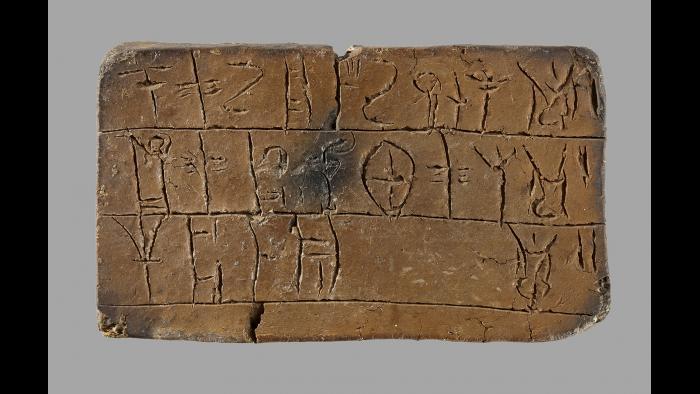
So. In some ways the model at Pylos is what I expected. This is sweat-shop industry; women and underaged children in groups of ten to thirty under a handful of supervisors work at one single element of textile production (usually spinning or weaving). For a stipend of grain and figs.
The older children are recorded as being trained in to the job. Or, if they are male, sent out to "the rowers" or other appropriately gendered tasks. There is no record of the women's names, or any economic activity except for the stipends, strongly suggesting an extremely servile status. In one of those tantalizing but telling glimpses, one tablet set appears to record how more than one group conveniently married en masse a corresponding male workgroup. Others, as I said, suggest the grown male children are separated and sent to other work. The recognized Linear B word for "slave" does not appear in these contexts but other than that...
So if my weaver protagonist was within one of these groups (as I had first imagined her) her life would be extremely circumscribed. It is unclear how a worker would ever advance from this drudge work, for instance.

The Knossos tablets, which although more numerous are also heavily damaged and thus harder to draw conclusions from, seem to record a very different world. Rations are not listed in any tablet series known to exist; instead, quotas are given. Analysis of the quotas suggest a given year's production could be achieved in as little as three months; this, and other details, strongly suggest a corveé labor system.
These are mixed groups. The meticulous documentation of children by age and gender in the Pylos tablets is absent; the presence of children could be inferred but the work group is essentially treated as a whole, under a single personal name who can be assumed to be the manager. The groups appear to be agile, assigned to different tasks as needed, and also as against the assembly line style of the Pylos work a single workgroup is capable of processing an entire garment from raw wool to finished cloak.
So these are obviously a better match for my character. But they are also not an isolated group of weavers ensconced in the palace; they appear to be, in fact, a group selected from the surrounding community, who spend the rest of their year working their own farms and whose social circumstances are otherwise ordinary.
There is suggestion of a live-in palace staff on some tablets, but Olsen makes convincing argument that the textile workers stationed at the palace (well, at Pylos, at least) are basically taking care of the domestic needs. They are not creating material for export.
But then, there is a lot of discussion in the field about whether export is the primary, or even an important, purpose of the centrally controlled textile industry. It is just as reasonably the utilitarian needs of a state, and the expensive luxury goods that sometimes find themselves traded to far-away countries are produced in independent...well, call them Merchant Houses.

Why all the bother about this?
See, I'm not writing about free agents, about people who can trod the empires of the LBA into the dust beneath their sandals (well, at least not at first). The details of the "Weavers Hall" are not a paragraph of background before the characters set out from their Bronze Age Shire on an epic journey. They are the story (for at least a good part of this novel.
Funny. My last novel was also very much about a strongly hierarchal society and, although my protagonist was technically a free agent (granted power she didn't want) she had already internalized her society, its structure and values. Her hardest fight was not any of the external enemies (and there were many) but trying to resolve within her the competing expectations, roles, and obligations.
Tuesday, August 28, 2018
I am my own programming language
Half way through the massive book of analysis of some of the Linear B archives. Bunch of other papers to read, prime among them an argument that depictions in The Odyssey can illuminate coastal raiders in the LBA, in particular those by the Sherdana.
I think I'm kicking my timeline back. The subject is both more complex and more contentious but basically the wave of destructions (for which, in an earlier age, the Sea People were often blamed) occur around the middle of the 13th century. This is apparently when the records at Pylos were baked in the destructive fires. It is also closer to the most likely historical analogs of the Trojan War.
Actually, I've got a pet theory. Just as I'm borrowing some names from the Pylos archives and moving them to Knossos, I think Homer may have borrowed Alexandros and Piyamarados (err...Priam) from the Hittite records, displacing them in time and changing some details to make a better story.
(The final wave which sweeps down along the coast and dashes itself against Egyptian shores is roughly 1190 too 1170 BCE, or some fifty years later).
I think I want to start after the Battle of Kadesh, and preferably after the death of Rameses II, but if I were to bracket my choices now I'd say the latest date I'd pick to start the story would be the year Rameses III comes to the throne. (There's two or three Pharaohs in the middle there, BTW. We don't get into the endless Rameses' until later in the Ramesid era).
A big reason is that I'm understanding the changes that happen in the Easter Mediterranean better. By the time Ugarit is sacked there's very little in the way of functional governments anywhere and sea trade has essentially collapsed. I want to tell a story of the storm, and of the coming storm, not of the debris field left after the storm.
I'm also backing away from the slippery slope of modern conception. I really do like the idea of people feeling they are living at the end of the world, and there are ways this is supportable, but they wouldn't and shouldn't construct it as the "Late Bronze Age Collapse" and they certainly won't construct the causes the way we do. Not to call it a simpler time -- it isn't, no time is simpler, just different -- but just as later historians came up with facile explanations that fit the preoccupations of their time, the locals should construct causes that fit their view of the world.
I'm still in a huge ball of fuzz about the relationship between the Mycenae, the Acheans (or whoever actually fought at Wilusa/Troy), the Sea Peoples, the Minoans, the eteocretans/pelasgians, the Dorians v. Ionians/Attic, etc. And folding all that in with whatever is happening on Crete, between the Palace, a Peasant's Revolt, and the Black Ships. Who represents or is connected to what? There are so many potential links, subtle as they are, but no single coherent pattern is coming out of it.
It has been suggested, for instance, that the Dorians are essentially the lower classes and military conscripts, who after central collapse moved out as a colonizing/invading force. Except the language map largely works in the wrong directions and paints in the wrong places. Similar for any connections between named Sea Peoples and any of the Mycenae locations; they sort of work, but then there's a counter-fact to blow it up again.
I'm willing to believe at this point that the evidence is thin enough that you could make convincing argument for just about anything. If that is so, though, I still have a big problem; I haven't decided what I want to be saying, and what kind of patterns best supports the story logically and dramatically.
All I'm sure of is I'm against the obvious; peaceful Minoans over-run by warlike Mycenae, and rising up to throw off their yoke. Or coalition of Mycenae try to take over a vassal state of the weakening Hittite Empire but end up destroying it. Of course in rejecting what appears to be trite I may be forcing my plot to reach for strained but equally trite alternatives.
And another thing. I've realized there's no-one in my cast who really lives and believes the Homeric Ethos. The situation on Crete is almost in terms of how it contrasts with the society of the mainland, and in any case is told from the point of view of people far down enough in the social scale they aren't forced to grapple with honor the same way Achilles did.
So, sure. I could go back to giving my Athenian-born mercenary more of a story, and let him have a character arc in which he understands, even embraces the code before abandoning it.
However. The whole Achilles in his tent business makes me think of chivalry; specifically, how the epic poems going on and on about knights-errant and courtly love were essentially written in the gunpowder era; long after those modes of behavior could be called descriptive. And, yes, we are well aware Homer was writing in a Greece that was coming out of the Greek Dark Ages, an iron-age world far from the world his poems described. Point I'm making is there's no reason to assume the elaborate Homeric codes of honor are reflective of actual LBA society.
I think Homer gives insight into how things work when it is boiled down to small warrior bands without a unified government. And there are elements that last through into classical society; but again one must be careful, as The Iliad became functionally a bible for the Classical Greeks; it is difficult to untangle where some cultural habit is carried over from history and where it is consciously adopted.
In any case, it amplifies again for me what I want to do with this book. Homer has been done...first by Homer and that's a hard bar to clear. Actual historical Mycenaean society is less explored.
And for all the questions I'm struggling to answer, all the subtle details about how to date the multiple Knossos archives (there appears to have been more than one fire) on so forth, I have to write for an audience who is lucky to have even heard of the Sea People or the LBA Collapse.
I think I'm kicking my timeline back. The subject is both more complex and more contentious but basically the wave of destructions (for which, in an earlier age, the Sea People were often blamed) occur around the middle of the 13th century. This is apparently when the records at Pylos were baked in the destructive fires. It is also closer to the most likely historical analogs of the Trojan War.
Actually, I've got a pet theory. Just as I'm borrowing some names from the Pylos archives and moving them to Knossos, I think Homer may have borrowed Alexandros and Piyamarados (err...Priam) from the Hittite records, displacing them in time and changing some details to make a better story.
(The final wave which sweeps down along the coast and dashes itself against Egyptian shores is roughly 1190 too 1170 BCE, or some fifty years later).
I think I want to start after the Battle of Kadesh, and preferably after the death of Rameses II, but if I were to bracket my choices now I'd say the latest date I'd pick to start the story would be the year Rameses III comes to the throne. (There's two or three Pharaohs in the middle there, BTW. We don't get into the endless Rameses' until later in the Ramesid era).
A big reason is that I'm understanding the changes that happen in the Easter Mediterranean better. By the time Ugarit is sacked there's very little in the way of functional governments anywhere and sea trade has essentially collapsed. I want to tell a story of the storm, and of the coming storm, not of the debris field left after the storm.
I'm also backing away from the slippery slope of modern conception. I really do like the idea of people feeling they are living at the end of the world, and there are ways this is supportable, but they wouldn't and shouldn't construct it as the "Late Bronze Age Collapse" and they certainly won't construct the causes the way we do. Not to call it a simpler time -- it isn't, no time is simpler, just different -- but just as later historians came up with facile explanations that fit the preoccupations of their time, the locals should construct causes that fit their view of the world.
I'm still in a huge ball of fuzz about the relationship between the Mycenae, the Acheans (or whoever actually fought at Wilusa/Troy), the Sea Peoples, the Minoans, the eteocretans/pelasgians, the Dorians v. Ionians/Attic, etc. And folding all that in with whatever is happening on Crete, between the Palace, a Peasant's Revolt, and the Black Ships. Who represents or is connected to what? There are so many potential links, subtle as they are, but no single coherent pattern is coming out of it.
It has been suggested, for instance, that the Dorians are essentially the lower classes and military conscripts, who after central collapse moved out as a colonizing/invading force. Except the language map largely works in the wrong directions and paints in the wrong places. Similar for any connections between named Sea Peoples and any of the Mycenae locations; they sort of work, but then there's a counter-fact to blow it up again.
I'm willing to believe at this point that the evidence is thin enough that you could make convincing argument for just about anything. If that is so, though, I still have a big problem; I haven't decided what I want to be saying, and what kind of patterns best supports the story logically and dramatically.
All I'm sure of is I'm against the obvious; peaceful Minoans over-run by warlike Mycenae, and rising up to throw off their yoke. Or coalition of Mycenae try to take over a vassal state of the weakening Hittite Empire but end up destroying it. Of course in rejecting what appears to be trite I may be forcing my plot to reach for strained but equally trite alternatives.
And another thing. I've realized there's no-one in my cast who really lives and believes the Homeric Ethos. The situation on Crete is almost in terms of how it contrasts with the society of the mainland, and in any case is told from the point of view of people far down enough in the social scale they aren't forced to grapple with honor the same way Achilles did.
So, sure. I could go back to giving my Athenian-born mercenary more of a story, and let him have a character arc in which he understands, even embraces the code before abandoning it.
However. The whole Achilles in his tent business makes me think of chivalry; specifically, how the epic poems going on and on about knights-errant and courtly love were essentially written in the gunpowder era; long after those modes of behavior could be called descriptive. And, yes, we are well aware Homer was writing in a Greece that was coming out of the Greek Dark Ages, an iron-age world far from the world his poems described. Point I'm making is there's no reason to assume the elaborate Homeric codes of honor are reflective of actual LBA society.
I think Homer gives insight into how things work when it is boiled down to small warrior bands without a unified government. And there are elements that last through into classical society; but again one must be careful, as The Iliad became functionally a bible for the Classical Greeks; it is difficult to untangle where some cultural habit is carried over from history and where it is consciously adopted.
In any case, it amplifies again for me what I want to do with this book. Homer has been done...first by Homer and that's a hard bar to clear. Actual historical Mycenaean society is less explored.
And for all the questions I'm struggling to answer, all the subtle details about how to date the multiple Knossos archives (there appears to have been more than one fire) on so forth, I have to write for an audience who is lucky to have even heard of the Sea People or the LBA Collapse.
Wednesday, August 22, 2018
Bull Session

I had the idea for so long this was titled "A Tribute to Georgia O'Keefe" but, really, Picasso was classier than that.
We more-or-less know the Greek gods. They were often regional, sometimes celebrated in veiled cults, but the playwrights and the philosophers alike wrote about them. We know significantly less about the Mycenaean gods. Homer and Hesiod are describing the Archaic gods, the gods (as far as we can tell) of their own time.
Some of the same names appear on the Linear B inscriptions, but so do unfamiliar names. Some of these names (or some of their attributes) appear oddly similar to Mesopotamian gods. But Linear B is always a narrow window. It records nothing of myth or philosophy; it records only when some temple with connections to the palace gave some valuable goods in or in the name of a god.
There are also frescoes and other illustrations, statuary that seems to have no other purpose but ritualistic, and the ruins of what appear to be places of worship. All the detailed reconstruction is conjecture, and it is thinly supported indeed.
The Minoans wrote in Linear A. The best that we have of Minoan worship is that there appears to have been some continuity from their time to Mycenaean; some of the same practices seem to have continued, even though some evidence points towards the Mycenae recognizing a difference. And there are some distinct changes in practice (the most major and obvious being that the Minoans appeared to have shrines in natural settings -- mountains and caves -- and though images of this kind of worship continue in frescoes and other decoration those shrines which have been recovered by archaeology show they fell into disuse during Mycenaean times.)
So, yeah.
Poseidon appears to have been in a place of prominence. He is a chthonic figure and associated with earthquakes, but not -- until Homer and Hesiod -- with the sea per se. He seems a more rooted fertility figure but that gets very odd in the early worship as pretty much everything seems to figure in some sort of death/life cycle, fertility and animals, sort of thing.
Zeus is appearing on the scene, perhaps a new guy, and there are various myths important to his birth and early years that are placed in specific locations in Crete. A place he comes back to again and again; he drags Europa there, to what in Roman times was Gortyns. He's a bull at the time, and I'll come back to that.
There is at least something of Potnia, but this name, meaning "mistress" and generally attached to a variety of goddesses, could mean practically anything in this period. Tantalizing mention is made in some places, for instance, of a Mistress of the Winds. There is also, unsurprisingly, a fluidity of relationship; sometimes Hera is a goddess equal to and/or consort of Zeus, or perhaps Poseidon, or there is a male "Hera" in addition to her.
And there are a whole set of images of a boy god seemingly worshipping an elder/more powerful goddess; possibly the young Zeus, or possibly some completely other character. This Boy Zeus stuff in particular makes me think of the Silver Age Wonder Woman; originally Wonder Girl and Wonder Tot were presented as stories from Diana's earlier days, but then they started showing up in the same timeline and having adventures together and now nobody knows how they are actually related any more.
Gods. They can do stuff like that.
Let's not even start on the whole Minoan snake thing (except to mention that the famous "Snake Goddess" figurine is almost certainly a priestess, not the goddess being worshipped). Bulls. Snakes. Oh, and boobs. The Minoans also seem to have been into boobs -- that is to say in a ceremonial/religious context -- and yeah once again the same iconography shows up in Mycenaean art but we can't tell if they kept the religious practices (and the outfits) or just liked painting topless women. Same thing for the bull-leaping. We assume the Minoans did it. The Mycenaeans painted it. They may have even done it -- but we have no idea what religious significance (if any) they gave to it.
Of course there's bulls. Bulls figure prominently in various Mesopotamian religions as well. The Mycenae seemed as fond of them -- at least decoratively -- as the Minoans. They also kept the Labrys, although it looks a lot more like just a decoration in Mycenaean times. And they seemed to have lost the Horns of Consecration that the Minoans put on every available roofline. But we can't read too much from Mycenaean figurative art. In Mycenaean art it is more likely to find the lions and other animals hunting or being hunted. Man is in the picture now, and He usually has a sword. And they kept the sea life -- but for some reason the Mycenae were really into octopus. Like, way into octopus as a motif. I'm pretty sure octopus-leaping was never a thing, so...does it mean anything other than "cool thing to paint on walls and make into really nice pieces of gold jewelry?"
So I'm playing with some very odd ideas. I want to reference The Chalice and the Blade but as a pleasant dream, not as a past reality. For the middle part of the book I am basically doing Berkeley in the 60's. (What? I went to school there.) So a people's revolution that has all of that wonderful illusion that within their reach might be a change in consciousness, a reshaping of the very paradigms of power and control. And some of the inner struggles too, a revolution that believes it is for everyone but is not always there for all the disenfranchised. As, for instance, so many women have written in oral histories of the Peace Movement; "First we stop The Man from trampling on our rights. Then we'll get around to your issues." A story which alas is familiar to anyone in the Atheist movement today.
Or to put it in the most simplistic terms; some of the revolutionaries see their struggle as returning the power and prestige of the Minoans (and their gods). A subset among them like to think that perhaps that this age of glory had also been a matriarchy.
(And, yes, this is very much going to run into realpolitik. Among my odd ideas for the politics of the time is the weak rulership is in a Devil's bargain with the Black Ships. If the revolution actually overthrew the palace...there would be nothing to stop the raiders from cleaning up before they left for greener pastures.)
How this works with what we know or conjecture about actual worship practices is, well... Heck, I have a lot of trouble trying to work out what the people of Knossos in 1200 BCE even know about what was happening in 1450, much less in 1700. (Those being roughly, the time the Mycenaeans came to prominence in Crete and a time of widespread destruction, and the time of the Thera eruption and, similarly, widespread destruction. And rebuilding into what is likely the Minoan Golden Age.)
Among the really odd directions I'm tempted by is that the bull of so much Minoan decoration is not being worshipped, per se. It is being feared. It is The Sleeping God, a power they keep propitiated lest it rise up and destroy them. Part of my reason for this is the bull motifs and the goddess figures of the peak shrines, surrounded by animals, don't seem to have anything to do with each other. The bull just sort of appears, sus generis. Or is that os generis?
And somewhere here, also, is the possibility of a change in order. Poseidon and Zeus have changed character by Hesiod's time. Was that happening already in 1200 BCE? Was it visible to worshippers of the time? Can you describe this as one religion being supplanted by another?
Oh, yeah. And everything I know of the actual iconography and historical traces of the old forms and plausible reconstructions says no way, but I can't shake a mental image of the bull of the Labyrinth, a massive and mysterious chthonic figure whose stamping hooves shake the earth...
Subscribe to:
Comments (Atom)