Standard practice among professional bodhrán players is to wrap the rim of the instrument with black electrical tape. That pretty much tells you all you need to know about the antiquity of that practice. But then, another standard of Irish music is the penny whistle, and Robert Clark of Manchester didn't start rolling them out of tin plate until 1840. (To be fair, fipple flutes are documented far earlier than that in the isles...back through tabor pipe and flagolet and eventually to what appears to be a bone flute discovered in a neanderthal grave.)
The earliest documentation of the gue in the Shetlands is also in the mid nineteenth century. The presumed ancestor(s) are attested to no earlier than the fifteenth century. But, again, the concept of the bowed lyre goes way, way back. So it isn't terribly presumptuous to assume something like the gue or a two-string talgaharpa -- as well as a frame drum somewhat resembling the bodhrán in shape and material if not in performance practice -- was in use by the Norse of the Viking era.
Not that I care overmuch. I'm composing a piece around my new gue, and I'll use whatever instruments sound good with it.
On reflection going for a worn, found-in-the-attic look for the gue was unsatisfying. Several people have expressed disappointment that I didn't chose to sand it down fine and give it a nice glossy coat of urethane. In all honesty, I would have had to spend a lot longer building it in the first place in order for it to stand up to that kind of detailing. In any case I still took it back to the shop and gave it another coat of polish.
Basically everything worked. It is also kinda neat that I made my own strings, meaning the only parts in it that were designed by someone else as part of a musical instrument are the pegs (and I could have carved my own.) I've been messing around with tuning to various pitches and shifting the position of the bridge. There's a fairly narrow zone of pitches where they work well on the string (not too tight, not too slack) and still sound good on the sound board. Similar constraints on the bridge placement; towards the sound hole improves the melody string at the cost of unbalancing the blend with the drone, but too far stretches the scale length until the fourth finger is no longer a comfortable reach.
The biggest problems are that the strings are a little too far apart to make it comfortable to finger both simultaneously, and the heel is awkward to clamp between the legs (as is not just standard practice, but the best position I've found so far). I've also changed to a reverse grip on the bow; jouhikko practice is apparently to use the forefinger to tension the bow string but I'm disliking the groove that puts in your finger and using the thumb works better for me.
##
Cherry did not work well for me on my first experiment with making a frame drum. I had some strips of 1/16" veneer so I soaked it and applied a heat gun used for stripping paint. It didn't bend nicely. Most of my sources lean towards dry bending, but in any case the hot pipe bending tool seems clearly superior. Fortunately one can be made with as little as a tin can and a light bulb.
There also seems to be a nearly even split between negative and positive forms. I found it a pain to shove strips of wood into a hole so next time I'll try wrapping them around a disk. But, really, I've been doing too many personal projects at work and not putting enough hours on the time card. Spent eight hours in the shop this Saturday and only four of them go on the clock.
(It also seemed to wear me out to where I never quite got it together today to go out and shoot some video. I'm anxious now to shoot the footage for Uncharted Worlds so I can go and retune the instruments from that back to either standard tuning or the Dorian mode I'm thinking of for the new piece.)
I am rather wanting a smaller, higher pitched hand drum for the new piece. That's the second reason to eventually find the time to build it (the primary reason is to learn how to bend wood). Also means buying a goat skin at some point. Oh, and the standard decoration for a bodhrán after the skin is glued down is upholstery tacks and a ribbon. Which would be a natural application for my card loom. Which I have yet to learn how to use. Which also might be short of cards to make a wide enough strip. Which would be nicest if I had a laser to run a few more off to the pattern I already have. Did I mention TheShop is closed for relocation, no other information forthcoming?
And so it goes. At least in the interim I can practice the gue. The Kreisler highway is narrow indeed on that instrument, and the zone where bow speed and pressure and tension (remember, you can adjust bow tension on the fly with a taglaharpa style bow) is equally narrow. Plus of course this is a fretless instrument, meaning muscle memory alone for where all the notes are.
Showing posts with label gue. Show all posts
Showing posts with label gue. Show all posts
Sunday, March 31, 2019


Wednesday, March 27, 2019
Gue Gone

Shetland Gue is done. Most of the surprises were positive. I was going for the rustic look of the Charlie Bynum museum replica; I didn't waste a lot of time with finish sanding -- in fact I sanded back the stain to mimic weathering. Used linseed oil for the finish -- although I did do a light pass of "Finish restore" to give it a bit of shine. After three days of prep the ebonizing solution did actually work, but I didn't care for how it looked on my sample piece. That's an experiment for another day.
Rather than spend forty-plus bucks on a peg shaver I used the peg hole reamer on a block of white pine and stuffed sandpaper in the resultant tapered hole to make a simple shaper for my pre-made violin pegs. They fitted nice and tight, hold tuning, and move smoothly enough to allow me to get close to pitch so that's a win.
Despite my misgivings three loops of sisal twine plus wrapping proves plenty strong and stable. (Most gue builders follow modern jouhikko practice and use a tailpiece that can be fitted with violin fine tuners. But I liked the nautical look of Charlie's stick tailpiece. That's an actual twig from the local woods, there. The standard is a tail pin, though; the only ones I've seen with holes drilled through the body are a couple of Michael J. King's builds.)
And the strings proved much easier than I'd feared. As per guidance from a jouhikko builder I wet the hank of brown Mongolian horse hair and combed it out. Then I separated the appropriate number of individual hairs, tied a figure-eight in the end and dripped superglue on the knot to secure it. Cut a slot in the end of the violin peg with the bandsaw and it was a simple matter to drop in the new string and tension it up.
My hair count for 28 for the high string and 36 for the drone. I've prepped another string at a 60-count that I may swap in to see if I can tune lower and still get a good sound. But I'm not unhappy with the pitches I get now; scale length is 19" so, unsurprisingly, it seems to want to tune to around guitar.
The other experiment is shaving the bridge -- or carving a new one. I'd like to see if a thinner, more flexible bridge produces more volume. I did find out after gluing a bass brace to the sound board that bracing a sound board generally dampens the low-order modes, producing a stronger top and a brighter sound.
The bow is also a work in progress. I need to rosin it up before I can test to see if I like the traditional jouhikko technique of tensioning the bow with your forefinger. For testing I'm using my third-best bow (the one that shipped with the Cecilio).
The next string instrument I'll tackle will probably be a ukulele. Although I have all the parts to run off a quick solid-body uke (something I've been planning for a while), I'm intrigued by classical construction and wood bending and would like to try an acoustic.
Or I'll make a hand drum. Viking drums are basically unrecorded archaeologically, but frame drums have been found in almost every culture world-wide. I could get my feet wet...wood wet...with bending by doing a frame drum, and I could use a small drum in some of the pieces I'd like to record next.
Monday, March 25, 2019
Hair Gue
Bronchitis is finally fading. Still coughing a bit but energy is back. And only six more performances to go until the kid's show is over!
Body of the Shetland Gue is done. Stained it today, and slapped on a coat of linseed oil (or as some of the woodies call it, "BLO.") I'm trying for a bit of a rustic look for it. I was hoping that by staining it, then sanding off some of the stain and re-staining, I'd get a nice weathered look. Doesn't seem to be quite happening. Also learned of a new trick; ebonizing wood with a ferric oxide solution, which can be made by sticking steel wool in vinegar until it turns into rust then mixing that with strong tea (no, seriously). Unfortunately it takes weeks and I don't have the patience to do that this time around.
Bought some cheap violin tuning pegs. I did get a peg hole reamer, and some rosewood to mess around with hand-carving, but shaping the pegs themselves requires an additional tool that starts in the high forty bucks and is well over a hundred by the time you arrive at Stew-Mac. The pegs seem to fit nicely. I have no idea if they'll actually let me tune, though (that majority of Jouhikko/Talharpa builders use violin fine tuners in their tailpieces. Most of them use nylon strings, too -- horsehair is not exactly stable in changing humidity.)
I also wasted some time twisting sisal twine into cordage. My instinct says it still won't take the load. I know one instrument builder who got rawhide strips by cutting up a dog's chew toy (no, he didn't take it from the poor dog. He bought his own). After snapping both leather and nylon I went to steel wire on the tailpiece of my Sutton Hoo lyre. But there's a museum replica build of a Shetland Gue that has a really lovely stick-and-twine tailpiece and I wanted to try to capture that look.
Or...maybe it's sinew on that replica. And I think I have a spool of that left over from trying to fashion a tool roll for my "abo" flint knapping set.
Yeah, so this is even more an experimental instrument. I think the stresses are larger (although the actual string loading is probably less), I know the body is thinner, this is also using pegs for the first time, and has bracing on the sound board. I do at least have a few decades of experience with making things out of wood so I have some instinct for grain and splitting and how stain behaves and so on, but I've been watching a lot of videos and it is alarming how many other things builders are worrying about, from acoustics of tone wood to book-ending patterns to differential swelling in changing humidity.
I've been following several ukulele and lute builds. For as cheap and simple as a uke looks, there's a lot going on inside there. All sorts of bracing and backing and dove-tails and so on. And that's without even laminate necks and perfling and...
So the Gue may not sound good. It may even explode when I put it under tension. Which is why I'm trying not to sweat the fine polish on this one.
##
Meanwhile the novel is back in Atlantis. Atlantis is coming at me three ways. There's the student film Penny made, with her playing an Adventure Archaeologist poking around a ruin looking for clues. And there's a later conversation in which she is interesting and informed. And there is a possible later book in which she is hired (more like pressured) to find the place for real.
And finds something. Not the Atlantis either of them expect, perhaps not an Atlantis at all. So that goes into the mix, too.
So the student film needs to stand as an example of how far she has come since then, but still have some ideas that are interesting enough to explore later. And I've been toying with throwing in the Sea Peoples (because everything goes better with Sea Peoples) but they and the Bronze Age Collapse are just too far off topic for the central mystery of the novel (that is, the so-called Dorian Invasion of some 400-600 years later).
The only thing I've narrowed down is that the Minoans are a blind lead. Everyone goes to the Minoans, and everyone mentions Thera, but the Minoans weren't Atlantis and that's that.
I'm also still trying to define Penny's character, her voice, her background, her appearance. I was talking to her today, asking her how she would describe herself. She described her hair as "coarse, black." And then said, unprompted, "I hate my hair."
Um, really? That didn't even feel in character. I asked her to expand, and she said, "My friends with fine, straight hair say they'd trade anything to have my hair. I say they're full of shit." Okay...that sounded in character. Penny will snark at any excuse, and I know it is a thing for many women to be always judging themselves, holding up their own appearance to some impossible benchmark, but actually hating any part of herself...well, that just isn't her.
So, I guess that's progress. But at this point I need to see how she functions in actual story. I need to write actual scenes, not notes. Which means solving Atlantis.
Body of the Shetland Gue is done. Stained it today, and slapped on a coat of linseed oil (or as some of the woodies call it, "BLO.") I'm trying for a bit of a rustic look for it. I was hoping that by staining it, then sanding off some of the stain and re-staining, I'd get a nice weathered look. Doesn't seem to be quite happening. Also learned of a new trick; ebonizing wood with a ferric oxide solution, which can be made by sticking steel wool in vinegar until it turns into rust then mixing that with strong tea (no, seriously). Unfortunately it takes weeks and I don't have the patience to do that this time around.
Bought some cheap violin tuning pegs. I did get a peg hole reamer, and some rosewood to mess around with hand-carving, but shaping the pegs themselves requires an additional tool that starts in the high forty bucks and is well over a hundred by the time you arrive at Stew-Mac. The pegs seem to fit nicely. I have no idea if they'll actually let me tune, though (that majority of Jouhikko/Talharpa builders use violin fine tuners in their tailpieces. Most of them use nylon strings, too -- horsehair is not exactly stable in changing humidity.)
I also wasted some time twisting sisal twine into cordage. My instinct says it still won't take the load. I know one instrument builder who got rawhide strips by cutting up a dog's chew toy (no, he didn't take it from the poor dog. He bought his own). After snapping both leather and nylon I went to steel wire on the tailpiece of my Sutton Hoo lyre. But there's a museum replica build of a Shetland Gue that has a really lovely stick-and-twine tailpiece and I wanted to try to capture that look.
Or...maybe it's sinew on that replica. And I think I have a spool of that left over from trying to fashion a tool roll for my "abo" flint knapping set.
Yeah, so this is even more an experimental instrument. I think the stresses are larger (although the actual string loading is probably less), I know the body is thinner, this is also using pegs for the first time, and has bracing on the sound board. I do at least have a few decades of experience with making things out of wood so I have some instinct for grain and splitting and how stain behaves and so on, but I've been watching a lot of videos and it is alarming how many other things builders are worrying about, from acoustics of tone wood to book-ending patterns to differential swelling in changing humidity.
I've been following several ukulele and lute builds. For as cheap and simple as a uke looks, there's a lot going on inside there. All sorts of bracing and backing and dove-tails and so on. And that's without even laminate necks and perfling and...
So the Gue may not sound good. It may even explode when I put it under tension. Which is why I'm trying not to sweat the fine polish on this one.
##
Meanwhile the novel is back in Atlantis. Atlantis is coming at me three ways. There's the student film Penny made, with her playing an Adventure Archaeologist poking around a ruin looking for clues. And there's a later conversation in which she is interesting and informed. And there is a possible later book in which she is hired (more like pressured) to find the place for real.
And finds something. Not the Atlantis either of them expect, perhaps not an Atlantis at all. So that goes into the mix, too.
So the student film needs to stand as an example of how far she has come since then, but still have some ideas that are interesting enough to explore later. And I've been toying with throwing in the Sea Peoples (because everything goes better with Sea Peoples) but they and the Bronze Age Collapse are just too far off topic for the central mystery of the novel (that is, the so-called Dorian Invasion of some 400-600 years later).
The only thing I've narrowed down is that the Minoans are a blind lead. Everyone goes to the Minoans, and everyone mentions Thera, but the Minoans weren't Atlantis and that's that.
I'm also still trying to define Penny's character, her voice, her background, her appearance. I was talking to her today, asking her how she would describe herself. She described her hair as "coarse, black." And then said, unprompted, "I hate my hair."
Um, really? That didn't even feel in character. I asked her to expand, and she said, "My friends with fine, straight hair say they'd trade anything to have my hair. I say they're full of shit." Okay...that sounded in character. Penny will snark at any excuse, and I know it is a thing for many women to be always judging themselves, holding up their own appearance to some impossible benchmark, but actually hating any part of herself...well, that just isn't her.
So, I guess that's progress. But at this point I need to see how she functions in actual story. I need to write actual scenes, not notes. Which means solving Atlantis.
Saturday, March 16, 2019
So up he rose to run once more
Finally over the 'flu and in the middle of that excess of vigor that comes sometimes. So did something I've been dreaming of for a while. Literally. I have this recurring dream where I wake up well before dawn and decide to go out for a run.
It went better than I'd feared. My endurance is shit right now. Could only run a block or two before I had to drop to a walk. But after a few rounds of that I caught a glimpse of the "zone." My heart finally answered the engine-room telegraph, the bounce came into my stride, etc. I erred on the side of cautious for this first time out, of course. And I'll have to see how my legs feel two days from now. But I'm aiming to do it again. (Plus now that the rain is over, resume walking to work on alternate days).

Started building a Shetland Gue. Made the mock-up above to check dimensions. This may look crude, but it is capturing bridge placement, scale length, "action" height, string access, foot shape. I built it to be comfortable held between the legs (seated), and close to vertical, with the supporting hand on the near pillar and the bow at right angles to the string. (I've noticed in videos, though, that many players hold it far off vertical and often bow cross-wise to the strings.)
There's an intentional modification to the traditional design on this one; I opened up the access hole to allow fingering up to the first octave (I also spaced the strings to allow placing the hand between the strings...some players do this to finger the drone string in addition to the melody string).

I did more research on tonewoods, including what woods are native to Scotland, but since this is more an experiment than a fancy instrument I went with white pine once more. I'm pushing the capabilities of that wood, though; taking the back and sides down to around 1/4" (the soundboard is once again 3/16" basswood, but I'm going to experiment with a bass brace on it).
Did most of the power tool work yesterday and probably should have glued and clamped the body then, but I felt like smoothing out the chamber a little more first. But then, the horsehair (for strings) doesn't arrive until next Friday so there's plenty of time to finish the rest.

Uncharted Worlds is done. Good enough. Cut the violin part, played with the mixdown. Really, it should have been an octave down. That's a danger of working from a MIDI file. By the time I'd compared with the original recording, my instrumentation was set.
Lessons learned. I'd really like to have another piece recorded by Tuesday but I can't think of anything that's close enough. Terminator is still struggling -- I want to try the Shetland Gue on that one and see if it solves any of the problems I'm having. At least the trumpet has come along to the point where I should be able to do that part of the Hellboy cover cleanly. Latest exercise has been rolling up and down the partials as fast as I can, top to bottom and back again.
But I have two performances today, I might want to go into the shop Sunday and put a couple more hours on the timeclock, and I might be walking to work Monday...
It went better than I'd feared. My endurance is shit right now. Could only run a block or two before I had to drop to a walk. But after a few rounds of that I caught a glimpse of the "zone." My heart finally answered the engine-room telegraph, the bounce came into my stride, etc. I erred on the side of cautious for this first time out, of course. And I'll have to see how my legs feel two days from now. But I'm aiming to do it again. (Plus now that the rain is over, resume walking to work on alternate days).

Started building a Shetland Gue. Made the mock-up above to check dimensions. This may look crude, but it is capturing bridge placement, scale length, "action" height, string access, foot shape. I built it to be comfortable held between the legs (seated), and close to vertical, with the supporting hand on the near pillar and the bow at right angles to the string. (I've noticed in videos, though, that many players hold it far off vertical and often bow cross-wise to the strings.)
There's an intentional modification to the traditional design on this one; I opened up the access hole to allow fingering up to the first octave (I also spaced the strings to allow placing the hand between the strings...some players do this to finger the drone string in addition to the melody string).

I did more research on tonewoods, including what woods are native to Scotland, but since this is more an experiment than a fancy instrument I went with white pine once more. I'm pushing the capabilities of that wood, though; taking the back and sides down to around 1/4" (the soundboard is once again 3/16" basswood, but I'm going to experiment with a bass brace on it).
Did most of the power tool work yesterday and probably should have glued and clamped the body then, but I felt like smoothing out the chamber a little more first. But then, the horsehair (for strings) doesn't arrive until next Friday so there's plenty of time to finish the rest.

Uncharted Worlds is done. Good enough. Cut the violin part, played with the mixdown. Really, it should have been an octave down. That's a danger of working from a MIDI file. By the time I'd compared with the original recording, my instrumentation was set.
Lessons learned. I'd really like to have another piece recorded by Tuesday but I can't think of anything that's close enough. Terminator is still struggling -- I want to try the Shetland Gue on that one and see if it solves any of the problems I'm having. At least the trumpet has come along to the point where I should be able to do that part of the Hellboy cover cleanly. Latest exercise has been rolling up and down the partials as fast as I can, top to bottom and back again.
But I have two performances today, I might want to go into the shop Sunday and put a couple more hours on the timeclock, and I might be walking to work Monday...
Wednesday, March 13, 2019
Likely to be bitten by a Gue
I'm working on the final mixdown of Uncharted Worlds. Re-recorded the fiddle part on the steel-string JP2, using a capo for the very first time ever. (Usually I retune, but this was played way up near the 12th fret).

The violin part is not working and I may abandon it. Here's the thing; you do home composing with MIDI instruments, you tend to write for strings as if they were a synthesizer pad. So long sustained notes. Which is not exactly easy on a single violin. Certainly not at my level, where each direction change is quite audible. (It's the violin equivalent of running out of breath on a long note).
Also I suspect that it may not be possible to have a part there. The piece as written has a lot of suspect harmonies already. You don't notice because these are fast arpeggios; a maze of twisty little passages, all similar. So all those out-of-chord tones come across as passing tones. Put one of the notes in a long sustained violin passage, though, and you start to notice the bass and the soprano recorder part are in disagreement and there are minor seconds everywhere.
Still, it is something I'd like to try to conquer. If not for this piece, for another. So I'm spending practice sessions just playing single notes over and over, trying for smooth starts and silent bow changes. And, of course, work on my vibrato some more. (Recent experiment demonstrates that hand vibrato might be superior on the chin-cello. Those heavy strings and consequent heavy bow pressure are not as compatible with proper arm vibrato).

And then there's another alternative. Above is a Shetland Gue; this picture being a museum replica by Charlie Bynum. It probably came to the islands North of Scotland with the Vikings, and is strongly related to the Finnish Jouhikko, as well as the Estonian Talharpa, and is a representative of a wide-spread family of bowed lyres (among which belongs the Cretan Lira, which looks rather more violin-like but shares the lack of a fingerboard with the strings being stopped by a light touch on the side).
Unlike the similar-looking plucked lyre of which examples were found in Trondheim and in the Sutton Hoo ship burial, there exist only period descriptions of the Gue. It appears to have had two horsehair strings tuned a fourth (or fifth) apart.
So, yeah. I've ordered the proper black Mongolian horse hair, and a peg hole reamer which just showed up today, but otherwise intend for my first attempt to do a simple pine body.
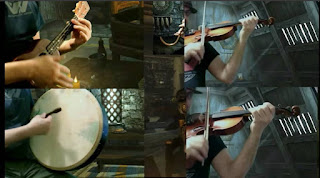
One thing I won't do right away is put the final mix up on YouTube. I'm not going to get as elaborate with the video but between weather and time and all I'd really rather be recording the next piece in the list rather than traipsing around the woods with a camera.

The violin part is not working and I may abandon it. Here's the thing; you do home composing with MIDI instruments, you tend to write for strings as if they were a synthesizer pad. So long sustained notes. Which is not exactly easy on a single violin. Certainly not at my level, where each direction change is quite audible. (It's the violin equivalent of running out of breath on a long note).
Also I suspect that it may not be possible to have a part there. The piece as written has a lot of suspect harmonies already. You don't notice because these are fast arpeggios; a maze of twisty little passages, all similar. So all those out-of-chord tones come across as passing tones. Put one of the notes in a long sustained violin passage, though, and you start to notice the bass and the soprano recorder part are in disagreement and there are minor seconds everywhere.
Still, it is something I'd like to try to conquer. If not for this piece, for another. So I'm spending practice sessions just playing single notes over and over, trying for smooth starts and silent bow changes. And, of course, work on my vibrato some more. (Recent experiment demonstrates that hand vibrato might be superior on the chin-cello. Those heavy strings and consequent heavy bow pressure are not as compatible with proper arm vibrato).

And then there's another alternative. Above is a Shetland Gue; this picture being a museum replica by Charlie Bynum. It probably came to the islands North of Scotland with the Vikings, and is strongly related to the Finnish Jouhikko, as well as the Estonian Talharpa, and is a representative of a wide-spread family of bowed lyres (among which belongs the Cretan Lira, which looks rather more violin-like but shares the lack of a fingerboard with the strings being stopped by a light touch on the side).
Unlike the similar-looking plucked lyre of which examples were found in Trondheim and in the Sutton Hoo ship burial, there exist only period descriptions of the Gue. It appears to have had two horsehair strings tuned a fourth (or fifth) apart.
So, yeah. I've ordered the proper black Mongolian horse hair, and a peg hole reamer which just showed up today, but otherwise intend for my first attempt to do a simple pine body.

Subscribe to:
Comments (Atom)