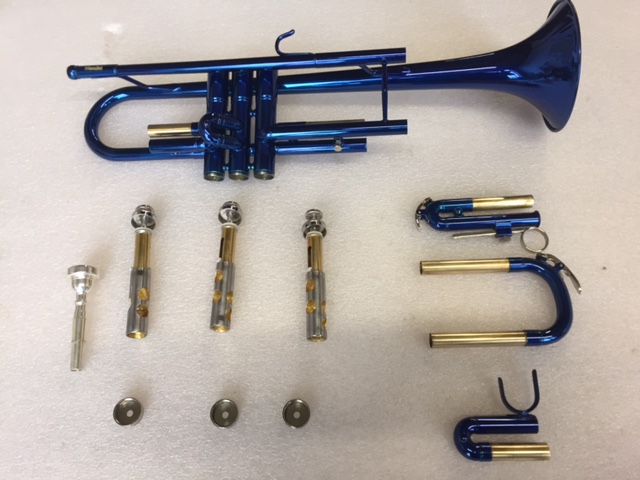
Showing posts with label trumpet. Show all posts

Saturday, August 15, 2020

Music Notes

 I am so overdue to record something new!

Trouble is, my skills keep improving, so I keep putting it off until I am "good enough." Well, that, and until I have time (and with the current plan to write the next two Athena Fox books before I stop trying to push that series...)

That practice really needs to include more reading and more ear training. So I opened the theme to Deep Space 9 on MuseScore but tried to do the trumpet part by ear instead of looking at the chart. I was getting that high note with the screamer mouthpiece, but when I checked it with the chromatic tuner, it was only a D flat. So what's going on?

Oh. My chromatic was set for Trumpet, so properly transposing, but the MuseScore track was in Orchestral pitch. So actually that part is a whole-tone lower than I thought it was. Still a high trumpet note for a non-jazz score.

Incidentally, this isn't just me making up terminology. Kelly really does call the MPC that:


And, yes, that really is a "non-whistling" string I ordered:


I put the new set of nylon strings and the aluminium E on my newly re-fitted bridge and I do like the sound. I had confidence to go through a couple of practice pieces with the mutes off.

See, this is where the chin-cello really helped me. The violin is another loud instrument and it makes terrible noises when you are still learning. This makes it too easy for someone like me to go at the strings weakly, which besides poor tone also leads to things like poor bow control, a lack of authority in string crosses, etc.

I have to hammer at that chin-cello to get it to play, especially on the C. Plus my current chin-cello is based on a solid-body electric so there's not a lot of volume either way.


Notice the extra-thick strings. And that's my carbon-fibre bow.

***

So I have the latest "that would be amusing" project in mind:


I've had versions of this thought before but I woke up with it feeling even clearer. There's a sort of rather formulaic fantasy/epic music with lots of repetitive figures and basic chord sequences that doesn't keep a composer up all night trying to work out the harmony (something that's killing me right now in, say, trying to do proper voicing on the Hellboy theme).

With random ethnic instruments, of course. Well, to some extent, I now play both basic elements of the orchestra and a smatter of ethnic instruments. And although my music theory is basically pants, I know enough to fake my way through a I to IV chord change and a minor second key change on top of it.

It is also more-or-less how I used to build music on keyboard. Question is whether I can do this with real instruments in any sort of efficient way...


Sunday, July 5, 2020

Strange Days

This weekend has been exhaustion and depression. I haven't felt up to working on the book and haven't wanted to work on the book.

Today I finally got back to it. Maybe I'll take some days off next week. We're supposed to work this weekend anyhow. We want to redo the test chamber while nobody is using it.

Made a travel mug of strong coffee with my new electric kettle. Had an apple cinnamon scone. Put on my Athena Fox mix tape. And finally got moving again.

Oh, and had a weird insight. I'm listening to one of Carlos Elene's excellent game covers as I start this. He's been working with more and more performers lately and that's all to the good, because while he plays quite competently at piano, bass, and of course his lead sax, I heard something new this time.

And that's the performance choices -- those tiny nuances of accent and phrasing -- are the same in all his instruments. And that I feel is a weakness. I can hear the same thing in SquidPhysics and I assume in other one-man-band recordists. There's a dialog between players, but there is also more richness even if they record separately, because each makes slightly different kinds of choices.

***

But back to the book. This was the scene that felt most difficult. Sure, I'm wrapping up a lot of plot lines and that is either easier or harder depending on how much has to be pulled together and how much time there is to do it.

I just could not find what it was I wanted to say. Actually saying it is easier. Well, the current draft is a total cludge but I think I have something at last.

And did I mention the problems I was having with the diary conversation had propagated back? Yeah, I'm two scenes back, because the problems in the diary scene had grown out of choices I'd made back there.

I'm not looking forward to editing this mess. Well, not the work. I can do that. But rewrites (as opposed to spell check) is a place where you can revisit the roads not taken. And for anyone like me that is a horrible place to be because I'll be back at the crossroads agonizing over the choice again, while my little horse thinks it queer that I'm not pushing on to formatting for publication.

Oh, yeah. I got nothing against self pub. I've got even less against traditional publication. But I feel I have more to learn before it is even worth approaching one.

***

My music has suffered in this time. Being stuck at home unable to practice. Lacking the energy and the time to start any new pieces. I put new strings on my lute-back ukulele and I love it (synthetic gut-and-silk strings -- very medieval sounding).

My original 7C has corrosion pits inside and no longer slots clean. I'd really transitioned to the 5C anyhow, which is more secure slotting with mutes (which I have to use for many of my practice sessions) and is probably good training for the upper register.

But I picked up a screamer to try out. Don't know exactly where it sits but probably close to a 12-something. (That's Bach numbers -- nobody agrees on the numbers otherwise, not even the direction). It leapt right up past the over-the-staff C first time I tried it. But I'm liking more and more the full warm sound of the 5C.

And speaking of full sound. The trombone is still a pain. The second partial is horrible for me. I keep blatting on it. I keep thinking of getting an Alto (plus I could use a better machine -- this one has a noisy slide, no tuning slide, and is heavy). Or even a soprano, which slots exactly like the trumpet I'm familiar with and wouldn't be splitting my training so badly. I've been listening to Seb Skelly, who uses a soprano trombone and shifts it down an octave in the mix and it sounds decent. But all that sort of thing feels like it defeats the purpose.

So best wait until I'm making more music before I set out to add more instruments to my collection!

***

And the grind continues. I'm back up to the diary scene and it is slow going. The immediacy helps. I'm still not doing quotes within quotes, though, and I think I have to. I need to hear what Linnet and Wentworth actually said to each other, not just Linnet's reporting of it.

And there is of course still so much pushed onto the shoulders of this one scene. So slow going and even though it is only two PM I already need a break.

And I put on a playlist of Bardcore and somehow managed to shove my way through the diary scene. I have no idea how much I may end up editing this. The nested quotations are nearly as annoying as I thought they would be.

I offloaded some material on to the last two diary scenes. That's fine. I've realized how this works; the dig ended last chapter and with this scene, Linnet's story moves into larger prominence. I could even say that while the center part of the story is Penny spending her days in the Nine Elms Shelter and going on adventures with Graham evenings and weekends, it is now Linnet spending her nights in the shelter and Penny's adventures have become more serious.

Graham gets one more chapter. I'm still far from happy how I dealt with the complexities of their relationship, but it will have to do until I am ready for rewrites. And beta readers. I really need to score some beta readers. I'm making more these days, though. So I could actually go to the ones who charge for it.

Friday, June 12, 2020

Not many people can pull off a decorative vegetable

It was probably a mistake to read so many things from UK authors while I was working on this novel.

Well, it isn't like I read most of what was on my want list. I just turned down a diary by a woman who worked at a lathe building parts for airplanes. During the war, that is. And there's another one which is mostly about the East End but still (from the sample chapters at least) all sorts of amazing things about being urban working poor during the war.

(And no, I didn't finish either of my archaeology books, either. Although I did read cover to cover a book about CRM planning. It wasn't actually much of a help but it was cheap.)

UK writers love being obscure. I was just reading a comment on Cockney Rhyming Slang that explained how the greatest art was coming up with one the listener had to strain to get. There's no street cred in using the slang everybody knows already.

And, well, using Ben Aaronovitch's books as an example isn't completely fair. He is writing for a post-Google audience. I think he completely expects you to notice when he is making a pop culture reference and, if you don't know it, type it into a search engine then and there. (Especially for ebooks as you can do that within Kindle Reader).

Example; when he's mentioned that some of the "Falcon-Aware" (as in, they know that magic exists) street cops have started joking about putting garlic buds in their lapels, "Seawoll suggested celery but I was the only one who got it."

So he's told you right off that celery in the lapel is a pop-culture reference and it is an obscure one, too. Oh and Ben used to write for Doctor Who.

***

I think I mentioned somewhere else that one of the things going on in these books is learning language and having fun with language. So Penny is picking up various sorts of UK usage and slang. But whereas the first book was largely blow-by-blow, covering every waking instant, this one crosses several weeks and there is quite a lot of "three days later..." in it.

So there's an entire scene where someone explains what "pants" means in British English. But within a scene or two either way Penny is referring to a cell phone as a "mobile" in the narration.

I'm really everywhere with the narration, anyhow. She's mostly using the American terminology and I've gone out of my way to assert it in a couple of places -- she describes Graham's place as a row house with entrances on the first floor, for instance. But various bits of correct (aka UK usage) language sneak in over time and most of them aren't explained to the reader except in context.

***

I have a scrap of graph paper where I jotted down the numbers from a couple of podcasters who believe in more structured plotting. It isn't quite Save the Cat level, but it is very much, "The first plot point must occur at 22% of the length of the book..."

Well, a quick stroll through the page counts and I'm coming within a few percent so far. And that's without having nailed down things with a heavily structured outline. Just instinct for how long to run a chapter and when something needed to happen. That's good to find.

***

Took a day and a half off work. Was so tired I ordered dinner so I'd have to stay awake (and hopefully get some writing done) while I waiter while I waited for it to arrive. Well, delivery was quick. The food arrived in under an hour and I was in bed in another. Slept twelve hours, and still was dragging today.

But I also got some four hundred words done that night, and another four hundred in the morning. Perhaps I've finally hit the place where it will start to go quickly.

Of course I'm plowing through another crazy conversation right now. The outline is, "Things become increasingly uncomfortable between Graham and Penny." (There's a blow-up scheduled in another couple of chapters). So subtext happening during a conversation. And what's the conversation? Why, about how the war changed society. Yeah, there's a few things there I have to look up as I go.

***

Stayed late today to have some peace and quite to practice brass. The trombone is now...functional. I can more-or-less get through a tune on it. I'd like to work the higher, sweeter register more but, really, I picked it up for the low end and all in all I like the trumpet better. The trombone lip is just too big and blubbery and the slide isn't as satisfying as tapping those trumpet valves.

So I pulled out the trumpet and my lip is still mostly there. Blew the cleanest, nicest-sounding (aka bright, sweet, brassy tone) "Slag Morning" (aka Pazu's trumpet tune from Laputa). But I've just barely got the C above the staff. I have lost a little lip in the reduced practice hours.

Oh and yes "Masterpiece Theatre" is next in my practice rotation and the damn thing starts on the second C. With a trill that's either on the top of the staff or just above it.

Plus I built a helmet. But that's another post.


Thursday, August 29, 2019

Badger of War

It might be smart to be already working up the next novel. Don't want to fall into a year-long slump wandering around wondering what idea is really, truly best.

The next novel might be smart to be either return to my Late Bronze Age historical, or to plan whatever it is Athena Fox will get up to next (Roman Britain. Shakespeare will be quoted and slings will be used. Other than that I really don't know).

Of course I'm not smart so I'm starting to think about what the preliminary research stack looks like for "Badgers" -- the file name for my Transhumanist Urban Fantasy Mil-SF Love Triangle.

With horror stuff. And that's the first question to ask. How does that connect? It has to be more than borrowed names and cliches, like the "glue some gears on it" disparaging description of some Steampunk.

Thing is, I think some of the tropes of horror -- even specific ideas within the horror landscape, like the walking dead -- have something to say about both the underlying questions of a Military SF story, and of a Transhumanist world. Many forms of horror have a relation to the Uncanny Valley where something is almost but not quite human. "If it tries to look like human but isn't you reach for your dagger" -- says the English-speaking, bipedal beaver holding his cuppa and tea scone. C.S. Lewis was never one for consistency.

Between the Undead and the cryogenically frozen is not that big a gap. No gap at all exists between a werwolf and the creatures of Doctor Moreau. Really, moving into the space of being "not entirely human" is almost literally what transhumanism means.

Yeah, about that. The only thing I can say for certain at this point is that if there's anything resembling a Singularity, the POV characters are still on this side of it.

Anyhow. I think the best place to start is probably Jason Covalito's books. Which I have at least two already in my library. He talks about the intersection between classic horror and modern pseudo-history, and I'm sure there is something there to get me started.

+ + +

Meanwhile I still have to practice trumpet at work. It is all about the open horn right now; cleaning up my slotting and working on my tone. Not even worth learning any new tunes, or getting back to sight-reading. Just twenty to thirty minutes a day of playing intervals. Sigh.

Sunday, August 18, 2019

Music not dead

Just don't have any time, between writing and recovering and a crazy project at work.

Took the Shetland Gue into the shop, sanded it down, re-stained, gave it a glossier coat of polyurethane. I'm still lousy at staining and finishing but it didn't come out so bad. Looks like tuning the strings to A and C is the key (ahem) to playing the Game of Thrones theme, but it is still a bad stretch to that top note. Need practice time before I try to record.

Balked at bidding on a horn I wish I had gone for. Soprano trombone, but not one of those ultra-cheap ones: a used Jupiter in mint condition with mpc and case. Closed at about the same price as those Chinese jobs. I have this crazy dream now of three Bb instruments -- so the slotting is nominally the same (err, except the French Horn starts at the second octave so actually no) -- and all are portable and I can pitch shift them electronically to seat them. But...I adjust pretty quickly to different ranges in the woodwinds and when you shrink the dimensions like that the sonic qualities really do start to collapse as well. The piccolo French Horn basically sounds like a flugelhorn. A really out-of-tune flugelhorn.

Really, a better use of my money would be to start the rent-to-own on a used student-level trumpet. (My local store only has an Eastman at the moment, which doesn't exactly inspire me.)

Changed pegs so my lute-back ukulele is now hanging by my desk for those "practice for a few minutes while a file downloads" moments. So I'm getting a bit more time on it.

Went to the shop last night. I needed to look at the paperwork for the crazy project because dimensions are going out Monday but anyhow. The main chance I get these days to blow into an open horn, and thus really listen to my tone. Well, tone was not what I worked on. My slotting is still not firm, especially when making larger jumps. Practicing scales (actually, scale) is cheating; you can work your lip bit by bit and not have to make a dead leap to the next note.

Apparently French Horns are so bad with this even an orchestral player on a professional-level horn will miss their opening. And unlike the Perlman quote, it is really hard to correct that before anyone else hears.

Oh, and I can hit the E above the staff once or twice in a practice session. Working on stabilizing the C above the staff before I really go crazy up there.

Sunday, February 24, 2019

A Mighty Wind

Was working on the trumpet today and realized I'd been cheating the lower notes by over-tonguing. That is, I'm not hitting those slots fast and clean and I was hiding that failing by playing very staccato.

I'm also still having a lot of trouble slipping the lip coming back down from the High C. So as usual, a lot of the practice session is very mechanical. Scales and worse.

That's how it goes; steadily smaller incremental improvements, meaning more practice time for less perceived gain. Which is a good reason why I find it more exciting to learn a new instrument than to continue improving on one that I own. I'd really like to learn another brass instrument -- especially since brass translates, meaning much of what I've learned on trumpet could be applied to, say, French Horn.

Against that is the thought of what might actually be useful in the task of getting some more music completed. I'm still playing with the idea of "bardic covers"; of using generally Early Music/folk instruments to cover a variety of game and movie themes.

The real fun of this is the challenge of using idiomatic writing and performance techniques of the instruments; renaissance recorder consort voicings, Irish bodhran licks and penny whistle ornaments, fiddle double-stops, and so forth.

And, yes, that's a hell of a lot to learn. Especially at the composing end, especially for someone who really doesn't know that much theory.

On the upside, the way the Terminator and Hellboy covers have been staggering shows me that stuff with a lot more rhythmic content is going to go a lot better. And if I can get over the hump of understanding the jig form, then I'll have a template to create and record (within the limitations of that style) with a great deal more comfort.

(Hellboy is a weird meter I still haven't quite figured out. Recording the bass part has been a pain in the butt as I keep jumping the thirds and slewing the syncopation. Terminator has a simpler meter but the original was dense pad-like synth sounds and that means the translation ends up with slow, legato, extremely exposed lines...lines where every bow crossing or intonation error leaps out in the listening.)

I've been listening to a lot of PPF and other YouTube multi-instrumentalists and I've come to a more nuanced position on digital trickery. Which is simply that I'm not about authenticity. I'm about expression. Sure, some people get bragging rights because they could perform the whole thing live. I'm just as happy if I can get it right once in a hundred tries and put that one on tape. I'm completely find with adjusting EQ, compressing, doing all the usual audio mixer tricks, but also doing pitch correction and effects (octave shifting, flanging, chorusing, distortion) as necessary.

(Speaking of which, I have a weird scheme in mind to improve the sound of electric cello. Which is to take the recorded performance, shift it up a couple octaves, play it back through a contact microphone attached to an acoustic violin, record that, combine the recording with inverted copy to remove the original signal and save only the body resonances, re-pitch that, and add it to taste back to the original recording.)

So, yeah. The smart thing to do now is to keep practicing at the instruments I have, keep working on arrangements with them, and prioritize pieces that fall within my existing skills (like Uncharted Worlds, which doesn't require any techniques I don't already more-or-less have, and should be possible within my existing instrument collection.)


Arrangement-wise, the new Terminator idea seems to be working in the MIDI mock-up. I'd really love to do a cover of the Relic Hunter theme. And there's a couple other Mass Effect pieces that are quite similar to Uncharted Worlds in instrumentation/technique needs. One being the first Citadel underscore. Another being...Vigil. Which really, really cries out for the melodic line to be played on a Turkish Ney...

Friday, February 22, 2019

3x3x2

I started trumpet practice today running up and down the slots. And something changed. Hit the high C and just kept going...every note fell right into place, nice and clear, as I continued up the scale. I think I hit the Double C before my lip finally gave. Didn't get back nearly as high the rest of the practice session -- but at the end of the day can still go to the E without too much trouble. (Now the big issue is working my lip back down smoothly from the high range).


Still, learning a new instrument is vastly more exciting than continuing to practice at one I can already sort-of play. I have much work to do on everything I own but my wandering eye falls on so many new toys...

Okay, and there's also upgrades to what I already have. A decent ukulele. A proper student-model trumpet. A real sax. On the flip side, though, I have a small apartment and have difficulty finding places to practice the louder instruments. For all that and more I kinda like specializing in the small and quirky; U-bass and Venova instead of bass guitar and saxophone, for instance.


Or piccolo french horn. These play in Bb, same as a trumpet. The sound is sort of a weird hybrid between french horn and flugelhorn, they aren't terribly in tune with themselves and are a pain to play. But they are cute...

So that makes roughly three instruments that I'm really wanting to buy right now that all fall into about the $300 range. And I'm going to try to hold off until I've paid off the Grecian vacation. I still don't know what a Grecian Urns but I'm losing a lot of work hours over the kid's show I'm in the middle of mixing now.

Thursday, January 31, 2019

Loquacious of Borg

No research, hah.

Doing a modern Indiana Jones gives you the worst of two worlds. You have to research the historical side as if you were doing a historical novel. And you have to research the modern world -- a multi-nation jaunt across the modern world and into awkward corners of it -- to try to avoid committing the "primitive natives and colorful spectacle" sin.

(It's a worse problem than, say, sending a character to Venice to discover life and love. Because your adventure archaeologist needs to go to places that are inherently dangerous -- conflict areas, disaster areas, resource-limited areas -- and there is controversy and recrimination swirling around these places and you really need to be sure of your facts.)

##

Not that it matters so much at the moment. I'm stalling and the words are lying lifeless on the page. Odd. I haven't had that for a while. Maybe the character hasn't gelled, maybe the voice isn't working, maybe it is just the plot has a slow start. But I really can't remember the last time I started a story and the words just sat there.

A good text is like a pop-up book. You start reading and fully dimensional phantoms arise from the page. This one is still sitting flat.

##

I'm also taking a step backwards on the trumpet. Glad I got the new mouthpiece. I was aware of the problem of jamming the trumpet back against your lips to hit the higher notes. Turns out there's a subtler form, which is forcing your lips up against the top edge of the mouthpiece. The 5C I'm practicing with is roomier and it makes the trick more obvious (and less effective).

So I'm back to long tones, trumpet laid flat on my palm to resist the urge to apply pressure to it. So I'm still not clean through the first two octaves up to the High C. And I'm having to put off working on tone. And working on reading from sheet music (a necessary approach as trying to memorize valve patterns for a song is not a good way to proceed).

And that means all the music I'm working on is on hold as well. I did pop the trumpet session from a few weeks back into Reaper but...not only isn't the trumpet ready, on coming back to it the bass isn't ready, either. I think that piece needs to go on back burner.

Really, the galaxy map song is a better match for my current skill as it is basically notes...no technical flourishes, no expressive lines, just stacks of ostinato/arpeggio-like figures.

Oh, except I really want to use the Baroquele for that and I am still paying off my Grecian vacation so haven't the cash to spare for that instrument.

Thursday, January 10, 2019

Information Extraction from a Hamming Oracle


1,900 words now. The first draft of Scene One that actually works for me. Stuck a lot of stuff in there that was supposed to be in the next scene, though, so that may come up a bit short.

Finished reading The Medici Conspiracy, Antiquities, Not all Dead White Men, and gotten up to the point in The Odyssey where all the massacre starts. Reading Indiana Jones in History now; more stuff about the context of archaeological artifacts and the antiquities trade. Browsing sample chapters for good books about the Roman presence in Germany and about the Ottoman occupation of Greece. And, yes, Tacitus is on the list for the former. Also been watching a lot of videos about all the stuff I missed when I was in Athens.

The third C is secure enough now I'm trying to push past it. Relatively comfortable going to D and E but I can only stay stable on them for a short time before my lip loses precision. The slots are way too close together up there. 

One of these days I should really practice all the other scales. But I want to move to sheet music first. It's sort of like the difference between early written languages and an alphabet. Right now when I learn a tune I have to learn the muscle memory for every note in sequence. Instead I should learn the alphabet, the muscle memory that goes with each of the notes the trumpet can reach. It's faster and more repeatable that way.


And it's less than six weeks before I have to go run board again. That's likely to suck up some time.

Sunday, December 16, 2018

Adrift on the High C's

I've got the second-octave C (the one that falls above the treble stave and is the highest note for which fingering is usually given in standard trumpet instructional materials.) But it isn't secure yet.

At least I'm getting practice in, even if it is only thirty minutes a day. I keep thinking of new songs I'd like to try recording, but actually putting tracks down is all but stalled out (I do have another take at the lead trumpet for the Hellboy cover, but I haven't even stuffed it into Reaper.)


In writing, I had to tussle through a nasty Dorian problem, but solving it also gave me some idea how to make up the missing page count. Basically, my character is going back to Athens and this time engages more deeply not just with the history/archaeology (aka, does a lot of museum hopping) but also with cultural context.

This is also what I think of as "second week" tourist stuff. The first week you spend in a new place is all, "I have to climb the Eiffel Tower! I have to visit d'Orsay!" You are basically in full tourist mode. In the second week you've sort of figured out where things are and how to get around and talk to people and you have time to sit in front of a patisserie in Montmarte, drink coffee and people-watch.

Or, putting it another way, the second week is when you do laundry. You are still an outsider, of course. You are still a tourist. But there's a different engagement with the place. This is one of the bigger downsides of the If It's Tuesday, This Must Be Belgium problem.

It's funny. My character is going into the Acropolis Museum just as I did; not terribly informed on Classical antiquity. My excuse is I was (and to an extent still am) tightly focused on the Late Bronze Age. Hers is that she only had a week to plan.

But yes, I'm reading Donna Zuckerberg's book as well, still finishing the Medici one, and gorging on podcasts mostly from the History of Ancient Greece podcast. I still have many, many questions. German dialects. Italian railroads. YouTube monetizing. I have decided that some of the historical figures in the story are going to be fictionalized; prominent among them, a pastiche of William Luther Pierce who is more of a collector and less, err, obvious as a white supremacist.


Thing of it is, I'm shy of hours what with the holidays, a couple of winter maladies, and a special project that ended up getting me less billable hours than I gave up to do it. At least I got a new digital caliper out of it. I'm not even quite making the time to get the writing and the music done, not at the speed I'd like, but I am starting to think I should be making use of my TheShop membership while I'm still paying for it, and cranking some props out to bring a couple bucks back in and pay off the credit card debt of my own Athens stay.


Friday, October 5, 2018

Coming to blows

Spent a whole practice session doing nothing but playing the same note over and over. With a tuner in front of me.

And it worked. Felt an immediate improvement. Seems that the burbling I'd been getting was me hitting the edge of the slot. Once I was focused on the pitch center, I could also start playing with tone; I'm finding the shifts in mouth shape and tongue position that give a darker, softer tone, or a more focused, brighter tone.

Oh, yeah. And like with the violin, when you hit the pitch center dead on there's a sympathetic resonance you can hear and feel.


But it's silly to wait until I'm "good enough" to record parts, because I'll never be satisfied. I'll learn more, and have more fun doing it, if I record now.

Above is a proof-of-concept draft: I recorded the horn part "wild"; over a portable mic, in the woodshop, without even a metronome. Once I put it in the working file I immediately realized the straight-up bass didn't work; what blended was the fake upright technique (thumb pluck and damping the strings near the bridge with the heel of the plucking hand).

And I had a bad moment when the piano didn't work at all. And I'd already tried organ and even guitar. But electric piano -- especially when I shifted from brushed snare to a brush hi-hat figure -- made a blend I liked.

So now I can work on solving the rest of the arrangement. And continue rehearsing the parts (the bass needs the most practice).


Picture from Ukulele Underground

The Hellboy cover is a very different direction. It is pushing instruments I don't know yet how to blend properly, or how to play properly. I want to get back to the "Bardic Covers" (game and movie themes done with Early instruments). Of course the direction I want to go there is a lot more authentic Early Music voicings, and there's a lot of theory to learn there as well. Plus my guitar--err, ukulele-- playing is really not up for the kind of parts I hear in my mind.

And stop with the instrument longings. More or less. I can justify the instrument above as my latest wish because my old uke just isn't up for what I'm demanding of it.

But as I've been thinking ahead towards the most likely next cover (the "Galaxy Map" backing track from Mass Effect) I can't help but notice there are multiple lines on different plucked or pitched percussion instruments. And wouldn't it be great to have a baby harp for this? Or...if for no other reason than harps are hard to play and building a lyre would be fun...

A "Sutton Hoo" style lyre.


Wednesday, September 26, 2018

Pushing peanuts up Pike's Peak

That's progress: I've reached a point where I can't play any of the parts in the piece I'm trying to record.


That is to say, I can't play them the way I now want to. Welcome to the uncomfortable intersection between expressiveness, artistic intent, technical proficiency, and standard practice.

I wish I had a better term for "Standard Practice." Almost all instrumental practice has a school-trained version. It may be recent, it may take place out of the classroom, but it is there. There are accepted, known ways to do things for every instrument out there and lots of people who will advise you learn to do it that way.

And I don't disagree. For starters, there's idiom. I was just reading a blog post from a cornet player who is learning the shofar (Hebrew ritual rams-horn trumpet). The mouthpiece is small and painful to use. So...change it? The sacred tradition says don't do it. So that's standard practice. Or, in this case, a liturgical tradition. But, hey, if you change that mouthpiece...it doesn't sound like a shofar anymore. So that's idiom.

And that's the point for me. Sounds can come from anything and if it meets your musical needs to pound on the side of a saxophone with a ball-peen hammer then so be it. But if you are coming to that instrument with the desire of a sax riff, well then, you need to play it like a sax is usually played. You need to learn standard practice.

The instruments of the symphony have their long traditions. Instruments like electric guitar are often learned by ear, self-taught. But even then there were players that were respected, a repertoire that was known and quoted, approaches to plucking and fretting that could be gleaned from interviews and videos and discussions long before School of Rock and video lessons and friendly YouTubers showed on the scene. The vibe is different, but the idea is the same; there's a Standard Practice and the beginner is strongly advised to learn it.

And that's the other side of it. Standard Practice got there because it works. There are unique ways of approaching every instrument, and players who have applied them to great success (the story is Harpo Marx fired his classically-trained harp teacher because the teacher kept wanting to learn from the (self-taught) Harpo). In any case, these are approaches that have been hammered out over decades and work for most people.

And yeah -- there is such a thing as outsider art, but the idea that learning the standard way will somehow stifle your creativity and cut off your chance of developing a unique voice is nonsense. Especially since very few of us are really in a place where we want to be totally unique and individual. We want to be in a place where we can speak to an existing audience with existing tastes, and where we can find work among people who speak the language of and expect a proficiency in the standards. Branching off from a position of knowledge is vastly superior to fumbling around trying to discover what has in most cases already been discovered.


All that said, some of us aren't on the Julliard path. Some are making music in our spare time, not in all of our waking hours. And for that the Hacker mentality is worth considering. I'm Theatre, myself, but Theatre, Maker, and Hacker share an emphasis on efficiency. Theatre people will use anything that's cheap and fast as long as it looks good from forty feet away. Hackers will never waste time inventing a wheel when there's a perfectly good wheel.lib for C++. And Makers will leverage new technologies in search of a better, faster....or, to be perfectly honest, more amusing...way to get it done.

And yes that's my general aim as a musician. I'm never going to be great at any instrument, or music in general. I'm unlikely to even be good. I'm too fascinated by the total picture to want to spend all my time polishing my chops on a single instrument, no matter how versatile it is. So my goal is to find every shortcut possible, find ways to get the energy and verite of a real instrument in as little time and money as possible and put it into a recording.

And the piece I'm working on now is where those two ideas collide. I'm trying to write idiomatically; I'm writing not just for the sounds of bass, trumpet, and piano, but something that sounds like it would be played by bass, trumpet, and piano. So it isn't a bass sound. It isn't even a physical instrument making a bass sound. It is an instrumental line using the style and techniques of an (upright) bass.

The trumpet line comes closer to being something I can cheat. The aim -- the idiom -- is a vocal, raspy, dirty sound with a lot of english, a lot of slurs, plunger work and growling and so on. To some extent, the overall artistic intent is achieved regardless of what control I have or don't have over the nuances. (Basically, I can miss a lot of notes and it will probably come across that I intended it that way.)

But only mostly. It can be as dirty as I'd like but to sound like an actual horn part played by a real (experienced) player I also have to -- sometimes -- hit the pitches. Get a clean tone. Be in time. Which is to say, I can fake it 90% of the time but I have to have the technical proficiency to get it right at least some of the time.

And now the piano part is in a similar place. I originally was going to comp some chords, or noodle around doing the kind of improv I used to do back at the common room in the dorms. But the higher artistic goal asks a recognizable style to the piano part -- I'm currently thinking Gospel -- and that takes chops I don't currently have. I can, just barely, write the parts, but I can't get my hands to perform them.


So in the sense that Standard Practice is a good tool to have, this is a good piece for me to be working on. I've reached a point in harmonic development where I'm using chord shorthand instead of dots on a line. I'm back to basics and doing exercises on bass and trumpet.

But I still wish I was recording. Other obligations are crowding up fast and it's getting hard to find that hour of instrument practice every day.

Wednesday, September 19, 2018

Frog in a well

The books do warn about developing bad habits. I disagree, though, that they take as long to unlearn as they do to learn.

My experiments with less pressure, soft blowing, and other changes to my embouchure that permitted falls and slurs meant I basically lost my old embouchure. But that's okay; it wasn't right and it needed to be changed. Now I have the makings of a new embouchure and I'm practicing a lot this week to climb back to where I was before.

Well, sort of. For a few days there I couldn't play a line without burbling. Now the line is coming back, but with better tone and control, less fatigue, and more flexibility.


The bass is at a similar place. I had never practiced muting. I hadn't been walking fingers and my fretting hand was curled. But since I have so much less time on the bass (really, it is more I have a lot of time building fretting and plucking habits on other instruments) it is more a matter of learning some fundamentals of stroke and fret before I can actually practice in earnest.

Which means most of my practice time lately has not been tunes or parts. On the horn, for instance, I'm spending a significant time blowing into the mouthpiece...without the horn even connected to it.

(The image to the right is from when I cut into my Kala Ubass to change the pickup. Among the things I had to do this week was rub the strings -- original Road Toad Pahoehoe "gummi worm" strings -- with talcum powder to tack down the stick, and replace the battery. I used a LiPo from the Holocron project, which means I have the only bass in town that can only be recharged from a Jedi Holocron.)


Oh, yes. And I'm delving deeper into music theory. Let me put it this way; I'd gotten the idea into my head that a dominant seven was built on the seventh degree of a scale (it's actually a V chord with a flat 5th. More or less.) Okay, blame inconsistent shorthand in some of the material I was reading. There's a lot of places where Roman Numerals aren't used for chords; like describing a Gospel style ending cadence as a "2-5-1" (since Gospel rarely uses simple triads, preferring four fingers or more per chord, that 5 is almost inevitably a dominant 7.)

So I'm not actually slipping down any on this one. I'm just spending most of my keyboard time scribbling on staff paper and not tickling ivories...err...acrylics...

Monday, September 17, 2018

Learning to Fall

Oh great. I'm not ready to record, not at all.

Not that I can't play the parts. I can. And not that I'm a stickler for doing things "the right way." And not even because I'm a respecter of idiomatic (if you aren't going to play a line the way a bass plays it, then why aren't you saving time and bother and just doing it on keyboard in the first place?)

Point being, technique does show. And this is a piece where it shows. The bass part, for instance, is just too exposed.

And it informs me just how much of a beginner I really am that I didn't even know how important muting is on the bass. How much it is an essential part of technique. So I'm trying to learn those finger tricks because I can totally hear the difference it makes in how the part sounds.

The trumpet is at a similar crisis. I've been blowing past little warbles in my tone, calling them a lapse of concentration or something that is unlikely to spoil the final take. Except they aren't. They are signals that my slotting is insecure, and basically my embouchure is wrong. And as I'm working on that, I'm more conscious of flaws in my tone.

(What really nailed it is falling exercises; basically, bending a held note up and down my whole range with either the half-valve technique or with the mouthpiece alone, no trumpet. And I've got spots where it burbles and breaks up. Not good.)

Again, this is stuff I didn't hear when practicing. I'd hope I would have heard it when trying to do the final mixdown. I'm pretty sure my listeners would have heard it in any case. So just as well I'm catching it now.

Just means I've got weeks more learning of basic technique before I can roll tape.

Saturday, September 15, 2018

The Octave Key

I've on the edge of a breakthrough on trumpet. Was working on doits and falls, read a couple articles, ended up watching a batch of videos, and there's a whole bunch of related stuff in there.

Okay, simple stuff first. The key to the fall is the half-valve trick. I'd already learned half-valve as a way to slur between two valved notes. Well, if you hold the third valve at the right spot, you can gliss all the way up and down your range.

But the more important thing. I knew not to grind the trumpet against my lips to reach the higher pitches. I was consciously avoiding hauling back on the pinkie hook (what some wags have called the "octave key" on the trumpet for just that beginner playing fault.) But I was still pulling back, only with my support hand instead.

One of the sillier-looking exercises is to put the trumpet on a table (with a towel to protect it) and see how far up you can get without pushing it off the table. For me was better approach to continue playing as softly as possible, but being conscious of keeping the pressure as light as possible and the air flow high.

While doing this I stumbled on a nice controlled pedal tone. And that, too, is considered a good exercise; work from the pedal tone up through the slots, instead of starting with the usual "lowest note."

(Refresher here; the trumpet plays a harmonic series based on multiples of the physical length of the piping involved. The "Bb" of a Bb trumpet, usually considered the lowest open note, is actually the first harmonic of a series that starts an octave below. Or, putting it in standard nomenclature and transposing to C -- it is a transposing instrument after all -- the series goes CC, C, G, c, e, g. )

And, yeah, it worked. At the end of all this I could play longer with less fatigue and reach most of the slots with less effort. And snap between them faster as well.

(Oh, yeah. And after reading some technical stuff about adjusting mouthpieces, I tried changing the gap slightly with a bit of electrician's tape around the stem of my current 7C. It didn't hurt, and it actually feels like it may have helped.


Went to the practice room today. Looks like the pedal tone I've been discovering is with my lower lip -- also explaining the nasty sound I'm sometimes getting; it is actually a split tone, with each lip vibrating at a different pitch. The relaxation techniques have ended my left hand death-grip and made the first octave smoother and faster, but the upper range remains a difficult push.

Thursday, September 13, 2018

When Pixies Growl

Got a Humes and Berg #112 in the mail. It isn't at all the sound I expected but it is a sound I'm sure I can use. Basically, it sounds like you are growling even when you aren't growling, and it seems to make it easier to growl when you do growl.

It's almost too much, though. With the #112 and the Home Depot plunger, I've got wah-wah, plunger vibrato, lip vibrato, growl, multiphonics, flutter tongue, slurs. And it starts with a dirty tone. Of course I'm not good enough yet to do "true" growl or shakes. But that's still a surfeit of options to ornament a melodic line.

And on the supporting hand; I'm all for ornaments and articulations and variations in tonal color. That's one of the things that's attracted me to live instruments over canned sampler patches.

But at the same time it is too easy to get lost in fancy techniques and not tend to basics. I have this nagging feeling that the great plunger mute players achieved their emotional power in part because when they landed on the note, they landed dead on.

Me? I'm not terribly on pitch even without a mute. All mutes drag you off pitch, and some mutes fight you as you are trying to slot. The #112 is no exception. Covering the bell completely with a plunger only adds to the difficulty. Seems to me it is going to be a couple more weeks of rehearsal before I can record this particular piece.

Sunday, August 26, 2018

Good Vibrations

Vibrato, technically "a periodic change in pitch," is standard practice for classical violin. So much so that playing without vibrato is considered a special instruction to the musician. Traditional fiddle music and early music performance may omit the vibrato -- there is lively debate on the subject!

Violin vibrato is physically achieved by rolling the pad of the finger along the string -- towards the scroll, properly, so pitch is lowered. The performer accomplishes this roll by rotating the hand backwards at the wrist, or by moving the hand and forearm as a unit, or by a combination of the above (depending on speed, taste, depth, position on the fingerboard, and so forth).

On guitar and bass the wrist rotates in order to vary the position on the fretboard and thus change the pitch. There is another technique, however, and that is bending; the performer pushes or drags the string sideways whilst remaining on the same fret. This increases the tension thus raising the pitch. Bending is usually slower and more dramatic. Standard practice is to bend an accurate half-tone -- instructors get annoyed at students who can't consistently hit their pitch on a bend.

In singing, vibrato comes from the vocal chords but there is also a related pulsation that comes from the diaphragm. Essentially, vocal vibrato is a pitch change and has a higher periodic frequency, whilst diaphragm motion produces a slower change that is predominately volume. The two interact, giving a wide variety of tonal colors (and as well a wide variety in the ability of the singer to find and stay on their pitch, or to, as the detractors would have it, to attempt to disguise their failure.)

The recorder and tin whistle both respond to diaphragm vibrato, although it is considered non-traditional on the latter instrument. In addition they can practice something that is better called a trill; a fast fingered change of note. Unlike the other examples, a trill if not indicated otherwise is performed above the written note. The tin whistle adds an interesting idiomatic variant; on notes higher on the body of the instrument, a finger can be flicked over but not touching a lower finger hole, thus providing a subtler (and rapid) pitch shift.

There are many possible ways to execute these sorts of variations and color on the brass and single-reed families. I have found on the soprano saxophone (or, rather, the Yamaha Venova) diaphragm vibrato provides interest, fast finger trills are more than possible, but there is also a unique technique that involves small changes to the size and shape of the mouth cavity and shape and pressure of the embouchure by moving the jaw in a regular fashion.

Diaphragm vibrato is difficult to control especially at speed and is best suited for deep slow volume shifts during long sustained notes. The "lip trill" is fast and easy to employ and changes of speed and depth are extremely easy.

On the trumpet, a similar approach is used. Different players have approached this in different ways, from a jaw motion similar to that used on the single-reed (my current approach) to physically shifting the instrument against the performer's face. There appears to be at least one school out there that teaches holding down a valve and wiggling the finger on it as if it were a guitar string; the result, one presumes, being to shift the trumpet in and out of the selected embouchure and thus create a change of tone and/or pitch.

The trumpet of course has a variety of techniques to similar ends (many shared with the saxophone), such as the shake, the growl, flutter tongue (possible on single reed if you are careful), and -- a trumpet particular -- rapidly shifting between alternate fingering of the same note.


Vibrato adds color and interest and an additional expression to notes you want to give prominence. It can provide an emotional swell within a held note that is otherwise kept at a stable pitch and volume.

The downside? Once you learn how to do it (getting to arm vibrato on the violin is a good year's work), it is very, very hard not to use it all the time.


Saturday, July 28, 2018

Trumpeting at Intervals

I'm having a problem with the trumpet. Something it does that is unlike any other instrument I play. And I think the only way to fix it is to move into sight-reading.

The problem is intervals.


A melody or motif isn't a fixed set of pitches, it is the relationships between those pitches. This distance between two pitches, this interval, can be so distinctive it will still be audible from the first "dit-dit-dit-dah" to the last cadence of Beethoven's Fifth. So distinctive you know from that first minor seventh that you are about to hear "Somewhere" from West Side Story.

The various intervals have emotional content, they fit into certain classical relationships, they relate in various ways to the scale; they are all distinct structural elements that can often be inferred from the rest of a tune. So it follows that intervals is how we usually remember, or reconstruct -- or for that matter construct -- a melody.

And, yeah. I'm mostly playing by ear and I'm finding my way on the fingerboard or tone holes by thinking about the intervals I'm trying to play.

The guitar is the most straight-forward.

Each fret is a half-step. So to get that perfect fourth that opens "Amazing Grace" or "Oh Tannenbaum" you count up five half-steps; five frets. And the really cool thing is, as long as you remember how many steps are between your strings, you can always map from whatever arbitrary fret and string you are at to at least one place that meets the necessary interval. For instance, if you started on the open B string on a guitar, the top E is already that perfect fourth.


In one way violin is easier; all the strings are the same fifth apart. However, the academy finger position is spaced over what would be seven frets on the guitar; so that the fourth finger in first position is at the same pitch as the next higher open string. This is achieved by the same distribution of half steps and whole steps as underlies the classical modes or scales (of which the major and minor scales are most common in Western music). Still by shifting to a "low finger" or "high finger" the entire chromatic range is achieved -- thus it amounts to the same thing in the end.

Keyboards and most wind instruments present the pitches in a similar linear fashion, particularly if you are staying within the root scale; for piano, that would be the white keys. The full chromatic range -- the tones that fall outside the scale -- are presented in that example as black keys. On a recorder, they show up as half-holed and cross-fingered notes...but now is not the time for a lecture on accidentals and why there are transposing instruments.

Point is, the brass -- in the case I'm talking about, the trumpet -- don't present this way.

On a recorder, there are as many finger holes as there are scale tones in a single octave. On a trumpet, you have three valves. They each switch in an extra bit of tubing, increasing the length of the trumpet; nominally, to lower the pitch by a whole step for the first valve, a half step for the second valve, and a step and a half for the third (that is, the same decrease in pitch achieved by holding down the first and second valves).


So how do you get the 2 + octave range? By overblowing. Sort of. As you change your embouchure, you cause the air column inside the trumpet to vibrate at different multiples of the fundamental (you can actually play the fundamental -- known in those circles as a pedal tone -- but it isn't considered part of the usual written range of the instrument). If you look at the chart below, you can see the distance from the 1st overtone to the 2nd overtone is a perfect fifth; just one half-step more than what you get if you depress all three valves together. Thus the entire chromatic range is available to the performer.


Thing is, the harmonic series is a converging series of smaller and smaller intervals. The relationship -- the interval -- between any two notes is, unlike every other example I've given, dependent on what those specific notes are. At one set of pitches a major third might require first and second valves held down together, in another just a single valve, in another no valves at all!


(And yes, that means there are alternate fingerings for the higher notes; something that is of use in several advanced performance techniques). If it was just fingers changing, that would be bad enough, but the "slots" (brass player speak for the different harmonics) are achieved with subtle shifts in the tension of various facial muscles; more felt than targeted.

And that's the problem I have. There's no clear physical relationship between any arbitrary pair of pitches. You can't count frets to chart a path from one to the other. Each trumpet pitch is a unique entity. (Yes, yes...you can usually go down from where you are, but going up is...confusing).

This is why I need to move to sheet music. I can't approach a melody with intervals. I need to go to exact pitches; I need to link the dot on the page (or the written pitch) to the neuromuscular memory for that pitch. I need to sight-read if I want to expand my trumpet repertoire.

Wednesday, May 16, 2018

A Doctor a Day Keeps Apple Away

Over an hour of practice yesterday. Put down ten bucks for a practice room and blew trumpet until my lips gave out. But they recovered; I was able to work more of the Hellboy theme when I got home (Weird fingering. First time I've had all three valves down at once.)

Oh and by the way; chin vibrato is easy on the trumpet now. It just hit, and I have no trouble at all applying it at will. Unfortunately my multiphonics are not keeping pace. I can growl one note fine but it messes me up trying to do quick slotting into another note. I'm sorta split now on Hellboy whether to stick with the original idea of harmon mute, go full open (and growl), or...pick up a pixie stonelined and a plunger and do it that way. Whatever. That octave leap is still a pain all by itself.

Oh, yeah. Horn was starting to feel funny so I took it apart for thorough cleaning. That leadpipe was foul. Corrosion starting on the exposed brass of the slides, too. I polished them up and was liberal with the slide grease when I re-assembled. I'm starting to rethink upgrading to a used Conn. Not sure I want all the maintenance!


That and fifteen minutes on violin during my afternoon break and about ten minutes guitar in the evening mostly working that fast back-and-forth pick action. That's gotten decent enough on the .020" pick I'm ready to take it up to a harder pick.

Arm vibrato has also taken off. So much so I have trouble forcing a wrist vibrato and I don't like the way it sounds when I do. Once you've got arm, you can go deeper and slower and the whole thing is much smoother. That's because there's so much more weight (and larger muscles) in the arm; you've got a full pendulum to shift and damp in a regular oscillation. In the wrist vibrato it's basically antagonistic muscles only; instead of being applied against the inertia of a weight in motion, the muscles are forced against each other until the wrist trembles.

Over-simplifying, but you get the idea. Wrist is choppy, and because your hand remains in contact with the violin the depth is less. Arm you can use the weight of that arm to force your finger completely flat and get a very wide vibrato, and because of the damping effect of pushing into the fleshy limits the motion is much more of a sine curve.


I'm overdue to make some progress videos. I was doing a regular series of the first few terrible weeks of picking up violin (and later, trumpet). But I got all of a dozen views each so I don't feel terribly obligated to keep it up.

No new music yet. Want to rehearse the Terminator parts for another week before I record. That first guitar part is still hairy but the penny whistle is bearing so much of the weight of the composition it really has to be lyrical and intense and that comes with being really comfortable with it.


Friday, May 11, 2018

"How do I get to Carnegie Hall?"

For all that the double-whammy of doxy and prednisone is doing to me, got some good practice in today. Did a "naked" session on the violin. I can actually do arm vibrato without a shoulder rest, even though it threatens to yank the fiddle out from under my chin. And my bowing didn't fall to pieces without that extra stability, either. Shoulder rest is the default, but it seems a useful exercise to go without every now and then. Sort of a sanity check on how I'm orienting to the instrument.

Trumpet is finally starting to slot properly again. If I feel good tomorrow I'm taking it to a piano room where I can open it up a little -- I'm getting tired of fighting the back-pressure of those practice mutes.

I have the penny whistle to the point where doing the finger tremolo is feeling natural, and the cuts and strikes feel good, too. Still a bit of a squeak changing octaves (going chromatic, you have to go from all fingers off to all fingers down and back again).

Guitar is progressing more slowly. Working on fast-picking right now; varying between James Bond theme on the low E and Godfather on the high E to work that double-pick action. My softest pick, held right up at the tip and slightly angled. The latest is cut from a scrap sheet of .020" styrene. Maybe I should take a few out to TheShop.build (sigh) and laser them out.


And yeah, that's how I practice. I'd like to spend more time. Really, I would. Instead of laps, though, I do wind sprints. It's not a way to become a good musician. It is a way to get competent, fast.

The big trick is concentration. Almost nothing is relaxed. But the big trick is keeping the balance. Don't fall into wasting time on easy rote exercises. But don't beat yourself up trying and failing at something that's beyond you. Stay right at the edge, just past your comfort level, because that's where you gain the fastest.

I split my time roughly in thirds. One third in pure exercises. These are designed to highlight one aspect but the trick to them is doing them slow and smooth and doing everything right. Like this week was all silent bow changes, on one note at a time. Adding arm vibrato when I was ready for it, but all through keeping an eye on tone, angle, Kreisler Highway, shoulder tension, etc.

(A note; vibrato and tremolo have distinct meanings but there are traditional ways of referring to certain effects on certain instruments and I bow to those in my usage.)

Another third is in experimentation. This is in trying things I can't do yet, or do very well. I'm constantly inventing exercises to work on a specific problem spot.

The last third (these are only rough in terms of time) is playing actual pieces. There are two advantages here. One is to keep your spirits up -- one can only stomach so many scales. The other is because when you concentrate in on just one technical problem you risk solving it in a way that won't work in the context of actual performance. The flip side is actual performance reveals weaknesses you wouldn't have discovered otherwise.

I spend roughly equal time to my instrument-in-hand practice time listening to other players, watching other players, reading up on technique, and thinking about what I've learned and what I should try next.

And, yeah, there's cross-over. No matter the instrument I'm practicing at the moment, I'm refining muscle and breath control, refining my pitch sense and rhythm, etc. I actually think practicing multiple instruments helps. It's like doing circuit training; I lose my lips for trumpet quickly but I can switch to another wind and keep learning. Or to a guitar and get my fingers a workout.


Music is going much more slowly. I'm on the fifth sketch for Terminator and still not happy. I have this idea in the back of my head of crossing it with "Toss the Feather" and in my head it sounds like it should work...of course my fiddle playing isn't up to that point yet...

I am also refining my ideas towards a Hellboy cover but there's a one-octave leap on the trumpet part that's still tough for me. Plus I haven't had the bass out of the case for a while, even if it is a simple riff. Pretty sure the original is bass guitar and french horn to start -- I'm having to pitch it up quite a bit to do the horn part on trumpet but going to try keeping the pahoehoe on my SUB for the nonce and use that upright bass-like sound instead.

Flirted with the idea of getting a snare and brushes but if I get that far, I'll toss the idea towards my drummer friend Don and see if he wants to record the drum tracks instead. That would be a lot of fun.