Showing posts with label Athena Fox. Show all posts

Friday, September 11, 2020

...quickly dissolve into banality and romance

Title taken from a Quora question on horror movies.

A Fox's Wedding is officially started. I would really like to kick this one out in six months. (On re-tracing of notes, Fox and Hounds took eight actual months -- although stretched over nine in calendar time, it was interrupted by a month of editing work on The Fox Knows Many Things. And on that note! I am doing another edit round on Hounds, meaning it will technically be in third draft before it is published.)


But back to A Fox's Wedding. As much as I'm already generating ideas -- and putting a few things off the table as well -- I really need to hold off on brainstorming until I've done the pre-planning.

That's a bit of brain work there. I want to identify what parts of the process could be better. I want to find where I could have written a better story, and even more, where I wasted time.

But anyhow. A few things I already know: I've largely given up the idea of a strong overall character arc through the series. Penny is still growing and learning and will do so for at least another book, but the place she is emotionally and in relation to her character and archaeology at the end of Hounds is really not where she needs to be to make Wedding work. So I need to think of these as episodic, not as strictly linear.

I want to use things I already know. However. The Writing Excuses podcast had a recent episode titled, "Write what you want to know." I like that. So the Takarazuka Review is in the book and I've bought my first book to start reading up on that. (Because I know almost nothing about it but I've always been fascinated).

I'm also pretty set that there will be scenes in Kyoto, and in Tokyo. And the Fushimi Inari shrine (the one with all the torii gates), and Toei Uzumasa Eigamura (the Edo-era standing set near Kyoto). Business that is probably in it is the earphone bit (with her friend Aki giving her lots of not-always-useful advice), dressing up as a Geisha (possibly with shamisen), and a big training sequence.

Things that may or may not be in it; wartime Shinto, Kusanagi (the sword, not the anime character), the Zanryƫ nipponhei (the last of whom probably died in the 1980s), Lupin III, UFO cults, Iga Ninja, a Rocky V twist to the training, and a "Yamatai" episode (aka the death island from Tomb Raider 2013).

Things that are probably not in it; the Tokyo Tower (anything I want to do with it, I'd rather do with the Eiffel), and Moe.

Re the latter. There's not going to be a lot of people calling her "cute" and trying to get her into amusing costumes. It could be fun but there's a better book for that (specifically, the No Man's Sky archaeological survey/Great Nintendo Burial book). So the joke I'm going for here is that to most of the Japanese she encounters she is westerner; crude and suspect and freakishly huge. And yeah there's a ton to unpack there so that's a lot of fun stuff to be writing with.

I've also decided to use the stuff I know: Speed Tribes, the Home Dramas I watched on TTV, other things which are really a decade or three anachronistic. I don't think this virus is going to calm down in enough time for me to fly back there and do more on-the-spot research, and I've got a bookshelf full of stuff I'd like to get some use out of.

Wednesday, September 9, 2020

I Hate Hamlet

No, actually, I don't. It's the name of a play. Which I've done. But sometimes I do hate history.

So there's several thematic threads that are running through Fox and Hounds. One of them is Shakespeare, and particularly Hamlet. Another is Doctor Who.

At the emotional climax of the story, Penny quotes from the Gravediggers Scene. She even goes on about Yorick's skull; why it shouldn't be some plastic anatomy model but should look like something that came out of a grave.

Finished the scene, finished the edit, compiled, uploaded. And then I hit something in my Quora feed.

The Royal Shakespeare Company has a real skull. It was bequeathed by Andre Tchaikowsky, a pianist and composer. It took them twenty years to finally use it in a production, but in 2008 it starred as Yorick in a production of Hamlet, alongside -- David Tennent in the title role. David, who previous played The Doctor in, of course, Doctor Who.

And I'm actually glad I didn't know about this before I wrote the scene.

Oh, right. Yes, book is uploaded and I've ordered pre-release copies. I want to give my Dad a crack at it before I hit the "publish" button:


I also took the chance to tweak the cover for the Athens book:


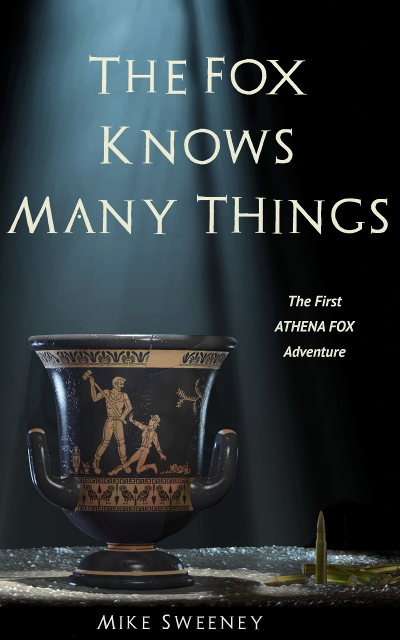
For some reason they both ended up looking rather dark. Well, so with two down and a third in planning, I've got a general scheme. Artifacts when possible. Athena and/or her fedora in the image in some disguised form -- if possible (it wasn't in Hounds).

Space; particularly, in a tunnel form. For the third book, this will be the line of torii gates from the famous hilltop shrine outside Kyoto. Color grading; Knows is the old teal and orange, Hounds is more in the umbers, and Wedding will be greens and reds. And the Owl of Athena.

***

So that's up. The first big step on the Japan book will be pre-planning. Looking at what I've learned with an eye towards finishing faster and being happier with the results.


***

The Apple crazies continue. You can't buy an older OS from them, exactly. You buy a license, and three days later they email you twice; a pdf, and the key to the pdf. Which when you open it with that password, gives you another code, which you then "redeem."

Says Apple "the Redeem link is right there in the Quick Links drop-down." Dudes, if there was anything in the drop-down tabs I'd click it. Turns out you have to be in the "Please buy whatever shit we think is hot this month" part of the Ap store for the particular tab to be visible.

So hooked up the Mac Mini again. And this time, after going through all the agreements to re-install Lion, instead of popping up with "That item is not currently available from your selected store" (seriously, you call that informative?) it starts downloading it. Whew!

If the contractor hadn't given me twelve-hour notice he needed access, I'd now have three computers and three monitors and two keyboards and drawing tablet and optical drive spread around the desk. Instead of three monitors, two computers, and one keyboard...

***

Ordered a hank of black horse hair from Amazon and made up a new string for my Gue. After a bit of trial and error, I now have a pair of strings that sound decent and can be tuned a fifth apart. Now I should write some music for it.

Once the Japan novel is properly started.

Sunday, August 16, 2020

Picking a Book

Dratted Apple. I suspect PhotoShop and their new stupid requirement to run their Cloud application just to let you use the software was also at fault.

My computer was running ridiculous hot, and stalling out on simple tasks. I checked Activity Monitor and it was Apple's Crash Reporter that was the culprit, taking up as much as 70% of the CPU and running constantly. 

And of course this is part of the "it just works" under the hood of Apple. Meaning no preferences pane, no control panel...ah, but there is the UNIX core down there and a power user had figured out how to delete it. I ran Terminal and sudo'd the fucking thing gone and my computer is back to not being the hottest thing in a small room on what are predicted to be several very hot days in a row.

***

I'm plowing through the "blue line" part of the edit.

Also took time to draft up my first scene/part divider idea so I could prep manuscript for the beta readers in something resembling final form:

And I don't like it. Surprise! I might try a new inking; I had thought damaging the coin might take some emphasis off the hat but it just made things worse. Time to try drawing a trowel and see if I like that better.

Anyhow.

What I did was read the book quickly from top to tail looking for places where there was a big block of description or expositional dialog. I marked all of those by changing text colors; blue for "this could be condensed," and red for "I really don't need this."

The next pass is going to be for through lines and necessary information. I'll be jumping around a lot more with that.

But there are a couple of scenes that need to be re-written completely and I've hit the first big one and I'm stalled picking out a book. The scenario; Linnet is in the Nine Elms shelter, reading, and Wentworth passes by and says something.

But what book? Every book I've looked at so far goes way off into things I don't want to have come up in that conversation. I want her to be cautiously optimistic and I want him to not have an easy dismissal of "That Buck Rodgers stuff."

First problem. Rationing and attacks on convoys. She's not going to be getting what's hot off the American presses. Second problem; most of what's exciting and appropriate in SF at that point is in pulp magazines with gaudy covers. Which is actually sort of cute in a geeky way and I might be able to work with that.

Third problem; SF in period, especially from British authors, was depressing. There was a big phase of rise-of-fascism dystopias going on. SF, even in the pulps, had moved a bit beyond Buck Rodgers and was already into socialist, psychological, feminist, and other themes. It was at that point straining to be literary -- even though the New Wave was surprisingly far in the future.

So here's a few I considered; Olaf Stapleton's Star Maker. Ridiculously cosmic scale, philosophical in outlook (although Brian Aldiss describes his take on the nature of existence and the future of humanity as being told in terms "vast, cool, and unsympathetic.") 

Contemporary C.S. Lewis was appalled, and yes he also gets on the list with Out of the Silent Planet, unabashed Christian polemics on a basically unrecognizable Venus; to my opinion, Narnia if it was trying to be serious enough for an adult audience (but only succeeded in being ponderous).

Gray Lensman is on the list but was being serialized in an American pulp. It does come up later in the novel...but I'm not sure I want to establish it quite so strongly as a running theme.

L. Sprague de Camp provides Lest Darkness Fall. The hardcover British edition wasn't until 1941 but I suppose I could let that slide. The big advantage is also the disadvantage; this is a Connecticut Yankee story in which the time traveler tries to stave off the Fall of Rome. So on the one hand, it lets Wentworth get on his horse about last stands and fallen empires, but on the other, it is off the tracks for Linnet.

There's a peculiar little book in the rise-of-fascism mode that was in Britain in 1937 and got recommended by a Leftist reading club. Written by a woman under an assumed name, it describes a future England under the deified memory of a savior Hitler. It is both future history and feminist dystopia and there's a lot of fun resistance and fifth column stuff going on. That title jumps out at one, though; Swastika Night

Which makes my conundrum even more complicated. I am going to elide most of the details -- this is a novel, not a book review -- but leave in just enough so the reader would be able to recognize the work. "This de Camp fellow is one of those fantasists, right?" "No, I believe he studied history."

In Katharine Burdekin's case, though, the novel is obscure enough (just recently got a big push from a feminist press) she really should get her details recorded.

(That's 1943 or 1944, I forget which. The title story is an absolute snooze, written by the editor himself and having nothing to do with the previously-painted cover.)

Monday, August 10, 2020

Pitch?

 Preview of the revision-in-progress:


So that's with the Tomb of Atreus background, new render of the calyx with cleaner ground and no bullets and a godray that took ten hours of render time even at 1/4 resolution. I had the side lighting cut because Dad complained about it, but I needed them to detach the pot from the background so rendered those off as a new layer and comped that in this morning.

One thing PhotoShop does not do, apparently, is let you adjust the kerning on individual letters. I'm still delving into that, though. (You can, of course, turn them into a bitmap and manipulate that.) It's really a sort of awful font -- Diogenes, and it was free at least. But it has the "Greek without being too awkwardly Disney Hercules" look about it.

And I just realized I'm breaking another rule by using a serif font with a sans serif. Well, with a decorative. The serif font is Archaeocaps, which is a caps-only font with a slightly awkward look that does sort of put across "history, but modern."

It's a tough cover problem, trying to juggle archaeological thriller with detective cozy. The other is worse. I haven't quite figured out how to not make it look like a crime novel.

And rewrites are going very slowly.


***

During lunch at work today I took the bridge off my violin and thinned it down. The main reason was because the mute didn't fit and it was cutting into my practice opportunities.

It's funny. You look at the "how to fit a bridge" and they all explain how to use sandpaper. Then the old pros speak up, horrified that you'd use anything but a very sharp knife. Well, I'm lazy. I used sandpaper. Although I did use a knife to fit the feet a little better than they had been.

The bridge fit. The violin also sounded nicer, much nicer. I am not into the bright sound and I just splurged as well for a "non-whistling E string." And a set of nylon-core (not the really expensive silk-and-gut ones, though). Strings don't last forever anyhow, and my A string had just unravelled and I had to scrounge up the strings I had before I got the Alphayues.

One thing led to another and I swapped back the old chin rest and it is finally starting to feel like it is placed right on my shoulder. Still some tension though, mostly in the arm.

Anyhow!

I put the strings on but left them a little slack so everything could ease in a little. Came back a few hours later, and with no reference pitches in my ear over that entire period tuned in the E to as close as my tuner could register it.

So maybe I do have perfect pitch? I really need to spend some more time training it up.

Sunday, August 9, 2020

rough comp

 It doesn't feel like a productive weekend.

I've identified the things I want to edit in the new novel. Other than that, it has been a lot of poking around trying to learn about Amazon categories and font use, looking through stock image galleries, trying to work up the blurb, and so on.

The concept for the new cover is to this stage now:

Of course I still need to model, texture, and render the bit of wall that says "Nine Elms Station" in that lovely Leslie Green tile-work. And purchase assets and take the real photo with something other than 100-baht pieces.

The select-float-change tool-move-anchor layer routine of Gimp got really old for me so I've installed the (bah) membership version of PhotoShop. Which has mucked up mightily with the Adjustment Layers -- I think they still do the same things, but that simple functionality is now harder to access.

And I had Poser running for 10-12 hours rendering a single god ray for a revised and cleaned-up version of the old cover. I want to play more interesting games with the font, and I re-rendered with a new color map for the ground (and no bullets) and this time I'm doing most of the adjustments before I collapse all the layers.

And, yes, on the work list is Third Printing revisions to text of the first book.

I don't want to be doing ANY of this right now. Actually, I want to be playing Fallout. I'm burned out. 

Or writing something new. The Japan book, for instance. (Which is to be followed by the Paris Book, except that one is more of a multi-city National Treasure tour as Penny clashes with a gang who have Templar Secrets on the brain).

And then a break from Penny. I need it.

Came up with another possible project, though. Was using PublishRocket to look at the Amazon keyword and category listings and realized I was getting really tired of the Slab Beefjerky heroes. And this is one plot bunny I am keeping under my top hat -- all I will share is the tag line:

THE WEIRD WAR JUST GOT WEIRDER

***

Oh; here's the current state-of-draft of the Amazon come-on:


AN AMERICAN ARCHAEOLOGIST IN LONDON. 

Penny Bright is going to be a real archaeologist. She’s not going to let tough classes, obnoxious fellow students, or her rapidly dwindling funds stop her. Nor the fact that she doesn’t, apparently, even speak the language.

Then things get interesting. Penny gets an opportunity to dig at an old Underground platform. At Nine Elms, she is drawn into the story of a young woman who sheltered there during the London Blitz. Meanwhile, a prickly and eccentric coin collector has come to her with his own mystery.

Before this is over she’ll have met mudlarkers and pantomime players, and gone from an illegal expedition into an abandoned power station to a bloody encounter on the very stage of Shakespeare’s Globe; all in search of answers about a lost love and a secret buried for over seventy years.

And when she is trapped deep under the streets of the old city and unsure of who her true enemy is, Penny is faced with the choice of becoming once again...Athena Fox.

Friday, August 7, 2020

Cover Girl

Before I get it into the hands of beta readers I have to do packaging. That includes things like interior graphics, cover, description...

First snag. When I started writing the come-on for the Amazon page, my first thought is I didn't have a lot to come on with. There's no big stakes, there's no clear antagonist...

Oh, but then I realized the book I'd written was not the book I outlined. When I outlined, I wanted the diary as part of the mosaic. Well, turns out it is the heart. This is a mystery story, but it isn't about the coins or the guns, it is about Linnet's lost love.

So I've several pages of scribbles on that and no editing done and I still have to do the scene dividers and the cover and...

You know, that's a really boring cover. A trowel? What, is this a gardening handbook?

There's nothing in the cover that says romance. Or London. The only thing it manages to say is "underground." And that's if the art works and after another search through Shutterstock and a purchase of yet more 3D software I'm not much ahead there and not looking forward to the work and maybe I've got the wrong idea all along.

Back to revisit the idea of putting the human in the picture. This isn't so much a mystery or a travel story as it is Penny's story. Like the last. Like all of them. So shouldn't I put a face on the cover?

Research time!

And, well.

With some new search fields I turned up a bunch of quirky female protagonist having adventures with an archaeological bent. And they're basically cozies.

But this is weird. Whereas a cozy set in a New England fishing village or set in 1920's Rochester has the typical cozy cover -- painted or hand-drawn, quirky, and no human figure -- the ones that are set around a dig in Egypt or something Maya or whatever have...artifact covers! (Most of them. There's up to a quarter -- from this completely ad hoc survey -- that have the quirky hand-drawn stuff).

Yeah, we're back to artifact covers. The samples I found lean cozy in that they tend to be a fully-lit artifact posed as if in a cabinet of curiosities; the thriller types (typically with an ex-SEAL with a ridiculously macho name as hero) have lots of Fog of Mystery, or for bonus points, fire around the object de jour.

And why am I tempted to write the Private Skippy series now? 

So I'm back to artifacts despite nothing coming to mind for the London one. Maybe I should bit the bullet and write to Transport for London? Naw. Even if they'd let me use the roundel, the price would be too dear.

I don't even feel like arting right now. And I'm too burned out to do editing. Something about this series destroyed my confidence in a way that writing military SF/horror doesn't (or I hope it doesn't).

And just to add to my work list: the whole reason to kick out another Athena Fox story -- and, yes, a third, as fast as I can write it -- is because multiple books multiply. Which means I really want to go back and do some clean-up on the FIRST book before I'm ready to push the "Publish" button on this one!

And so I'm right now doing test renders seeing if I can clean up some of the things I don't like about the first cover, while also taking another look at just paying someone -- because while I'm bad at a lot of things, typography is something I'm really wretched at and I can tell how amateurish the thing looks at present...

Monday, August 3, 2020

Weeding

I just went through the woods with a can of orange spray paint, marking all the dead wood that needed to go and the thickets that needed to be thinned.

I'd call it the most productive couple of hours I've had in the whole writing process.

Did I mention I finished the first draft? Finished early Sunday Eve and I was completely wrung out physically and emotionally.

The books say to put your story aside for as long as you can and come back with fresh eyes. I should do that at some point, but right now -- now that I've just written the chapters in which I had to take up all the dangling plot threads and knot them off -- I have the best understanding of the architecture of this story I ever will have. This is absolutely the best time to go back and see when I introduced ideas and if I repeated myself or said too little...

...Or more often, said too much.

The worst repetition I see right now is that there are too many diary entries that tackle what living underground was like. There may be a way to collapse or trim these but that will take a separate work session. There's no overlap...so this will be a matter of losing what right now feels like important world-building details.

There's also two pub conversations which are basically mid-career management for the CRM archaeologist. There's overlap there.

Otherwise...not too bad. And the best part? I was able to take a whole bunch of things I'd brought in either because I thought I might need them or because the research was at the tip of my tongue, and mark them to be trimmed or removed. 
 
I mean, I don't want to lose James Henry Greathead, but if it helps the story...

I'm feeling good about the editing process. I think I can tighten this one quite nicely, and it won't take but a week or two (work and health permitting).

***

And I was reviewing comments I've gotten and I realized something else. In this book, I can explicitly flag some of the things for the reader as "you aren't expected to get this reference."

The Athens book was about trying to fit in around people who knew and appreciated the Classics, and there was a lot of "But everyone know about..." in the dialog. In the London book, I've underlined many times that the Brits are competitive. Hey, there's a scene in which Penny says, "can you please explain to the poor American" and they say, "nope, no can do."

The Japan book will offer an option to go this one better. They don't expect the foreigner to know or understand anything. She's not Japanese, after all! So anything Penny actually gets, there will be a big reaction. 

But the important thing is that I can flag for the reader, basically telling them, "No, you aren't stupid, nobody is expected to know this."

Still better to take out stuff if I can. It doesn't take much to leave a flavor of there being a whole world out there.

Speaking of. The Panto scene is up on the block for major re-write. That's going to end up longer, I'm afraid. It went far too much tell and not nearly enough show to justify it being in the book in the first place. I'm at 79.5K total, with a good 500 words already marked for deletion so...not bad.

Friday, July 3, 2020

Siege Mentality

One again I start the weekend with no confidence at all in writing. I don't think I can do it. And I don't think it is worth doing (not writing in general, I mean what I am doing).

So of course I also realized another place in which I ended up telling a different story than I'd set out to. I was looking at questions on Quora again and someone was asking about symbolism and that started a train of thought.

Well, the keyword I started this particular book with was "Under Siege." No, not the movie on the boat. That the arc of this book was sending Penny to London, having her suffer in cold weather and unfamiliar surroundings, go broke, and be shivering and starving while also being harassed by her fellow students as she's struggling to make a go of it as an archaeologist.

And the book would move underground in stages; starting with a "soft" introduction with the Tube as a place that is dirty and damp and scary and progressing towards both digging into and getting second-hand experience via what they were uncovering with the literal siege of the Blitz.

The big symbol through this is the North Sea, as a storm surge, a tide, paralleled with invasion and siege, from Boudicca's sack of Londinium to Penny's current situation, and it culminates in Penny trapped underground in a W.W.II shelter as the waters are rising.

But, you see, that's where plotting happened.


***

I've been writing about this on Quora and if I write that How To Write book it is going to be a big part. And that's the "Where do you get your ideas?" question. Because it is almost exactly the wrong question for someone who is writing.

As much as it makes sense for someone who has yet to learn how to write. And that's Quora in a nutshell. It is for people to ask beginner questions. It isn't like a forum, where you join, familiarize yourself with the place, learn the questions people hate to answer, and otherwise fumble around picking up the basics without, honestly, a lot of help. Quora is really not where advanced writers meet to hash out nuances in how to properly do an untrustworthy narrator in First Person. They are a place where people ask, "What is the difference between First Person and Third Person?"

It is a bit frustrating. It is like asking about what the controls on a car do. Yes, you need to learn that at some point. But it isn't something that really comes up when you are actually learning how to drive.

And that's really most of what is in a book about how to write. It is the stuff that everybody who writes already knows but, even more importantly, knows so well they don't think about it most of the time. You've got the basics. Now you are struggling with the interesting questions. It is nearly impossible for a book (or an explanation!) to do justice to both levels.

This is a long-winded way of saying that "Where do you get your ideas?" is an unanswerable question.

It isn't about the ideas. It is about the writer. The ideas are everywhere. But the ideas are also nowhere if you don't have that skill in figuring out how to use them.

So, yeah. I'm still learning how to use them. This was a good learning experience I guess. I'm not unhappy with the directions the story went. What I would like is to understand how it went as it did. Was it that I lacked the skills to tell my "siege" story? Or that the idea simply wasn't capable of carrying the story and HAD to be modified?

It is possible -- I realized this during the Battersea sequence and am even more confronting it over the Globe sequence -- that I had a basic error in outlining.

When I set up this story, I pretty much looked around and said, "What are some fun things to do in London?" I didn't realize how much it was going to turn into a Blitz story, not at first. So the idea that there are scenes at Trafalgar Square, The Tower of London, The New Globe, Highgate Cemetery, Battersea Power Station, and not even slightly to mention Bradgate Park in Leicestershire, is a bit off that model.

It isn't like there aren't a million Blitz related things I could have done. What with the Imperial War Museum, the new Blitz Experience near the London Eye, HMS Belfast, the Churchill War Rooms, the Deep Underground Shelters...

My objection was generally that this was a little too on-the-nose. That having Penny go to London and somehow every single thing that she gets involved in is about the war looks like author manipulation. Well, that was one reason. The other reason being I wanted to use the Globe, my dad wanted me to use Highgate, and I thought if I used Battersea I could work a Pink Floyd joke in there.


***

I recently watched a short video on the skilled editing job that rescued Star Wars from the dismal mess that had been the first cut. And a couple YouTube articles on writing. And I'm sort of giving up at the mid-point of the second book of a series I found on Kindle.

The first book had promise. It looked like he was figuring out how to write a story, and I wanted to see where he was going to go next. Well, apparently that was where he had been trying to go, and the second book was more of the same. It does seem that what he wants to write, somebody wants to read, because he's up to twenty-odd books between a couple of series and I didn't look at his numbers but he can afford full-painted covers so there's that.

I happen to want to tell the kind of story Ben is telling in the Rivers of London series, though, and that particular set of books is getting not just readers, but awards, a comic book, and options on a TV series. I'm not making a comparison, mind you. It isn't about that.

***

So that may be a lesson as I head into plotting the next book. Okay, I'm still not fixed on what my next project is going to be. Probably the next Athena Fox story, though -- because as much as I am getting really tired of First Person and finding it harder and harder work talking in her voice for the length of a novel, a series has more weight both among readers and in the numbers game of Amazon's ecosystem.

And I'm still a little split. The Japan book would make more sense a little further down the road. Especially, it might make more sense after the "Paris" book -- the latest thought being that one is more of a greatest hits, multiple city tour book. The "Paris" book is the Eco book; Penny is caught up in a fake Templar Conspiracy and at the climax watches Notre Dame catch fire.

The reason to do the Japan book first is I'm trying to shake some bad habits. Habits the Paris book is totally tailored to bring out in force.

So on the one hand, I'm assembling another list of "wouldn't it be cool" stuff for Japan. At this point some of them are so much in my head I'd have trouble letting them go, like climbing the Tokyo Tower (probably by the stairs but you never know), getting attacked by ninjas at the Toei standing Edo-era village set outside Kyoto, and getting lost at Fushimi Inari during the kind of weather that gives the book its title. And is going to wear kimono but that's a given.

I just hope that when I've got it all plotted out those won't end up feeling out of place, like the New Globe is for the current novel.

I'm still brainstorming but I'm seeing it in sort of three parts. Part One is the same Romancing the Stone game; Penny is getting mistaken for the YouTube character she created, and put into crazy situations she manages somehow to survive.

In Part Two, she finds out this wasn't luck. There's a very off-the-records effort by a flamboyant and charismatic agent of the Japanese Government to take down a cult leader with an interest in fringe archaeology. So there's an excuse here for the whole range of Junior Spy activities, from Embassy Balls with handlers sending instructions to a hidden earpiece, to a training montage in the spectacular scenery. But for me, one of the major attractions is being in social situations where Penny has to use every bit of acting skill and misdirection and social engineering to keep anyone from figuring out she really isn't Athena Fox.

In Part Three, the government gets a clue, a spine, or both and cuts their losses. Penny is left without support and with the illusion crumbled. And gets a chance to find out just what the real Penny can do.


At least, that's the scheme right now! I have a month of writing and basic edit and then I'll be scrounging for beta readers. For the reasons above, I don't feel I can afford to spend a lot of time in rewrites. I need another book up there STAT so I can build my numbers. And quality is going to have to suffer.


Sunday, June 28, 2020

Great Klonos' carboalloy claws!

I've reached a very annoying scene.


Over the third part of the book I've been trying to sneak in a parallel story. While Penny is digging with her fellow archaeologists ahead of the construction crews at the old Nine Elms Station, a local paper has been publishing excerpts from the diary written by a young women who sheltered down on the abandoned platform during the Blitz.

I didn't get the parallelism as good as I might have liked. Well, I also didn't like it to be too obvious. Well, the way the scenes shook out for me as I moved from outline to actually fleshing them out, Penny's relationship with her friend Graham is hitting critical points just as Linnet has finally managed to start writing about Captain Wentworth, the man responsible for sticking an Aux Unit depot in the Nine Elms shelter.

And they are bonding over SF. Which was a somewhat late addition on my part. Wentworth is mooning over the glorious last stands of the past, from Rorke's Drift to the Siege of Acre. Linnet, not to be a passive part of the conversation, is coming back with the armageddons of, well, Buck Rogers.


And this is already tough as hell to write because while an educated woman of 1940 -- particularly one that educated largely on pulp magazines -- is a familiar voice to me, quotes within quotes are just not much fun. The scene I'm working on, Penny and Graham are discussing Linnet's latest diary entries where she discusses what she and the Captain talked about and this is less Phillip Nowlan and more Christopher Nolan.

(Cue the Inception sound effect).

There's two other things on the table at this point. Penny has been zig-zagging back and forth between being a responsible -- but boring -- worker bee of an archaeologist. A junior digger. And in the excursions inspired by Graham, she's been running around meeting eccentric people and eventually getting into more and more "stunts." Like breaking into Battersea Power Station.

So this is coming to a head as well. At the center of this particular story, as much as it is wrapped in a mystery and a Blitz story, is Penny feeling forced to decide between Serious Archaeology and being Indiana Jones.

But there's a subtler side to this. Whatever happened in Athens that let Penny be a real-life Athena Fox, it is an uncertain magic. The main reason she got shot with a bow at Highgate Cemetery is so she could be bleeding and in pain for the rest of the story. Stunts don't always work and real violence isn't like the movies.

One of the things Captain Wentworth is hiding is the kind of violence he experienced first-hand in ugly things like the Arab Revolts. And Linnet is in the same naive stage where she is going to volunteer for SOE before this is all over.

And Graham may appear to be an ordinary, out-of-shape guy, but he's a serious Roman reenactor. Well, something he did let him understand something of how violence really works. It is a lesson Penny is going to be learning deep under the streets of London. It is something I'm going back and forth on endlessly and having a lot of problems with myself because it totally changes the feel of her stories.

So I'm trying to fold this in as well. My Inception conversation over chicken tikka masala is trying to parallel not just Linnet and Penny both spending their days/nights down in the Nine Elms shelter, it is both having too close a contact with worlds of fantasy and having an older male mentor figure (though not Mentor figure) who is for whatever reason unwilling to try to explain to them the true cost of violence.

And thus it is going to suck. I mean, sure. I can write it. I can cut out a lot and it would probably be a better scene for it. Allusions the readers doesn't get just makes them bored and confused. The thing that really sucks is I can't possibly put in it what I wanted to put in.

All those months of figuring and outlining and researching and everything I know about Captain Wentworth and his past and his relationship to Linnet I can only touch at third hand, through a half-dozen snatches of quoted dialog. And that ain't enough.

The other thing I realized this weekend is that Penny is exhausting. Maybe it is just a quality of First Person. Maybe it is her energy and raw nerves and the way she jumps around like the later regnerations of The Doctor. Or maybe it is the peculiar effort of going inside the head of someone very different from you and having to feel what they feel as you speak in their voice.

Whatever it is, I had to take frequent breaks. So I'm happy I got 2-3,000 words done over the weekend. Even the first draft of the Lensman scene. Next chapter includes the sword fight, so I know I'll lose a little time doing some specific research for that. Might even open my book on the New Globe. Assuming I still have it!


Sunday, December 15, 2019

Stop, Youth!

I have the bones of a plot. Trouble with sharing it is, it is easy to list "they go here, they do that" but it doesn't capture the reasons that place and that activity are going into the plot. Theme and pacing and the hidden structure that makes a story out of an event are much harder to put on paper in this way.

This is why writers seem to go out of their way to collect silly-sounding terms, and keep waving them around. Thing is, when I say "I chose a three-act structure" that is not just descriptive of the form, it is also documentation of a process; that I am saying I considered and rejected "save the cat" and "heroes journey" and a number of other structural/analytical frameworks.

So I need this, as I am working through plans and notes. I can't write out the entire thing every time I want to ask myself "do I want to do A or would B work better"; I have to have short-hand methods of describing the parts I am trying to fit.

Well, this one is original with me. "Stop, Youth!" doesn't describe the whole plot. It describes a plot where there is a sharp turn, a specific sort of sharp turn.

It comes out of the second Lensman book. Kinnison has defeated Boskone, saved humanity, and is strolling into the sunset with the girl. Then Mentor of Arisia stops him dead with a telepathic warning. Turns out "Boskone" was just one face of the vastly larger and more deadly Eddore, and Kim has just burned every link, every clue he had towards finding the real enemy. A real enemy who, by the way, just saw them using the super-weapon that ended the last book, and can now reverse-engineer their own...

I had wanted to make an arc that points down for most of the book, but for various structural reasons instead I have an upturn. An interlude that lasts far too long to be called a Hope Spot.

***

So caveats given, here's the nascent outline:

Part I: Penny is at Field School in the London area but everything is going wrong. She's not gaining the contacts and professional experience she so desperately wants and she's going broke, too. So lots of down and out in London stuff, street views of living London, and of course stuff on the practicalities of Archaeology as a career and the actual process of an investigation.

Part II: someone she met on the previous adventure shows up and now there is an enemy that is a little more obvious and basically everything is a little less serious. So a romp through dead parrots and Roman re-enactors and the New Old Globe and even Pantomime. Culminating in a real fight with fake swords.

Part III: a rescue dig in the subways. A real chance for real experience and camaraderie...and then it goes bad in a flash with violence that can't be faced with a costume and a quip. And this is where I really have fun with underground London.

And, actually, they are all interwoven. She's still down and out through most of it, just she has increasingly better living arrangements available. The reality and the reality of violence is under the surface through the Dead Parrot stuff. And the rescue dig came in about half way through that sequence.

So, yeah. It is ALL getting in there. I'm still at about 60K worth of plot so there's more to play with here but having that long "comic interlude" and then the sudden "stop, youth" moment as the sharp turn into the pit lets me get the coins, Romans, metal detectors, wartime London, field school, theatre and all in there.

***

But there's another thing. Another thing that makes this slow going.

This plot is going to some dark places. There is violence, and a strong undercurrent of sexual violence. I'm uncomfortable with it, and uncomfortable thinking I'm going to be putting it in front of other people. So this is even worse than feeling my research is not good enough, my characters are not believable, my dialog is unrealistic, I'm culturally appropriating all over the place and I'm basically not a good writer.

Basically, I can only work for a few hours, then I have to put it aside until I can work up the courage and confidence to go back to it.

Would help a hell of a lot if I had more sales. I'm entirely within my personal predictions; lifetime sales of around a hundred, meaning 2-3 a month, meaning the first month can go by without a single book getting sold. At least my KPP page count is still there. The algorithm is opaque (apparently genre changes the "pages read" that the algo generates) but my best estimates still say there are more pages read then there are in the book. So that's a good sign.

***

Reading list time. I wanted to outline as much as possible before hitting research so the research pool was smaller. I really do have to do some general reading about what is under London, though. And browse through some materials on theatre, especially pantomime.

Friday, December 6, 2019

Wrong Lever, Kronk!

My head is splitting. Some of that is the head cold.

I did the small edits, then crawled through the entire manuscript looking for bad dialog punctuation and doubled spaces. Don't know how ProWritingAid missed those last ones.

Uploaded all of the files to KDP. All that is left now is to hit the button and the book will be made available at Amazon.

Print is going to take a little longer. I have to make camera-ready text and a correct-to-the-bleed paperback cover.

There's also advertising and promos to consider.

And second thoughts. Do I want to change that one word? How is the new blurb working? Should there be more front matter? Is the cover too dark?


So much, I just had to guess where it was going to be when it all came together. That's the fun part of projects; when that much time is invested, there are early forks in the road that it simply isn't plausible to go back to.

Wednesday, December 4, 2019

What deaf banjo player gives Max Planck quartz?

I guess I've decided this is the cheap book. That is; not worth hiring editor or cover artist.

Well, not that cheap. But I'm hoping this is amortization. Get the tools, learn the stuff about cover design and so forth now, and then the next book it won't be a problem.

As long as I make December. And my new stretch goal is to have prints delivered by Jan 1. No pressure!

So.

I knew this way back, when I was still aiming for trad publishing, and sending off loads of short stories to the magazines. The best way to make money as a writer is to make money off writers.

This got really clear when I listened through a podcast on cover design. Which turned out to be basically an advertisement for the podcaster's course series, meaning the entire thing was pushing courses like the one that they were sort of but not really previewing here by interviewing a guy about his course and book, which does actually have some advice but is just as much an advertisement for his book-cover creation business.

Okay. It felt more Inception than it was. Still, I did feel several shells deep in the effort to actually get at useful information.

Once again, I've discovered the problem of being a fast learner. I quickly move to the "gifted amateur" stage but it is hard to find the resources to move up from there. Top-level searches and resources with wide circulation are inevitably aimed towards the first-time learner. At least for some things, past the transition hump are the serious resources. Which are usually serious money and time -- this is a good reflection of how "jack of all trades, master of none" works out with real subjects.

Come to think, Penny has the same problem. I should put this in the next book.

So there are a zillion tutorials on how to, kludge something up in PhotoShop. Rather fewer on useful techniques and pointers once you've gotten past "how to turn it on and what a layer is."

Anyhow, right now I'm trying to learn a little about fonts. Hours of podcasts, tens of pages, and one full book purchased and read and I have enough actual solid useful advice to fill maybe two typewritten pages. Double-spaced.

 Actually, assuming the more decorative design fonts actually work and don't distract too much from the total design, the main thing I got out of searching a bunch of fonts sorted by keywords was a desire to write the stories/settings that went with some of those fonts. Like, ooh, I want to do a story involving Celtic Britain so I can use that font in the title!

And the calyx is in renders. More adventures there. I am tempted to open Poser9, despite the broken Flash (Aaaah!) problem. Because I just can not get IBL -- HDRI lighting -- to work properly in Poser11. And apparently it doesn't work at all in the Superfly render engine, or so forums tell me.

Of course I'd already seen the problem coming. Red-figure Attic ware means large parts of the body of the pot are black. Especially the sides, if I am framing the central image. And I'm doing it against a black background.

I reversed the artwork, though, and I didn't really care for the black-figure look. Not for any connotations; just because so much red pottery just didn't look right in the composition.


So a couple of tweaks to go, then I'll render three to five layers. Since the light shaft is so hard to control, both the top light and the associated atmospheric effect (the "god ray") will be rendered on a black image. That light will be removed from the main color render. I might do the rim light as a separate layer as well. For that matter, it might be safer and easier to do a reflection layer separate (I mashed together some free pictures to make a semi-spherical "tholos interior."

And haven't decided if the bullets are going to be in this. I don't want to diffuse the focus but I also want something that says "action" -- a pot doesn't. And then back again to render a trowel for the back cover. (8×57mm IS rounds, since the appropriate rifle is an FN Model 24).

And, yeah. Back when I thought of using a pot instead of the Parthenon against mysterious brooding clouds, or a stock photo in a leather jacket running away from something out of frame, I was using artifact-based titles. I was amused by the idea of continuing to have the contemporary character and appropriate scenes showing up in ancient art; as the stamped image on a Roman coin for the story that was going to be called The Aurelius Dupondius, for instance.

Incidentally, for those that have forgotten, this is the image that is being referenced, both in the art and in the actual story:

Probably better than a paste-up of stock photos. We'll see. Here's the kind of covers you tend to see if you pop "thriller" and "history" into the Kindle search engine: some good. Some...not so good.


Tuesday, October 22, 2019

Ten Months


Draft is done.

81.6 thousand words. Almost dead on.

That's more by accident than not. The original plan said I'd spend about 60% of the page count in Athens and I hated that I had to spend so much time on a side quest. Then I realized I was going to fall short and added more incident to the detour. At that point I was sure I was going to end up with too little of Athens, especially as I had no real ideas other than "go to some museums."

Well, the riot sub-plot got me 4K, Markos when I added him into the museum scene gained me 2K, and I ended up with 30K after she returned from the detour to Germany. So that means just slightly over half the text takes place in around Athens, which was kind of the point of this plot; that I could write a bunch of stuff about a place I'd actually visited recently.

So now for edit.

The first edit is large-scale tweaks. There are scenes I didn't like and need to be reworked, bits that didn't work, and misplaced emphasis in several places.

Example of the latter; don't talk about Nazi's until at least Munich. I know. She's in an Indiana Jones hat being chased through a woods by crazy Germans and there's even been swastikas (on a pot sherd, actually) and she's from Burbank. How could she not think about Nazi's? But I'm going to walk around it and point the camera in other directions because I don't want it to be one of the first things I say about the German people.


That's the first big one.

It cascades down in that what she realizes on the DB to Munich will be different. This is when she makes the distinct connection to cross-national racists, but even then I want to keep that a bit on the back burner. I hate the Dorian theory and part of the reason I hate it is the racist underpinnings of so much hyperdiffusionist but it is an easy target that makes it look too much like a polemic.

Plus, here and in the big Vash confrontation at Oktoberfest, I really have to sort out just how far I'm going into the social media pressure cooker.

The drndl scene is probably shifting into dialog with the dresser lady becoming more of a speaking role and interesting character. Possibly she's going to take over some of the "I learned from Robert" facts she got off-stage, and on-stage them.


The final gimmick in the Vash confrontation either isn't clever enough or needs to be told better. So that's a scene that's going to need some re-thinking.

Outis is going to "appear" in the Oktoberfest scene and that's a whole little sub-scene I have to write. Yeah, and at some point I have to decide if I'm going to allow a running gag about him being named "nobody." I tried it a few times in the final chapters but it can get confusing quite quickly and probably wears out its welcome as well. (No, it isn't his name. I'd say at this point that outside of Vash not a single male bad guy actually gets his real name. Penny had to name them all.)

The first night in Verona should probably be unpacked and made into a proper scene, complete with her finding out which door out of "Signori" and "Signore" that she's supposed to use. Really, all of Verona could be expanded into fuller scenes. And I'm not entirely happy with the "Wherefore art thou" scene, either.


The end of the Venice Chase gets expanded into a proper scene with a bunch of Venetians arguing. And an annoying kid translating when he can be bothered.

The "Sheep" scene just before the ferry probably gets deleted. It isn't working for me as it is and I want to try a different way of handling that business. Or maybe I can reach into the "Sheep" scene and twist it to be more about pigs and sorceresses? Yeah, it is a scene doing two things; showing Penny abusing her power for good, and riffing on the Odyssey.


The ferry chapter gets completely reworked. The stomach flu becomes only a nuisance, she talks about the aristeai in the "reading the llliad" scene because it is too late to set it up in the conclusion of the fight with Enceladus on Spider Island, there's a bunch more running around and, like I said, the "Sheep" thing may happen there if I can figure it out. That's going to take a few days to plot out.

Back in Athens, the third scene at the National Museum of Archaeology, the "Why did you stop with the Romans?" scene with Markos, is rebuilt so we can do the lightning tour of Greek history with the visual aids provided by the museum. And I really have to work in the reconstructed costumes that are on special display right then.


The speech needs work. I knew it would need work. Writing an inspiring speech is not an easy task.

She needs to do something a lot more clever to deal with Outis at the climax. It isn't working right now. Also Diana isn't anywhere near as dangerous feeling as she should be.


And that's the big ones! After that is cleaning up dialog to give more distinct character voices. And run the whole damn thing through Grammarly. Or whatever the Grammar checker I finally decided to buy is.

Or maybe I'll take a short break first and work on the cover art.

Friday, April 26, 2019

A terrible feeling of wheat

Did I mention I hate the predictive speech-to-text on the current iOS?

The crazy gallery reception chapter is almost finished. Just have the bit where a Greek Margaret Dumont presses a protective amulet on her, and a short conversation with the gallery owner just before Penny, done with the marathon bit of improv she just pulled off, has a bit of the shakes and what will only be her first ouzo of the evening.

I'm already at 4K. Does mean I still fall short overall, though. And, yes, I could easily expand any of the existing conversations. I could have painted a more detailed picture of the Minoans, for instance. But this would only, to borrow a phrase, fatten the book, not expand it. What I really need is either more plot...or a "B" plot.

As it is I feel there's a little much already. Especially since a lot of the history and myth being talked about isn't important to the central conflicts. Both chapters 1 and 2 are largely about people showing off their knowledge; chapter 1 is Penny on the Acropolis demonstrating how she's able to have a successful history show on YouTube, and Chapter 2 is a fluid, multi-side conflict masked as polite conversation:


“Alea iacta est,” Howard raised his glass to us. “The die is cast.”
“Said?” Vash prompted.
“Wasn’t that Caesar?” Safe bet; Howard had all the signs of a military history buff, and that “est” made it Latin. “When he, what was it, crossed the Hellespont?”
Vash shook his head. “The Rubicon. Caesar crossed the Rubicon.”
“Alexander crossed the Hellespont,” Howard amplified.
“So did Xerxes,” I said.
“Alexander threw a spear into the soil,” Howard volleyed back.
“Xerxes had the river whipped,” I replied.


And never mind that the Xerxes story only appears in Herodotus and Caesar had spoken in Greek (if he said it at all). That's history for you. You can always drill deeper. Always.

Yes, there are plot-important things hidden in all of these, but for the most part they are subtle. Still, one can't just have a man jump out with a gun. Because that's not plot, either. Plot is, well, plot. Not description or dialog or action, by themselves, but what those things advance.

Speaking of which. Somewhere down the road I need to do a complete dialog pass. This is mostly to get the different speakers sounding more distinct. I also want to listen to a bunch of native speakers (I'm pretty sure I can just search "interview Greek musician" and find something) to get some of those subtleties of word order et al that come when someone isn't speaking their first language.

But also I want to make some distinctions between Penny's voice and the voice she puts on when in the character of Athena Fox. Dialog is one of the places I can underline the access she has to confidence and a projection of competence when she is in character.


(And apropos of nothing, my file names for the current "books" of the narrative are "Agora-Phobia," "Black Forest Hams," and "Owed on a Grecian Urn." If I somehow manage to add to the plot, it might give me a fourth; "What Does the Fox Say.")

Monday, April 22, 2019

On to Atlantis!

The writing finally started happening. In fact, it is happening so well right now I'm tempted to take a chunk of the week off work to keep at it. 5.5K in the can now, and ready to hit the crazy chapter at the Atlantis Gallery.

Sure, I was able to save a bunch of text from the previous draft. But there was a lot of re-arrangement and quite a lot of new stuff from scratch. I think I've accomplished a pretty good balance on the opening chapter; showing the situation, making it interesting in the moment but also laying the ground for later chapters, showing the character enough to make her interesting and also leaving the right amount of mystery for later.

I decompressed the opening prologue some, and shifted around the "asides" to make them work better. It is a strange thing I'm trying there; basically this is a fake-out opening, showing the adventurer archaeologist in action only its actually a budget video. I really shied from the usual approaches, like doing it all in italics, but I did want to clue in the reader and, rather more importantly, slip in some background information. So I've reserved the italics for a pair of disembodied voices that comment on the action.

Anyhow. Been messing around with some new approaches to keeping track of the text I shift around. Anything I delete, I shift to a save folder just in case the original was better. I set up macros to color blocks of text, which I'm currently using as green for desired additions, red for things that should probably be deleted, and blue for general commentary.

The problem I think I have is that I treat prose too much like it was, say, lyrics. By which I mean the flow and the rhythm mean too much to me. I've read about writers who block in a scene using vague, general terms then fill in the details later. I can't do that. The difference to me between a Mercedes or a Lincoln as a background detail is not just what each might say about period, location, economic status, but which fits the meter of the surrounding line, brings the sentence to the proper length, has the right vowel sounds.

Which means I really don't have the luxury of skipping over something with a RESEARCH LATER tag and coming back to it after I have a draft in the can. Also, when it comes to details of location and technology and similar, the action IS the thing. I need to know before I write the scene if the character is carrying an axe or a sword, because a sword can go into a scabbard but an axe is going to be awkwardly in their hand the whole time unless there's a sentence there about them setting it down.

So the next chapter may turn out to be really, really annoying. Because there's a free-wheeling conversation that jumps from one thing to another the way conversations do. I know the places I want to go and the personalities involved but not the order or the Traveling Salesman algorithm that takes the conversation where I need it to go.


Monday, April 15, 2019

Mystic Crystal Revelation

My "tek" is finally coming along, to the point where I could play a little Maqsum rhythm along with a YouTube lesson. But that's not important.

I sat down at the writing desk* and actually managed to hammer out a revised 800-word prologue chapter. Complete with some physical stunts, some archaeological puzzle-solving by Our Hero, and the requisite glowing crystal Atlantean dingus.

*It's the same desk I'm currently eating dinner at, and if I had moved a little quicker this evening be soldering LEDs at. But the idea is there.

This might have been the most fun research I'll have the whole novel. I found a "paper" (actually, slides from a presentation) at Academia.edu claiming something novel about Minoan burial customs and I can totally use that. I don't need to see if this has any academic standing or if I'm understanding it right, because in the prologue scene everything is supposed to be styrofoam and matt paintings. So is a particular god Hurrian or Hatti, did they have bronze axes or only copper...who cares! I only need to make it look cool.

(The one difficulty in the scene is descriptions. I can't say "horns of consecration" because that makes an assumption that the viewer of the video knows Minoan iconography. I have to say "curving stone horns.")


I figured out my thematic problem. I think. I spent a morning at a cafe and wrote a thousand words of notes basically about her hair. It makes sense in context. The big thing I came to is that "becoming the mask" -- no, even putting on the mask -- isn't even an option until half way through the story. So in that first critical scene at the gallery reception she's not hiding behind her created character, because she has never immersed herself in that character in a real-world situation.

And the other thing is that the fact that Athena Fox is fictional is a totally open secret. In the reception scene, the challenge is to do a good acting job; nobody there thinks the character is real. But this is true later in the book(s) as well. The conceit I'm going with here is something many actors, and most stage magicians, have faced; the "Yes, but" response. As much as the magicians protest, or even demonstrate, that their act is nothing but trickery, the best they will get from one small segment of their audience is, "That may be, but even if you aren't aware of it yourself you do have Real Powers."

(The most piquant actor equivalent is the action star who despite protests get smacked on the nose by a fan who is totally sure they really can block a punch as well as their character can.)


Saturday, April 13, 2019

Two characters in search of a concept

But first, the plot bunny of the day. There's a bit of optional overheard dialog in Mass Effect 3; "We need to design a gun that shoots Thresher Maws" (a very, very, very large example of that species had just killed a Reaper on the Krogan homeworld). So....what about going with biotech as the best chance to stop the Reapers? After all, the grafted-on endings of the third game reframe the Reaper cycle as being something about the inevitable conflict of "organic" and "synthetic" intelligences. Shepard herself is (after the first twenty minutes of Mass Effect 2) a fusion of both. And there's a tiny, tiny fetch-quest in the third game where you collect the material to Jurassic Park up some dinosaurs...for Krogan warriors to ride into battle.

It would be awesome. It also touches on another theme. The basic themes are cooperation, strength in diversity, and particularly in Shepard's case, indomitable determination. Well, these are similar themes to the original Berserker stories by Fred Saberhagen; short, one-trick stories where the remorselessly logical city-sized killing machines of the title were owned by organic life being messy and complicated but ever so tenacious.

(And it being, you know, a third-person shooter sort of game, a meat-sack with a rifle is exactly the tool needed to take down a hostile base, starship, giant whatever. They might have weapons that can burn cities but get marines inside and their fate is just the same as a 20th century tank that's driven too far ahead of its crunchies.)

Hey, there's even more connection to the game. The big third act on Tuchunka is the effort to reverse the Krogan Genophage. Which was largely thanks to...Mordin Solus, everyone's favorite fast-talking, Gilbert-and-Sullivan singing, Scientist Salarian. So make Mordin the hero of the story, the one who leads the effort to gather all the civilizations of known space together to stop the Reapers. After all, "Someone else might have gotten it wrong."


So on to the topic. The problem I'm continuing to have with the current novel is with the basic underlying concept. How it works. If it works. I was reading the Scalzi-blog yesterday and they were talking about Impostor Syndrome. That is an idea I had for Penny/Athena. She's very much not a real archaeologist. She will end up in situations where she has to try to do the work of, pretend to be, or get mistaken for a real archaeologist.

But actually it is more complicated than that. This core element comes from a lame attempt to do an end-run around the impossibility of the Adventure Archaeologist archetype, and all the associated Lost Cities and Booby-trapped Tombs and Ancient Super-Weapons baggage. But, you see, I'm still on the fence about whether this stuff turns out to be just as much nonsense in the book as it is in the real world, or whether something different but just as implausible ends up actually being true.

On the smaller scale it seems to work. Various people can mistake Penny for her creation Athena, or at least treat her like it. And she can both get into situations that you would think only the fictional Athena would get into, and get out of them with stunts only that same fictional adventurer should be able to pull off. And lampshade it constantly, of course.

But...an actual Atlantis? Or, rather, something just as ridiculous? I don't know if it works.

Which is probably why every time I try to hit the first scene where Penny is (possibly!) mistaken for either a professional archaeologist or for someone who actually goes traipsing around the world addressing people in six languages (when they aren't shooting at her) and digging up the local equivalent of Excalibur (King not necessarily included), I run into problems.

I want her to have a conflicted relationship with the role. To recognize that playing Athena can get her into places...and into trouble. And to recognize that the character archetype and, more broadly, pseudo-archaeology and other misconceptions about archaeology are both wrong and potentially harmful.

So I keep veering back and forth about whether she is fully conscious of what she's trying to pull off as she acts her way through a situation, or whether she immerses in the role. And there's where Impostor Syndrome comes in; she of course recognizes she doesn't have, on one hand, the real-world professional skills she is pretending to, and on the other hand, the Protagonist skills of an Indiana Jones type. But does she think of this as pretending to be Athena and getting away with it, or that when she "dons the mask" of Athena -- lets herself be immersed in the character -- things become possible? I can't decide.

And there's specific issues with the first story. Basically reader trust and the contract with the reader. Played straight, in this key scene in a reception at a classy antiquities gallery we have an average-girl passing herself off as a professional and showing up people who might actually have degrees in the appropriate fields. And various people (herself and others) are speaking confidently and persuasively about a couple of pseudo-archaeological concepts.

At this point the reader doesn't know that these theories are going to be shown up as garbage. They might assume that this version of the Dorian Invasion is my own personal hobbyhorse as well. They also don't know that Penny is going to be very firmly lectured by an actual practicing archaeologist on just how insulting her pretense is.

There's an unconnected thread as well. This is the origin story, and large parts of the first half are Penny learning how to actually be the world traveler she pretends to be when she plays Athena. So the first chapters will show her visiting the typical tourist spots and acting like a typical tourist and seemingly not realizing all that she's getting wrong. Which is to say; I'll be looking like I only looked up the typical tourist places and if I visited, acted like the Ugly American.

Oh, and did I mention that she is making mistakes, mistakes about history, mistakes about dates, mistakes about people that she's not going to realize she made until many chapters later? First person she has dialog with, she describes as an Eritrean immigrant. Actually, he's a resident and his family has been in Greece for generations.

So, yeah. I want to keep the reader long enough to get to where Penny re-visits Athens. And gets out of the big Western-style hotel to live a little closer to street level. And where she questions the Return of the Heracleidae story she was told earlier. And where all the everyman-hero and Chosen One garbage is taken and thoroughly shaken out.


And here's another thing I'm on the fence about. There's a real tendency for the First-Person Sarcastic character to drop pop culture references everywhere and I'm trying to avoid that. There's enough to deal with (and enough wealth in potential historical references) that I don't want the narrator to be constantly comparing what is happening to something from a recent movie or, worse yet, a video game.

Trouble is, this is a legit part of her backstory. Her YouTube channel paid for the trip. Some of the conflict comes specifically from the way social media can leap on and amplify something (like the stupid Dorian theory someone in the story just dragged out). And, heck, if I'm talking about the reality of travel, talking about travel in the world of Google Street View and e-tickets and selfies is, well, part of the story.

Thing is, it would make sense with her character and background and within the larger plot -- all the way out to the meta-plot about public perception of what an archaeologist is, etc. -- for her to be media savvy, image conscious, social-media active, etc. And for various key plot points to unfold via the new technologies.

Here's some specific examples. I already have in my notes that the bad guys are tracking her across Europe because her too-helpful business manager has been updating her Facebook status for her. And a key moment in her shift to immersion in Athens is when her phone is damaged during her unplanned swim in the Adriatic and she's forced to interact more, actually ask for directions and attempt to read street signs and so on. (And it also figures in the plot where the bad guys lose track of her and thus it isn't until she returns to the gallery that...) Heck, I even had a thought about someone thinking the evidence was destroyed until she tells them she uses cloud storage for all the pictures she took (and the incriminating picture had its flag set, alas, to public).

Some of this, heck, most or even perhaps all of this, can be solved with sufficient skill. For instance, the same reception where the Dorian nonsense is trotted out, someone else is going on about Atlantis. All that might be necessary is to carefully frame it so both stories are presented in the same way, thus planting that necessary doubt even as the narrator takes the former at face value. Heck, Biro, the Athenian student whose dad cooks a mean tsebhi, could be shown rolling his eyes as Penny hails yet another taxi.

But this still doesn't answer my basic questions.

Wednesday, January 16, 2019

When outlines fail

1,600 words is actually pretty thin for an outline. Look; I did a story of over 100K words by seat-of pants. Actually came pretty close to classic three-act structure, although it got away from me at the end (it didn't feel like it was properly resolving and I had more stuff I wanted to explore, so I kinda went fourth act on it).

Nothing wrong with that either. Sondheim's Into the Woods is famously a musical that mixes multiple fairy tales, sending a host of characters out on their hero's journeys, bringing them home for Happy Ever After. Then comes Act II...

Some people do spread sheets. There are a lot of ways to try to map puzzle pieces, character arcs, story beats, character meetings, travel from location to location. People also fill out long forms of background, character biographies, more maps... I didn't feel this story needed or wanted that. It is an origin story wrapped in a mystery served with just a single POV character. It just isn't that complex, structurally speaking.

Yeah, I do have a Scrivener folder that puts together some research materials and has a page for each major character. Those pages are largely empty, however. I'm a fan of discovery writing because there are organic things that happen within the actual on-the-page interaction. When you try and construct a conversation between two fictional people, you discover questions you didn't realize needed to be asked. When you put a character into a realized world with all its complexities and warts, you stumble into situations you hadn't projected.

It is easy to write in your character bio, "He doesn't use money" but a lot tougher to actually navigate them through a modern city.

Which is all leading up to that I hit Chapter Four and stopped dead.

I love the kind of questions that open up for examination the unstated assumptions that created the problem. Sometimes up the chain, multiple times, until you have Carl Sagan'd yourself into asking questions about the origin of the universe itself.

My outline said of Chapter Four that Penny pretends to be an archaeologist. I started tackling that problem as I went into draft; what tools is she going to use to pull it off. Then I realized it was as much a question who she was trying to trick. Then I had to ask why she would do this in the first place -- a question my outline hadn't addressed. That in turn asked me to explore how she feels about archaeology, history, her own skills. And what her background is; turns out what was in the bio sheet wasn't enough to answer these questions.

The nice thing about an outline, though, is it gives you an overall structure. I know where I can bend, what is open to be explored, and where I have to stay within the envelop lest the plot fall apart.

So at the end of a couple of days of thinking about it during work and scribbling notes during my breaks I had come to a better understanding of the forces driving her character. I now know why and when she was in theatre and why she got out and what she does for a living now. I know how she feels about crowds and strange places and the when and where of when she has confidence in her physical and technical competencies (and what those are). In short, a more defined character and a better character voice.

And, sure, it is going to change a lot of what I wrote already but that's okay. I expected I'd have to go back and forth a little, especially in the early chapter. Besides, a draft is like an outline. Once it is there, you have an idea of the basic structure works and how far you can bend it before it breaks.

So, yeah. This is an outline "failure" if you think the point is to write continuously, never blotting a line, through all your daily goal word counts and out to the finish of something resembling a draft. But I'd say if the goal was making a story...it is still working pretty well.