Showing posts with label raygun. Show all posts

Monday, April 11, 2016

An Oblique Approach

Came up with a couple of ideas to try on the Holocron lighting. Had some pink "Cree" LEDs left over from the Raygun project


so I was able to throw together a lighting test of back-to-back Crees with a PCB and LiPo between them. And it looks okay with the only complete Holocron innards I have to work with at the moment.

Another alternative I came up with was to use four NeoPixels (as I did for the first one) but use through-hole ones or find some right-angle headers so they could be easily slipped into place on the PCB without a lot of fiddling about. This is mechanically a better idea, and a simpler circuit, but I want to keep exploring the Cree infrastructure...plus the NeoPixels are 20ma a channel versus 300 for the Cree.


Anyhow, test pans out. The lighting coverage is acceptable even without additional diffusors for the LEDs (something I'm still tinkering with, however, since it would be simple to incorporate a sheet of material and some stand-offs within the existing "spider" support for the circuit board.)


Not as much progress on the Wraith Stone. I got out my Sculpy and made an extremely rough test model. It showed me the outer envelope for scale (at 3-3/4 inches long), told me something about the shape of the total artifact (possibly arrowhead, more likely flat-backed), and also gave me a sense of what it would be like to carve by hand (painful but not impossible...but also, understructure is mandatory).

This did lead to some new questions, however. The big one being, what is this thing? Was it made from scratch and then given the power to communicate with/control the Unknown Entity, or did it start as a natural object with those powers and get carved/incorporated into a more elaborate shape?

It is plausible this thing is Atlantean technology, like "Excalibur" and the Galali Key, in which case the shape is simply whatever Natla's people thought made a cool-looking housing. But there's an intriguing irregularity about some of the depictions I've seen around, an irregularity that speaks of a found object that has been hand-shaped to try to bring out certain shapes (like the skull/face) but only within the limits of the existing material/artifact.

And while the depiction I'd been looking at is smooth and precise, I like the idea of something that's a lot more worn and "been around a while" looking. Which is all a way of saying that half-melted, off-center and "primitive" is a lot more interesting to me than seeing it as a machine-neat bas-relief carving.


And speaking of the Atlanteans. I realized two things about my Tomb Raider/SG1 fanfic. 

https://www.fanfiction.net/s/10519853/1/Day-of-the-Falcon

One is that (due to starting without a plan and basically just working it out as I go) it reads a lot more like a serial. Episodic, really. Which is to say, the overarching story is just the MacGuffin or the linking element to connect practically stand-alone sequences like the Giza chapters, her infiltration of Stargate Command, or the Prague adventure. Or the completely independent-but-parallel adventure of Major Carter on her first independent command. Which means I can basically just keep writing new ones until I get bored.

(There's no chance of running out of ideas. There's way too much interesting archaeology in the real world -- even if not all of it lends its way in obvious ways to the climbing-and-shooting approach of the archaeologist least likely to gain tenure since Indiana Jones.)

Anyway. The other realization is I already gave away the Asgard plot. The Frost Giants are simply not enough of a revelation for my final act. So I might as well pretend the effort to stop Horus' plan was going to turn into a sideline all along as I explode some of the illusions about the Ancients and what they were up to around the Dawn of History.


Saturday, February 20, 2016

Gun too long

A question.

If you take replication of specific theatrical creations out of the equation, what is the point of building a prop raygun?

It is straight-forward to carve, cast, assemble, print, or whatever a nice looking raygun. And it is fun to do. But at the end of it, you have a gun-shaped object. And you could spend ten bucks at the local toy store for a NERF or water gun. Or spend a few more bucks to get a nice looking thing -- assuming you either don't care or even, rather like that it is a duplicate of something used by the third Stormtrooper to the left on the second film of the first trilogy.

To my mind, there are a few possible reasons to do your own.

First is that it is fun. You are doing it because you want to do it.

Second is to save money. And this is a "Sort of." You probably can't get something as nice as a quality replica prop for less than it would cost to just order one. But you can get something better than a water pistol for less than you'd spend for a quality replica.

And last is to get something that just isn't out there. Leaving aside, again, the question of wanting a replica of a specific (licensed or unlicensed, historical or fictional, whatever) item, this question narrows into uncommon design elements.

The raygun I made for my sister qualifies; it is a type of retro design that is uncommon and hard to find pre-made (well, hard to find pre-made in semi-realistic form).

A direction I've been tempted in for years is towards the sort of materials and fine detailing of watches and expensive lighters. For that matter, there are few fictional hand-arms (available as reproduction or not) that have the sleek hard simplicity and the look of precision machining of real hand guns. The most typical design form is oversized, rounded, sort of lumpy (pretty much any first-person shooter game with a future setting).

So maybe, there is a value in making prop pistols with high-end fabrication techniques; something showing real metals, real woods, moving parts.

All things, in short, not readily achievable in sculpting, carving, casting, 3d printing...in clay and MDF and craft foam and found objects...in short in any of the materials and methods that are fun and easy to do.

I could probably whip out a nifty-looking laser gun prop in a week using the kinds of traditional materials and methods I have lying around the apartment. But I can't think of any good reason to do so.

Thursday, August 13, 2015

Raygun: moving forward

There's been no interest yet in having a second raygun made. But if there was?

The larger part of the labor on this one was doing the CAD, writing the software, and of course experimenting and problem-solving. Since I know how to best prep the material now, and am willing to spend a little extra for such niceties as ordering "polished" instead of the raw WSF, I think painting and assembling a new one could be done over a long weekend.

Once the prints arrived, that is -- and I'd want to make some minor changes to the CAD in any case -- so about two weeks lead time in addition to the assembly time and time for paint to dry.

Done this way, I'd make the following modifications to CAD-for-print; dimension all the holes for sheet metal screws (instead of bolts or threaded inserts), make the pot strap integral, dimension the inside of the nozzle for standard acrylic stock, add locator pins for the side greeblies, and fix a couple errors in the CAD (such as the grip cutout being 1/8" too large on one side).

I'd also make a few aesthetic adjustments; add the same locator/seam hider ridge to the grip as is on the main body, and chamfer the outer edges to better show off the assembly seam.


Of course, I am unhappy with the performance of the electronics. I believe a normal speaker would work better than the surface transducer, and it also should have some sound holes added to the CAD. The LED is a question -- I don't know at this time why it seemed so dim when finally assembled, especially after the great performance I got from an RGB on the desktop. It may be a software issue, a battery issue, an issue with the LEDs I ordered...

Okay; just tested and I learned one thing; the pink acrylic reacts strongly to red (my first test rig) but the "pink" (rather, purple) LED I got on eBay doesn't illuminate it quite as nicely. And the old wattage problem is still there; I was running two 350ma circuits in parallel, but it takes 10x the power to read twice as bright to the human eye. So what I really needed is a 10W red LED, and mod the driver to that.


Which brings up another change I'd want to make to manufacture -- well, really any of them. And that is to make a dedicated fork off the "duckNode" designed specifically for this gun. Cutting and re-routing traces was more fiddly than I'd like to do.

(A second experiment: the "pink" LED does a good job lighting up a well-frosted clear acrylic. Still doesn't answer if it lights up properly on the lower voltage and amperage of the lithium polymer cell).

In any case, these modifications add a day or two of experimentation but basically can be accomplished within the framework of the existing files, CAD and software.


Sure, there are alternatives. I could re-design the print (or merely fill everything in with clay) to take molds, and do resin casting. I'm not set up for foam casting. I would have to mod the prints -- possibly destructively -- to make vacuum former bucks. But either is probably the way to go if I wanted to make dozens of the things. The cost of a dedicated print is somewhat less than the cost of all the molding compound I'd need, and the savings in bulk wouldn't really show up until I hit at least a dozen.

It would probably need a re-design to make the functional trigger, though -- something like a printer or even laser-cut drop-in trigger group.

In any case, there aren't any orders for these things. There are orders for grenades. There is interest in all-metal firearms at the RPF. And there's interest there in the holocron as well.

My next firearm, however, will be a little different. You see, I took the class on the CNC "Shop Bot" router more than two weeks ago, and I really need to run a project through there before what I learned in class completely escapes my memory. (It is already enough of a chore remembering the controls and sequences on vacuum former, laser engraver, 3d printer, and CNC mill when I run in to do quick jobs on those).

The only practical part of this thing will be a spring-loaded trigger. The rest is a test in fast, high-efficiency fabrication; CNC routing of the basic shape, glue, sand and paint.


Wednesday, August 12, 2015

Raygun Postmortem

So what have I learned from this project? How did it go, overall?

In overview, the original commission was much simpler. I talked the client up to more than I should have asked them for, and brought it into new methods which I knew going in were untested. What I hadn't anticipated or evaluated properly is the constraints of grinding poverty through critical parts of the build; being unable to afford components or tools and having to spend weeks at a time unable to work on the project (either waiting on parts, waiting on money to get those parts, or working to earn that money).


Raygun XV.I

Raygun is shipped. Fatigue is already hitting.

I was on schedule enough to try for some of the stretch goals. Made two out of three, more or less, of the revised stretch goals. The original stretch goal was to hand it over early enough so "friends" would see it and order their own. When the CAD went long, there was no longer any way of achieving that window (I didn't have any techniques fast enough to make dupes in the time that would remain).

An idea that came at the last minute was to add pouches and stuff to the belt, Science Patrol style. Not enough time. It was that close to the wire; I could make those up in one morning.

But I did have the leisure to make the belt itself -- aka it was a stretch goal to make a belt for the holster -- and I even dared to make the alternate buckle design, the "Radio Box" buckle.


I have no progress pics for the latter. Not a single one. This was sort of the ultimate in micro-fab. I finished the holster at 11:15 this morning, discovered there was a one-hour slot available on the otherwise totally reserved out laser cutters, jogged down to BART, and did the Inkscape files on my laptop on the train. Ran the vacuum former and raced back home.


What was the build? Took an Altoids tin and pulled (aka vacuum formed) a duplicate out of PETG. Laser-cut an acrylic plug for the back, glued that up, and spray-painted it chrome silver.  (Ride Eternal, Shiny and Chrome!) Laser-cut a faceplate from 1/8" white acrylic including all the component mounting holes and a speaker grill, screwed some random indicator lights and switches into the holes and hot-glued a bit of interesting metallic fabric behind the speaker grill. Glued the face-plate on with Loctite Plastic Bond and stuffed small wood screws into the corner holes, each held in with a dab of wood glue.

The reason for the vacuum-form step was to avoid having to cut holes in the Altoids tin (which is sharp and metal and not fun to be poking around inside. The screws in the corner are dual-purpose; both decorative, and if I'd had time they would have actually held the faceplate, so I could cram some basic electronics inside the box.


The belt, I also didn't take pictures of. The buckle is a chunk of CNC'd aluminum, with a decorative "button" in laser-cut acrylic. Unfortunately file transfer between Fusion 360 (stl files) and Illustrator (for the laser cutter) is difficult. I roughed in the button by eye but it doesn't look quite right.


Incidentally, that shape...large gentle curves in profile, and rounded corners, turned out to be a bit of a pain. So many of these methods and sources, they want to add more. Extend the curves, smooth everything, add details. It is tough to get the very clean lines of cartoons and certain design periods (like Atomic Age, for instance).

I ran short of time to find bolts that were short enough, so instead of tapping the holes I just rammed sheet metal screws in. I can always drill out and tap some day in the future, right? The "ears" were also just undersized; they hold the belt exactly as designed, but they are too tight to allow the velcro end to pass.

But I'm getting a little ahead. I came very close to just hemming two sides, but at last did the belt the traditional fabric belt way; stitched a tube, turned it inside-out, then ran a line of stitching on both sides a half-presser foot from the edge to help it maintain its shape (since you can't iron pleather, at least not well).

And oh yeah. Turning a 2" wide, 40" long pleather tube inside-out? Not fun. It took me about forty-five minutes to finally wriggle the thing through. (Not helped by the fact that I'd stitched the velcro before making the tube, so that the stitching for the latter wouldn't show).


And thus we come back to the holster. Remember the problem? The gun has this 2" dish on the front, meaning if you make the holster big enough to clear the dish without difficulty, the gun ends up rattling around once in.

So I added padding. I had a big hank of white cotton-linen I'd purchased for pants pockets. No batting, and the fabric stores didn't open until 10 am. So I used cotton balls.


I literally shredded cotton balls until they didn't wad up, then carefully stuffed those into the "coffin liner" shape I'd made. I'd pretty much had it with fabric glues and epoxies, so I hot-glued it inside.

And, yes, this was largely to cover the visible (and ugly) inside. I also tore out the previous glue job and wrapped the pleather around the PETG frame instead of where it had been. So now everything is properly hidden; all that is exposed are all my gaping hems and ripped-out mistakes.

The thing that really keeps the gun snug is thicker padding right around the opening. Since it is flexible, and the gun can be angled to clear the dish, it can be made tight enough to grip the gun decently. So that was yet another fabric tube, with quilting passes done by eye (as an aside, I've always loved that look of ribbed quilting in certain sorts of science fiction costume. In this case, it was strongly functional; it kept the stuffed fabric tube from buckling in an unsightly fashion.)

That, too, was hot-glued in place. And there was no more time or the inclination to tear out more stitches in order to work in a keeper strap, despite the 3d printed Element Tikium snap covers I'd made up.


And maybe it's just me, but it looks so much like some sort of Apollo hardware I immediately dubbed it the "A7L Raygun Holster." 

But here it is in full function (the last pics I managed to take before everything went out the door);


Tuesday, August 11, 2015

Raygun XV

Raygun is assembled. For all the effort I went through to make it loud and bright, it is a severe under-performer -- as weak as a typical toy. Not sure all the reasons why, but a big part can be traced to the undersized battery.


Today was pretty much all spent (as was yesterday) trying to make a holster. And basically, this thing doesn't holster well. That big fancy dish at the front end means the holster has to be big at the top end, and that means it rattles around.


I started my experiments with soft holsters. I had purchased some clear vinyl for that (as seen on trial #3 above). But soft-side holsters had two fatal flaws; it was difficult to get the dish in, and it was difficult to get the dish out. Even with two hands it tended to hang up.

So I moved to a hard-shell holster. Built out a shape in cardboard and duct tape around my prototype gun, checking frequently to see that it moved correctly. Then slathered up the form with Bondo.


This was a very fast way to rough up the form, and I knew it would stand up to the rigors of the vacuum forming machine. The downside to this sort of additive layering is the dimensions are increasing; if you want a snug fit, you need to reinforce on the inside of the form, then strip away the skin. If I'd had a bunch of plaster, and the time to let it cure, I would have gone that way instead.


A coat of primer for luck, and my new secret weapon; baby powder. I was able to get three clean pulls and got the buck back in one piece, too.

But then the nightmare ensued. I spent hour upon hour trying to fit white pleather around the shell I'd made. On the pleather side, you can't iron the seams to make them lie flat, every stitch leaves a permanent hole (so you can't baste and rip out), and it seems indifferent to many adhesives.

Worse for the PETG. But fortunately I had an epoxy that seems to get a decent bond on it.


While various glues were setting I took a quick file and sandpaper to the CNC'd buckle. I will probably be using that. I had a fun idea to dress up an Altoids tin with some of the various odd indicator lamps and knobs I have lying around, but I got far too hooked on the idea of using a laser-cut faceplate; that would save me from having to punch through the Altoids tin (which never goes well) and also would let me do a cute speaker grill.

But, alas, the lasers are booked solid. And that's too many cuts to want to by hand. So at least the glues finally dried:


Pity the holster is just too loose. Oh, and another smallish problem; the prototype had a shorter emitter. But the way it rattles around in the bucket, it hardly matters. Well -- tomorrow (we've moved final delivery to 5:00 tomorrow) I'll make another run to the fabric store for some batting, and do a quick quilt on the inside of the holster.

And maybe there will be enough time to finish the buckle, and stitch a length of belt. And if I for some reason had more time than that...I thought of putting gear pouches on the belt as well for that full Space Patrol look. Which would be simple boxes stitched up out of the remaining pleather.

With Atomic Tiki buttons -- because I did waste the time running a half-dozen of those off on Sunday night when the 3d printer become mysteriously available despite all expectations.

Oh, yeah. And here's a silly video with the various behaviors illustrated. Perhaps one day I'll make a proper recording of the sounds themselves...


Raygun XIV.V

Not the final post, not yet. Raygun "ships" today. I might be able to sneak in a Wednesday night delivery if I really have to but the client is packing that night for an early Thursday departure to the land of Tiki.

Deep in to agile micro-fabrication. Went in to the shop yesterday with one hour before I started machining -- and I didn't even have a CAD file. Designed, drafted the thing in plenty of time, but the CAM software was being weird; the computers upstairs were all in use or out of service (I wasted a perfectly good ten minutes trying to find missing keyboards and restore any of them), and the computers in the lab weren't remembering tool settings.

And, yeah. I went in really needing one part. I couldn't get the CAM software to play nice and generate G-code for it. But I could get the software to generate G-code for a part that was a luxury, thought-of-it-at-the-last-minute and if-I-have-time-I'll-make-it. So of course I spent three hours at the CNC mill making that. And barely had the energy left to jump over to the manual mill and do the part I really needed that way instead.

Yeah. So much for the joys of computer-aided manufacturing. The lasers were all booked solid through the next several days (up until Burning Man, basically). So my "this is simpler" is actually more complicated; thirty minutes of CAD drafting and ten minutes of cutting is going to turn into three hours of hand-cutting plastics if I still chose to go down that route.

I lathed the nozzle on Sunday, which was a delight. The acrylic flexed a lot even when I re-ground my custom lathe tool (bought a blank of high speed steel at Grainger and ground it to the profiles recommended on a couple sources for acrylic). And the compound slide was jamming; I couldn't line it up at the five degree angle I needed to cut the taper.

So I pulled out a bastard file and profiled my piece by hand. Applied 220 and 400-grit by hand, with the lathe still turning...and it looked good just like that so I kept it. Wanted to give myself some options so I chucked in the clear acrylic I'd bought but that piece shattered when I tried to lathe it down. Next time, I'll figure out how to make the pieces work with standard stock dimensions!

I would have made more progress with the holster on Sunday but I was a buck short. By at least an hour. Monday morn, I continued working to finish the vacuum form buck, and that was the last thing I did before crawling back to BART. And fortunately I got two clean pulls in PETG.

This morning's first exercise was to see what of the glues I had on hand would actually grip PETG. Loctite Plastic Bonder seems to grip decently (Zap-Gap failed immediately and Weld-On #16 doesn't feel strong). So now I just have to figure out how the various fabric pieces are going to work, then stitch up a belt and finish building a buckle if I have time. And I'm still tempted to make a run down to the fabric store to add some silver edge trim.

Oh...and I have yet to put the last couple screws in the gun. Or glue the flashes on the side. Or upload the new "power up" code I just wrote for it. Or take some pictures before it goes out the door.

No pressure!

Sunday, August 9, 2015

Raygun XIV.IV

Programming is done and wiring harness completed. I'll add a pic once the paint on that side of the clamshell dries.

And here's the pic. I decided against adding a connector to allow detaching the grip; it is hard-wired now (the LiPo, of course, pops out on a spring catch.) That's another "gotcha" that will catch you up some times; the sheer volume of the wiring can make the difference between everything fitting in a tight prop, and not being able to screw down the lid.

(And this also illustrates why I didn't use a sound board, even though Adafruit has several wonderful ones. There's no space!)


On the downside, the volume was lower than I'd been hoping on 5v -- it is even lower running on the LiPo. But on the upside -- it runs, everything works, and the sounds are basically the same. Also on the downside, the silver paint takes fingerprints a bit. I noticed that when testing to see if the clamshell would close properly on the completed wiring harness.

I'm pretty much over the delights of synthesis on the AVR. It is so sensitive to program flow, even when you have access to multiple timers, that even RTOS programming doesn't quite help you. The last trick I did before I closed it up was program the all-the-way-over knob position. Which plays a clave rhythm (I wanted to program a bar of "Garota de Ipanema" but with the cobbled-up synthesis framework I'm using it would have been a huge pain.)

Some of the sounds were fairly nice. One of the few small advantages to getting old. I've spent time in the trenches doing synthesis, all the way back to programming on FM (hardware!) synthesizers. Never worked with any of the really old-school stuff but read enough about the theory so I grok ADSR envelopes, VCOs, and all that. Which is to say; I have some sense (between that and a lot of sound design doing manipulation of samples with other tools) of how to achieve certain effects.

So I was able to get an okay clave sound.

The effect I'm most pleased with, oddly, is the knob. The "Set Atomic Ray to Stun!" knob is a simple linear-taper potentiometer with a hardware switch that breaks the main power lead. Something I learned from on the Morrow Project CBR!

The code does an anti-jitter routine by not reacting unless the current analog read off the knob is 2% or more off the stored value. When this increment is detected, it goes to the PWM timer that is outputting to the speaker and commands a single square wave. This makes a "tick" sound. So as you turn the knob, it clicks softly as it turns.

As certain preset bracketed values are entered it does a similar routine to see if it is already in that state, if not, it sets a new state (playing State Machine here) and plays a short beep using both timers (the PWM out giving the voltage and the second timer setting the frequency via an ISR -- Interrupt Service Routine.)

The continuous beam settings are all warbling tones anyhow, so the functions are written open-ended so at each pass through the tone and light generating function, the program flow goes back to check the knobs-and-switches status again.

The "zap" settings are handled differently; each enters a function with a single timed loop in it, and a toggle is set that requires the trigger be released before the function can be triggered again.


And, yeah, based on this, I'm definitely going to fork the DuckNode project. One fork will be a simple 3-channel (or perhaps four) Cree driver with minimal hardware connections for simple adjustments (aka tuning in a color on the fly). And that means I can do it with an ATtiny45.

The other I'll jump up to the more popular ATtiny2313. Or something. Eventually I'm going to have to learn to solder larger SMD chips. And learn how to manipulate the USB stack properly. And find a cheaper radio solution than the XBee.


So tomorrow, or Monday, I'll lathe up the nozzle. And start on the holster (I'm waiting on client approval for the design of that item). Dunno if I'll have time for the Disintegrating Pistol, though.

(I'm also wondering if it is worth making a quick "buck" to form the clear parts of the holster around. One of these days I want to fire up the CNC wood router, but -- as in so many other things -- I need to find time to create the computer files as well.)

Lathe reserved. In the meanwhile, got a start at making the holster. First stage; working up the shape in successive mock-ups:


Saturday, August 8, 2015

Raygun XIV.III

In any project, one of the nicest places to arrive is where a cut-out is possible; where you can go to a simpler plan, finish it up and put it in the box.

I took one of these a while back when I dropped the machining to have most of the gun printed. But I'm choosing not to take two others; to go with "good enough" on the programming, and to accept the results of the Rub 'n Buff experiment.

The latter first. I did several pieces in Rub n' Buff before discovering that although it generally wears well, it was coming off the sharp edges. Such as on the grips, with the decorative grooves. So I've gone back to Krylon Premium Original Chrome. Over the black epoxy enamel I'd sprayed earlier (for strength, mostly.)


Paint on the left, Rub 'n Buff in the middle. The trigger guard is real metal; CNC'd aluminium with my M40 Grenade-tested treatment of 220 then 400 grit wet-dry paper, a buff with 0000 steel wool, then a protective film of sewing machine oil.

The picture is a little misleading. The Rub 'n Buff looks better at a distance, and the aluminium piece is at the wrong angle to the light to catch highlights here. And I can see some typical orange-peel in the paint (like a lot of metallics, it doesn't achieve the really good shine unless you put it on heavy enough for it to self-level).

But it works. And, yes; this is another huge advantage to all-metal construction; you can ding that stuff up pretty badly without scratching the "paint." (Would have also helped in some of my mechanical connections -- the e-cell catch, for instance, was really designed around metal-on-metal contact, and it also suffers from the larger footprint required of brass thread inserts over the original plan to tap the aluminium.)


The final details are coming together. I spent another day at the 3d printer. TechShop finally got a second printer working -- which they gave to the classes, but at least that gets those out of the way of making a reservation. And they have at least four of the Zim machines being prepped now. So in the long term printing there will be less of a chore.

Speaking of which. Someone had run nickel-powder PET through the machine I logged into, and perhaps because of that or perhaps because the bed is increasing warped (Type A Machines really need to look into a better print bed) I could not get my prints to adhere. Spent a good hour messing around with the settings (and adding more and more glue to the print bed) until I finally started getting clean prints.

Also oddly -- I set up the first print using the Cura v.15.06 they had loaded on the machines at Techshop, but the subsequent prints I sliced with my own copy of Cura v14.12. And whether it was the software itself, or the possibility that my own tweaked settings had been saved to my copy, but I got nicer prints and a better printing experience with those.

My original idea was a Starburst; a typical Googie design element I really wanted to incorporate (just as the design consciously includes boomerang shapes, jet nacelles, tail fins, etc.) But a last-minute suggest from a friend was another famous bit of Atomic Age design; the atom.


The top is the Starburst idea, but that side is actually where the power setting knob will be. The Atom will be on the other side. And, yes...it should have had three orbits for a proper Bohr atom (which would be Lithium, right?) but I was modeling at warp speed while sitting at the printer with the minutes on my reservation running low.

While I was trying to figure out how many electrons I wanted I had the inspiration to make this the element Tikium, atomic number 12:8 -- with a tiki head for a nucleus. Which is a little easier to see in the Cura display (where I tried and tried to put the quick Carrara model into the quick Fusion model, and after crashing Fusion multiple times finally gave up and did with two prints and some superglue).


Besides re-painting -- and painting up the fresh elements -- the only physical task left on the gun is to lathe out the emitter. Which with luck I'll get to on Sunday.

And finish the wiring harness. All the electronics are mounted now, but it is a good thing I left some of the wiring loose because I had to make several adjustments in how things were wired. I've really fallen out of love with the ATtiny84. I picked that chip for the DuckNode as a compromise between the tiny footprint of the ATtiny45 and the greater number of I/O ports. But there really aren't a lot of ports anyhow. I'm sharing ones I'd rather not share, and at some point I'll be in that ugly little round of having to disconnect the ISP in order to test a pin function properly.

It also only has two hardware timers (not including the watchdog timer, which I'm not about to get into. So my program has ended up taking on certain aspects of RTOS programming again. I have to really watch the operations I perform (modulus is an ugly one on the smaller AVR's -- even though they have a math co-processor it takes them 15x longer to run a modulus calculation than it does to run an "if" statement.)

So within the loops I have to program exceptionally lean. Because the program has to step through everything fast enough to be able to run a software PWM of the light (in order that I can fade it smoothly), and fast enough to not put too much jitter into the audio. And the timing is hyper-critical to where the sound only sounds right with the right number of delaying elements in the loop; meaning there's at least one spot where I have to use modulus just to get the timing to come out right!

Yes, more discoveries. The Arduino "delaymicroseconds" function leverages a timer. So I can't call it without messing up my own timers. And for some reason changing the system clock prescaler on either of the timers makes the "delay" function either run slow or not at all. Don't understand what's going on there.

More so, it appears my stick of ATtiny84's shipped with, instead of the 8 mHz internal oscillator ATmel promises they are supposed to default to, but the 128 kHz low-power oscillator selected! Fortunately, "burn bootloader" from the latest Arduino IDE -- patched with various third-party AVR-duino packages -- reset the fuses. Because I'm not up for trying to remember how to use the avrdude chain right now. (No doubt discovering a broken instal somewhere along the way!)

Thing is, in this kind of micro-computing one doesn't write a program. One writes a "sketch." The idea is you aren't trying to make something bulletproof, and test it before uploading to production. You just throw together whatever pile of code gets the project of the moment working. If Larry Niven's Pak Protectors programmed, this is how they'd do it.

Hence my current code-in-development, a horrible hybrid of Arduino macros and register directives written down so close to the metal they might as well be in Assembly. And of course lots of lines commented out, magic numbers everywhere, a few scrawled notes here and there, function calls done entirely so I can see where I am in the program flow, etc. Sure, your code might look like this when you are coming up with ideas, but I'm quite literally testing this in production; uploading it in real time to the hardware to see what happens.


But with any luck, I won't need to make any more hardware layer alterations, and I can finish the wiring harness and close it up. Today, I'm hoping. I just need to finish writing the Power Selector Knob routines, a nice Continuous Wave setting, and if I get ambitious a Power On hum for when the system boots and a "Phaser on Overload" for when you twist the control knob all the way over.


That is, assuming all the paint has dried by then. I may have to wait until Monday to bolt everything back together (it was all bolted together for the test assembly so I know that part is all good). And switch to working on the holster instead. Picked up a couple yards of white pleather and clear vinyl to play with...


Thursday, August 6, 2015

Wavetable Synthesis on the ATtiny84

Yes, it is actually possible. I wouldn't recommend it; the built-in 8 mHz oscillator is slow enough that even Interrupt calls take enough clock cycles to be heard as "grit" or "chatter" in the sound.

But I've got a code hacked to the point where I can control frequency, volume, and get an audible difference between sawtooth and square wave. (Haven't plugged in the wavetable for a sine wave yet...but hopefully that will sound a little purer).

I figured it out from Jon Thompson's excellent article over at Make. Although it took quite a lot of mental struggle before it all became clear! Thus this post; I'm going to attempt to explain what it is I figured out in the almost certainly quixotic hope that someone else will find my fumbling explanation easier.


Wednesday, August 5, 2015

Hardware/Software

That's the lovely thing about embedded computing; the software and hardware layers are so intimately entwined.

On the one side, since the software is controlling physical processes (like servo motors, ultra-bright LEDs, etc.) a software error can "crash" the hardware. I've bent a servo shaft more than once due to getting a line wrong in the code I was testing.

And on the other side, the hardware can make for a less than pristine software environment. I was struggling this whole evening to get tone generation via timers to work sensibly. And as it turns out -- even though the amp I'm using was designed to be attached to Arduino clones, when I sent a full-strength pin signal to it, it crashed the chip and caused it to reset.

The reset is FAST on AVRs. Fast enough that the result was actually in the audible domain; the chip would crash and reset as fast as 400 times a second.

I finally clued in to what was happening when I realized I couldn't write a time out function that worked. And a single slim resistor before the amp seems to have solved that issue.

So good thing I got into this now. Would have been even more of a pain to debug when I had trigger switch and LED and so forth connected as well.

And now I'm comfortable enough again with the hardware timers on the AVR to make another shot at software synthesis. I found a cute little article on waveform lookup tables on the AVR and although I don't really need the waveform per se, I do want the ability to make complex tones that would be difficult to achieve with the Arduino tone() library.


So the raygun is more or less on schedule. I didn't finish the electronics assembly (preferring to leave parts out until I'd figured out which pins were best to drive the speaker with). But that's solved, and finishing the harness is maybe another hour. The biggest chunk of time left on this project is the programming, and all in all I made a good start at it today.

Oh, yeah. And now one of the companies I called asking for work calls back to see if I can drop in for a week or two to cover a guy who is on vacation. And it's a company I do not want to turn down...

Tuesday, August 4, 2015

Raygun XIV.II

Took longer than I wanted, but all the assembly work is done. Everything fits (except the nozzle -- I'll be lathing that this week). Made several hardware store runs to get the appropriate bolts and so forth. Still shy the 4-40 setscrew to hold the barrel assembly (but it is a tight fit anyhow).


So now all the pieces are cycling through the paint stages. They've all been wiped with superglue and sanded with 220. I'm progressively priming, wet sanding with 400 grit, then spraying on the epoxy black. Which takes 24 hours to cure completely, so only the back of the dish (my test piece) is actually finished.

Mildly annoying, because I kinda need the right side housing to complete the electronics work:


Trigger and switch is working great. Setting knob works. And the e-cell seats nicely and with the new spring, is a lot easier to extract from the handle. The picture below is from before it was modified to plug directly into the gun:


Tonight's task (assuming I have any energy left) is to solder up the CPU and constant-current PWM driver for the LED, using one of that first run of "Ducknode" boards I got made at Osh Park.


And I've been reading about wavetable synthesis. It's a bit much -- but I can probably handle creating a white noise burst. Not sure how to combine it with the tone generation, though. One handy thing; I don't have to do any clever things with interrupts. The way the functionality of this gun works, it runs through a complete "pew!" sequence before it bothers to poll inputs for control changes.


The last main task will be to create the holster. I've pretty much narrowed down the design in my head to a wide belt worn snug at the natural waist, holster depending from it for ease in draw, decorative buckle. The holster itself stiff, shaped, and clear but edged with the same white vinyl as the belt.

And I hope there's enough time left for the Disintegrating Pistol. There certainly isn't time for jetpack or bubble helmet!

Monday, August 3, 2015

Raygun XIV.I

TechShop is sort of bugging me. One lathe is still busted. Still only one printer, and not only is that reserved most of the time, it keeps getting dragged off to be used in some sort of afterschool outreach they are running. And today...the bandsaw was busted (and like the lathe, the parts may take weeks to arrive, if ever... apparently Jet Tools is not the best at support).

With no bandsaw, I made do with file, hacksaw...and mill. Was actually able to use the mill to cut the pieces I wanted to width and length, then used grinder and file to do the final shaping.

My CNC parts went okay. I seem to have forgotten which corner needs to be set to properly zero the various steps; my G-code had the cuts way off in space. So I eyeball zeroed the CNC mill to where the cuts would land on my stock -- lots of air passes to make sure I was getting it right.

After I broke my old end mill that other day, I've been a lot more conservative in my G-code. So much so I was able to dial up to 100% machine speed over-ride (aka, running the G-code as written) and the mill sounded just fine. 8 ips, by the by, step-over of 30%, and a plunge depth of .04" on a .25" end mill.

V-Carve Pro is not the most complicated software out there, and I didn't want to play with trying to face my stock. So I faced on the manual mill, and exported only the contour cut-off path from V-Carve. That worked fine...but facing with a 1/4" end mill takes a while! If I had really gone through with making the raygun all metal, I would have had to break down and purchase a face mill (well..you can get one for under a hundred bucks on eBay).

Clean-up was the other reason I chickened out on all-metal. There were several notches in the parts I ran off today that the end mill couldn't reach, and I spent a good hour with a file working on that. And these were simple outlines; the main parts with all their compound curves are giving me a hard time just with sandpaper and the soft plastic I got back from Shapeways!

(And, yes, there are several errors in the CAD. I've been having to cut into the plastic in various places, as well as add more material with scrap plastic and superglue. The revised e-cell connector took even more than that; I assembled that with Apoxie Sculpt.)

Well, the metal parts fit. The sound board is a lot smaller than I thought, but jammed up against the housing and fed a strong audio signal from my computer, it seems sufficiently loud anyhow. But that means that, more and more, assembly is bleeding into electronics assembly/final assembly. And that means I have to finish most of the painting.

And painting is currently waiting for the trial piece in epoxy enamel to finish curing so I can evaluate if all the pieces are going to get that treatment. At this point, it looks like the combination of superglue seal on the plastic and epoxy enamel as final coat will give the tough shell I need, and Rub 'n Buff will give a metallic sheen that will look appropriate and last a while.

And oops. Before I put on the final coats of paint I really need to print off the "swooshes" for the side. If and when that last ailing 3d printer at TechShop even becomes available again!


Sunday, August 2, 2015

Raygun XIV

My short bit of summer stock -- painting sets in the hot sun -- is done for now and it is back to the Raygun with a week and a half remaining before the deadline.


The Shapeways parts arrived earlier in the week and I'd started sanding them down. This weekend, I moved to the next step on that; painting them with Superglue to seal them, then spraying them with primer.

Experimented with a couple different paint treatments on the mockup.


The leading contenders now are rattle-can chrome (Krylon Premium Original) or Rub 'n Buff. The former is shinier but I'm not sure I want that, and the latter may have better wear characteristics (but also might stain). I also didn't like the OSH-brand black gloss, and am experimenting with an epoxy enamel now (for greater strength).


The other big task was making sure everything fit together correctly. The original design was for tapped holes, but the plastic print didn't stand up to that well. Some of the parts will be held in with sheet metal screws into the plastic, but both for ease in multiple assembly/disassembly, and for the look of the original bolts, I added threaded inserts.


And it turns out getting inside the grip to unhook the battery cable just wasn't working. So I spent a big chunk of today coming up with a revised approach. Because, after all, I'd gone through all the effort to make the e-cell removable, and it seemed a shame to lose that.

Tomorrow is the first machine reservation I've been able to make since I started summer stock. With luck I'll be able to CNC the guard, trigger, the strap that holds the potentiometer, and the sounding board the transducer presses against to make sound.

All the pieces are basically sanded and primed, and I'm already moving into electronics and functional parts. So I have pretty good hopes of finishing up this week. And I can start on the holster over the weekend.

Tuesday, July 28, 2015

Perspective

I have this recurring ideal that keeps coming to me; a really difficult, mentally challenging task, but in a situation where my basic needs are being taken care of; so I'm eating well and sleeping well, and can devote full concentration.

Reality too often is when I'm up against a deadline, shows to be built without enough time or material in places with difficult access...I'm also more often than not, it feels like, at the end of my financial rope.

I'm there right now. Painting all day out in the hot sun is physically challenging, trying to work fast enough for the opening night deadline yet neat enough is mentally challenging, as well as physically challenging in its own way; I'm struggling just to keep the tremors down from near-heat exhaustion, yet having to make extremely precise moves with an unfamiliar brush.

But, of course, I'm doing this hungry -- can't even afford lunch anymore, and there's not enough gas in the tank to get me to work through the end of the week, either.

This was among the tasks for today (well, actually -- we ended up doing the stairs differently. This was me working in Carrara to see if I could problem-solve how to translate the desired pattern on to the surface of a flight of stairs. The ones I did today were done with ruler, and once again I felt like I was trying to trisect the circle or something as I worked out the geometry.)

(And, yes. It's one of the two well-known musicals that requires swastikas. Makes you wonder if there are musicals that require, say, the Japanese W.W.II "Meatball." Well...if you want dangerous symbols, I know of one musical that might require the Elder Sign...)

Today, I felt okay after work. I could have actually eaten something quick and ran off to the City to put in a couple hours on the Raygun. But, alas -- I can't afford to purchase food so I'm left trying to cook something with whatever is left in the kitchen and not too rotted, I can't really afford the transit fares to the City...and, oh well, I probably couldn't get a machine reservation anyhow.

The Shapeways order arrived, at least. The parts all look plausible, and I am really happy now that even if I do go on to make a metal one some time in the far future, I will have been able to problem-solve the CAD files on a simpler 3d print instead.


I've tried a light test fit and so far nothing is critically wrong. The parts also seem firm enough to do at least a PETG "pull" (aka make a vacuum-formed duplicate) but this isn't necessarily a good idea.


The parts I printed at TechShop don't fit quite so well. I need to re-print the donuts, probably. Which is a pity; I did a nice job of smoothing them out -- chucked them in my drill press and held sandpaper up to them.

And of course I still need several other parts, both printed and (preferably) milled. Which is basically going to have to wait until next week. About the only things I can really do this week is sand smooth the print and prime it, as well as install the electronics (and get started on programming.)

Among other compromises to meet deadline, I'm skipping trying to make the Atomic Energy Cell work properly. As of the moment, it will have to be pried out, and the connector to the Lithium Polymer battery fished out of an inconveniently small hole in order to recharge the thing. Well, it beats the Morrow Project CBR -- a failure in the lid latch meant I had to glue the box shut around the batteries!


Also for next week is any plan to run off this thing:


Yes: it's the Acme Disintegrating Pistol. And yes; in the original cartoon Duck Dodgers holds it with one finger inside the trigger guard, as shown here. I am somewhat tempted to just fire up my scroll saw and knock this thing out this week out of 1/4" MDF, but some parts are so thin I am afraid it might actually disintegrate (like its namesake, if not quite as completely) unless I make it from better wood or something like acrylic.

And besides -- as much as I want to turn this thing in to the client on the same due date as the Raygun, the latter must take priority in my efforts. At least once this week is over I will be a little bit freer of immediate financial worries.

If I can somehow stretch one day of gas and two days of food to cover from Wednesday through till Friday....

Sunday, July 12, 2015

And it's no, nay, never, no nay never no more

I've been applying for work-work. Cable repair, speaker assembly, that sort of thing. The only scene shop looking for a carpenter this week is a long commute away, unfortunately. I'm not giving up on the freelance life. But I need a cash infusion to keep on with living expenses...and prop-building expenses.

Basically I'll be waiting around for the next week or two for the major elements of the Raygun to come back from Shapeways. I can mill a few parts in the meantime (once I get a new end mill) and work on the electronics, but this is a pretty good time to veer off and do something else. Like earn a little money.


Went into the shop yesterday; printed out the "donut" insulator ring at the lowest resolution the printer could deliver, and also as an experiment (and because I had time left on my machine reservation), the energy cell assembly that sits in the grip and contains the battery:


Always good to do a sanity check. There are a couple spots where this part could be improved. Also printed out in under an hour so not a real problem to go out and print another.

Really, isn't much of a chore watching a printer. I take my laptop and I work on other files while the print is going (it is the sorry truth of this new computerized, software-driven, micro-fabrication age; more and more computer work that needs to be done. Unlike what some people seem to think, going CNC and 3d print and all doesn't mean the computer does all the work for you. It just means it looks different while you are doing it.)

This is what that part looks like in CAD, by the way:


The main work I was doing while the printer was spooling out Zen Toolworks PLA a millimeter at a time was cleaning up the new Holocron design. I was even able to get a very subtle texture into the diffusion layer (basically, acrylic is either frosted by the laser, or not. There's no equivalent to the range of tones you get when you burn wood.)


And, no, I don't really care for the big Jedi symbol. And I was working off the wrong cutting vectors for the inner pieces anyway -- they were slightly large, and the snap-fit wasn't tight enough. I'm sure I've got that data somewhere, though, since I cut a whole set for the "Jedi Master" (who vanished into hyperspace after I shipped him a full kit to try out.) So I have at least one more trip out to play with the lasers before I can start a Project Run thread on this and start collecting money for materials.


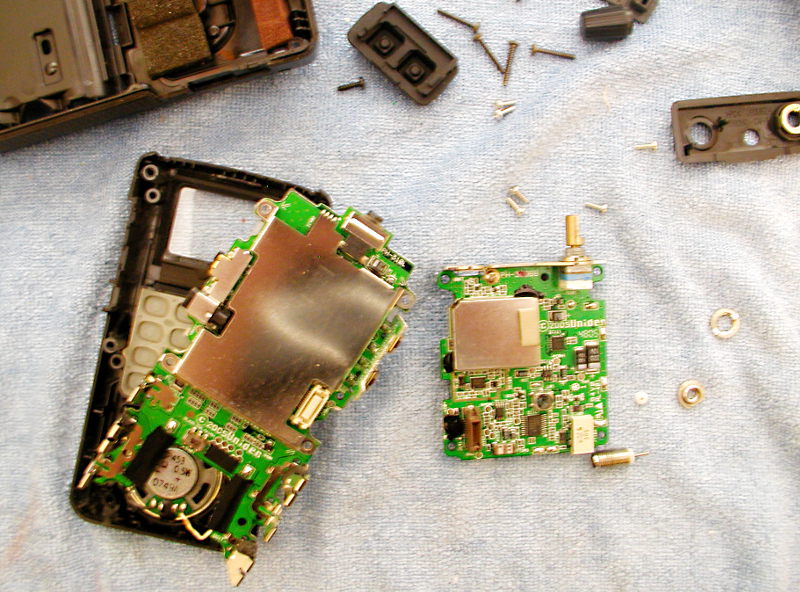
Today was a semi-productive day as well. Finally got around to opening up my Uniden Bearcat scanner to confirm that, yes indeed, the bulkhead jack for the antenna was cracked in two places:


A trip to the Sprint Shack and I have a new connector in there and can use it as a radio again. But the jack I purchased is too short so I'm leaving most of the screws off until I can get the right part from Digikey. Might replace the speaker, too -- it has been sounding weak.

Also picked up some fabric and leather, Ritt dye and a couple pieces of poster board to use as seamless backdrops for model photography. Which is overkill for the size of most of my props these days:


That's my very first 3d print, BTW. Found the file on Thingiverse, printed it off in my new roll of pink SLA, then sanded the heck out of it. Tried three or four times to get a nice color on it. What seemed to sort of work was a primer coat of (bright yellow!) Rustoleum Super-Coat, followed by Tamiya Olive Drab2, then wet-sponging with a mixture of mostly pthalo green and burnt umber, with a couple of coats of gloss to cover.

The artists were inconsistent -- not only do promo pics not resemble the in-game prop, not only do neither resemble the official collectable shipped with the pre-order game, but it is rendered several different ways in game! That said, this is a pretty poor approximation of any of the versions, but it was fun to make.

And after all of that seamless-backdrop stuff, I still find I prefer taking prop pics with all sorts of random garbage in the image:


(That's a nautical clock, actually. And real charts, although I think they are Chesapeake Bay. And a far too modern and clean-looking reproduction firearm as well. I used to throw handfuls of NATO 5.56 crimps into the background, but I gave those away...)

Friday, July 10, 2015

Oops

Logged on to the Tormach CNC mill today.

On the plus side, I figured out how to use the software "wizards" to face a piece of stock on the Tormach itself (these are tiny sub-programs made available in many CNC tool drivers that allow semi-automated, semi-manual operations to be performed).

On the minus, my G-Code was bad. The code I'd sent from Fusion 360 wasn't useable. And the code from Cut3D -- well, despite being within the recommended tolerances, the moment I made my first machine pass it ramped down steeply and snapped my good end mill clean off.

Oh, yes. And the setscrew was completely stripped on the quick-collet when I got the machine (fortunately -- maybe fortunately -- I knew how to install a regular collet), and someone had left a stop secured to the vice...and it took fifteen minutes of searching the shop to find the right allen key to remove it.

This is the problem with a rental tool facility. The Tormach has the problems above. One of the two lathes is still out. Three of the 3d printers are dead. And the reservation calendar is starting to stretch for two weeks in advance.

I'm getting a real case of buyer's remorse here. I chose to pick up a year's membership at once because it was much cheaper. But that was a lump sum I really can't afford this month. I'm down to too little to pay bills. And nothing lined up to cover next month's rent.

Which is another reason to seriously rethink the Raygun prop. I think I need to turn to projects I know will earn money (I'm basically doing the Raygun at a loss) and come up with the cash to have the body printed at Shapeways instead of trying to machine it out.

(And, yes -- I could print it at TechShop, but it would take a week's worth of reservations and the tolerances wouldn't be as good. I've rather rethought the usefulness of being able to print there, as well. Printing is just too time consuming, and the lack of available machines and the short reservation period makes that a big problem.)

Thursday, July 9, 2015

Keeping Tabs

The CAD file is complete and I have the CNC mill reserved for tomorrow. And I've run into two critical problems while setting up the actual tool paths.

The first is the growing realization that I won't be able to achieve the shapes that are on the CAD. Not, at least, without significant hand-work. There are too many curves and angles to make traditional milling possible, and the contour milling leaves too many fillets behind. So there is going to be time-consuming clean-up.

The critical one, at this moment, is a seemingly tiny problem. I can't set up support tabs in Fusion 360. Within, say, Cut3D the available tabs are primitive but they do the job:


Fusion 360 doesn't have that easy option. There are tabs in some of the milling operations, but they aren't global. And there are also some operations that can be instructed to stay clear of objects that could be part of a support structure. It may even be possible to define a set of tabs as a "fixture" -- I'm looking into that now.

But basically, I'm at a point of crawling through forums and watching endlessly slow, fatuously self-pleased instructional videos hoping that one of them may happen to mention this essential work-holding issue, and that it will be appropriate to the version of the software that I'm running (a perennial issue with Fusion 360, as they are re-writing it faster than anyone can document it).

Fortunately my fall-back is looking more plausible.

Cura (which is a freeware multi-platform "slicer" for 3d printing) estimates 1:58 to print the largest of my pieces. Which based on experience is about 1/2 the time the printer will actually take, but that still makes it just possible within a single machine reservation.

Even better, they all fall into the "within the density where calculations are performed on the bounding box" at Shapeways, to the point where all the major parts can be printed for under a hundred bucks total! If I had any spare cash at the moment, I'd probably put an order out right now just to be on the safe side...


I'm also depressed because I'm working sixteen hours a day trying to complete this commission and I'm flat broke. Can't even go look for work because, well, sixteen hour days trying to complete an existing commission. And the thing is really scaring me now. I don't know if I will be able to complete it (and it is already well behind on the delivery date I wanted.)

Well, maybe. If this thing gets done, I'll move on to the Jubal Early (which will be a lot easier based on what I've learned now). Heck..from what I've learned already, a PPG would be straight-forward. Perhaps even more straight-forward! If I can just survive a few more months, I just might be able to move on to some of the machined props people have been asking for. And one or two of those would pay my way for a considerable period...

Monday, July 6, 2015

Raygun XIII.II

So still haven't started cutting metal.

Been working hard to get there...pretty much exhausted myself; ended up crashing early on the evening of the 5th and sleeping over ten hours.

Where I am now, is where design for function, design for assembly, and design for manufacturing all butt heads. The shape of the gun is fairly fixed now; it's been through too many stages of prototyping and approval for me to make significant changes in dimension or shape. So I have to design the actual milled parts to support that shape.

Which also, of course, have to fit together. And it has to be possible to assemble them (not the same thing; this takes into account assembly order, tool access, and so forth). And they have to be manufacturable. Which is to say; I need to be able to create those shapes on the mill.

So one of the things I've been pushed into over this past week is to generate all my GCode in Fusion 360. There's one obvious utility; this means I can tweak the GCode right on my laptop during the actual milling session.

The stronger necessity, however, is to have better selection over which operations are performed on which part using which tool.


The CAM software I learned (and cut with) previously looks like this:


It is a friendly-looking interface, with helpful pictures. Fairly powerful, and even more advantageous, it has already made a lot of the more complicated decisions for you, presenting a simplified pallet of choices that is easy to navigate.

The CAM interface for Fusion 360 (which apparently is based around a fairly mature existing CAM package they licensed) looks like this:


There are a lot more options.

The advantages here are several; first, you have more algorithms (such as the spiral finishing path above) that can optimize speed and final finish. Even more importantly, there is a lot more choice in what you cut. In the above, the finishing pass is restricted to just the object itself; it isn't attempting to make passes through the entire bounding box.

But beyond that -- for several of the parts I have, I need to make sharp corners in order for them to fit together. But these same parts also have compound curves that need to be gone over in contour passes with a tiny ball-end end mill. Fusion gives me the opportunity to create specific operations that will place the flat end mill right into those right-angle corners, whilst leaving clearance for the finishing passes on the rounded bits.

More or less. It takes even more work to set all this up in the files. In a number of places I am better off re-thinking the mating surfaces so I don't have to do these passes this way.

And the big downside is I don't know what a lot of the options actually do. Which means I have a lot more work in setting up feeds and speed and clearances to make sure I'm not going to crash the head or do something else nasty and expensive.


Oh, yes. And I spent a while worrying about whether I could even get the end mill down into some of the deeper features (especially on the main body, which is over 1.5" wide). I looked up various end mills at Grainger and other companies, pulling down lots of numbers on available flute length (the real key to cut depth), as well as other numbers for stick-out and collet clearance.

And I'd forgotten that when I ran off my first test part, I'd already purchased my own starter set of mills. And the primary one has a nice generous flute length that is at least 1/8" larger than any of the ones I'd been looking at. Long enough, in fact, to have no trouble at all reaching down into the deepest pockets on my workpiece.

That still doesn't solve everything, though. There are still spots where the cut is going to end up rounded over, and I have to compensate for that in the mating surfaces. And there are still a few spots where I didn't think out the geometry properly and some of the cuts are actually impossible (as in, overhanging material). So I still have a few days of tinkering before the files are really ready.

And then when I hit the machines, I expect to find out a great deal more.