Saturday, September 29, 2018

Jade

A jade necklace showed up in Tomb Raider 2013, the first game of a new reboot of the venerable series. I made a copy myself working from a file on Thingiverse, but now that the new Tomb Raider movie is out WETA Workshop has weighed in, making it canon that (despite in-game appearance to the contrary), it is actually a pounamu necklace from New Zealand.

This is mine, not WETA's

The 2013 game is all about the lost kingdom of Yamatai and its (undead) Queen Himiko. Well, the archaeological news of the day is that more indications have been found that the real Yamataikoku (mentioned in Chinese texts as flourishing somewhere around the 3rd and 2nd centuries) may have been located in Nara Prefecture, at the present-day archaeological site of Makimuku.

Yeah, I like that necklace (so does my sister...she borrowed it and I've never gotten around to making another). So I put it in my 100,000 word Tomb Raider fanfic (the story that got me really hooked on historical research). Since I was mostly using the earlier, "Crystal Dynamics/Tomb Raider Trilogy" canon, I made up my own back story for the necklace.

I pretty much threw a dart at a map, and in my fanfic, Lara had found the jade necklace at....Makimuku.


(I also came this close to name-dropping the lost city of Kitezh in the fanfic. That was a year before any details were released about Rise of the Tomb Raider. The plot of which includes....Kitezh.)

Wednesday, September 26, 2018

Pushing peanuts up Pike's Peak

That's progress: I've reached a point where I can't play any of the parts in the piece I'm trying to record.


That is to say, I can't play them the way I now want to. Welcome to the uncomfortable intersection between expressiveness, artistic intent, technical proficiency, and standard practice.

I wish I had a better term for "Standard Practice." Almost all instrumental practice has a school-trained version. It may be recent, it may take place out of the classroom, but it is there. There are accepted, known ways to do things for every instrument out there and lots of people who will advise you learn to do it that way.

And I don't disagree. For starters, there's idiom. I was just reading a blog post from a cornet player who is learning the shofar (Hebrew ritual rams-horn trumpet). The mouthpiece is small and painful to use. So...change it? The sacred tradition says don't do it. So that's standard practice. Or, in this case, a liturgical tradition. But, hey, if you change that mouthpiece...it doesn't sound like a shofar anymore. So that's idiom.

And that's the point for me. Sounds can come from anything and if it meets your musical needs to pound on the side of a saxophone with a ball-peen hammer then so be it. But if you are coming to that instrument with the desire of a sax riff, well then, you need to play it like a sax is usually played. You need to learn standard practice.

The instruments of the symphony have their long traditions. Instruments like electric guitar are often learned by ear, self-taught. But even then there were players that were respected, a repertoire that was known and quoted, approaches to plucking and fretting that could be gleaned from interviews and videos and discussions long before School of Rock and video lessons and friendly YouTubers showed on the scene. The vibe is different, but the idea is the same; there's a Standard Practice and the beginner is strongly advised to learn it.

And that's the other side of it. Standard Practice got there because it works. There are unique ways of approaching every instrument, and players who have applied them to great success (the story is Harpo Marx fired his classically-trained harp teacher because the teacher kept wanting to learn from the (self-taught) Harpo). In any case, these are approaches that have been hammered out over decades and work for most people.

And yeah -- there is such a thing as outsider art, but the idea that learning the standard way will somehow stifle your creativity and cut off your chance of developing a unique voice is nonsense. Especially since very few of us are really in a place where we want to be totally unique and individual. We want to be in a place where we can speak to an existing audience with existing tastes, and where we can find work among people who speak the language of and expect a proficiency in the standards. Branching off from a position of knowledge is vastly superior to fumbling around trying to discover what has in most cases already been discovered.


All that said, some of us aren't on the Julliard path. Some are making music in our spare time, not in all of our waking hours. And for that the Hacker mentality is worth considering. I'm Theatre, myself, but Theatre, Maker, and Hacker share an emphasis on efficiency. Theatre people will use anything that's cheap and fast as long as it looks good from forty feet away. Hackers will never waste time inventing a wheel when there's a perfectly good wheel.lib for C++. And Makers will leverage new technologies in search of a better, faster....or, to be perfectly honest, more amusing...way to get it done.

And yes that's my general aim as a musician. I'm never going to be great at any instrument, or music in general. I'm unlikely to even be good. I'm too fascinated by the total picture to want to spend all my time polishing my chops on a single instrument, no matter how versatile it is. So my goal is to find every shortcut possible, find ways to get the energy and verite of a real instrument in as little time and money as possible and put it into a recording.

And the piece I'm working on now is where those two ideas collide. I'm trying to write idiomatically; I'm writing not just for the sounds of bass, trumpet, and piano, but something that sounds like it would be played by bass, trumpet, and piano. So it isn't a bass sound. It isn't even a physical instrument making a bass sound. It is an instrumental line using the style and techniques of an (upright) bass.

The trumpet line comes closer to being something I can cheat. The aim -- the idiom -- is a vocal, raspy, dirty sound with a lot of english, a lot of slurs, plunger work and growling and so on. To some extent, the overall artistic intent is achieved regardless of what control I have or don't have over the nuances. (Basically, I can miss a lot of notes and it will probably come across that I intended it that way.)

But only mostly. It can be as dirty as I'd like but to sound like an actual horn part played by a real (experienced) player I also have to -- sometimes -- hit the pitches. Get a clean tone. Be in time. Which is to say, I can fake it 90% of the time but I have to have the technical proficiency to get it right at least some of the time.

And now the piano part is in a similar place. I originally was going to comp some chords, or noodle around doing the kind of improv I used to do back at the common room in the dorms. But the higher artistic goal asks a recognizable style to the piano part -- I'm currently thinking Gospel -- and that takes chops I don't currently have. I can, just barely, write the parts, but I can't get my hands to perform them.


So in the sense that Standard Practice is a good tool to have, this is a good piece for me to be working on. I've reached a point in harmonic development where I'm using chord shorthand instead of dots on a line. I'm back to basics and doing exercises on bass and trumpet.

But I still wish I was recording. Other obligations are crowding up fast and it's getting hard to find that hour of instrument practice every day.

Wednesday, September 19, 2018

Frog in a well

The books do warn about developing bad habits. I disagree, though, that they take as long to unlearn as they do to learn.

My experiments with less pressure, soft blowing, and other changes to my embouchure that permitted falls and slurs meant I basically lost my old embouchure. But that's okay; it wasn't right and it needed to be changed. Now I have the makings of a new embouchure and I'm practicing a lot this week to climb back to where I was before.

Well, sort of. For a few days there I couldn't play a line without burbling. Now the line is coming back, but with better tone and control, less fatigue, and more flexibility.


The bass is at a similar place. I had never practiced muting. I hadn't been walking fingers and my fretting hand was curled. But since I have so much less time on the bass (really, it is more I have a lot of time building fretting and plucking habits on other instruments) it is more a matter of learning some fundamentals of stroke and fret before I can actually practice in earnest.

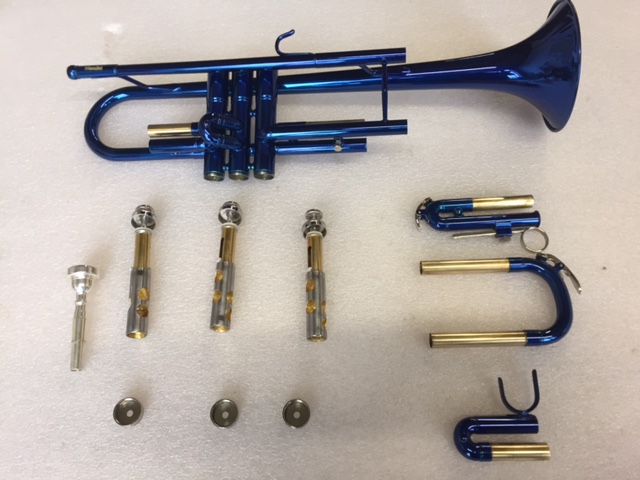
Which means most of my practice time lately has not been tunes or parts. On the horn, for instance, I'm spending a significant time blowing into the mouthpiece...without the horn even connected to it.

(The image to the right is from when I cut into my Kala Ubass to change the pickup. Among the things I had to do this week was rub the strings -- original Road Toad Pahoehoe "gummi worm" strings -- with talcum powder to tack down the stick, and replace the battery. I used a LiPo from the Holocron project, which means I have the only bass in town that can only be recharged from a Jedi Holocron.)


Oh, yes. And I'm delving deeper into music theory. Let me put it this way; I'd gotten the idea into my head that a dominant seven was built on the seventh degree of a scale (it's actually a V chord with a flat 5th. More or less.) Okay, blame inconsistent shorthand in some of the material I was reading. There's a lot of places where Roman Numerals aren't used for chords; like describing a Gospel style ending cadence as a "2-5-1" (since Gospel rarely uses simple triads, preferring four fingers or more per chord, that 5 is almost inevitably a dominant 7.)

So I'm not actually slipping down any on this one. I'm just spending most of my keyboard time scribbling on staff paper and not tickling ivories...err...acrylics...

Atlantis keeps popping up like a cork

I'm committed to the Crete story, and following it a bunch of fun stuff in New Kingdom Egypt. On paper sounds amusing enough; the coming of the Sea Peoples and the beginnings of the end for the Mycenaean civilization in the Aegean at the end of the Bronze Age, through the eyes of a young woman. And for Egypt, an extended musing on the process of understanding history and immortality set in the worker camps of the Valley of Kings and the ruins of the royal city of Akhenaton.

But I can't help think of things that are easier to write.


My trouble with Atlantis is that it isn't possible, not as given. This is true for pretty much all the popular conspiracy fodder, from Lemuria to Hollow Earth to the Bermuda Triangle. (Which is to say, the ideas that are well-known enough to attract a casual reader's eye, detailed enough to be easy to write about, and "big" enough to spin some epic about.)

Re the latter, archaeologists get excited about whether overshot flaking was developed earlier than supposed, but its hard to imagine chase scenes and gunfights erupting over that secret.

So, yeah. You could come up with an original mystery that isn't as badly contravened by the evidence as is Atlantis. Say, that Great Zimbabwe had steam power, electrification and sent explorers as far as Wisconsin. (One has to assume the Rhodesian Government did a hell of a lot more covering up than they are even historically blamed for). Or if hard tech isn't to your taste, that the real source of the Mayan mathematic genius was the Norte-Chico civilization, who had moved far beyond Set Theory into multi-dimensional manifolds and chaos math. Or if biological advances are your go-to, that the Sumerian King List is actually factual, that they had somehow managed to bred for extreme longevity, and aside from some of the Noachian patriarchs and odd hanger's on like Lazarus the line died with them.

All bunnies above are free for the taking, by the by.


Atlantis just doesn't work, not in the real world. There's three major ways around it. One is to change Atlantis, but by the time you've made it a town in the Italian Alps in around 200 AD there's hardly a point in claiming any connection is left to Plato.

The next is to assume it is, indeed, fake. You can go an Eco-ish route with this; either people who can't accept it is fake and build their own conspiracy around it, or it is indeed balderdash but in the process of looking into it anyway some totally unrelated thing is discovered. ("Look, guys, it isn't a Deep One after all -- it's just old Mr. British Petroleum trying to hide his fracking operation!")

Or, you change the world. (Actually, you pretty much have to change Atlantis a little anyhow. Continent filling the ocean and diving beneath the waves in a day? Not going to happen on this globe). I rather like the possibilities of this one. Plato wrote, then other writers added to, commented, criticized. There is archaeological evidence. Basically, it was a real place that left a real impact on the historical and archaeological and, yes, geological record.


And that brings me around -- Atlantis not necessarily included or wanted -- to two very different books I might prefer to be writing.

The first is the Fake Real. A story set either in a period of historical archaeology or in a couple of periods, with the discoveries made in one era being amplified on by another. The later would allow you to put both Carter and Ventris in the same story. So in this one, the past is stranger than it is in our world, and so is the present. Not only do some of the hidden technologies of the Atlanteans (or whatever) start showing up in the shops of London or as weapons in the wars, the historical characters themselves become para-historical; younger, stronger, prettier, more accomplished.

The other is the Real Fake. A story set in modern day or, better yet, somewhere between the 70's and the 90's (between the rise of Von Daniken and the rise of the cable TV pseudo-history channels.) Not only are the Lemurians as fake as they are in the real world, so is the archaeologist; a Remington Steele type created by a television show to be the world-famous discoverer of a new secret every week. Except that their patsy develops a conscience. Hence tension...and story.


Monday, September 17, 2018

Learning to Fall

Oh great. I'm not ready to record, not at all.

Not that I can't play the parts. I can. And not that I'm a stickler for doing things "the right way." And not even because I'm a respecter of idiomatic (if you aren't going to play a line the way a bass plays it, then why aren't you saving time and bother and just doing it on keyboard in the first place?)

Point being, technique does show. And this is a piece where it shows. The bass part, for instance, is just too exposed.

And it informs me just how much of a beginner I really am that I didn't even know how important muting is on the bass. How much it is an essential part of technique. So I'm trying to learn those finger tricks because I can totally hear the difference it makes in how the part sounds.

The trumpet is at a similar crisis. I've been blowing past little warbles in my tone, calling them a lapse of concentration or something that is unlikely to spoil the final take. Except they aren't. They are signals that my slotting is insecure, and basically my embouchure is wrong. And as I'm working on that, I'm more conscious of flaws in my tone.

(What really nailed it is falling exercises; basically, bending a held note up and down my whole range with either the half-valve technique or with the mouthpiece alone, no trumpet. And I've got spots where it burbles and breaks up. Not good.)

Again, this is stuff I didn't hear when practicing. I'd hope I would have heard it when trying to do the final mixdown. I'm pretty sure my listeners would have heard it in any case. So just as well I'm catching it now.

Just means I've got weeks more learning of basic technique before I can roll tape.

Saturday, September 15, 2018

The Octave Key

I've on the edge of a breakthrough on trumpet. Was working on doits and falls, read a couple articles, ended up watching a batch of videos, and there's a whole bunch of related stuff in there.

Okay, simple stuff first. The key to the fall is the half-valve trick. I'd already learned half-valve as a way to slur between two valved notes. Well, if you hold the third valve at the right spot, you can gliss all the way up and down your range.

But the more important thing. I knew not to grind the trumpet against my lips to reach the higher pitches. I was consciously avoiding hauling back on the pinkie hook (what some wags have called the "octave key" on the trumpet for just that beginner playing fault.) But I was still pulling back, only with my support hand instead.

One of the sillier-looking exercises is to put the trumpet on a table (with a towel to protect it) and see how far up you can get without pushing it off the table. For me was better approach to continue playing as softly as possible, but being conscious of keeping the pressure as light as possible and the air flow high.

While doing this I stumbled on a nice controlled pedal tone. And that, too, is considered a good exercise; work from the pedal tone up through the slots, instead of starting with the usual "lowest note."

(Refresher here; the trumpet plays a harmonic series based on multiples of the physical length of the piping involved. The "Bb" of a Bb trumpet, usually considered the lowest open note, is actually the first harmonic of a series that starts an octave below. Or, putting it in standard nomenclature and transposing to C -- it is a transposing instrument after all -- the series goes CC, C, G, c, e, g. )

And, yeah, it worked. At the end of all this I could play longer with less fatigue and reach most of the slots with less effort. And snap between them faster as well.

(Oh, yeah. And after reading some technical stuff about adjusting mouthpieces, I tried changing the gap slightly with a bit of electrician's tape around the stem of my current 7C. It didn't hurt, and it actually feels like it may have helped.


Went to the practice room today. Looks like the pedal tone I've been discovering is with my lower lip -- also explaining the nasty sound I'm sometimes getting; it is actually a split tone, with each lip vibrating at a different pitch. The relaxation techniques have ended my left hand death-grip and made the first octave smoother and faster, but the upper range remains a difficult push.

Thursday, September 13, 2018

When Pixies Growl

Got a Humes and Berg #112 in the mail. It isn't at all the sound I expected but it is a sound I'm sure I can use. Basically, it sounds like you are growling even when you aren't growling, and it seems to make it easier to growl when you do growl.

It's almost too much, though. With the #112 and the Home Depot plunger, I've got wah-wah, plunger vibrato, lip vibrato, growl, multiphonics, flutter tongue, slurs. And it starts with a dirty tone. Of course I'm not good enough yet to do "true" growl or shakes. But that's still a surfeit of options to ornament a melodic line.

And on the supporting hand; I'm all for ornaments and articulations and variations in tonal color. That's one of the things that's attracted me to live instruments over canned sampler patches.

But at the same time it is too easy to get lost in fancy techniques and not tend to basics. I have this nagging feeling that the great plunger mute players achieved their emotional power in part because when they landed on the note, they landed dead on.

Me? I'm not terribly on pitch even without a mute. All mutes drag you off pitch, and some mutes fight you as you are trying to slot. The #112 is no exception. Covering the bell completely with a plunger only adds to the difficulty. Seems to me it is going to be a couple more weeks of rehearsal before I can record this particular piece.