Monday, June 29, 2015

Fusing

I'm really starting to like Fusion360. At least, for parametric models. I have no idea what it looks like in mesh and whether the output would be useable in the Poserverse. One big one; unlike my usual mesh modeler (Carrara), booleans work great in Fusion. In fact, booleans are emphasized by the software.

So I'm making pretty good progress figuring out all the internal bits and pieces that hold the raygun together and put the electronic parts where they need to be:


As a little recap; this is a commission prop, with a firm due-date (now less than seven weeks away). The spec was a retro-looking raygun; "Jetsons, but as if it were real." Thus metal-body construction and exposed hardware.

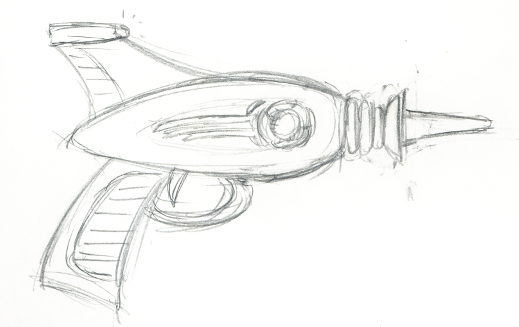
After several weeks of sketches we hit on the right look:


The first thing I made was a paper mock-up, extrapolating from various gun-like objects I had around the house to scale the grip and body. That mock-up showed the dimensions needed a little more tweaking:


Next, to help visualize the thing, I made a second scale drawing, cut that drawing out of foam-core, and when the dimensions seemed decent, padded up the foam-core with expanded polystyrene:


Sanded down, smoothed out, painted silver, it gave me a good sanity check on the shape and I could let the client hold it and see how it looked on her. I made a few notations at this point for adjustment to some of the dimensions:


After that the project moved into CAD. More problems had to be solved within CAD, and I made several changes -- some of them accidental, such as the new direction of the grip texture. More emails back and forth. I also went to Urban Ore to look at old drills and similar tools to brush up on appropriate assembly details. But at last, the outer shape was set. This is a quick render from inside Fusion360:


And now the internals are getting finished up in the CAD -- this week I'll finally be able to start cutting metal:


And since the mock-up had been useful getting to this point, I spent a little time modifying it to reflect the new shape:


Don't mourn -- it will get all smoothed out again. (And next time I do something like this, it will be done with MDF and Bondo so it can take details properly and hold up to the rigors of casting or forming). The mock-up is better already; it is pink now:


Oh, yes. And I shipped the latest grenade order, bringing the total number of Aliens M40's I've made and sold to....44. Which would look something like this, if I still had any of them here:


Sunday, June 28, 2015

TechShop: Tool Data

TechShop does not believe in having a lot of information online. But neither do class handouts, or even Front Desk, make a good resource for when you want to know what kind of machine it is, what size materials it will handle, what tools fit, etc.

I'll likely come back and re-visit this entry frequently as I find out more. All data is for the San Francisco TechShop, and is current with my posting dates.


Vacuum Former: It is a Formech FM660, with a street price of $8,000 or so. It can handle sheets up to 26" x 26", with a forming window of 24.5" x 24.5", and up to 1/4" in thickness (thicknesses over 4 mm, however, are not recommended). Styrene (available at craft stores and in the form of "For Sale" signs at larger hardware stores), ABS (available at Tap Plastics), polycarbonate, extruded acrylic and PETG all work. TechShop carries pre-cut PETG (forms extremely well, food-safe, clear) at the front desk. I have only used PETG on this machine.

3D Printer: TechShop SF is currently down to ONE functional printer, a Type A Series 1, 2014 model with the metal frame (currently selling from Type A for $2,700). It can handle PLA, High Carbon PLA and PET filament and has a print volume of one cubic foot (12 x 12 x 12 dimensionally). It includes the CURA software that already has the printer's profiles built in. PLA filament in several colors is sold at the front desk at as low as $34 a roll.

Metal Lathe: TechShop SF currently has two Jet GH-1440W3 lathes (about $12,000 new), of which one is currently broken. The universal tool post appears to be a BXA, and the tool holders in shop can handle 3/8" tools. The lathe has a swing of 14" over the bed, 8.5" over the cross-slide, with 40" between centers. The gearbox can (apparently) handle metric and inch threads. It is an engine lathe with gear-driven horizontal and cross travel, with a manual compound rest on top of that. There is a Acu-Rite DRO (Wizard 411) that reads down to ten thousandths for horizontal and cross travel only.

Mill: There are two "Bridgeport" type mills from Jet, capable of handling steel. Model number appears to be JTM-4VS. A basic selection of well-used end mills are available at the check-out desk, as well as some smaller end mills (mostly suitable for the Tomach, below) sold at the front desk.

Laser Engraver: There are 4 Epilog lasers in the 60 watt range available, as well as two other lasers reserved for the really serious users. These appear to be the discontinued Epilog Helix (price around $24,000 with filtration system included). Bed is 24" x 18", a size that is also sold downstairs in 1/8" and 1/4" acrylic as well as laser-compatible (?) MDF. They can cut or engrave acrylic, most woods, rubber, delrin, styrene, paper, cardboard, and engrave some ceramic, stone, glass, and coated metals. They can not engrave raw metals or cut them at all, nor should they be used with foam-core, PVC, vinyl, expanded polystyrene, ABS, and several other materials. The shop does not recommend cutting anything thicker than 3/8". I have used acrylic and sheet styrene with good result.

CNC Mill: this is a Tormach PCNC 1100 (base price $8,400). It has a 1.5 HP motor, and the table is 34" x 9.5". The shop is strongly disinclined against cutting anything harder than aluminium, but it can (supposedly) handle a 1/2" end mill easily. Takes Mach 2/3 Arcs (inch) G-code, as well as G-code Arcs (inch) with the *.tap suffix. Cut3d, which includes a compiler for the above formats, is on the machines upstairs (as are several CAD and 3d programs, notably the complete suite from Autodesk). The front desk has ball nose and straight end mills for a very reasonable price, but the only aluminum are blanks suitable for carving injection molds.

Shopbot: The SF shop has three. First is a PRSalpha that can handle stock up to 4' x 8' x 6", with collets for 1/8", 1/4", 3/8" and 1/2" shank. They may be getting a better supply of bits to be sold from the counter. Soon.  They also have a "Buddy" (24" x 48", I think), and a desktop model with a 24" x 18" bed. The Alpha goes for over $17K new, and it whizzes through birch ply, cutting out a coaster in a minute or two. It can handle most woods and many plastics and composites.


Friday, June 26, 2015

The Amazon Effect spreads

..to my "local" hardware store.

OSH has revamped their branch to be tighter organized by project, instead of the former organization by general category. This makes a certain sense in their desire to serve more DIY traffic; the hope is that someone will walk in saying "I want to put a new sink in the bathroom" and they will be directed to a part of the store that has everything to put a sink in, but only what it takes to put a sink in; no confusing options or related tools or parts.

This is of course entirely bogus for any project that can't be so easily categorized. And I don't just mean prop creation. What about if you are trying to repair an existing sink? What about if you are trying to put a sink into a non-standard room? What if you are trying to hook up one of the small on-demand water heaters that are getting increasingly popular? Or what if you are putting in a shower, but several of the parts are shared and usually found closer to the sink section?

Even my second favorite online electronics source -- Adafruit -- has succumbed to this. Their site is now primarily organized to require you to drill down by application. So are the LED driver chips in Cosplay, or in Arduino?

Not saying the reverse can't be an excess. Digikey offers everything, period. You drill down using consecutive booleans, and hope you didn't over-specify too early in the search (as in, limiting your parameters to switches in the 500ma range as you try to find smaller and smaller switches, without realizing the keyboard type switches you are looking for actually have a higher rating and thus are not showing up in your selection).

But you can do a two-tier system. Generalized search, paralleled by helpers. Amazon and Adafruit both do this...the problem is the lead-you-by-the-nose search is prioritized to the detriment of even basic functionality of the more open search. In Amazon's case, boolean search terms are largely broken and the filters are too open. And there are excessive pop-ups taking bandwidth from your computer and, more importantly, your own attention, each desperately hoping they've found the One True Box that you will then make lots of purchases from. Adafruit, unfortunately, takes the latter to an excess mostly due to the huge graphics and code load of their current pages. It is all but impossible to navigate their site with DSL now -- I need to go into the shop to use the ultra-fast connection there!

Philosophically... well, that is part of the process of learning anything. That is, learning the envelope, the parameters. How are things called? How are they categorized by the majority of users? You learn, over time, that a handsaw does wood, a hacksaw does metal, but both are hand tools. So if you want the latter, you look for hand tools but steer away from the obvious wood-working tools. In everything you attempt you find yourself needing to learn the names, the concepts, the implicit groupings; the territory.

You learn how the slag hammer is used when you learn to weld (stick, that is), and thus you know the name and shape of it and know it will probably be found with the wire brush and the sparkers, not with the mallets and the claw hammers. And this is true whether you are in a workshop or at a hardware store. Or in the Grainger catalog.

Sorting things by "Here is all you ever need to know in order to do one specific task" short-circuits this entire learning process. And to me, it is as bad -- as well as being all-too-similar -- to the Amazon urge to "Find me another book that is as identical as possible to the one I just finished reading, and don't open my mind to the wealth of other choices that are out there."

Thursday, June 25, 2015

POV

I've been musing a little on POV in fiction. An important note; Orson Scott-Card has an excellent book called "Characters and Viewpoint" that covers this subject in more depth than I possibly can.

I did writing all backwards, of course. Wrote short stories. Wrote a novel. Shopped the novel. Then sat down and spent another ten years writing fanfic and, well, actually learning something.


RaygunXII.III

I forked the CAD file, tried out several variations, emailed the client...and I think I've boiled down a little to a tweaked version that maintains things I liked about the prototype while still walking that line between maintaining that recognizable "Jetsons" ancestry but looking solid and practical:


I just can't get the insulator "donuts" any bigger without it feeling unbalanced. But the less busy fin and the longer "swoosh" and smaller dish are helping a lot, I think. I'm trying to keep some hints of 1950's propmaster here, but the "jewels" (marking intensity settings) were just a little too much in that direction. Besides...the unmarked dial means I can put any arbitrary number of behaviors into the software.

I keep wandering off into elaborate sidetracks, like the idea of a remove-able energy cell. As of the moment, I'm reserving the option but the access plate in the pistol butt is just going to be there to get at the USB charge cable. I'm also having a lot of trouble thinking in 2.5d.

Here's the thing; the majority of this is going to be run off on a CNC mill. I'm flipping parts once to do the back sides, but that means every cut I make has to be possible to reach from one side or the other. Took me forever to wrap my mind around how the catch for the butt plate works, until I finally saw that from the viewpoint of the mill, where the catch needs to go looks like a slot.

I have forty pages of sketches brainstorming the various mechanical details. But of course how they actually work out gets revealed in the CAD. The assembly details of the front don't look right in the CAD, for instance; the sketches had a more generous space for tapped holes. So I'm wobbling right now on a range all the way from woodruff keys to threading down to just throwing JB Weld in there and doing a friction fit.

The electromechanical components are all here now; medium surface transducer, lever (limit) switch, potentiometer with integral twist switch, 3W pink Cree. The metal (and acrylic) is here as well. Sigh. Always something -- a 3/8" acrylic rod would fit right in with minimal lathing necessary. But the acrylic I want isn't available in that diameter. So I need to lathe the length of the rod, which is again unexplored territory.


Doesn't help that I had a grenade order that got delayed by the unexpected dance show. I finally finished lathing them today. I'm ambivalent there as well. I have learned so much since the first orders, and on average the quality of the work continued to improve. But at the same time my patience for achieving that possible quality is slipping. I'm skipping more steps and going "good enough" more often than I should. Doesn't help that it took 10 hours over three different trips to the shop to make just four grenades -- for merely $160, as I was doing a bulk savings offer as long as the leftover metal from the last big order lasted.

Which is why I'm seriously considering another lighting hang in Mountain View, despite it being a three hour commute each way. I'm saving a big chunk now on my TechShop membership -- got a year membership at one go. But that means my cash is dropping down towards critical again.

But with seven weeks to go until drop-dead delivery date, I simply have to push aside my financial woes and move the raygun forward. At least the CAD is finally moving properly. With luck I'll be ready to start cutting metal by this weekend.

Wednesday, June 24, 2015

Raygun VII.II

The CAD has been fighting me. I always love tutorials from the people bankrolling the software; it is extremely rare when they openly admit they are only doing the kinds of shapes the software wants, and letting it make their design choices for them. A luxury I mostly do not have, as this project has proceeded through a careful series of pre-production sketches, concept models, and so on -- with client approval at each step.


In any case, the surface detailing is basically done. I've also been struggling -- pretty much, throughout the design process -- with balancing the sleek menace of a "real" looking weapon, with the kind of playful, puffed-up cartoony look we are after. I may have been looking at this model too long, but right now frankly I prefer the mock-up:


It has a sleeker feel to it. Some appears unavoidable consequences of the tooling up; the client requested the "donuts" be larger and more prominent, for instance (which felt like it required a larger dish as well). The setting knob has to be bigger in order to get fingers inside it (although I suppose I could use a knob with a knurled outer edge instead -- or even go with a chicken-head instead of the 1970's television dial style recessed disk). And the new direction of the cuts in the grip was an accident, but I think it looks better. It does, however, pull away from the strong horizontal flow of the prop.

Even the fin almost looks better as a flat slab, instead of the sculpted airplane tailfin I had originally envisioned.

But there's only seven weeks until delivery. That's already far short of my original target of having a month for the client to show it off and maybe inspire some friends to purchase their own. So I can no longer afford to do a lot of second-guessing. Including with the software; I have to accept the ways it is forcing the shapes to go and live with that.

Monday, June 22, 2015

Raygun VII.I

This project is scaring me. I'm tempted to bail on the all-metal version and switch to making a nice sculpt. CAD is going depressingly slow, and I am filled with concern about the extent of the unknowns in the process. 

Plus even though the CNC step is the big one, there is a good week of work in electronics and in the plastic parts, each.

So finally got the details cut into the pistol grip. On the surface, simple enough; create a spline, turn it into a pipe and use that as a tool to make a boolean cut. Except not, of course. I haven't found any shrink-wrap or surface following in Fusion3D yet -- only the ability to snap a point to an existing point or plane (which half the time ends up adding the point to the previous sketch or body or whatever.)

And the way that operations are supposed to stack in history...meaning you could edit the spline curve to correct the look of the cut...well, that didn't work. So I had to do the cuts by trial and error. And that was after sort of figuring out how the spline tools work (apparently there are at least two different edit modes. In one, constraints show up as icons that can be deleted. In the other, constraints do not display and the only way you can figure out if they are there is by toggling them on then toggling them off again. For every single selectable point.

The other mild success is I hooked up the 2.5 watt mono amp to the surface transducer, and taped it down to a nice solid chunk of machinery (a nautical clock I happen to own). And it was pleasingly loud, especially when I hit some natural resonances. Probably not loud enough to be impressive at a convention, but with luck this will work for the prop. I'm starting to get concerned about interior space, though. The transducer takes up a big chunk of space and there's not a large hole between where the trigger mechanism has to go and where the potentiometer is mounted for the knob.

Oh, yes. I also ordered pot, trigger switch, a rotary switch in case I change my mind...and the metal. Hopefully the CAD won't suddenly call for stock dimensions larger than I estimated.