So I'm at a lecture hall where several Makers are giving presentations. That is to say; these are people who make a living/reputation by being tech savvy, by learning to use the tools of their choice, by being flexible and clever in solving problems.
First a word of background. There are multiple video standards in the world, and even more peculiar video cable alternatives, especially in the every-changing Mac world. If there is a common standard protocol, it is component video -- followed by VGA. Practically every video projector and other conference display system will speak these standards. Whatever the flavor-of-the-month connector Apple has decided to put on their latest laptop is NOT a common standard.
And you don't have to spend any time at all on the presentation circuit to figure this out. Well before you have ever learned how to create a nice slide show, you will have realized the importance of bringing the correct adapter to connector YOUR hardware to the standards of the outside world.
Out of some two-dozen people involved in these presentations, exactly one had the foresight to bring his own adapter. Another had one on him (but I can't say for certain it was foresight). Which he loaned to the following groups, which didn't always have compatible laptops to that adapter anyways, so they borrowed a laptop from a third presenter and then struggled to transfer their presentations.
Points for clever for the group that used YouTube as an impromptu cloud server, and streamed their own video back off YouTube during their presentation.
I've gotten used to this at the rental hall I do most of my work in now, but I didn't expect to see this sort of not-planning-ahead from Makers.
On the same day, a renter is in with an ambitious music/dance show at my regular hall. Now, we've had renters before who talk up the sound guy they bring. And said sound guy then takes one look at our rather modest board and says "Um...the one I usually use is a bit smaller...."
But not this one. This guy knew boards. There were a couple peculiarities of our routing that I had to answer questions on, but even then the questions were precise and intelligent and he understood the answer before I could even finish speaking. And his sound check was wonderful. I felt so good, having someone who so really, really knew what he was doing -- as well as being so calm and professional and friendly -- using "my" board.
It was like loaning your skateboard to Tony Hawk. It was just that nice to see it getting used by someone who could really get the most out of it. (And that isn't me!)
And maybe there's some insight here about DIYers versus professionals. But I don't think so. Both of these are more like outliers. As I said...I'm used to seeing Makers being very creative about working around limited resources, and I'm used to seeing renters at our theater be, well, less capable.
If there is a take-home, it is that no matter what you are doing, whether crafting a costume for your own pleasure, or spending thousands of dollars putting on a performance, it is smart to plan ahead. Anticipate problems. Try to understand the environment you will be going into. Expect difficulties and have a Plan B.
Okay; maybe, maybe, the presenters are used to operating in a corporate world where there are always AV people on hand with adapters, internet connections, spare power supplies (also a surprise how many renters I've seen with show-critical software on their laptop and nothing but the battery in it to get it to show time. And no back-up copy or even a measly thumb drive to get the data out in case of a problem).
Except I don't quite believe it is ever that smooth. Even if you assume financial levels where everyone automatically has whatever Apple is selling this very month, therefor all the hardware and software are automatically compatible with everyone else's -- well, that isn't the environment they just walked into. They knew it was a school. They knew it was a budget situation.
Me, I'd bring my own projector. Even if the building had promised one, I'd have my own tested system. Because accidents happen. If it is mission-critical, a back-up is cheaper than refunded tickets.
Oh, and just to confuse whatever attempted parallel might be here -- the board op was a Maker. In fact, he'd run sound at Burning Man. And, boy, is that a bunch of budget improvisation...!
In other random news, I'm heading into tech but I'm already over the show. Several of the design team are already over the show. It will be decent, but we're basically ready to stop having brilliant ideas that change everything (and cause the throwing away of tens of hours of completed work) and just go ahead and nail it down and ship it out.
I also glued most of the parts inside the CBR kit and did a test fit. The existing circuit board actually fits. Unfortunately that's a naked Arduino board without space for the proper high-voltage drivers. So I'm probably going to set that board aside and solder up something completely new.
And unfortunately -- I am far from immune to failures of foresight! -- I didn't think to order something like an ATtiny2313. Which means there isn't room on a single perma-proto for the Supertex high-voltage shift register and any CPU I currently have in stock (and, once again, this isn't something you can buy at Radio Shack).
So I either need a bigger boat...err, circuit board...or two circuit boards, or wait another week and order more components. None of those options are attractive.
Monday, October 15, 2012


Wednesday, October 10, 2012
So....sloooow......
Is this progress?
 Soldered many, many wires on to the Vacuum Fluorescent Display module. Next time I do a project like this, I'm getting a display that has a serial backpack already included.
At least this is better than the poor fellow who assembled the original "Timer" prop for the TV show "Sliders." He had so many display elements, he had to use fine wire-wrap wires to connect them all!
But, of course, the high-power shift register I have is a drain, not a source, and same goes for my new love, the ULN2803 Darlington Array. So I can't actually connect this thing properly until my new chips arrive in the mail.
 Instead I worked on other circuit elements. This is a sound test; a 3" speaker is dangling inside the case from those wires.
And yes -- hard as it may be to see in the clutter of my not-at-all neat breadboarding, I am using one channel of the ULN2803 as an audio power amp! The source is a PWM pin on the Arduino, and simply writing "analogWrite (9, 120)" made for nice loud angry alarm tones. Later I'll code up some more siren-like swoops, and perhaps some Geiger Counter type clicks.
 More Arduino tricks. That's just an LED in a nice looking chrome bezel bought for a couple bucks at All Electronics. Then there's a 1 meg resistor, and the Capacitance Sensor library from the Arduino Playground. And it triggers nice and accurately, too...even running off battery with no ground to call its own.
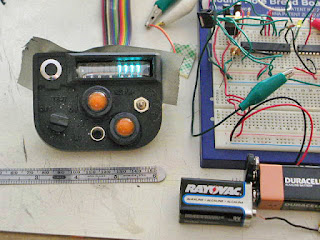 I can't CONTROL the VFD, but at least I can show it off. Here it is stuck in place with a bit of black gaffer's tape, hard-wired to display a row of "7"s. Yes, the filament voltage should be a current-controlled AC. But a small resistor is enough for this application. And, yes, the cathode really wants 30-60 volts. But it lights with 9, and looks decent with 18.
I've got both a DC-DC step-up and the parts to build a MOSFET-based boost converter on order, of course.
But now I'm in a quandary. I could wire up a static display like this, and get most of the rest of the buttons and horns working per spec, and box it up. I purchased some neodymium magnets to hold the top of the case on, which looks to be easier than affixing tiny brass screws into the 5mm plastic lip I have to work with.
I could even call that the prototype, and wait to put better electronics in a better pull (and probably a better mold) from the original master.
Or I could hold off for the driver, which should allow me complete control -- the chip I have on order is basically a 20-channel shift register good for up to 90 volts.
But either plan fails before knowledge that I start loading in a show next week. And I've got another show to run this weekend, plus meetings the next two days, and I really, really have to do some preparation and repairs for all of that.
As much as I hate it when I have to do it, I need to put the breadboard in a box, clear the work table for production soldering on other things, and haul it back out when things calm down. Even if they won't calm down until AFTER the deadline I've been trying to make.

At least this is better than the poor fellow who assembled the original "Timer" prop for the TV show "Sliders." He had so many display elements, he had to use fine wire-wrap wires to connect them all!
But, of course, the high-power shift register I have is a drain, not a source, and same goes for my new love, the ULN2803 Darlington Array. So I can't actually connect this thing properly until my new chips arrive in the mail.

And yes -- hard as it may be to see in the clutter of my not-at-all neat breadboarding, I am using one channel of the ULN2803 as an audio power amp! The source is a PWM pin on the Arduino, and simply writing "analogWrite (9, 120)" made for nice loud angry alarm tones. Later I'll code up some more siren-like swoops, and perhaps some Geiger Counter type clicks.


I've got both a DC-DC step-up and the parts to build a MOSFET-based boost converter on order, of course.
But now I'm in a quandary. I could wire up a static display like this, and get most of the rest of the buttons and horns working per spec, and box it up. I purchased some neodymium magnets to hold the top of the case on, which looks to be easier than affixing tiny brass screws into the 5mm plastic lip I have to work with.
I could even call that the prototype, and wait to put better electronics in a better pull (and probably a better mold) from the original master.
Or I could hold off for the driver, which should allow me complete control -- the chip I have on order is basically a 20-channel shift register good for up to 90 volts.
But either plan fails before knowledge that I start loading in a show next week. And I've got another show to run this weekend, plus meetings the next two days, and I really, really have to do some preparation and repairs for all of that.
As much as I hate it when I have to do it, I need to put the breadboard in a box, clear the work table for production soldering on other things, and haul it back out when things calm down. Even if they won't calm down until AFTER the deadline I've been trying to make.
Tuesday, October 9, 2012
Feeling stupid
Spent the entire productive part of the day putting a minimal Arduino on a breadboard. There's like, 12 components in total, and I still messed it up four times.
About the only thing I did right was to work step by step.
Built a 7805-based voltage regulator. Which didn't work. And turned out it was an old problem; my solderless breadboard doesn't continue the power strips the full length. So a couple of bridges, and now that's working. But if I hadn't put a "power on" LED I'd still be staring at a dead circuit...
Built the Arduino and it didn't fire up. Swapped the ATmega168 for a known good one with the "blink" program already loaded on it. And finally, after staring at the thing for an hour, realized I was holding the Reset low instead of high. And you don't actually need the pull-up resistor anyhow -- there's an internal pull-up on that pin.
Then hooked up the ISP and kept getting error messages. Stuck the ISP on to the ICSP header of a working Arduino and confirmed the tool chain was working. Was basically wiggling parts at random when I thought of pulling off the pin 13 LED. And that did it. So why isn't this necessary on a standard Arduino? What's different about my LED?
Well, finally got to the point where I could hook up the ULN2803 (Darlington Array) and proof the quick-and-dirty solution I had to lighting the VFD; to have it display "00000000, 11111111, 22222222...." And nothing. Until finally the niggling little memory of how I wired the robot came back to me and I realized the ULN2803 sinks, not sources!
Which means I can't even do the quick-and-dirty. Not on what I have.
While I wait for delivery of the Supertex HV5812P-G serial driver chips -- which I haven't even ordered yet -- about all I can do is confirm the LEDs that are going into the Dialight indicator light enclosures are nice and bright, and try to build a capacitance touch switch. Oh, and I guess I could write a simple look-up table for doing alpha-numeric on my seven-segment vacuum fluorescent display.
I would work on a boost converter, too, but I don't have a nice switching MOSFET or a Schotkey diode on hand. Nor does Radio Shack really have anything useful there.
Looks like this project won't be ready by East Bay Mini Makers Faire. And immediately following the fair I go into tech. Dangit. I could have made more progress if I had just a little more cash earlier on. Like the robot, I've had to make too many design compromises and too many gambles based on trying to work on too tight a budget.
It is a variation of the Sam Vimes Theory of Economic Injustice. When you are shy of capital, you have to proceed in ways that are actually more wasteful of funds. Worst case being, when you can't quite justify the safer, surer, but more expensive route, and gamble on the cheaper route -- which then fails, costing you as much as it would have just to go the expensive way in the first place.
About the only thing I did right was to work step by step.
Built a 7805-based voltage regulator. Which didn't work. And turned out it was an old problem; my solderless breadboard doesn't continue the power strips the full length. So a couple of bridges, and now that's working. But if I hadn't put a "power on" LED I'd still be staring at a dead circuit...
Built the Arduino and it didn't fire up. Swapped the ATmega168 for a known good one with the "blink" program already loaded on it. And finally, after staring at the thing for an hour, realized I was holding the Reset low instead of high. And you don't actually need the pull-up resistor anyhow -- there's an internal pull-up on that pin.
Then hooked up the ISP and kept getting error messages. Stuck the ISP on to the ICSP header of a working Arduino and confirmed the tool chain was working. Was basically wiggling parts at random when I thought of pulling off the pin 13 LED. And that did it. So why isn't this necessary on a standard Arduino? What's different about my LED?
Well, finally got to the point where I could hook up the ULN2803 (Darlington Array) and proof the quick-and-dirty solution I had to lighting the VFD; to have it display "00000000, 11111111, 22222222...." And nothing. Until finally the niggling little memory of how I wired the robot came back to me and I realized the ULN2803 sinks, not sources!
Which means I can't even do the quick-and-dirty. Not on what I have.
While I wait for delivery of the Supertex HV5812P-G serial driver chips -- which I haven't even ordered yet -- about all I can do is confirm the LEDs that are going into the Dialight indicator light enclosures are nice and bright, and try to build a capacitance touch switch. Oh, and I guess I could write a simple look-up table for doing alpha-numeric on my seven-segment vacuum fluorescent display.
I would work on a boost converter, too, but I don't have a nice switching MOSFET or a Schotkey diode on hand. Nor does Radio Shack really have anything useful there.
Looks like this project won't be ready by East Bay Mini Makers Faire. And immediately following the fair I go into tech. Dangit. I could have made more progress if I had just a little more cash earlier on. Like the robot, I've had to make too many design compromises and too many gambles based on trying to work on too tight a budget.
It is a variation of the Sam Vimes Theory of Economic Injustice. When you are shy of capital, you have to proceed in ways that are actually more wasteful of funds. Worst case being, when you can't quite justify the safer, surer, but more expensive route, and gamble on the cheaper route -- which then fails, costing you as much as it would have just to go the expensive way in the first place.
Saturday, October 6, 2012
First Pull
A day of discoveries. More or less the concept for molding these things proofed. More or less.
 Not bad for a first-ever pull. I think the last casting I made was fifteen years ago, in some-one else's mold (it was an overnight repair of a show-critical prop, and fortunately the master mold was right there in the shop where I could find it.)
Not great, either, but actually I only need the one. The client has only ordered one box...the only real reason to cast is to be able to model in any material but deliver in sturdy resin.
 The master survived de-molding, too, with just a few dings. So I could in theory make up a better mold from it.
That was not something I could actually hope for. All my reading suggested that masters rarely survived coming out of a silicone mold, and this is a particularly fragile master, being mostly from lightweight floral-type foam, balsa, and wallboard spackle.
So here's lessons:
1) I'm sensitive to tin-cure silicone. The first mold I did made me rather nauseated -- enough to skip dinner that night. The second one, I worked right under a window and made sure not to hold the measuring or mixing cups too close. I still got a slight upset stomach, but not enough to make me skip lunch.
2) A small apartment is no place to be casting. I need to take this sort of thing to a shop space -- where there is good ventilation, where a spill doesn't mean I risk my cleaning deposit, and where I don't have to sleep next door to chemicals and dust.
But enough of enumeration. Back to essay style.
The first mold is actually a two-piece. Since the Shapeways print already had the desired thickness, it was pretty much cast one face, flip it over, slather the silicone with petroleum jelly as a mold release, cast the inside face. That worked pretty well, but....
a) The first pour was shy a few CC's and didn't end up with a level surface. This meant only mold stiffness held it flat when I cast.
b) The mold was a bit small for a box mold (I'm really, really broke and can't afford much silicone), and had no registration keys. When I did the first pull, one wall ended up being quite thin as a result. I should be able to firm it up with a little Bondo, tho.
c) Locating a thick pour spout on the inside wasn't the best idea. It was a pain to carve away once it was cast.
The second mold was a one-piece open-top box mold for a slush cast. What did I learn on this one?
a) I fixed the model to a slab of wood, and built a basswood box around it. But by "fixed," I mean with clay. And the master is so light, when all that silicone got into the box with it, the master floated right up! As a result I wasted a bunch of mold material under it, I had to cut a big nasty hole to release the master, AND the master ended up at an angle to the box thus some of the mold walls were very thin.
b) It takes more than you think. It took the entire starter kit of Oomoo to do these two molds. And it was still a little short. Fortunately I had some plaster I could square off the end with; that was the base after I flipped it over.
c) Yes, you can clamp wood together for the box, but it would be worth it to spend longer in carpentry and have a solid box that could be dissembled and re-assembled in exactly the same position. At least it didn't come apart on my mid-cast and spill resin all over the kitchen!
d) Smooth-cast 30 is not optimal for slush-casting.
 This is what the inside looks like. More slush than cast! Also quite heavy; I used up over half of the resin in the starter kit as well.
Fortunately all that has to go in here are the electronics, but I'd be way out of luck if I tried to make a battery door now. Well...I'd have to take a Dremel to it to chew a decent hole. And that would be messy. Very messy.
As I said, all I need is one, and even the electronics is a stretch goal. But given my budget, time, and the lack of funds to get yet more casting supplies, I may just back-burner casting the MEDKIT for a few weeks. Oh, and I really wouldn't mind taking a break from the chemicals for a while, too! I really, really, should not be messing with MEK (and spray paints, and superglue, and Bondo, and so on) in a small not-that-well-ventilated apartment!
Heck...once the next show is up and running, I might just drag my casting supplies over there and work on that during the day before a performance. Seeing as they got that robot from me labor-cost free (and the debris from that project is STILL kicking around here), I think they might owe me that much.
 I could always wave the master for the MEDKIT around, anyhow. Now that it has finally gotten shiny enough where I'm willing to call an end to the days of spackling and sanding.
That might even give me time to order some vinyl lettering for the controls. Although I kind of like the spooky effect of unlabeled controls.
 And delaying the MEDKIT also gives me the time -- and the funds -- to give Shapeways a little more love. Like the funky shape here in shiny stainless steel. This is the "treatment comes out here" part for the MEDKIT. Not to scale with the box models you see behind it; the largest dimension is barely 3 centimeters.
Shapeways could also knock out some new knobs in study metal, that I could tap so they would fit firmly on the shafts of the rotary switches.
Such useful services aside, I'm still horribly attracted by the idea of doing an electro-etch of custom graphics, then rubbing color into the metal. Because that's all I need now; to be electrolyzing metal and creating hydrogen in my apartment!

Not great, either, but actually I only need the one. The client has only ordered one box...the only real reason to cast is to be able to model in any material but deliver in sturdy resin.

That was not something I could actually hope for. All my reading suggested that masters rarely survived coming out of a silicone mold, and this is a particularly fragile master, being mostly from lightweight floral-type foam, balsa, and wallboard spackle.
So here's lessons:
1) I'm sensitive to tin-cure silicone. The first mold I did made me rather nauseated -- enough to skip dinner that night. The second one, I worked right under a window and made sure not to hold the measuring or mixing cups too close. I still got a slight upset stomach, but not enough to make me skip lunch.
2) A small apartment is no place to be casting. I need to take this sort of thing to a shop space -- where there is good ventilation, where a spill doesn't mean I risk my cleaning deposit, and where I don't have to sleep next door to chemicals and dust.
But enough of enumeration. Back to essay style.
The first mold is actually a two-piece. Since the Shapeways print already had the desired thickness, it was pretty much cast one face, flip it over, slather the silicone with petroleum jelly as a mold release, cast the inside face. That worked pretty well, but....
a) The first pour was shy a few CC's and didn't end up with a level surface. This meant only mold stiffness held it flat when I cast.
b) The mold was a bit small for a box mold (I'm really, really broke and can't afford much silicone), and had no registration keys. When I did the first pull, one wall ended up being quite thin as a result. I should be able to firm it up with a little Bondo, tho.
c) Locating a thick pour spout on the inside wasn't the best idea. It was a pain to carve away once it was cast.
The second mold was a one-piece open-top box mold for a slush cast. What did I learn on this one?
a) I fixed the model to a slab of wood, and built a basswood box around it. But by "fixed," I mean with clay. And the master is so light, when all that silicone got into the box with it, the master floated right up! As a result I wasted a bunch of mold material under it, I had to cut a big nasty hole to release the master, AND the master ended up at an angle to the box thus some of the mold walls were very thin.
b) It takes more than you think. It took the entire starter kit of Oomoo to do these two molds. And it was still a little short. Fortunately I had some plaster I could square off the end with; that was the base after I flipped it over.
c) Yes, you can clamp wood together for the box, but it would be worth it to spend longer in carpentry and have a solid box that could be dissembled and re-assembled in exactly the same position. At least it didn't come apart on my mid-cast and spill resin all over the kitchen!
d) Smooth-cast 30 is not optimal for slush-casting.

Fortunately all that has to go in here are the electronics, but I'd be way out of luck if I tried to make a battery door now. Well...I'd have to take a Dremel to it to chew a decent hole. And that would be messy. Very messy.
As I said, all I need is one, and even the electronics is a stretch goal. But given my budget, time, and the lack of funds to get yet more casting supplies, I may just back-burner casting the MEDKIT for a few weeks. Oh, and I really wouldn't mind taking a break from the chemicals for a while, too! I really, really, should not be messing with MEK (and spray paints, and superglue, and Bondo, and so on) in a small not-that-well-ventilated apartment!
Heck...once the next show is up and running, I might just drag my casting supplies over there and work on that during the day before a performance. Seeing as they got that robot from me labor-cost free (and the debris from that project is STILL kicking around here), I think they might owe me that much.

That might even give me time to order some vinyl lettering for the controls. Although I kind of like the spooky effect of unlabeled controls.

Shapeways could also knock out some new knobs in study metal, that I could tap so they would fit firmly on the shafts of the rotary switches.
Such useful services aside, I'm still horribly attracted by the idea of doing an electro-etch of custom graphics, then rubbing color into the metal. Because that's all I need now; to be electrolyzing metal and creating hydrogen in my apartment!
Friday, October 5, 2012
Oomoo Loomoo Gloopity-Gloo...
...I've got a couple questions for you.
One being, why am I doing this?
 Spackle, sand,
 Prime,
 Spackle again, sand again...
I'm not just getting bored with it, and a little frustrated that the surfaces are still far from pristine, but I'm also getting tired of dust everywhere, paint cans and spackle and putty and glue and sandpaper scraps everywhere, and still bits of foam and balsa and styrene everywhere as well.
And I'm worried, too. I finally found some molding rubber (after trying multiple art stores) and I've started my first pour:
 But I don't know how well it is going to work. I could even lose the master I've spent all week sanding.
(And, yes, that's not an effect of the camera. The oomoo looked well-mixed in the cup, but when I started the pour I could see it was still a little streaky. I can only hope it will still set up right! This in addition to worrying about release from the original, and how I'm going to make a proper two-piece mold, and if I've got enough silicone for all the pieces....)
For this project, it really would have been more economical (for money and certainly for time) to print the faceplate for the MEDKIT as well. And, possibly, print the body of the CBR kit. I'm still working out how to design the molds so I'll have a proper wall thickness and the pieces will fit together to make a single unit. I just don't patience to build a full battery door, at least not in the fragile masters.
And Shapeways is probably superior for another element, too; surface.
See, there is a real flaw in the way I design things. I contrast with, say, the typical Hollywood approach. Which is to say; you greeble it up. Whatever it is, it tends to have a lot of small meaningless surface detail. If they start with a real object, they hide it under big piles of added stuff.
This isn't always the way. It is more like a scale. Steampunk at one end. The many-litlte-bits of the Star Wars universe, and many game universes. Working through the more design-centric Star Trek. And in a few vehicles, you hit the modern era of real-world design; fluid, smooth shapes with fewer "lumpy" details.
Anyhow, for whatever reason, when I sketch out a design I tend to stay pretty close to Platonic forms. Well, more like silhouettes. Like the great cartoonists like Carl Barks taught, you want a shape that will read well in silhouette; that will be distinctive, that will have emotional associations. You might detail it up, but that strong shape should still read.
 I do struggle to draw those kinds of shapes, but then when it comes to detailing, it seems I really don't. My robot had the same problem; it was one smooth glossy hemisphere, surmounted by two glossy bullet-shaped eye housings. So everything was spackle and smooth for days, even weeks.
These Morrow Project boxes are the same problem. Part of the issue is, of course, the same one the Hollywood prop builders face. Which is to say, hiding the fact that it is a model. If you've re-purposed a disposable razor, you want to alter it and detail it to hide the origin. If you've carved out of clay and wood, you want to hide the tool marks so it looks like a product of industry, not a cottage.
I swear, the next prop I build should be a fantasy dagger or magic item, so I don't have to work so hard to hide the tool marks!
Anyhow. The way this works out in the Morrow boxes is I'm trying to get the surfaces as flat as possible, with corners as defined and machine-like as possible. And that makes for a lot of frustration in time trying to clean up the shapes.
And makes it a better match for Shapeways.
(Still...printing the bodies of the boxes would be over a hundred bucks each. Although I suppose an interlocking top for easy assembly/dis-assembly, and/or a real battery compartment door, and maybe even rails to support the circuit board, are all wonderful advantages of doing it that way!)
De-molded the first piece. The Oomoo-30 set up just fine, and didn't react with the clay or the Shapeways print. Still not quite sure how to deal with the cut-outs -- break the mold there, or build up clay dikes, in which case they'd turn into giant plugs of resin... Also did a couple more smoothing passes on the MEDKIT faceplate and it is starting to look like something. So basically I'm a lot more happy with this project right now. It is even possible the CBR body will survive de-molding (but not likely -- that battery cover is going to be ugly. Unless I can get in there with toothpick and a lot of patience and seal it properly.)
I'm really coming around on the existing knobs I have, but if I do replace them, I think I will resin-cast around a salvaged brass insert. Of course that makes yet one more thing to purchase...along with olive drab paint, inductor for a high voltage power supply, screw terminals for the CBR, the mysterious "treatment" area as a stainless-steel Shapeways print, nameplates and/or custom vinyl lettering...
Now if only I had some income coming in.
One being, why am I doing this?


I'm not just getting bored with it, and a little frustrated that the surfaces are still far from pristine, but I'm also getting tired of dust everywhere, paint cans and spackle and putty and glue and sandpaper scraps everywhere, and still bits of foam and balsa and styrene everywhere as well.
And I'm worried, too. I finally found some molding rubber (after trying multiple art stores) and I've started my first pour:

(And, yes, that's not an effect of the camera. The oomoo looked well-mixed in the cup, but when I started the pour I could see it was still a little streaky. I can only hope it will still set up right! This in addition to worrying about release from the original, and how I'm going to make a proper two-piece mold, and if I've got enough silicone for all the pieces....)
For this project, it really would have been more economical (for money and certainly for time) to print the faceplate for the MEDKIT as well. And, possibly, print the body of the CBR kit. I'm still working out how to design the molds so I'll have a proper wall thickness and the pieces will fit together to make a single unit. I just don't patience to build a full battery door, at least not in the fragile masters.
And Shapeways is probably superior for another element, too; surface.
See, there is a real flaw in the way I design things. I contrast with, say, the typical Hollywood approach. Which is to say; you greeble it up. Whatever it is, it tends to have a lot of small meaningless surface detail. If they start with a real object, they hide it under big piles of added stuff.
This isn't always the way. It is more like a scale. Steampunk at one end. The many-litlte-bits of the Star Wars universe, and many game universes. Working through the more design-centric Star Trek. And in a few vehicles, you hit the modern era of real-world design; fluid, smooth shapes with fewer "lumpy" details.
Anyhow, for whatever reason, when I sketch out a design I tend to stay pretty close to Platonic forms. Well, more like silhouettes. Like the great cartoonists like Carl Barks taught, you want a shape that will read well in silhouette; that will be distinctive, that will have emotional associations. You might detail it up, but that strong shape should still read.

These Morrow Project boxes are the same problem. Part of the issue is, of course, the same one the Hollywood prop builders face. Which is to say, hiding the fact that it is a model. If you've re-purposed a disposable razor, you want to alter it and detail it to hide the origin. If you've carved out of clay and wood, you want to hide the tool marks so it looks like a product of industry, not a cottage.
I swear, the next prop I build should be a fantasy dagger or magic item, so I don't have to work so hard to hide the tool marks!
Anyhow. The way this works out in the Morrow boxes is I'm trying to get the surfaces as flat as possible, with corners as defined and machine-like as possible. And that makes for a lot of frustration in time trying to clean up the shapes.
And makes it a better match for Shapeways.
(Still...printing the bodies of the boxes would be over a hundred bucks each. Although I suppose an interlocking top for easy assembly/dis-assembly, and/or a real battery compartment door, and maybe even rails to support the circuit board, are all wonderful advantages of doing it that way!)
De-molded the first piece. The Oomoo-30 set up just fine, and didn't react with the clay or the Shapeways print. Still not quite sure how to deal with the cut-outs -- break the mold there, or build up clay dikes, in which case they'd turn into giant plugs of resin... Also did a couple more smoothing passes on the MEDKIT faceplate and it is starting to look like something. So basically I'm a lot more happy with this project right now. It is even possible the CBR body will survive de-molding (but not likely -- that battery cover is going to be ugly. Unless I can get in there with toothpick and a lot of patience and seal it properly.)
I'm really coming around on the existing knobs I have, but if I do replace them, I think I will resin-cast around a salvaged brass insert. Of course that makes yet one more thing to purchase...along with olive drab paint, inductor for a high voltage power supply, screw terminals for the CBR, the mysterious "treatment" area as a stainless-steel Shapeways print, nameplates and/or custom vinyl lettering...
Now if only I had some income coming in.
Thursday, October 4, 2012
Dead Oomoo
Is this progress?
I prepped the Shapeways printed faceplate for casting...both to save a back-up of a part that took not just fifty bucks to print, but a whole day to clean, and to practice molding on something simpler than the box.

Jolly King plasticine clay that must have been in the bottom of my Art Supplies box for decades (I switched to oven-hardening Fimo that long ago). And a jolly time reading up to find out if it was sulfur-based and otherwise compatible with my Silicone molding rubber. And even more time re-reading tutorials and the Prop-Makers handbook and planning how I was going to make the molds.
The (large) check for equipment rental I was expecting last Friday still hasn't come in, nor has the funds from selling off some old gear cleared PayPal. So I used the very last of my cash to buy plastic cups (to measure and mix the molding and casting compounds) and petroleum jelly (as a mold release).
At which point I found out I'd totally forgotten Oomoo has a shelf life. My nice big bottles of Oomoo-30 silicone casting rubber were nice big perfect interior casts of the bottles they came in.
More or less at the same time (you have to multi-task if you don't want to be wasting days sitting around waiting for paint to dry), I'd decided the vacuum fluorescent display sat too deep in the display hood to look right.
So I pried the top off the box and carved deep into the thing:

Until I had the display looking a little closer to how I wanted it:

And then started rebuilding the curves and reinforcing the now rather chipped balsa:

The standard formula Apoxie doesn't appear to grip balsa well until it is completely cured. Unfortunately that lets out the golden carving time; when it is firm enough to get good detail but still soft enough you can carve into it with an X-acto knife. Once it is completely set up it is about the hardness of soap stone...and over the next few days arrives at something a lot like granite.
So in my eagerness to get the shape re-refined, I'm trying some super-white instead (which otherwise is not my favorite).
At least I got one thing finished: I decided against any inset for the injector port. So that means finishing off the battery is the last task before the final coat of paint. There are still some random little divots and seams but I've spent long enough on this one!

(Okay...maybe a couple of panel lines or something on the battery. And perhaps some lettering..although I'd love to see if vinyl letters will stick to the mold, thus allowing me to cast them as incised letters...)
I prepped the Shapeways printed faceplate for casting...both to save a back-up of a part that took not just fifty bucks to print, but a whole day to clean, and to practice molding on something simpler than the box.

Jolly King plasticine clay that must have been in the bottom of my Art Supplies box for decades (I switched to oven-hardening Fimo that long ago). And a jolly time reading up to find out if it was sulfur-based and otherwise compatible with my Silicone molding rubber. And even more time re-reading tutorials and the Prop-Makers handbook and planning how I was going to make the molds.
The (large) check for equipment rental I was expecting last Friday still hasn't come in, nor has the funds from selling off some old gear cleared PayPal. So I used the very last of my cash to buy plastic cups (to measure and mix the molding and casting compounds) and petroleum jelly (as a mold release).
At which point I found out I'd totally forgotten Oomoo has a shelf life. My nice big bottles of Oomoo-30 silicone casting rubber were nice big perfect interior casts of the bottles they came in.
More or less at the same time (you have to multi-task if you don't want to be wasting days sitting around waiting for paint to dry), I'd decided the vacuum fluorescent display sat too deep in the display hood to look right.
So I pried the top off the box and carved deep into the thing:

Until I had the display looking a little closer to how I wanted it:

And then started rebuilding the curves and reinforcing the now rather chipped balsa:

The standard formula Apoxie doesn't appear to grip balsa well until it is completely cured. Unfortunately that lets out the golden carving time; when it is firm enough to get good detail but still soft enough you can carve into it with an X-acto knife. Once it is completely set up it is about the hardness of soap stone...and over the next few days arrives at something a lot like granite.
So in my eagerness to get the shape re-refined, I'm trying some super-white instead (which otherwise is not my favorite).
At least I got one thing finished: I decided against any inset for the injector port. So that means finishing off the battery is the last task before the final coat of paint. There are still some random little divots and seams but I've spent long enough on this one!

(Okay...maybe a couple of panel lines or something on the battery. And perhaps some lettering..although I'd love to see if vinyl letters will stick to the mold, thus allowing me to cast them as incised letters...)
Wednesday, October 3, 2012
Paint a little, sand a little, cheap cheap cheap!
(Sung to a tune from "The Music Man.")
The boxes are taking shape. The usual round of refining; spackle up gaps, sand carefully, paint with primer. See new gapes, spackle them, sand them, give it another coat of primer. Eventually I was down to wet-sanding with 220, and that's where I'm going to leave this one.
I may put a couple more details in. A finger notch above the "battery" (which is actually just a groove in the surface). Perhaps inset the "injector port" (which for the CBR is an LED in a rather medical-looking chrome bezel). But I'm a little afraid to try to make a neat inset oval carving into the curve surface that is already there (and took so much time and so many steps to smooth). Perhaps I'll just dremel one into the first casting, where it will be easier to fix.
This is assuming the pull goes okay. It has been a loooong time since I did any casting, and I don't believe I ever did latex casting. At the worst case, I could even ruin the master and have to start from scratch. Which would be really annoying.
So before that, pictures:

CBR on the left, getting the final (I hope!) divots filled. Med-Kit on the right, with a lot of shaping and smoothing still to go.
As I've said before, I wish I had a table saw. Or a full shop. Or a ShopBot. Working with hand tools, it seems smartest to carve from the lightest materials -- balsa and foam, instead of MDF or basswood. But that makes these very fragile, and I spend a fair amount of time just filling pores.
I didn't know if these lightweight materials would actually make it, or if I could make those curves, or if I was going to end up dropping another hundred bucks at Shapeways to print the whole body. Thus, no progress pics.

The CBR has two curves, both inspired from the one and only drawing in the Morrow Project official game literature. The front is rounded over at a generous radius. And then at the back is a roughly major-limb-diameter curve -- "Apply Med Kit Directly to Forehead." Err, "...Wound." The most annoying part of the CBR was actually that little cut-in corner, where the terminals to connect up the external siren go.
Harder to see (because I had it printed in Black Detail), is the top of the CBR kit.

And this is them posing; the CBR with the printed top (the components have yet to be mounted in the holes), and the Med Kit in the bag the original came in.
The core of the CBR is one big block of foam. Then sheets of styrene were cut to size and glued on every side. Then a whole bunch of filling -- with mostly wall spackle -- to smooth out the joins. The Med Kit is, on the other hand, built around an actual US Army bandage-and-aspirin box, with balsa for the flat parts, foam for the curve, and apoxie sculpt for the sunshade around the display.
I'm still of two minds about which was easier; printing the weird cut-outs, or carving them. Carving is annoying and long and I'm a little worried about how I'm going to cast it and be able to have the right shaped space to stick the VFD in. Printing was an annoying amount of fiddling to make a mesh that was dimensional and watertight and printable. But as a result it has nice flat surfaces, square corners, plus it is an exact and known thickness, making mounting buttons and lights easy.
Well, we'll see how it goes. By this time tomorrow the latex mold for the first one should be curing. And now I'm off to read Thurston James AGAIN (plus I'm now following a second amazing prop-maker here on Blogger.)
The boxes are taking shape. The usual round of refining; spackle up gaps, sand carefully, paint with primer. See new gapes, spackle them, sand them, give it another coat of primer. Eventually I was down to wet-sanding with 220, and that's where I'm going to leave this one.
I may put a couple more details in. A finger notch above the "battery" (which is actually just a groove in the surface). Perhaps inset the "injector port" (which for the CBR is an LED in a rather medical-looking chrome bezel). But I'm a little afraid to try to make a neat inset oval carving into the curve surface that is already there (and took so much time and so many steps to smooth). Perhaps I'll just dremel one into the first casting, where it will be easier to fix.
This is assuming the pull goes okay. It has been a loooong time since I did any casting, and I don't believe I ever did latex casting. At the worst case, I could even ruin the master and have to start from scratch. Which would be really annoying.
So before that, pictures:

CBR on the left, getting the final (I hope!) divots filled. Med-Kit on the right, with a lot of shaping and smoothing still to go.
As I've said before, I wish I had a table saw. Or a full shop. Or a ShopBot. Working with hand tools, it seems smartest to carve from the lightest materials -- balsa and foam, instead of MDF or basswood. But that makes these very fragile, and I spend a fair amount of time just filling pores.
I didn't know if these lightweight materials would actually make it, or if I could make those curves, or if I was going to end up dropping another hundred bucks at Shapeways to print the whole body. Thus, no progress pics.

The CBR has two curves, both inspired from the one and only drawing in the Morrow Project official game literature. The front is rounded over at a generous radius. And then at the back is a roughly major-limb-diameter curve -- "Apply Med Kit Directly to Forehead." Err, "...Wound." The most annoying part of the CBR was actually that little cut-in corner, where the terminals to connect up the external siren go.
Harder to see (because I had it printed in Black Detail), is the top of the CBR kit.

And this is them posing; the CBR with the printed top (the components have yet to be mounted in the holes), and the Med Kit in the bag the original came in.
The core of the CBR is one big block of foam. Then sheets of styrene were cut to size and glued on every side. Then a whole bunch of filling -- with mostly wall spackle -- to smooth out the joins. The Med Kit is, on the other hand, built around an actual US Army bandage-and-aspirin box, with balsa for the flat parts, foam for the curve, and apoxie sculpt for the sunshade around the display.
I'm still of two minds about which was easier; printing the weird cut-outs, or carving them. Carving is annoying and long and I'm a little worried about how I'm going to cast it and be able to have the right shaped space to stick the VFD in. Printing was an annoying amount of fiddling to make a mesh that was dimensional and watertight and printable. But as a result it has nice flat surfaces, square corners, plus it is an exact and known thickness, making mounting buttons and lights easy.
Well, we'll see how it goes. By this time tomorrow the latex mold for the first one should be curing. And now I'm off to read Thurston James AGAIN (plus I'm now following a second amazing prop-maker here on Blogger.)
Subscribe to:
Comments (Atom)