Or bash it aside with your shield, if you are following protocol according to Homer.
When I heard the rumor the next Assasins Creed game would be set in Greece I worried. Then I saw the title was Odyssey. That's all I needed; for a major AAA game to be set in the Heroic Age, especially if they went all accurate about bronze age Aegean culture. A three-hundred person team with years to work can do some pretty serious research.
But, thankfully, the game turns out to be set during the Peloponnesian War. (More-or-less. The Assassins Creed series has very nice looking history, but the actual events get a bit bollixed.) In any case, this is high Classical Greece. Four hundred years after "Homer penned" The Odyssey and eight hundred years after the setting of my novel.
Although, from the looks of the previews I've seen, the lead dives on what looks suspiciously like a sunken Minoan palace, and meets what has to be the minotaur.
So maybe it isn't just my current focus that has been making me notice more and more of the Classical age (that is, Greece and Rome) getting talked about in various corners. Maybe there's a renewed interest in those corners. Not that the classical world ever went away, but we are today far from the mindset of Schliemann and his contemporaries, who lived and breathed Greek Myth and the Glories of Rome in a way that shaped their perception of the past and their overriding goals in learning more about it.
(The game is also a full RPG with a dialog wheel and "choices that matter" in the Mass Effect et al style. And nary an assassin in it, cueing various people to sneer that they'd never buy it while it pretended to be an Assassins Creed game, but then they only buy Assassins Creed games anyhow.)
(One of the complaints is you can chose which gender to play. Which the purists don't like because it sort of flies in the face of the "reliving the genetic memory of your ancestors" thing the games were originally built around. I'm unhappy because as egalitarian as I want my games, the experience for men and women is different, particular in earlier ages. Further, the game gives you choice of playing as an Athenian or a Spartan. Well. Spartan women were expected to be fit and know how to fight but the shit would really have to have hit the tower shield for one of them to be out on the front lines. Their sacred duty was, basically, to make more Spartans.)
(The Athenian woman, on the other hand -- were rarely let out of the house (well, there's a class distinction here, plus the rules were different for non locally-born but anyhow) For all that vaunted Athenian democracy it was one of the most repressive of the Greek City states (a low bar when it comes to Classical Greece -- the Laconians are very much the exception) when it came to women's rights. The evidence is unclear how widespread female literacy was in Athens, or how much exposure they got to the vaunted philosophical, artistic, and scientific glories of the golden age. The evidence is somewhat clearer that the nobel Athenian women were, however, bored out of their gourds.)
(Point being, it is not impossible for the player avatar to be out there adventuring. But every interaction should be colored differently depending on gender as well as background. What I am afraid is with all the RPG elements and millions of lines of recorded dialog and so forth there simply won't be resources spared to make the experience differ in any substantive way. And it should matter. Not because it is historical, but because it gives a richer experience.)
The reason I got into this particular series of games in the first place was to be able to walk the environments and interact with the people of historical times. I'm getting this game, if and when it comes down and price (and so does the computer that can run it). But more and more I have to recognize that this is less a walk through history and more a deeply flawed diorama; well-positioned, nice artifacts, but the plaques and posters explaining it are complete garbage.
Tuesday, June 12, 2018


Monday, June 11, 2018
Spelling B
I got a wee bit into the character system of Linear B today. I wanted to engrave side names on the tablets I'm lasering up for my mini loom. But anyhow.
Everyone knows their alphabet. That is, alpha, beta, gamma, delta... And, yes, there's an alphabet song for Classical Greek. There aren't obvious equivalents in the Linear B script. No "B" sound, for instance. I don't know what the rules are for transliteration. Apparently I'm not alone; evidence from the Linear B tablets at Pylos is the scribes themselves did not have consistent spelling -- neither between scribes, nor even the same scribe on different days. (There are also clear indications of a scribe smoothing out the clay and marking a different symbol instead.)
Contrast this with say kana. Written Japanese is a combination of ideograms and syllabary. The former being the "kanji" or characters adapted from the Chinese, the latter the kana; hirigana and the harder, more angular katakana (it's the same -kana suffix for both; there's one of the subtle rules of Japanese that softens hard consonants in certain contexts.)
The katakana are sort of like italics; perhaps carrying over from their use to transcribe foreign words, they carry a sense of emphasis and angularity. So katakana get used a lot in advertising, and sound effects in manga are almost entirely in katakana (sometimes a manga-ka will use hiragana for a more old fashioned/refined feel).
There is a bit of variation but the general rules for transcribing English are easy enough to pick up. "Brian" comes out as ブライアン or "Bu-ra-i-a-n." Linear B has a similar problem; "mi-sa-ra-jo" in Linear B is probably meant as "misraios," meaning a person from Egypt. As you can see, diphthongs are difficult to transcribe unambiguously, and compound consonants are worse. This is why in all academic writing, the original Linear B inscription is usually spelled out, with the currently assumed Mycenaean Greek transliteration given after, if at all.
There's another cross-language bit of interest here. The same scribes are recognized by their handwriting. In specific, the direction and order of the strokes used to form the characters are different from scribe to scribe. If there is a paper attempting to trace them back to groups or teachers I haven't seen it, but it is unlikely, since basically the Linear B fragments form very narrow slices of time (most of the preserved material was the temporary clay records of a single week's work for that particular shop, which then got fired and thus preserved when the shop itself was fired, and, well, not preserved. Or at least, only archaeologically.
This differs quite strongly from Japanese, where the stroke order (and direction) are an imbedded part of the learning process. Perhaps that is because when you are getting up into the 14-stroke Kanji, you need something to keep it sorted in your head. The Linear B characters are generally simple -- rather alchemical looking, if you ask me -- and in any case in the hands of individual scribes degenerate pretty quickly into simplified scribbles.
And just because the picture isn't complex enough. Linear A was used to write Minoan, and the only thing we're really sure of is it wasn't Greek or even of the same language family. However! There was a long transition period in which Mycenaean words were sneaking into Linear A inscriptions. This is the best entry the would-be Michael Ventris's of this generation have into finally unlocking Linear A.
By the way, despite existing dictionaries and syllabary not all characters in Linear B are unambiguous. But then, there seem to be some ideograms worked in there as well. For many languages, the ideograms came first and then were re-used rebus-style to construct a syllabary. Say you have ideograms for cow, asp, and tortoise, but you need to write "cat." Well, use the first three ideograms and make it clear you are only using them for their sounds.
In Japanese, this can be ambiguous; it isn't always obvious on first glance if you are meant to use the On or Kun reading. In Egyptian Hieroglyphs, there's actually a special character that means, "read the previous group as sounds only." All languages with this system give ample opportunity for puns (puns, which, alas, are difficult to translate, dependent as they are on the juxtaposition of sound and meaning in a particular character set.)
(In Takahashi Rumiko's Urusai Yatsura there is a crazy Buddhist monk whose name is written Sakuranbo -- a nice traditional-sounding name; a common name for the quiet traditional girl in manga is Sakura. Both mean the Japanese Cherry, but in the monk's case the pronunciation "Cheri" is given in ruby above the kanjii of his name. Also not unheard of that a Japanese name is meant to be pronounced differently than written, although it never gets to the Monty Python sketch level. The joke has hardly started, though. Instead of the usual kanji for the Japanese Cherry, two kanji with similar pronunciation are used; two characters that when mashed together like this could be read as meaning "Deranged Monk." Actually; the "deranged" here is "Ranbo," which has a certain sense of explosive violence that meant that the Japanese posters for Sylvester Stallone's trio of movies about a violent veteran simply used his character name rather than trying to translate the title. Oh, and of course -- this is Takahashi-sensei after all -- that sort of random explosive violence is entirely appropriate for the crazy free-for-all style of the manga, and Cherry has a too-often repeated phrase in which he compares monastic life to a cherry, "sweet on the outside but inside it's the pits.")
How much of any of this I'll use I don't know. Scribe 103 is going to be a character in the novel, and if my Cretan weaver continues to have her strange gift of seeing writings from the future she is going to have to study (and inevitably will geek out a little about) writing. But at this point I don't even know if the magic is staying...
Sunday, June 10, 2018
Thank You, Jeeves
I broke down and added a Venova, Yamaha's "Casual Musical Instrument," to my collection. Since it is a soprano saxophone that fingers like a recorder, you could by a stretch call it a kind of recorder. Just as the Vorson electric guitar and the Kala Ubass (and the Baroquelele that I tried to get a first-hand look at over at Lark in the Morning) are technically ukuleles.
The Venova is also my first single-reed. (My bombarde is a double reed, like an oboe, and so is the crumhorn although in that case it is a reed cap instrument and your lips aren't in contact with the reed). A Rico 2.0 reed, at the moment. The Venova ships with a plastic reed but it is stiff and hard-playing and doesn't sound as good, so I slipped a real cane reed into my mpc right away.
(Yes, I'm already starting to talk sax. They never write "mouthpiece" all the way out.)
From squawk to "that sorta sounds like an instrument" was about an hour on this one. At the moment I'm balancing the needs of tone and range over the needs of not having the neighbors bang on my door; it is actually fairly easy to play softly and I do like the tone with that kind of embouchure but the range is constricted; bottom two notes are rough and I can only get a few notes into the second octave.
Why is another question, one I'm really starting to obsess over. I have yet to get my keyboard arranged so I can start using it again. I have lots of musical thoughts but I'm not really writing or recording anything. It is just endless practice. Practice which keeps underlining how much of an amateur I am and am likely to remain.
Which is maybe why. I can't play an instrument well enough to carry a performance with just that. So instead I'm orchestrating -- and for that, it is nice to have a good pallet of colors.
(The fact that I'm trying to play these all live now, instead of doing them with MIDI...well, that's another issue.)
Friday, June 8, 2018
Different for Girls: Assassins Creed III: Liberation

I read an article recently that pointed out the problems of gendered mechanics in games. Fortunately it isn't done so much these days. In, say, Mass Effect the experience of playing Commander Shepard doesn't change a bit no matter what gender you assign her. You don't get suddenly better with melee and worse at ranged combat if you play a male Shepard, and there's certainly no rainbow heart attack or "only boys can use explosives" for the femshep.
That Aveline is the first female Assassin in the franchise doesn't change a thing about her abilities. What changes is the context. She can run and climb and fight exactly as well as any previous Assassin. But she's doing it as a mixed-race woman in 1700's New Orleans and when she does so she gets noticed.
That utterly changes the experience of play. But it changes it in a way that is oddly consistent with the core gameplay of the series. And by doing this, and the way in which it does this, the game throws a light on gender experience.

The Assassins Creed games have always been about controlling your visibility. This is through a combination of outright stealth, blending into the background, and social invisibility; the last via a mechanism called "notoriety" that reflects a general awareness of the authorities and their agents that someone looking like you has been in the area doing mischief. Guards get suspicious faster and remain suspicious longer, and are quicker to act on their suspicions as well. Get notorious enough, and they will hunt you down.
The social blending is a fun aspect of the games but is also a little weird in later games, where one of the selling points is the badass outfit your avatar gets to wear. A character in Black Flag lampshades this by mentioning, "...the distinctive costume of your Secret Order." At least in Black Flag, everybody dresses weird. Pirates, you know. It looked a lot odder in Assassins Creed III, when Connor was blending into a crowd of Proper Bostonians wearing his great hooded robes crossed with bandoliers.
When Aveline is going incognito she dresses as a slave. In this costume and this persona it makes complete sense she could fade into the background. In one animation she'll actually pick up a loose broom and start sweeping up. Ten feet away from the men she is tailing, she might as well be a piece of the furniture.
Other Assassins Creed games have had segments where you go in disguise. The interesting element Liberation adds is that Aveline basically has three personas. She dresses to one of three roles, and the role she is playing modifies the mix of her options. Dressed as the well-brought up young Lady she is, her social status allows her physical access her other persona are not freely given. But she can't run in those hampering skirts and although she can (and does) fight quite well, such unladylike behavior gets instant attention and quickly raises her notoriety.
As the slave she can run and fight but she is also looked at with suspicion when she does so in the open. Fortunately she also has the easiest option to regain her anonymity; merely tear down a few wanted posters.
The last option is to wear the fancy Assassins kit. And boy it is a gorgeous outfit, but this personae starts with one point of notoriety. Just being a woman dressed in trousers is enough to attract attention. When she does do something illegal it seems the main thing all the witnesses remember is her gender. In any case her notoriety also shoots up fast, and it is difficult to dismiss.

This is almost deconstructive. And it is wonderful and chilling. No matter what Aveline she is being at the moment, you are always aware of the eyes on you, judging you, watching you suspiciously to see if you properly fulfill your gender (and class) role. As the lady dressed to the nines you are particularly constrained, unable to act out lest people take notice; allowed great freedom of movement as long as you stay within those narrow boundaries.
One of the cuter mechanics is that the Lady can flirt with a young gallant who will then follow her around for a while with his sword and musket ready to defend her. When she's dressed as a slave, the same gallant takes not the slightest notice. But of course the invisibility of the slave comes with awareness of your near total lack of any rights or recourse. And as the Assassin, you are outside the bounds of all society. At least you can run and climb -- within reason -- because she starts out so outré her physical activities are just looked on as one more eccentricity.

Just to add an extra layer, the game is presented as a game created by the fictional Abstergo, part of the secret Templar plot to rule the world (a conceit explored in more detail in Black Flag.) There are no distracting "real world" segments in this game. Sort of. Instead the game itself is interrupted by the efforts of a "hacker" who then forces you to replay certain segments with a more truthful version of events than the one that Abstergo had originally presented.
(This conceit is carried so far that among the usual pre-game titles are ones of Abstergo and the Animus.)
Then there's a probably unintentional layer. There is a lot of overheard conversation in the streets and a lot of names and history being discussed and most of it is in French. One wonders if the experience at the Canadian developers and with their playtesters was different from that of a typical monoglot American player (like me, for instance). The past is another country, all right. In this case, a rather alien and even confusing one.
There is one thing that as of game four Ubisoft hasn't gotten right. And that's making the history accessible. What I mean is, when you pass a historic building or meet a historic character you have a brief moment to click a control that takes you to the right page in the growing "Animus Database" where there is a tiny paragraph on the thing. And then you have to back out of the database with a half-dozen keystrokes and hope you didn't leave the game paused in some awkward moment.
It really should be a one key pop in, pop out -- or better yet, an overlay; something that keeps the person or building or whatever in frame and you in the world and in the moment.

Liberation is basically a re-skin of Assassins Creed III (the one set during the American Revolution), even though it was released at the same time. It is a shorter game, like an expansion pack released as an individual game. So the work Ubisoft did on ACIII is carried over; the counter-centric fighting style, the free-running with the particularly helpful tree highways, and the lovely vegetation and weather effects.
As with the other two games in the series I've played, Liberation messes with the control options and gets a hit-or-miss with that. Not all of the controls can be remapped, either; the aiming system for the blow dart is particularly inconvenient in this regard. It also has the twin flaws of insistent tutorialization one moment, and throwing brand-new mechanics at you in the middle of a fight.
I think the latter is actually a philosophy of play at Ubisoft. I think they are making a point about the way goals change and the way situations develop. So the game will throw a tailing mission at you in the middle of a dialog, and just as you've finally settled into the groove of tailing, suddenly change it up and insist you switch to fighting or something.
I end up with a lot of restarts from last save point when they do this. And that is another annoying peculiarity of the series. Most games save a snapshot of where everything is and restore you to that. The Assassins Creed series "restores" you to where the game thinks you should have been at that moment. Which is really annoying when you managed to climb to a nice vantage point, but the game sticks you in a bush and just to add insult to injury doesn't take into account you'd restocked on all your special sleep darts just for this mission.
(Actually, it does make internal sense; you are supposed to be reliving a set of genetic memories, and to die is to "desynchronize"; to have failed to reproduce the original's experience.)
The tutorials are annoying, though. And inconsistent. Sometimes the game will pop-up a reminder about a special action each and every time that action is possible. Other times it will only mention once (at a moment when you are too busy to pay attention) something you'd really want to be using later. I actually got stuck in the first five minutes of the game because it assumed I'd patiently wait to be shown how the counter/parry control works and I'd already killed the first two bad guys. The game basically froze in the middle of the fight, with the other bad guys waving ineffectually like martial arts movies background fighters, waiting their turn for a button press that had already happened.)
But more on that in my Black Flag interview. All I really wanted to touch on here is how breaking the rules worked for this one. Whether you play a game in first or third person (the over-the-shoulder camera) you begin to identify with the avatar you are controlling. Games have experimented and philosophized for decades about whether allowing the player to customize their avatar, or whether to make them voiced or voiceless, effects the depth of the player's identification.
My opinion is it doesn't. With one big caveat; you don't need to be playing a character that is of your gender, race, or species. But it helps to know that your gender, race, or species is represented; if not in this game, or in this avatar, at least somewhere. If every single avatar option is a buff white guy with crew cut you start to feel like the games weren't written with you in mind.
I'm not a woman like Aveline. But I'm not an N7 rated Space Marine like Commander Shepard, either. And I can't shoot lightning from my hands like my latest Skyrim character. Thing is, being in Aveline's skin, and being in a world that reacts to that skin, is a sobering experience. And what I find most elegant about this game is it isn't something extraneous. In the same way Shep's reputation and the intimidating figure she strikes gives you actual play options in how to win through, Aveline's visibility and social constraints give her both obstacles and options that actually matter in play....and feel organic to the game experience.
Sunday, June 3, 2018
...from major to minor
Here's a proposition; video game tunes are the Jazz Standards of the internet.
If you don't know what I mean by jazz standards, I mean the way that a collection of oft-covered songs came to make up the core of the repertoire that jazz players and entire jazz movements went on to cover, re-work, improvise on, and jump off of in new directions. They came from all over, from novelty songs and Tin Pan Alley and the studious compositions of the jazz masters but many of them also came from pop and, even more, from Broadway.
So many great jazz tunes came out of otherwise almost forgotten musicals. Class example being "My Funny Valentine," out of the Mickey Rooney vehicle Babes in Arms.
Anyhow.
There's a whole bunch of people covering game music now. And I think there are some of the same reasons going on. It works better to cover a familiar song. You have the brand attraction, for one. And you enter into a dialog, for another; your cover is compared with other covers, each learning off the other -- and both adding to the weight of familiarity the piece gathers as it moves to being a Standard.
And game music has some of the same attributes of show tunes; it is emotional, and melodic, and memorable. And more. A whole lot of the covers aren't of pieces that were made more recently and with the full resources of the symphonic pallet. No; prime fodder for covers, and source of many standards like "Guiles Theme" or "Vampire Killer," is the 8-bit days.
I think there's a reason why. With only four voices to work from, and rudimentary synthesis to boot, the original composers were forced to be melodically and rhythmically intriguing. And instead of thick orchestral textures, they had to build texture harmonically; these pieces have often surprisingly complex harmonic structures.
These all make them a natural for new orchestrations. The basic parts are so simple and clean they are easily transcribed, and the voicing of the original is so (relatively) undefined you don't have to fight against the idea of "correct" orchestration for it; instead the cover artist is free to interpret within the instruments they want to apply.
But no matter what you do with them, the drive of the original ideas...the melody and harmonic underpinnings...are still there supporting you.
And of course this is the online, social media world. These musicians are having a dialog right out in the open with fans and other musicians, at the various approximations of face to face available in the online world; in videos, comments, chats, pages, etc. (And many of them perform in public as well.)
The first of this crop I ran into were essentially soloists. Often violinists. I wonder if this is how it works today; that the violin (not the piano) is the jumping-off point for certain kinds of musical activity. Anyhow. One has to lead off with Lindsey Sterling, of course. Then there's Taylor Davis, and Taryn Harbridge (who I first encountered doing a multi-track cover of "I Am the Doctor.") And many more.
That's the next step up, in a way. Artists who multi-track (usually) the same instrument to create their compositions. Violinists do this. There's others like Peter Holland who do it a cappella.
Or guitarists -- but no guitarist owns just one guitar. So when a guitarist multi-tracks themselves doing a cover, they tend to play at electric, acoustic, and bass. Or whatever combination you like out of the various guitar-like instruments available. There are some wonderful covers, especially by those who can really play an acoustic, but I can't come up with names at the spur of the moment.
And then there's the multi-instrumentalists. These are people with the daring to try to play as many parts as they can themselves, across a number of different instrument families. Top of the list here has to go to insaneintherain -- Carlos may specialize at sax (although he is a fine keyboard player) but, man....! The jazz arrangement intelligence and the soul and the chops he brings....
I'm continuing to discover these peculiar and daring souls tucked away in the corners of YouTube. Squidphysics (who stands out for me in demonstrating you can get musical results from $100 instruments), PPF, Erutan, String Player Gamer.
And of course there are groups. The Consouls, Tetrimino....but anyhow! That's enough to advance the point.
How strange the change indeed.
The Third Cretan Lie
I stumbled across a reference to Eteocretan writings being in the collections unearthed at Ugarit. That makes it contemporary with the period of the novel.
Odysseus -- engaged in a lie about his true origins at the time -- describes Crete in the famous phrase "An island in the midst of the wine-dark sea." He specifically describes a confusion of tongues, and goes on to list; "Achaeans, hearty Eteocretans, Cydenonians, Dorians of waving plumes**, and goodly Pelasgians."
The question still remains how the elite of the period of the novel came to power, and how other Cretans look at them. The archaeological data is sparse. Cities were burned -- probably -- between the collapse of the Minoan culture and the Mycenaea-sizing of the island (changes in pottery styles, in urban design, in writing system). The great "palace" of Knossos wasn't destroyed, and doesn't seem to have been radically altered as it continued in use through the next couple centuries.
Basically, it's the same problem we have in Anatolia and the Levant; did the new Aegean cultural attributes come over with invaders, or with refugees who streamed in after the dust had settled? And was there really large-scale sacking and burning? There were earthquakes. There may have been revolt. And as one writer puts it, it may not be as easy as we think it is to tell one carbon layer from another -- maybe they were just having a lot of barbecues that year.
So I can spin it all the way from easily identified mainland invaders who speak a different language from the people my protagonist Kes grew up around, and who are still looked on with great resentment by the majority population. Or the other extreme, that this is just "Crete," a melting pot society, their continuing Mediterranean trade now aided by new technologies, immigrant bookkeepers, new faces around the market but as far as the people on the ground are concerned it is still the same kingdom.
The one thing I can be sure of is, no matter what the "real" story, there will be people and groups putting their own spin on it to advance their own purposes. It could be the softest transition of power that ever happened in the Bronze Age World (well...there's a low bar!) and there would still be young hungry demagogs talking about foreign rulers came to the throne in blood, the mailed fist in the mailed glove and all that.
And make no mistake; whatever may have happened in the past, part of my thesis (borrowed from various historians) is that the Bronze Age aristocracy has become dangerously and unsustainably despotic and decadent. So whether, in the confusing way Bronze Age cultures looked at ethnos, these are "foreign" or merely "aristocracy," they are certainly despots. And not in the friendly Greek City-State original meaning of the word, either.
So here's where I am with Troy now. I think Wilusa is the first domino to fall (well, not really the first domino. But to muddy metaphors a little, the first big one.) I'm thinking about Menelaus and his adventures in Egypt (depending on the source, as with anything involving the Trojan War), Odysseus' wandering and Agamemnon's less than happy homecoming: pretty much all the warlords who had been in the Troad returned to chaos at home (if they returned at all).
And before that you have Achilles raiding up and down the Anatolian coast, Odysseus also spent time in Egypt both raiding against them and working for them*, and even Herakles got his hand in taking a Troy of an earlier decade (presumably before Poseidon built those walls).
Basically, the Trojan War looks like the Bronze Age Collapse. This is disintegration of the social order, mass warfare and displacement, on an accelerating curve. And that's how I want to use it. With my Athenian character being at least close enough to those topless towers to have to fight his way down the coast to (dubious) safety afterwards.
One other thing I'm sure of. I don't want any names. Not even (as tempting as it might be) transliterations via Linear B to some weird early-Greek approximation. The only exceptions I can think of are Alexandros and Priam himself, because forms of those names show up in actual period inscriptions. That also goes for using any name that figures prominently in the Illiad. I just don't want the reader to be making too many connections that may not be supported by the text.
*A paper I'm reading now -- expanded into a recent book I've also got my eyes on despite the $80 price tag -- argues that the Wiley One's adventures in Egypt strongly parallel the Sherden experience there. Who were part of the first coalition of "Sea Peoples" who were turned back by Merneptah, and then later hired by him as mercenaries.
** A lot of people in the Bronze Age liked a horse-hair crest on their helmets, but something about this phrase really makes me think of those strange frond-hatted peoples depicted among the Sea Peoples on the Medinet Habu inscriptions.***
*** And just to make things totally confusing, the Dorians may be linked with the Sons of Herakles who swarm over the Greek Mainland in the 800 BCE's spin on the putative Dorian Invasions. And linguistic evidence says that the Dorians...or, rather, the Dorian dialect which is identifiable and distinct from Ionian Greek during the Classical period...had to arise among a Greek-speaking peoples isolated long enough for the language to diverge. On, say.......an island like Crete.****
****Except that the Greeks wrote of the Dorians as sweeping down from the North, with limited penetration into the Southern tip. And then there's Athens, with claims to being Autochthonous that even other Greeks looked askance at. But then, why are you tracing ethnical patterns from descriptions made four hundred years later? Which is about the span of time between the fall of the Minoans and the date of the novel, note....
Monday, May 28, 2018
Plot Twist
So I went to TechShop -- sorry, "TheShop." (Idiots). And despite the calendar showing it was open, and even the tool reservation calendar showing tool reservations being made....it was actually closed. No, there wasn't any notice. Closest they came was a question asked by a member on the private Facebook group that was answered by another member.
Yeah, great communications. Why am I paying membership to these idiots?
Wasn't a total waste. I went over to MOMA and looked at art (I get in free all year -- more benefits of the full-time job).
Was kind of tired after closing night anyhow. Had a light go out. I have five front lights so I really, really needed it. Corroded socket of course, so all I could do is scratch out the worst of it with a nail file. On closing night the instrument dropped out right at the top of the show...fortunately it hangs right in front of the light booth so I was able to tap it back to life with a broomstick and then I spent the whole show carefully never turning it all the way off (because it would never turn back on).

So I still don't have anything I need at TheShop. But I'm eager to get checked off on the machines I've used in the past so when a future need comes I can go in and start bending metal. (Well, not bending metal...I didn't do the Safety and Basic Use classes on the brake and sheer yet).
What I have for the moment is random fun-to-do projects. Chief among which is making a mini loom. Honestly, for what I want in a loom I can tinker up something at my workplace. The only reason to do a laser-cut version is to, yes, get my permission in order for future lasering.
Could also cut some guitar picks, again just for the fun of it. Weaving tools gives me a few other excuses to unlock tools; 3d print a spindle whorl. Or even lathe one up on the wood lathe. Or could even CNC a spindle whorl out of aluminium but...
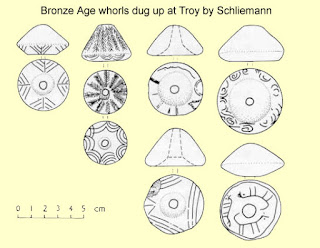
Oh, right. Haven't ordered the churro yet (did order some deerskin scraps and rawhide to make a tool roll for my traditional flint-knapping kit). Found a 1oz pack of wool roving in the embroidery supplies at my favorite local fabric store but my first attempt at hand spinning did not go swimmingly. Mocked up a quick drop-spindle from a bamboo chopstick and some red clay. Did eventually get a short two-ply that doesn't look horrible, but I went back another 2,000 years down the tech tree to create that one; I rolled it on my thigh.
Yeah, looms. Sure, I might make a ukulele strap with a tablet loom, but it is primarily for historical research. Even if I don't even know if my Cretan weaver is using a fixed heddle. Or any heddles. Certainly not tablets. Well, probably not. Remember what I said about adoption? It is a tech that is of limited use in that time and place, and I can defend that it might have arose here, been known to a few people but never documented or achieved any prominence.

As for prop projects: after I've gotten some cleaning done I'll dust off the Holocrons and see if anyone at the RPF still wants one. Unfortunately I haven't been able to think of anything that really leverages the kinds of equipment I have available at TheShop. There's always Aliens grenades, but they are a finicky machining project that takes way too long to be profitable. Or interesting.
Unfortunately top of my prop list right now seems to be re-doing the "Yamatai" necklace. This is actually a good lead-in project for the Wraith Stone as I intend to do the same sculpt-and-scan process to make a 3d file. Which I'll then have printed at Shapeways for the fine detail available there, clean up and hand-detail the print, then cast it in resin. Then make the 3d file publicly available.

References are of course poor. I'm almost tempted to play the game again to see if I can get a better screen shot. There are some visualization and promotional artworks, but they look rather different. In fact, there's almost reason to go with two necklace designs (at least in part because the artwork version has a clearer link to real existing traditions -- chiefly Maori -- and to my eye is a more pleasing design anyhow).

And actually, that might be a quick laser project too. Would make the sculpt easier if I created a flat "armature" out of some thin, stiff material like 1/16" acrylic...
Yeah, great communications. Why am I paying membership to these idiots?
Wasn't a total waste. I went over to MOMA and looked at art (I get in free all year -- more benefits of the full-time job).
Was kind of tired after closing night anyhow. Had a light go out. I have five front lights so I really, really needed it. Corroded socket of course, so all I could do is scratch out the worst of it with a nail file. On closing night the instrument dropped out right at the top of the show...fortunately it hangs right in front of the light booth so I was able to tap it back to life with a broomstick and then I spent the whole show carefully never turning it all the way off (because it would never turn back on).

So I still don't have anything I need at TheShop. But I'm eager to get checked off on the machines I've used in the past so when a future need comes I can go in and start bending metal. (Well, not bending metal...I didn't do the Safety and Basic Use classes on the brake and sheer yet).
What I have for the moment is random fun-to-do projects. Chief among which is making a mini loom. Honestly, for what I want in a loom I can tinker up something at my workplace. The only reason to do a laser-cut version is to, yes, get my permission in order for future lasering.
Could also cut some guitar picks, again just for the fun of it. Weaving tools gives me a few other excuses to unlock tools; 3d print a spindle whorl. Or even lathe one up on the wood lathe. Or could even CNC a spindle whorl out of aluminium but...

Oh, right. Haven't ordered the churro yet (did order some deerskin scraps and rawhide to make a tool roll for my traditional flint-knapping kit). Found a 1oz pack of wool roving in the embroidery supplies at my favorite local fabric store but my first attempt at hand spinning did not go swimmingly. Mocked up a quick drop-spindle from a bamboo chopstick and some red clay. Did eventually get a short two-ply that doesn't look horrible, but I went back another 2,000 years down the tech tree to create that one; I rolled it on my thigh.
Yeah, looms. Sure, I might make a ukulele strap with a tablet loom, but it is primarily for historical research. Even if I don't even know if my Cretan weaver is using a fixed heddle. Or any heddles. Certainly not tablets. Well, probably not. Remember what I said about adoption? It is a tech that is of limited use in that time and place, and I can defend that it might have arose here, been known to a few people but never documented or achieved any prominence.

As for prop projects: after I've gotten some cleaning done I'll dust off the Holocrons and see if anyone at the RPF still wants one. Unfortunately I haven't been able to think of anything that really leverages the kinds of equipment I have available at TheShop. There's always Aliens grenades, but they are a finicky machining project that takes way too long to be profitable. Or interesting.
Unfortunately top of my prop list right now seems to be re-doing the "Yamatai" necklace. This is actually a good lead-in project for the Wraith Stone as I intend to do the same sculpt-and-scan process to make a 3d file. Which I'll then have printed at Shapeways for the fine detail available there, clean up and hand-detail the print, then cast it in resin. Then make the 3d file publicly available.

References are of course poor. I'm almost tempted to play the game again to see if I can get a better screen shot. There are some visualization and promotional artworks, but they look rather different. In fact, there's almost reason to go with two necklace designs (at least in part because the artwork version has a clearer link to real existing traditions -- chiefly Maori -- and to my eye is a more pleasing design anyhow).

And actually, that might be a quick laser project too. Would make the sculpt easier if I created a flat "armature" out of some thin, stiff material like 1/16" acrylic...
Subscribe to:
Posts (Atom)