Skyrim is still going strong. The energy is not just in the new Elder Scrolls Online. Some people, apparently, still want to life their alternate lives in solitary splendor.
And put an amazing amount of work into improving the experience for everyone.
Project Aho is a massive new adventure in the Skyrim universe, released as a free mod on March 22 of this year. There is much good to say about it and I intend to do so here, but that is not the main purpose of this mini-review. That purpose is to address an elephant that was in the room, and the way in which this elephant seems to be selectively visible.
First, the mechanical stuff. It plays smoothly and looks professional. That is a lot more work to achieve than you might think. It isn't enough to have nice-looking scenery; you also have to play-test the heck out of the stuff so players and AI's don't get trapped in intersections of the geometry or end up clipping out of the world entirely. Big budget AAA games have shipped with these kinds of bugs. I didn't encounter a single one in playing Project Aho.
The assets are not just well crafted, but artistically inspired. The characters are alive and interesting, the voice acting almost without flaw, the settings intriguing and unique as well as spectacular. The music is also outstanding, and it all works to support the core conceit; of this hidden community with its own bizarre ecosystem and rituals.
This is the greatest strength in play as well, but it goes hand in hand with the greatest weakness. Your existing Skyrim character is ripped out of their usual surroundings and deposited -- trapped -- in this new and confusing land and has to explore and interact and try to make sense of it all. The first third of the game is slow and almost meditative as you slowly learn your way around this strange place and begin to adjust to its ways and rhythms.
Here is the weakness; the way the writers chose to place you here is to kidnap and enslave your character. Which is manipulative, rail-roading, in a way that goes against the basic play style of Skyrim. Skyrim is an open-world game, where you can take off in any direction at any moment, explore freely whatever you can reach. And a game in which you always have choice.
It is built into the basic philosophy, a philosophy shared by the hardy Nords who call this region of Tamriel home; it is all about choice. About the freedom to make your own moral and ethical way, and accept the consequences of your own actions.
In any quest in Skyrim you may find yourself being asked to do random fetch quests, to trudge through tundra or tunnels in search of some random item just because someone else wants it and has asked you to get it for them. Making your character a slave, and the only path to freedom to complete these tasks, changes the perception of this process. You can't walk away, other than by closing the game.
Yes, this is only perceptual. This is a strange world, you don't even understand how it works much less how to escape. So you start doing favors for random strangers. That's how RPGs have worked, from well before KOTOR. It is just a little...odd...that you are doing this despite being, you know, a slave. It becomes more and more off-putting as people interact with you as if you are the ordinary wandering Joe adventurer. Instead of someone who was kidnapped here, is being actively threatened with torture and murder by their master, and is trying desperately to escape. "Could you help me find my wife's wedding ring? I think it fell in a haystack" takes on an entirely different flavor than the one the writers presumably intended.
The last two thirds of the game are epic dungeon crawls with tons of combat. This is a Nintendo Hard mod, with the leveled monsters being much, much tougher than their main game equivalents (let me put it this way; my mage was getting killed by mid-level enemies inside Project Aho, but after she escaped she polished off a leveled Dragon without breaking a sweat).
Which makes for an odd contrast, but anyhow. The quests are amusing enough and the build decent, although the quest markers could use improvement. Another quibble I have is that there is far too much loot. Not only is it unbalancing even within Project Aho, it is grossly unbalancing to the main game. But that's not even the worse of it; the worst is there's simple so much it gets in the way. You finally have to just ignore it.
Eventually you are brought to a moral choice. Of a sorts. And here is where the elephant becomes overwhelming.
Your murderous, largely-insane master is discovered to be embarking on a mad scientific experiment that threatens the entire hidden community. You didn't, of course, get to do anything at all, anything active, anything productive towards the revelation. But for some reason the powers that be announce they'd prefer to have you working for them anyway and offer you your freedom in return for stopping him.
Actually, its a little odder than that. They say, "Sorry for kidnapping and enslaving you. Here's your stuff back. You are free to go. But if you stick around to stop the bad guy, we could see about slipping a little extra cash your way."
The thing is...the thing is...
They are still a slave-holding culture. There are slaves in the room when they are making this grand offer. Which is twenty feet from where, while you were on the auction block, they murdered another slave before your eyes. This is slavery in one of the worst ways; the slaves (with you as an odd and rather unexplained exception) are voiceless and nameless. Literally. Their tongues and their names are taken along with all ability to resist (a control collar that, in game only acts on you as an invisible wall and the annoying inability of people like Dear Master to die when you firebolt them at point-blank range.)
This is where that selective visibility comes in. Because there's no dialog option to talk about it. No place to make a different bargain. No way to work to change that society. No option, ever, to free a single one of your fellows in bondage. Apparently, you are supposed to be happy that you got all your stuff back.
And the writers may not be wrong. I took at look through comments at the Nexus and Steam and I couldn't find a single person speaking about this. It is a sobering blindness.
It is a lovely place, of course. Almost a utopia. I can understand why the writers believed that players would be happy that they were free to leave, and would then be happy to jump right in to the community, buy a house there (yes, this is very much an option), go on all the remaining little fetch quests, hang out with the people there, etc. Their own private little garden tucked into a corner of Skyrim.
Yes, players just may be that selfish. But the writers should have been better than that. Leaving this status quo was unacceptable. Letting them get away with taking more people from their homes and freedom and stripping their very voice and name from them was unacceptable.
I went back to Dear Old Master and when he said, "I'm about to throw this Big Red Switch over here because I'm mad and evil and I want to see what happens," I said, "I'll help!"
Showing posts with label Skyrim. Show all posts
Showing posts with label Skyrim. Show all posts
Tuesday, May 22, 2018


Wednesday, May 2, 2018
Stations of the Cross
In Christian practice, this is a series of fourteen images from the Crucifixion that the worshipper visits in order, praying before each, recreating the Passion with their own journey.
The term got re-purposed in modified form as part of the critical language of Fan Fiction. There are at least a thousand fan-written stories that re-tell Harry Potter's first year at Hogwarts. Even though each is different, with a different focus, different endings, different characters, even wildly different settings, the cantus firmus of the original novel is still back there. And thus, even if the story is set in 1950 and "Harry" is a girl, a ward of Dick Tracey, and from the Moon*, she'll still be unwrapping chocolate frogs with Ron on the Hogwart's Express.
The big difference being that not all of the familiar incidents and characters show up. This is more a statistical tendency towards a relatively small number of popular items from the original canon. So it is a little more like one of those churches with multiple saints in their own individual niches and you can Chinese Menu which ones you visit.
A similar effect is in alternate history, where W.W.I. may have kept going into the early 40's and Bismark II is a nuclear-powered hovercraft....but Winston Churchill is (somehow) still PM (and Adolph gets a brief appearance in the text; even though he's a well-established portrait painter in Free Austria, you still have to visit that station.)
Video Games would seem a strange place for this effect. Even in the most linear game, however, you can as player establish a different internal life for your character. I can play Tomb Raider 2013, for instance, as a scared kid or as a roaring arc of revenge. The results are basically the same and the cutscenes are, alas, the same, but there are nuances in how the actual play unfolds.
A game like Skyrim is very, very open to different paths.
In Skyrim, there is a Main Campaign and a whole bunch of side quests. And there's also stuff to do, like explore, gather herbs, hunt, learn smithing, run a farm. You can (many do) play for hours without ever touching on any of the scripted content.
You can also pick and chose. The episodes of the Main Campaign must be completed in order, but there's no time limit. You can go away to fight the Thieve's Guild or become Arch-Mage of the College of Winterhold for a few months and come back...the dragons will still be waiting.
These form the stations. Not just the memorable incidents of the Main Campaign (the flight from Helgen, the summons of the Greybeards) but also the other accomplishments and memorable incidents from the longer side quests (meeting Torvald, adopting an orphan, making one hundred iron daggers).
Not only can multiple people play this game and have unique experiences -- sharing only these Stations of the Cross as they come across them -- but one person can play the game multiple times, again each time with a unique experience.
And that means even coming at the well-known, well-worn incidents again and again, there is still new insight and new delight. Meeting Ulfric Stormcloak for the second time is a lot different if you meet him as a young dark-elf mage, or as a sturdy Nord who already beat-down the only other known Dragonborn in dragon-to-dragon combat.
And, yeah, there went a few more hours. I've been working a late-night install (we have to start after the offices clear out) and it took a bit of work to flip my biological clock around.
* Free Plot Bunny! I would totally read an H.P. fanfic in which Moon Maid (or Honeymoon) went to Hogwarts, and Voldemort joined Pruneface and Flattop and the other wackaloons in Tracey's Rogues Gallery.
The term got re-purposed in modified form as part of the critical language of Fan Fiction. There are at least a thousand fan-written stories that re-tell Harry Potter's first year at Hogwarts. Even though each is different, with a different focus, different endings, different characters, even wildly different settings, the cantus firmus of the original novel is still back there. And thus, even if the story is set in 1950 and "Harry" is a girl, a ward of Dick Tracey, and from the Moon*, she'll still be unwrapping chocolate frogs with Ron on the Hogwart's Express.
The big difference being that not all of the familiar incidents and characters show up. This is more a statistical tendency towards a relatively small number of popular items from the original canon. So it is a little more like one of those churches with multiple saints in their own individual niches and you can Chinese Menu which ones you visit.
A similar effect is in alternate history, where W.W.I. may have kept going into the early 40's and Bismark II is a nuclear-powered hovercraft....but Winston Churchill is (somehow) still PM (and Adolph gets a brief appearance in the text; even though he's a well-established portrait painter in Free Austria, you still have to visit that station.)
Video Games would seem a strange place for this effect. Even in the most linear game, however, you can as player establish a different internal life for your character. I can play Tomb Raider 2013, for instance, as a scared kid or as a roaring arc of revenge. The results are basically the same and the cutscenes are, alas, the same, but there are nuances in how the actual play unfolds.
A game like Skyrim is very, very open to different paths.
In Skyrim, there is a Main Campaign and a whole bunch of side quests. And there's also stuff to do, like explore, gather herbs, hunt, learn smithing, run a farm. You can (many do) play for hours without ever touching on any of the scripted content.
You can also pick and chose. The episodes of the Main Campaign must be completed in order, but there's no time limit. You can go away to fight the Thieve's Guild or become Arch-Mage of the College of Winterhold for a few months and come back...the dragons will still be waiting.
These form the stations. Not just the memorable incidents of the Main Campaign (the flight from Helgen, the summons of the Greybeards) but also the other accomplishments and memorable incidents from the longer side quests (meeting Torvald, adopting an orphan, making one hundred iron daggers).
Not only can multiple people play this game and have unique experiences -- sharing only these Stations of the Cross as they come across them -- but one person can play the game multiple times, again each time with a unique experience.
And that means even coming at the well-known, well-worn incidents again and again, there is still new insight and new delight. Meeting Ulfric Stormcloak for the second time is a lot different if you meet him as a young dark-elf mage, or as a sturdy Nord who already beat-down the only other known Dragonborn in dragon-to-dragon combat.
And, yeah, there went a few more hours. I've been working a late-night install (we have to start after the offices clear out) and it took a bit of work to flip my biological clock around.
* Free Plot Bunny! I would totally read an H.P. fanfic in which Moon Maid (or Honeymoon) went to Hogwarts, and Voldemort joined Pruneface and Flattop and the other wackaloons in Tracey's Rogues Gallery.
Sunday, January 21, 2018
Cold
Been reading a little fiction lately. The level of look and feel I like in a book seems rare. A military SF story didn't have it. A YA fantasy did.
I also played a little Skyrim, with several popular fan-made mods that make the cold and rain (and hunger and disease) a bigger threat than the wolves. And that reminded me that for some details of traveling, working, camping out in the wilds, I don't have to draw from secondary sources. I'm in no risk there of copying what another writer said about how it feels to labor in the cold rain to build a shelter, or to stare into the night waiting on an attack so long, and on so little sleep, the hallucinations begin. I can draw from experience.
There's got to be some advantage to having a few decades of life experience behind me. And it hasn't all been sitting at a computer. (I still wish I had a deeper grasp of the Classics, but even history -- at least at the depth I'm currently grappling with it -- is relatively new to me).
There was -- perhaps still is -- a chance to take a mere gloss of the Bronze Age and write (relatively) generic adventure on top of it. But research has a way of taking over. I just picked up a book on the history of weaving, and have an eye on an excellent book on women's experience in the Bronze Age that, unfortunately for me, comes in at a staggering $170 for hardcopy.
It is basically a fluke of Linear B; how words are constructed in it and how it was employed in the palatial societies, but one of the tiny windows into the lives of ordinary people in the Bronze Age looks upon the lives of women weavers attached to the palace.
And, yes, a similar window, a similar fluke of documentation looks into the community of artisans working in the Valley of Kings. (There's also an unusual bit of paperwork addressing the duties at a Hittite frontier guard post). And, yes, other people have pursued enquiries through these windows, which is why there's some pretty good resources on Mycenae weavers.
All of which is a long way of saying I am increasingly attracted towards writing more towards the mainstream of historical fiction. About people's lives, about their worlds. Less about military exploits with minimal context.
With these kinds of resources -- and with the situation of the Late Bronze Age -- I could elaborate the story of any single character into a novel's width. Their backstories are, currently, more interesting to me than the team-up, and I want to tell them. Even if I end up with three books before the Avengers Assemble.
At the moment, though, one of the few other elements that is coming to clarity is how I want to use magic. To borrow a term from the paper-and-pencil RPG Runequest, no "battle magic." All the cultures I've studied so far have magic that is trivially easy to use -- amulets, cantrips, potions, sacrifices -- but their effects are trivial. Or, at least, subtle. The big stuff, the live-changing prophesies or the resurrection spells or the typhoons and earthquakes take a while to set up. And often as not involve the gods.
There's little cultural equivalent of someone casually flying or throwing a bolt of fire or any of the other easily-accessed, extremely-effective magic of anyone from a Dungeons & Dragons magic-user to the Wicked Witch of the West.
I'm not ruling out the big magic, note. Although I really, really don't want to involve gods.
I also played a little Skyrim, with several popular fan-made mods that make the cold and rain (and hunger and disease) a bigger threat than the wolves. And that reminded me that for some details of traveling, working, camping out in the wilds, I don't have to draw from secondary sources. I'm in no risk there of copying what another writer said about how it feels to labor in the cold rain to build a shelter, or to stare into the night waiting on an attack so long, and on so little sleep, the hallucinations begin. I can draw from experience.
There's got to be some advantage to having a few decades of life experience behind me. And it hasn't all been sitting at a computer. (I still wish I had a deeper grasp of the Classics, but even history -- at least at the depth I'm currently grappling with it -- is relatively new to me).
There was -- perhaps still is -- a chance to take a mere gloss of the Bronze Age and write (relatively) generic adventure on top of it. But research has a way of taking over. I just picked up a book on the history of weaving, and have an eye on an excellent book on women's experience in the Bronze Age that, unfortunately for me, comes in at a staggering $170 for hardcopy.
It is basically a fluke of Linear B; how words are constructed in it and how it was employed in the palatial societies, but one of the tiny windows into the lives of ordinary people in the Bronze Age looks upon the lives of women weavers attached to the palace.
And, yes, a similar window, a similar fluke of documentation looks into the community of artisans working in the Valley of Kings. (There's also an unusual bit of paperwork addressing the duties at a Hittite frontier guard post). And, yes, other people have pursued enquiries through these windows, which is why there's some pretty good resources on Mycenae weavers.
All of which is a long way of saying I am increasingly attracted towards writing more towards the mainstream of historical fiction. About people's lives, about their worlds. Less about military exploits with minimal context.
With these kinds of resources -- and with the situation of the Late Bronze Age -- I could elaborate the story of any single character into a novel's width. Their backstories are, currently, more interesting to me than the team-up, and I want to tell them. Even if I end up with three books before the Avengers Assemble.
At the moment, though, one of the few other elements that is coming to clarity is how I want to use magic. To borrow a term from the paper-and-pencil RPG Runequest, no "battle magic." All the cultures I've studied so far have magic that is trivially easy to use -- amulets, cantrips, potions, sacrifices -- but their effects are trivial. Or, at least, subtle. The big stuff, the live-changing prophesies or the resurrection spells or the typhoons and earthquakes take a while to set up. And often as not involve the gods.
There's little cultural equivalent of someone casually flying or throwing a bolt of fire or any of the other easily-accessed, extremely-effective magic of anyone from a Dungeons & Dragons magic-user to the Wicked Witch of the West.
I'm not ruling out the big magic, note. Although I really, really don't want to involve gods.
Monday, January 15, 2018
It's Not Easy Being Green
Made surprising progress today on the better version of the video:

I tried setting it up with my high-CRI fluorescent light but it actually worked better to just use room lights. And tilt my desk lamp over to get a little front light on my musical instruments.
Compositing was straight-forward in ShotCut. Also, I sent Yakima the Photographer/Bard back into Skyrim and pulled some background plates. Plus did another camera fly, this time a straight zoom into Riften. It was a little jerky -- Skyrim is running on the edge already what with the quality cranked up to High for the shoot, and enough fan-improved meshes and textures added on to bring it up past Special Edition standards, and adding the overhead of a Quicktime screen grab is almost too much for my poor computer. But...ShotCut makes it easy to re-time a clip, and at 4x the base frame rate it got nice and smooth.
The next trick is to "bake" the performance clips first, rendering them out as new video files that can then be added back in without all the overhead of multiple layers of cropping, scaling, color grading, and chromakey magic. But it looks like it is going to work.
And not take a lot more time away from the Sea People.

OpenShotCutEditor
First draft of the video for the "Khajiit" piece done. It's not working for me.
Not just for technical issues, but for a lack of focus and flow. Also...a thing that is unique about this piece is that I performed all the parts on acoustic instruments. On period acoustic instruments, in some cases. So the video should show that off and the first draft doesn't.
I was going to get a little crazy with costumes and chromakey and shadow-filled lighting because I'm shy (and because it looks like it would be fun). But seeing as I've already stuck my mug on several YouTube videos on my efforts to learn violin and trumpet, maybe I'll just set up the camera in front of the nice wooden fence we have in the backyard and film that way.
So the first quest was footage. Used QuickTime Movie Player as a screen recorder, which caused the game to slow and stutter quite a bit. I created Yakima the Location Scout-Cat and sent him out into the wilds of Skyrim for footage, armed largely with a barrel full of console codes (as I didn't have the patience to build him up to where he could actually survive the war zones we wanted to photograph).
Skyrim, as far as I am aware, doesn't really have a Mechanima plug-in, so there was a lot of ducking in and out of camera options via console. Unfortunately there seems to be no easy way to trigger a performance animation or even a walk from the "free camera" -- which really restricts the available shot angles -- and of course there's no keyframe spline to guide a tracking shot.
Then edit. iMovie is of course nearly useless. Pity the Mac never had something as nice as Windows Movie Maker. I tried out ShotCut, which generally did the job but I wanted full keyframing. Filmora keeps pushing itself everywhere that purports to be a list of "best editors" but even without the $50 price tag it just seems...underpowered.
OpenShot was well worth a try. Full keyframing, infinite layers of video tracks. The most recent versions have moved from a friendly floating tabbed window for certain functions to a tiny docked panel in which the options are less clear and a lot harder to manipulate. Still, it technically did the job...except that it borked on anything bigger than a still frame. It would hang for minutes before displaying what was right under the timeline pointer.
Natron was very interesting and worth a second look. This is the only node-based compositor in this list. One of the warning signs of open-source software is when the Linux version is highlighted. This software is deep, complex, and largely undocumented. It took a few hours to get over the hump and figure out how to patch input file through processing and merge nodes to an output render. Unfortunately, it too didn't run smoothly enough on my Mac Powerbook to allow cutting video to a music track.
So back to ShotCut. The lack of keyframes means you can't animate changes in position and scale of your clips, but it does offer fade and cross-fade. Since filters are applied per clip, not per track, you can arbitrarily slice a single clip into sub-clips and apply different filters to each; essentially keyframes without any of the inbetweening that usually smooths it out.
So how to the next version? I think I need to pen-and-paper this; to actually make something like a storyboard, if not a full script and shot list. On the flip side, I only want to spend so much time on this project. I have other, better, music waiting. And the Sea Peoples, of course.
Not just for technical issues, but for a lack of focus and flow. Also...a thing that is unique about this piece is that I performed all the parts on acoustic instruments. On period acoustic instruments, in some cases. So the video should show that off and the first draft doesn't.
I was going to get a little crazy with costumes and chromakey and shadow-filled lighting because I'm shy (and because it looks like it would be fun). But seeing as I've already stuck my mug on several YouTube videos on my efforts to learn violin and trumpet, maybe I'll just set up the camera in front of the nice wooden fence we have in the backyard and film that way.
So the first quest was footage. Used QuickTime Movie Player as a screen recorder, which caused the game to slow and stutter quite a bit. I created Yakima the Location Scout-Cat and sent him out into the wilds of Skyrim for footage, armed largely with a barrel full of console codes (as I didn't have the patience to build him up to where he could actually survive the war zones we wanted to photograph).
Skyrim, as far as I am aware, doesn't really have a Mechanima plug-in, so there was a lot of ducking in and out of camera options via console. Unfortunately there seems to be no easy way to trigger a performance animation or even a walk from the "free camera" -- which really restricts the available shot angles -- and of course there's no keyframe spline to guide a tracking shot.
Then edit. iMovie is of course nearly useless. Pity the Mac never had something as nice as Windows Movie Maker. I tried out ShotCut, which generally did the job but I wanted full keyframing. Filmora keeps pushing itself everywhere that purports to be a list of "best editors" but even without the $50 price tag it just seems...underpowered.
OpenShot was well worth a try. Full keyframing, infinite layers of video tracks. The most recent versions have moved from a friendly floating tabbed window for certain functions to a tiny docked panel in which the options are less clear and a lot harder to manipulate. Still, it technically did the job...except that it borked on anything bigger than a still frame. It would hang for minutes before displaying what was right under the timeline pointer.
Natron was very interesting and worth a second look. This is the only node-based compositor in this list. One of the warning signs of open-source software is when the Linux version is highlighted. This software is deep, complex, and largely undocumented. It took a few hours to get over the hump and figure out how to patch input file through processing and merge nodes to an output render. Unfortunately, it too didn't run smoothly enough on my Mac Powerbook to allow cutting video to a music track.
So back to ShotCut. The lack of keyframes means you can't animate changes in position and scale of your clips, but it does offer fade and cross-fade. Since filters are applied per clip, not per track, you can arbitrarily slice a single clip into sub-clips and apply different filters to each; essentially keyframes without any of the inbetweening that usually smooths it out.
So how to the next version? I think I need to pen-and-paper this; to actually make something like a storyboard, if not a full script and shot list. On the flip side, I only want to spend so much time on this project. I have other, better, music waiting. And the Sea Peoples, of course.
Saturday, January 6, 2018
Oh, the terrible shawm of it!
The bulk of the work is done on the "Khajiit" piece. This is a mix-down of work to date. I will be tweaking it more. (I may, for instance, remove the shawms).
There's only one variation left to do from the original song; it's a kind of repeated short chorus. I can record those parts in pretty quickly. However, I've been thinking of going off-model after that point and instead of doing 3 more rounds of the verse and chorus (as the original does) instead do an extended Bodhran break. (And had I patience and skills, a proper recorder consort with baroque polyphony...)
Hrm. I wonder if I could do a slow jazz using the crumhorn as a bass...?
There's only one variation left to do from the original song; it's a kind of repeated short chorus. I can record those parts in pretty quickly. However, I've been thinking of going off-model after that point and instead of doing 3 more rounds of the verse and chorus (as the original does) instead do an extended Bodhran break. (And had I patience and skills, a proper recorder consort with baroque polyphony...)
Hrm. I wonder if I could do a slow jazz using the crumhorn as a bass...?
Sunday, November 26, 2017
As We Stumble Along
I've recorded parts into MIDI before. I've almost never tried to record instrumental performances of my own. Certainly not to a click track. So this is basically the first time I'm playing along with someone else (even if the "someone else" is the previously recorded tracks).
And not all the tone colors work. I mixed sound for live bands for a few years but this is the first time in which I am having to make the overall musical decisions. It isn't just the placement of the microphone, but how hard to pluck, how far sul tasto to place the bow, where to place the tone hand on the bodhran. It isn't that easy to hear, not while also playing the parts in.
But the biggest disappointment is how ragged I am. How obviously uncomfortable, how much I struggle just to get through the instrumental line without error, with little left over to bring out expression and nuance.
Of course I'm doing a multi-instrumental recording that includes instruments I've held for less than a month. So I don't have the comfort -- the chops -- to let me go on automatic and leave me free to following the beat, hitting necessary accents, adjusting tonal qualities, etc. This is the downside to not practicing four hours a day.
(I do have that kind of practice on the recorder. Which isn't as helpful as it could be in part because of the crazy accidentals of this D, E, D#, Cm chord progression, but even more because, drat it, the recorder parts I wrote are neither idiomatic nor play to my strengths on that instrument.)

On the technical side, crashed the Powerbook once. Chased around a terrible lag and finally solved it by turning Chrome off (it was fighting with Reaper over the audio drivers, apparently). Using some of my old mic collection through an external phantom power/pre-amp and a cheap Behringer USB interface. I really, really miss my Pro37 condenser, though. It just had a magic touch on so many instruments. The only positive comment I can make on the mics is the MK1000 kick mic does a nice job on the bodhran.
I think I'm going to move some of the recording to my workplace for a quieter and more importantly more private environment where I can take the mute off the violin and back up the mic. Close-mic is not really the right trick for some of these sounds, and I really don't need to be worrying what the neighbors think in addition to all my other performance stresses.
Wednesday, November 15, 2017
My Dog Has Fleas
My first solo recording project is an acoustic rendition of Miracle of Sound's Khajiit Like to Sneak (a comical look at some gameplay elements of the massive RPG Skyrim.)
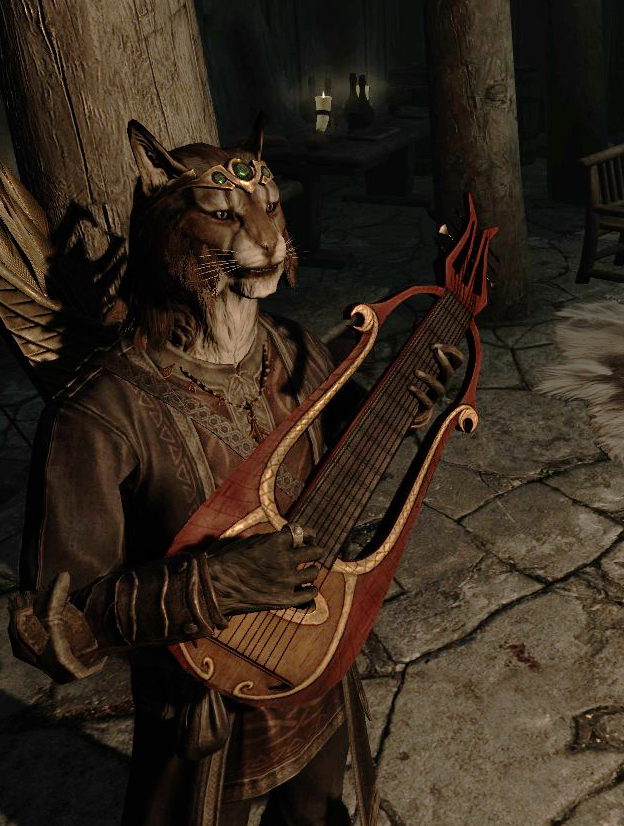
I've been playing a Khajiit bard, so it occurred to do a cover of this piece using instruments not entirely unlike the bardic collection; lute, end-blown flute, hand drum, etc. The Khajiit accent and cultural trappings are vaguely Arabic and/or Spanish (perhaps Moorish Spain?) to the extent that the extant (third-party) collection of Khajiit songs uses classical guitar. So there's that to fold in, too.
And one big problem; the original song is spoke-sung, meaning it can be notated for time but not for pitch. Fortunately someone posted the underlying chord form up at one of the big guitar tab sites (even if I'm not sure they got it quite right). So I have some guide to possible pitches.
The other angle of attack -- and again I've forgotten the proper musical term -- is using the implied pitch of vowel sounds; like the ukulele mnemonic I've used for my post title. "Khajiit," for instance, implies a medium-sized interval with the lower note first.
Over the past few days I've worked up a MIDI mock-up, using patches that sound similar to the instrumentation I have available, making sure to stay within the actual note range, and practicing to see if I can actually play the ideas I'm writing out.
I've solved the basic orchestration issues. I have sounds that work well together. Now the two-fold task is capturing more of the accents and changes of the original (particularly the rhythmic accents), and fold in more early music and/or Flamenco references (I'm limited to what I can actually play on "guitar" -- actually, a ukulele with leather pick standing in for lute with plectrum -- but I do have a few techniques like rasgueado that I can use).
Of course a major element is going to be bodhran drumming, which I have yet to even start learning!
After that is general tightening. This mock-up is entirely internal; I'm using it as a guide and click track to record the actual parts. The more I problem-solve in MIDI, however, the easier the process is going to be.
The big problem-solve left is voicing in the Recorder section. My first idea was to use a Recorder Consort, interwoven lines performed on SATB (despite only owning sopranino, soprano, and alto recorders myself...they get rapidly more expensive as they get deeper in pitch). It still sort of seems like it will work, but it has been a long time since I studied voice leading and species and so forth.
This is the only place where I'm going dots on a line (at least, until I prepare the parts for recording). I already went to notation for the melody. Borrowing a technique I used extensively for theatrical sound effects I imported the original song into the Reaper file and synchronized the metronome. Then I was able to type out lyrics in the notation view and make sure they lined up accurately with the original vocals. With that, and the chords as a guide, I could come up with pitches that sort of worked.
And that's where I'm going to collect the three or four Recorder lines so I can make sure they are properly outlining the underlying chord progression. This is the sort of thing I did on paper way back long ago. I have a new booklet of staff paper but as with so many things these days it works well enough on the computer.
It still bugs me that the original is really using time and texture to express its ideas, but once you add melody there is inherently a focus on tonal and harmonic elements. Well...I'll see how it goes as I try to clean it up and focus it in better on the important ideas.
I've been playing a Khajiit bard, so it occurred to do a cover of this piece using instruments not entirely unlike the bardic collection; lute, end-blown flute, hand drum, etc. The Khajiit accent and cultural trappings are vaguely Arabic and/or Spanish (perhaps Moorish Spain?) to the extent that the extant (third-party) collection of Khajiit songs uses classical guitar. So there's that to fold in, too.
And one big problem; the original song is spoke-sung, meaning it can be notated for time but not for pitch. Fortunately someone posted the underlying chord form up at one of the big guitar tab sites (even if I'm not sure they got it quite right). So I have some guide to possible pitches.
The other angle of attack -- and again I've forgotten the proper musical term -- is using the implied pitch of vowel sounds; like the ukulele mnemonic I've used for my post title. "Khajiit," for instance, implies a medium-sized interval with the lower note first.
Over the past few days I've worked up a MIDI mock-up, using patches that sound similar to the instrumentation I have available, making sure to stay within the actual note range, and practicing to see if I can actually play the ideas I'm writing out.
I've solved the basic orchestration issues. I have sounds that work well together. Now the two-fold task is capturing more of the accents and changes of the original (particularly the rhythmic accents), and fold in more early music and/or Flamenco references (I'm limited to what I can actually play on "guitar" -- actually, a ukulele with leather pick standing in for lute with plectrum -- but I do have a few techniques like rasgueado that I can use).
Of course a major element is going to be bodhran drumming, which I have yet to even start learning!
After that is general tightening. This mock-up is entirely internal; I'm using it as a guide and click track to record the actual parts. The more I problem-solve in MIDI, however, the easier the process is going to be.
The big problem-solve left is voicing in the Recorder section. My first idea was to use a Recorder Consort, interwoven lines performed on SATB (despite only owning sopranino, soprano, and alto recorders myself...they get rapidly more expensive as they get deeper in pitch). It still sort of seems like it will work, but it has been a long time since I studied voice leading and species and so forth.
This is the only place where I'm going dots on a line (at least, until I prepare the parts for recording). I already went to notation for the melody. Borrowing a technique I used extensively for theatrical sound effects I imported the original song into the Reaper file and synchronized the metronome. Then I was able to type out lyrics in the notation view and make sure they lined up accurately with the original vocals. With that, and the chords as a guide, I could come up with pitches that sort of worked.
And that's where I'm going to collect the three or four Recorder lines so I can make sure they are properly outlining the underlying chord progression. This is the sort of thing I did on paper way back long ago. I have a new booklet of staff paper but as with so many things these days it works well enough on the computer.
It still bugs me that the original is really using time and texture to express its ideas, but once you add melody there is inherently a focus on tonal and harmonic elements. Well...I'll see how it goes as I try to clean it up and focus it in better on the important ideas.
Saturday, July 22, 2017
Virtual Lithics
Skyrim has mods.
This has the potential to become an interesting problem for the game industry. On the one hand, Bethesda is one of the companies that strongly supports the modding community, releasing the Creation Kit for anyone to try their hand at adding new content, changes in focus, or basic bug fixes to the worlds of Skyrim and the Fallout series. This, when it works well, gives games some of the advantage of Open Source. There are some very skilled people out there who don't happen to be working for Bethesda (or who don't have any deadlines other than self-imposed ones) and are able to do things the original creators did not or could not.
On the flip side, official DLC can look bad by comparison. I have to say that Bethesda shot themselves in the foot a bit with Skyrim, at least. The two big DLC's, Dawnguard and Dragonborn, got decent reviews and are considered more-or-less worth the price. However, Hearthfire is considered by most reviewers to be a waste of money, hence a waste of employee hours by Bethesda (unless they got a lot of sucker sales).
This has the potential to become an interesting problem for the game industry. On the one hand, Bethesda is one of the companies that strongly supports the modding community, releasing the Creation Kit for anyone to try their hand at adding new content, changes in focus, or basic bug fixes to the worlds of Skyrim and the Fallout series. This, when it works well, gives games some of the advantage of Open Source. There are some very skilled people out there who don't happen to be working for Bethesda (or who don't have any deadlines other than self-imposed ones) and are able to do things the original creators did not or could not.
On the flip side, official DLC can look bad by comparison. I have to say that Bethesda shot themselves in the foot a bit with Skyrim, at least. The two big DLC's, Dawnguard and Dragonborn, got decent reviews and are considered more-or-less worth the price. However, Hearthfire is considered by most reviewers to be a waste of money, hence a waste of employee hours by Bethesda (unless they got a lot of sucker sales).
Dawnguard: Adventure Found Me
This is not my Skyrim review. I hope when I get to that it will be a little more organized than this. This instead is an exploration of ludonarrative in the emergence of a character arc from meta-textual elements.
Or, in short, how a young Breton with dreams of becoming a bard was pulled into a conflict she didn't even know existed, became a legendary hero and saved the world.
Or, in short, how a young Breton with dreams of becoming a bard was pulled into a conflict she didn't even know existed, became a legendary hero and saved the world.
Wednesday, April 19, 2017
After the battle
I've been trying to learn "Far Horizons" from the game Skyrim and that's led me to muse on a contrast.
In both Skyrim and Tomb Raider 2013 there are lethal encounters with the locals. In Tomb Raider, when the fight ends there's a brief quotation of the character theme; muted and tinged with the melancholy of all you've lost, as with every other piece of music in this particular Tomb Raider, but nonetheless a horn flourish celebrating a moment of triumph.
The only time you hear the "Dragonborn" character theme in Skyrim (outside of bardic performances in taverns) is when you are being attacked by a dragon. What plays at the conclusion to most encounters is something more wistful, even elegiac. It is a piece of music that invites one to contemplate the fragility of life and the shared humanity of you and those you've just slain against this harsh, bleak, starkly lovely landscape of steep rocks and chilly snow.
(It is in fact one of the generic wilderness travel snippets -- the piece I opened this discussion with -- but it is scripted to always show here and I can't believe the emotional impact of that choice was not considered).
Im Tomb Raider the bad guys are somewhat humanized before the fight; if you sneak well enough you can hear snippets of conversation. Unfortunately there is no conversation allowed during the fight; once guns are drawn there is no negotiation allowed. Following the fight, all that is left is to search the bodies for more ammunition.
In Skyrim, you also search the bodies. Such is the stock mechanics of AAA games. But in doing this you are also led through their campsites and rooms and shelters. Where you find bedrolls tucked into a niche of the rock out of the rain, personal possessions tucked away in drawers, a couple books beside a table, a meal on the fire, a chair set up for no other purpose but to relax and take in a vista of distant mountains. These material goods are so particular and homely they give a mute description of their owners, a more sharply drawn and more universal one than any dialog snippet.
You can not help but place yourself shivering in that bedroll, warming yourself over a rude meal on that campfire (as often enough, you do in the course of the game) and greeting the day sitting in that chair looking over the vast snowy land of Skyrim. It invites you (sometimes literally) to put yourself in the hide shoes of those you were forced to kill. (Of course, in this game there is also no great distance between you and them. Your background is similar, your adventures similar. You aren't some well-equipped American stand-in mowing down foreign hordes, not in this game).
Even the nature of the encounter is different. In Skyrim you largely chose to engage; you can leave the bandit camp alone, or even run away. In Tomb Raider you are largely scripted in. It is an extremely linear narrative and often the next door will not even open until you've performed the sacrifice the game demands. Once combat is joined, of course, most AAA games are alike. There is no parley, no quarter.
Except not even this is absolute; Skyrim has a third-party mod that can be installed that allows your enemy to surrender instead of fighting to the death. And, sure, this is not a creation of the original designers. But the original designers did permit the end users to change the story and make this possible. Tomb Raider will not even allow the player to look in a different direction than that which the script requires.
(The only AAA game I've played in which quarter is possible in the base game is Batman: Arkham City. In that game, psychological warfare is all-important. The Batman is, after all, shaped to be a figure of fear to the cowardly and superstitious. So if you do well enough in striking from the shadows and otherwise appearing as an unstoppable phantom, some of the bad guys will drop to their knees to cower in place instead of continuing the fight. It ain't much, but it beats having to flatten everyone).
Am I reading too much into this contrast? Perhaps. Skyrim is intelligently designed by a company that knows how to search out a specific and nuanced emotional tone. Tomb Raider 2013 is a lumpen creation-by-committee where every decent emotional arc sputters out in ludonarrative disconnect against the brainless mechanics and an insulting restriction of any player choice.
(I have to go a little bit further here. This isn't just a contrast between open world and linear narrative. The Half-Life series is also a linear narrative, and restricts exploration just as much. But Half-Life is designed by people who knew what they were doing; it leads the eye and hides the choices rather than forces them on the player. It shows that a linear narrative and even tightly scripted events can take place without making the player feel like a passive observer of the game being played).
In both Skyrim and Tomb Raider 2013 there are lethal encounters with the locals. In Tomb Raider, when the fight ends there's a brief quotation of the character theme; muted and tinged with the melancholy of all you've lost, as with every other piece of music in this particular Tomb Raider, but nonetheless a horn flourish celebrating a moment of triumph.
The only time you hear the "Dragonborn" character theme in Skyrim (outside of bardic performances in taverns) is when you are being attacked by a dragon. What plays at the conclusion to most encounters is something more wistful, even elegiac. It is a piece of music that invites one to contemplate the fragility of life and the shared humanity of you and those you've just slain against this harsh, bleak, starkly lovely landscape of steep rocks and chilly snow.
(It is in fact one of the generic wilderness travel snippets -- the piece I opened this discussion with -- but it is scripted to always show here and I can't believe the emotional impact of that choice was not considered).
Im Tomb Raider the bad guys are somewhat humanized before the fight; if you sneak well enough you can hear snippets of conversation. Unfortunately there is no conversation allowed during the fight; once guns are drawn there is no negotiation allowed. Following the fight, all that is left is to search the bodies for more ammunition.
In Skyrim, you also search the bodies. Such is the stock mechanics of AAA games. But in doing this you are also led through their campsites and rooms and shelters. Where you find bedrolls tucked into a niche of the rock out of the rain, personal possessions tucked away in drawers, a couple books beside a table, a meal on the fire, a chair set up for no other purpose but to relax and take in a vista of distant mountains. These material goods are so particular and homely they give a mute description of their owners, a more sharply drawn and more universal one than any dialog snippet.
You can not help but place yourself shivering in that bedroll, warming yourself over a rude meal on that campfire (as often enough, you do in the course of the game) and greeting the day sitting in that chair looking over the vast snowy land of Skyrim. It invites you (sometimes literally) to put yourself in the hide shoes of those you were forced to kill. (Of course, in this game there is also no great distance between you and them. Your background is similar, your adventures similar. You aren't some well-equipped American stand-in mowing down foreign hordes, not in this game).
Even the nature of the encounter is different. In Skyrim you largely chose to engage; you can leave the bandit camp alone, or even run away. In Tomb Raider you are largely scripted in. It is an extremely linear narrative and often the next door will not even open until you've performed the sacrifice the game demands. Once combat is joined, of course, most AAA games are alike. There is no parley, no quarter.
Except not even this is absolute; Skyrim has a third-party mod that can be installed that allows your enemy to surrender instead of fighting to the death. And, sure, this is not a creation of the original designers. But the original designers did permit the end users to change the story and make this possible. Tomb Raider will not even allow the player to look in a different direction than that which the script requires.
(The only AAA game I've played in which quarter is possible in the base game is Batman: Arkham City. In that game, psychological warfare is all-important. The Batman is, after all, shaped to be a figure of fear to the cowardly and superstitious. So if you do well enough in striking from the shadows and otherwise appearing as an unstoppable phantom, some of the bad guys will drop to their knees to cower in place instead of continuing the fight. It ain't much, but it beats having to flatten everyone).
Am I reading too much into this contrast? Perhaps. Skyrim is intelligently designed by a company that knows how to search out a specific and nuanced emotional tone. Tomb Raider 2013 is a lumpen creation-by-committee where every decent emotional arc sputters out in ludonarrative disconnect against the brainless mechanics and an insulting restriction of any player choice.
(I have to go a little bit further here. This isn't just a contrast between open world and linear narrative. The Half-Life series is also a linear narrative, and restricts exploration just as much. But Half-Life is designed by people who knew what they were doing; it leads the eye and hides the choices rather than forces them on the player. It shows that a linear narrative and even tightly scripted events can take place without making the player feel like a passive observer of the game being played).
Subscribe to:
Posts (Atom)