For all that the double-whammy of doxy and prednisone is doing to me, got some good practice in today. Did a "naked" session on the violin. I can actually do arm vibrato without a shoulder rest, even though it threatens to yank the fiddle out from under my chin. And my bowing didn't fall to pieces without that extra stability, either. Shoulder rest is the default, but it seems a useful exercise to go without every now and then. Sort of a sanity check on how I'm orienting to the instrument.
Trumpet is finally starting to slot properly again. If I feel good tomorrow I'm taking it to a piano room where I can open it up a little -- I'm getting tired of fighting the back-pressure of those practice mutes.
I have the penny whistle to the point where doing the finger tremolo is feeling natural, and the cuts and strikes feel good, too. Still a bit of a squeak changing octaves (going chromatic, you have to go from all fingers off to all fingers down and back again).
Guitar is progressing more slowly. Working on fast-picking right now; varying between James Bond theme on the low E and Godfather on the high E to work that double-pick action. My softest pick, held right up at the tip and slightly angled. The latest is cut from a scrap sheet of .020" styrene. Maybe I should take a few out to TheShop.build (sigh) and laser them out.
And yeah, that's how I practice. I'd like to spend more time. Really, I would. Instead of laps, though, I do wind sprints. It's not a way to become a good musician. It is a way to get competent, fast.
The big trick is concentration. Almost nothing is relaxed. But the big trick is keeping the balance. Don't fall into wasting time on easy rote exercises. But don't beat yourself up trying and failing at something that's beyond you. Stay right at the edge, just past your comfort level, because that's where you gain the fastest.
I split my time roughly in thirds. One third in pure exercises. These are designed to highlight one aspect but the trick to them is doing them slow and smooth and doing everything right. Like this week was all silent bow changes, on one note at a time. Adding arm vibrato when I was ready for it, but all through keeping an eye on tone, angle, Kreisler Highway, shoulder tension, etc.
(A note; vibrato and tremolo have distinct meanings but there are traditional ways of referring to certain effects on certain instruments and I bow to those in my usage.)
Another third is in experimentation. This is in trying things I can't do yet, or do very well. I'm constantly inventing exercises to work on a specific problem spot.
The last third (these are only rough in terms of time) is playing actual pieces. There are two advantages here. One is to keep your spirits up -- one can only stomach so many scales. The other is because when you concentrate in on just one technical problem you risk solving it in a way that won't work in the context of actual performance. The flip side is actual performance reveals weaknesses you wouldn't have discovered otherwise.
I spend roughly equal time to my instrument-in-hand practice time listening to other players, watching other players, reading up on technique, and thinking about what I've learned and what I should try next.
And, yeah, there's cross-over. No matter the instrument I'm practicing at the moment, I'm refining muscle and breath control, refining my pitch sense and rhythm, etc. I actually think practicing multiple instruments helps. It's like doing circuit training; I lose my lips for trumpet quickly but I can switch to another wind and keep learning. Or to a guitar and get my fingers a workout.
Music is going much more slowly. I'm on the fifth sketch for Terminator and still not happy. I have this idea in the back of my head of crossing it with "Toss the Feather" and in my head it sounds like it should work...of course my fiddle playing isn't up to that point yet...
I am also refining my ideas towards a Hellboy cover but there's a one-octave leap on the trumpet part that's still tough for me. Plus I haven't had the bass out of the case for a while, even if it is a simple riff. Pretty sure the original is bass guitar and french horn to start -- I'm having to pitch it up quite a bit to do the horn part on trumpet but going to try keeping the pahoehoe on my SUB for the nonce and use that upright bass-like sound instead.
Flirted with the idea of getting a snare and brushes but if I get that far, I'll toss the idea towards my drummer friend Don and see if he wants to record the drum tracks instead. That would be a lot of fun.
Friday, May 11, 2018


Wednesday, May 9, 2018
Give me that old-time religion
I'm almost ready to start plotting in earnest. Just have one major area to clear up before I go. One more research task, one that has sent me out with a brand-new JSTOR membership (or, rather, a reduced-access monthly pass) to do research.
And that is religion.
As an aside, I have some new aphorisms I've been working on when trying to understand history, or writing historical fiction:
"The past has a past." Bronze age empires of the near east had their own antiquarians. There were New Kingdom scholars who were working on restoration projects. The pyramids, after all, were older to Cleopatra than she is to us.
"It was never the past in the past." No person of any time thought of themselves of living in a quaint previous time. They all lived in the modern world, one that was highly advanced -- if not dangerously modern.
"People are complicated." No society was ever doing things simply, using simple language, thinking in simple ways. Anatomically modern humans go back way further than history, almost as far as archaeological artifacts, and they are always pushing the boundaries of what is possible. We may have massive computer-controlled looms these days, but send a modern back to pre spinning-wheel, pre treadle loom, and they are still going to find it a lifetime prospect to get really good at weaving.

Fortunately as a fiction writer I feel less constrained to find "the" way some historical element should have been. Instead I'm picking what works best dramatically. The problem I'm facing right now is not a lack of freedom, but too much of it. I need to be guided a little more about what is historically plausible in order to narrow down on all the directions I could be taking things in the narrative.
So we know only a little about Mycenaean religion, and half of that is assuming continuity into the later Greeks. We know even less about the Minoans. The fun thing about religion, from a writer's point of view, is that archaeology preserves outward forms but not inward meanings. We know there were places where people gathered and while they were there ate and drank from pottery that occurs no-where else. But we don't know if this was an offering to the gods or a tailgate party. Even when we have a shrine and what appears to be offerings, we don't know how they thought of the ritual, what they meant by it, what they gained from it.
There is one thing, though, one thing which is intriguing me although it also makes my plotting problems more difficult. The Greeks don't have a creator figure. The familiar Greek gods, Zeus on down, didn't create the world or humanity. They are merely another inhabitant. When you get closer to the original documents, the term "immortals" seems to come closer. They are a people like humans but better in every way; stronger, longer lived, better artists...heck, they are a bit like some depictions of the Fair Folk. They aren't our guardians or shepherds. At best, they are amused by us, as we are by the frolicking of wild animals, and vain enough so they can sometimes be cajoled into doing us favors (and also petty enough so when annoyed by us, they can wreak terrible vengeance.)
Everyone has creation myths. But looking around for a Creator, the Abrahamic religions start to look like the odd man out. It's probably an effect of packing all the roles and obligations into a single entity. And probably why Christianity in many of its flavors ends up with so many saints -- they're a lot easier to pray to.
The Egyptians come across similarly, as the creator figures in their pantheon are terrible and distant even to the other gods. Or the Norse gods, who similarly more-or-less inherited the world and in any case were more interested in their own affairs than those of mortals. I have to say I have a certain fondness for the Egyptian gods, who come across to me like working stiffs. They all have duties, often onerous and even dangerous jobs they have to do to keep the cosmos running. One almost feels bad tugging on their sleeve to get them to take some time away from their busy day to deal with your own petty little problems. Didn't seem to bother the ancient Egyptians, though, who were actively pestering them for favors.
In any case. Much as we don't know about the Minoan religion, there have been (basically unsupported and often fanciful) theories. Prime among them being a Mother Goddess cult. Which suggests to me a much more active role, both in creating the world and in caring about some of that creation. Apollo might help out if you bribed him enough (one suspects bribes, no matter how they are rationalized by the people making them, are the one truly cross-cultural constant of worship). A Mother would, you think, help because she wanted to.
On that note I'm not sure which religions have figures that have a duty towards humanity. The mesoamerican entities seemed to have a reciprocal working relationship; you keep us fed with blood, we'll be able to keep the world from collapsing. I feel like some of the First Nations had entities with more of a parental feel to them, though. I am hardly an authority on world mythologies!

Back to the Mycenae. Through into at least Roman times there were multiple local deities and private worship practices, most famously (!!) the Mystery Cults. There's some evidence of cultic practices in Mycenae and Minoan times; places of worship that seem to be local and private. And there is tons of evidence (well, within the context of how much we have overall) of specific gods -- or at least similarly-named ones -- getting carried through from one culture to another.
So it isn't the least bit contentious to say that on 12th-century BC Crete there would be a continuation of Minoan worship practices -- at least in remote areas, but possibly quite openly and alongside of whatever passes for mainstream religion (possibly state-sponsored...there are more often than not links between power and worship, with rulers being priests or at least having religious duties).
And, yeah, from the first moment I heard of them I wanted Kes to have originally come from one of the Peak Sanctuaries. More and more, I don't think she was an actual priestess, but it still leaves open the question of how much she learned, whether this was a carry-over Minoan practice, whether such carry-over practices are known and understood more widely, and what form they might have.
This could as I said go in a dozen directions. One of the things I'm playing with is about the past of the past. The evidence of the Etocretan language, some inscriptions, some names and of course a semi-continuity of artistic traditions (that blends into the later Mycenaean) is that a "Minoan" identity could still be filtered out of the mainstream culture. One of my conceits for the novel is that the people who chose for various reasons of identity (largely, class) to recognize themselves as distinct are having to reconstruct from scattered sources -- and they get it about as right as Sir Arthur Evans did.
Lately I've thought I want more than one reconstruction going on, and I think the Peak Sanctuaries (and other Mystery Cults) may play into this; that there are self-identified Etocretans who imagine themselves descendants of a powerful thallasocracy -- myth-making that verges on Atlantean here, with powerful fleets, rich kings, weapons of a finer metal than anything available today. And then there are others who disagree; these are a direct and obvious call-out to The Chalice and the Blade, being a peaceful mother-goddess harmony-of-nature bunch who were all but wiped out by those warlike Mycenaeans.
Which is why I'm deep into reading papers at JSTOR.
Tuesday, May 8, 2018
Adaptations for Strings and Winds
It has been so long I no longer remember what it was like to pick up an instrument for the very first time. That instrument was almost certainly piano, with recorder following after. I was too poor to consider brass or strings and the guitar cut my fingers (as it does to everybody) but eventually I got a ukulele which is much gentler instrument to learn on. Ten years after that...it starts to steam-roller.
So I can't say what it is like to try to play from the position of a complete novice. But I can say what it is like to transition from certain starter instruments to others of a similar family.

Take note that I spent long enough at it to learn standard strum, pick, and finger-picking, at least a dozen chords, and some basic techniques like hammer-ons and lift-offs, slides and bending.
From Uke to Guitar:
 Fairly painless. The top strings have the same interval pattern (keeping in mind the re-entrant tuning of the bottom string on the uke) so uke chords transfer right over.
This is a steel-string 3/4 scale Yamaha JR2 folk guitar; the strings do cut into my fingers a bit and the nut is narrow enough to make finger-picking more difficult. Other than that...it opens up the tonal possibilities, has deeper bass and more sustain, but I can do exactly what I used to do on the uke and it sounds just fine.
From Uke to Electric Guitar:


Not really fair, as this started life as an electric ukulele. I'd long ago stuck a piezo pick-up in my Rogue ukulele and had already messed around a little with distortion pedal. So this is really more of the same; bigger, metal strings, more pick work, more tonal options. Not really much of an adjustment to start playing.
(Like the folk guitar, the hurdle is learning how to take advantage of the new possibilities of the instrument. Also, the ukulele is more forgiving; the guitars pick up more of the fret noise and finger brushes and other stray sounds, and that longer sustain means you have to pay more care to damping or re-fingering.)
Oh, right. That's a Vorson FSUK1BK solid-body electric ukulele, currently pitched to guitar top four with a set of nickel-wound D'Addario EJ22 "Jazz Medium Gauge" guitar strings.
From Uke to Bass:


Again not really fair; this is a Kala U-bass.* Means it has the body and frets of a baritone ukulele even as it is pitched as a standard four-string bass.
The frets are wider spread, meaning changes in how you finger (particularly, that fourth-finger stretch is now hard enough you are better off re-mapping it). More importantly, it is ultra-sensitive to good fretting and the strings pick up every bit of finger noise. Damping is all but mandatory.
*SUB solid-body model with flame maple finish, retro-fit with "California" pre-amp with built-in tuner, still hung with the original Pahoehoe strings from Road Toad.
From (basically) Ukulele to Violin:

Okay, this one is a big transition. It would be shorter to list what I was able to carry over from the ukulele than what I had to learn. Which is strength and accuracy in the fretting hand, mostly. Even though a violin has no frets, there's still muscle memory in going to the right spot in both instruments so that's a skill that translates over.
Other than that, what I had to draw on was a little music theory, the start of ear training, and the ability to think in terms of relative strings; remapping on the fly based on the interval between strings to figure out where the next note would be located.
Everything else is learned from scratch. Holding the bow. Holding the instrument. Bowing. Fingering. Months before I could get through a simple tune without going haywire. Two years now and I still squeak and scratch.
Actually, I'd say the biggest leg up I got from the ukulele is I knew I could learn an instrument because I'd done it once before.
(The instrument pictured is my second violin. I started on a Cecilio solid-body electric violin, then moved up to a Pfetchner student violin. As of a week ago I re-strung it with Alphayue strings, which are synthetic core and I find have a warmer and more responsive tone.) D'addario natural light rosin and the original Pfetchner bow, Bonmusica shoulder rest, and Guaneri chin rest.)
From Violin to Chincello:

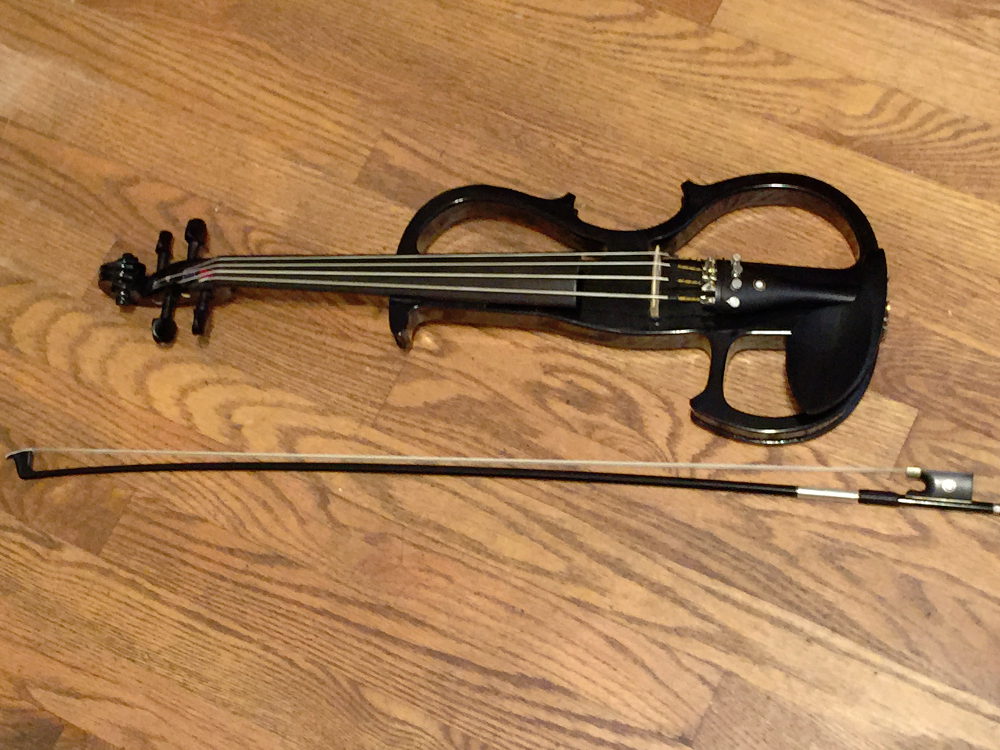
Also not really fair, this is my original Cecilio CEVN-2BK electric violin -- what Yamaha calls a "silent violin" -- newly strung with Sensicore octave strings; or rather, a CGDA set custom-assembled by the Electric Violin Shop to bring a violin body down to cello pitches. Still using the Crescent carbon-fibre bow and Everest shoulder rest, but now rosining up with Nyman bass rosin.
The transition here is basically that the strings are thick and heavy as heck. It takes a hard bow and a firm grip in fretting, and you have to learn to play a little slower and let the strings catch up.
In short, the transition to other members of the lute family is nearly painless. Within a day of picking up each I was playing again and could put my attention on the fun stuff, like trying out new techniques -- or trying to play cleaner. The bowed strings are a lot more like learning an instrument from scratch.
 Next there's the wind and brass to consider. Here's my starting point; decades of recorder, during which, although I may never have gotten that good, I messed around with a lot of different techniques including flutter tongue, fingered tremolo, diaphragm vibrato, "chanter" fingering, and multiphonics. I also had half a suite of recorders, from sopranino to alto, so I was used to changing the width of my grip.
Not to mention a growing collection of Pier 49 "bamboo flutes" and a couple of Early instruments.
From Recorder to Crumhorn:


Another nothing transition. The fingering is slightly different. And it is a reed-cap instrument so the tonguing is different; instead of stopping your tongue against your teeth you stop by putting your tongue over the hole. Other than that, all that time learning breath control and clean fingering translates right over.
This crumhorn is a Susato alto crumhorn in ABS plastic with two extension keys and a plastic reed.
From Recorder to Tin Whistle:

Actually a tougher transition, but only towards playing the tin whistle idiomatically. The fingering is quite different and the articulation is very different (typically little to no tonguing) and the idiom is to do a lot of cuts and strikes and trills. Oh, yeah, and whether or not the traditionalists frown on diaphragm vibrato, the cool thing to have in your box of tricks is fingered "vibrato." (Fluttering a finger rapidly on or over a tone hole one or two holes below the lowest fingered hole).
Pictured is a Feadog "Generation," probably a Bb like mine. I also own a Clarke in the traditional high D.
From Recorder to Trumpet:


The biggie here. Now, I had tried to buzz into a brass mouthpiece before I got it, so I knew I could at least make a tone. I'd also messed around on a Breton Bombarde (what musicologists call a "folk oboe") a double reed of the shawm family originally fitted with a tough-as nails straw reed. So I could shove air.
Brass, though. This was a steep learning curve for the first couple weeks, both learning the basic embouchure and getting enough lip strength to play for longer than a minute at a time. After that first few weeks, though, it got easier; it takes less pressure, less effort, I can go more easily into the higher registers and concentrate more on tone and clarity and all that other fun stuff.
So now I'm messing with wah-wah mute, multiphonics, slides...but I have yet to care a whit about using the tuning slides (I just lip the worst of the notes and call truce on the rest).
What did recorder do for me? Breath control, and a hint at slotting with that recorder overblow to second and third octaves (on the trumpet, you "overblow" through the harmonic series.)
Medini/Cecilio MTT-BL Bb trumpet with blue finish. I'm using a classic Harmon mute with stem, a LotFancy compact practice mute, and now, a Yamaha Silent Brass practice mute with built-in microphone. Plus I'm on my second can of Spitballs -- I swear by those things to keep the trumpet clean.
Monday, May 7, 2018
Musician-Shaped Objects
I've decided it makes no sense to hold a single position on cheap musical instruments. The reason is, there's not one kind of musician.
I sort of have a hard time going into the headspace of a band student now.
(I wish I'd done band as a child. The practice, the skilled instruction, but more than that, playing with other people, playing what you are handed, playing when required. The chance to get real-world performance chops and the exposure to so much of the standard literature. Learning on your own, it is too easy to be a two-trick pony; to learn just enough to get by on whatever it is you are currently interested in.)
In any case, band is demanding. You need an instrument that can stand up to constant use. You need one that meets standards; you can't chart around the weaknesses of a bad instrument. And you need one that is made of good materials with standard fittings so when the inevitable breakage occurs it can be repaired.
The learning process of a student is different. You are learning everything at once; musical ear, notation, pitch relationships, rhythmic sensibility, and -- assuming you are young enough -- the basics of fine motor control.
The student needs a decent instrument. They don't have the experience or the leeway to be struggling with their own instrument. So no cheap instruments. Not even used instruments -- unless you can afford to take it to a professional and get it repaired tuned and properly setup. So rental from a company that does rentals, or put down the money for a decent student instrument from a name brand. Anything else is a disservice to the student -- and to their instructor and their bandmates.
For this market, the hundred-dollar Big Box instruments are a disservice, no, worse, a trap, and can not be sufficiently condemned.
And then there's the other musicians. I'm going to leave aside the professional gigging musician, because that isn't a group who has a need to shop for low-priced instruments.
Instead I mean everyone from the fifty-bucks-a-service pit musician or the pick-up band or the home recordist. People who aren't making a living at it, and don't see themselves on the career path to a chair in a regional symphony orchestra.
For these people this is a golden age; used instruments, cheap instruments, experimental instruments. They move in an environment that is open to experimentation and flexible about what can and can't be achieved. It won't blow the second octave? Rewrite the part. Out of tune? Fix it in the mix. A key fell off? Glue or the appropriate fixit skill. The whole instrument fell apart? Well, then it was a noble experiment and it isn't like they have to have one for class in the morning.
The latest to catch my eye is the Yamaha Venova. Billed as a "Casual Wind Instrument" it is planted as a weird cross between a student saxophone and the kind of ABS recorder found in every classroom. It is pitched as a soprano sax and more-or-less sounds like one but has very few keys; most of the holes are played with the bare finger, just like on recorder. It is even designed so with one quick adjustment it is fingered recorder-style.
It is of a folded-pipe design and to give it an even more space-age appearance there is a weird funnel-like extension. Although it is a cylindrical bore instrument, the extension changes the harmonic series and makes it overblow at the octave like a sax. Interestingly enough, if you stopper the extension, it sounds like a clarinet...just a clarinet that won't play in pitch (as the keys no longer line up with the harmonic series).
Truthfully, I don't know if "experimental" (or should you call them "novelty") instruments are cheaper because of intrinsic qualities (the electric ukulele, for instance, has only four string and is smaller than a guitar, meaning less material) or because they haven't been accepted widely enough. I suspect the latter, because Ubasses are coming out now that cost several times what the first crop did.
What I do know is these are new enough to bypass the "academy" thinking that swarms around established instruments. What I said above about the student versus the adult amateur stands, but I've found a great many people don't understand or can't accept the later group. They get almost angry about anyone who won't get a proper instrument and sit down in proper classes -- with the unsaid expectation of playing semi-professionally ten, twenty years down the road.
Some people can throw every waking hour and every spare dollar into their hobby. Most of us don't. There is music to be had outside of the standard path. And for those on that path, even the instrument-shaped object takes on a very different shape.
I still think you are better off with a used instrument or an experimental instrument, but if you have sufficient skills and the fortitude to stomach blowing a few hundred bucks on something that doesn't work at all, they have their place. That said, most of mine are modded now, making them more experimental than cheap.
Oh, yeah. And the adult beginner? I mean, a true beginner to performance? Your path should look more like the band student's path. Except as an adult you need (and can afford, both mentally and financially, an accelerated profile). Rent a decent student instrument. Hire a one-on-one instructor. You don't have the luxury of endless rote practice time and you don't have the background to hack it alone. And you, too, should stay away from those damned ISOs.
Saturday, May 5, 2018
Call me Deacon Blues
That's how back-burner thinking works. You let the problem simmer, dropping new ingredients in randomly as you come across them and not really paying attention to what's really starting to look like stone soup. Cold stone soup.
And then one day it boils over, and you can hardly write fast enough to take down all the insights as everything starts to fall together. And there went that metaphor...just couldn't keep it all in the pot.
Was re-reading the discussion in Eric Cline's 1177 about the archaeological (and paleobotanical) evidence for drought and subsequent famine around the time of the LBA Collapse in the Aegean. I'd been thinking of the story of Hathor's wrath as described in the first part of the Book of the Heavenly Cow, and inspired by the Red Weed that appears in later parts of H.G. Wells' The War of the Worlds, I'd been thinking of something symbolic, some kind of invasive species or something, that could be thematically linked to the wave of destruction and chaos.
And there's one available. A literal crimson tide; a harmful algal bloom. It's dinoflagellates, occurs in a variety of colors including red, may be climate-linked, and contains a variety of neurotoxins.
And it just keeps getting better. It's red, linking to the Hathor myth and echoing many Biblical and Homeric descriptions of rivers running red with blood and blood staining the seas. And specifically one of the Plagues of the Bible. It contains neurotoxin that can cause memory loss, seizures, and death as well as behavioral changes; off the California Coast there was the famous "Chaotic Seabirds" incident -- tentatively linked to domoic acid -- that inspired Hitchcock's The Birds. And oh yes; it is particularly concentrated in shellfish, making a weak link to certain dietary laws.
As soon as I'd set that down I read that the palatial economies may have been peculiarly susceptible to disruptions of trade. Which for the palaces is largely luxury goods. Conveniently, my Kes, as a skilled weaver, is employed by or for the palace and thus is part of the creation of those goods. Which are traded with, among other places, Egypt. Meaning a possible official reason for Setna to be visiting, who (since Egypt is largely self-sufficient) has an outsider's perspective to the impact and vulnerability of this luxury trade.
Which leads to the particular impact piracy had on Mycenae, who as a warrior culture (who might even have some of the drawbacks of the later Spartan system, oppressed underclass and all) really suffer from Peak Tin. (Amusingly enough, there are multiple scenes in The Illiad where a bronze weapon breaks and no spare is readily available, leading the heroes to attack with rocks and fists).
So is the Trojan War then an attempt to secure trade routes, particularly to that essential tin? Could this be similar to or part of the documented trade embargo imposed on "Ahiyawa" by the Hittite Empire? So either attacking the Hittites in the Troad or trying to open up better routes around them by going after Wilusa? And could the pressure of the old embargo become suddenly critical because pirates have started blocking other trade routes? Or maybe they pulled a dirty trick at Byblos and the loose-knit "Phoenician" peoples imposed their own embargo?
And these pirates. Perhaps the peasant revolt on Crete succeeded, perhaps it failed, but either way there is the start of movement of people and some of them are taking to ships. And even though they may be speaking a different Greek dialect and have their own peculiar variations in material culture this only echoes the "Dorian Invasion" -- which if it took place at all, took place hundreds of years later. But it is still a way of looking at the changes, of migration and of revolution, that are spreading across the Peloponnese and up into the Greek Mainland.
And for some reason this brings me back to gods. I'm reversing myself sort of. No gods will appear in person in the narrative. The characters will act as if their existence and their acts are obvious. However! There will be things that do not have a strictly rational explanation, and they will fall outside that which can be explained away.
Kes is going to keep her ability to see texts from the future, although I've been modifying how that works and how she interacts with it as my understanding of my nerdy, upbeat little goat-girl is ongoing. The Red Tide gives a thin excuse for some weird behavior, including specifically some convenient cultists who show up with literally uncanny prescience to harry the protagonists. And lastly I'm really thinking of having a certain god talk anyhow; but through a shaman. But again, not a deniable magic; the shaman will distinctly say things that she has no good reason to know.
All in all a very productive morning. I've got a doctor's appointment later today and I'm really hopeful I'm going to be able to clear up my breathing problems and that's going to really improve my work on the trumpet. No plans to learn to play the saxophone, though. Not yet. (Not saying I'm not really tempted by Yamaha's Venova....)
Thursday, May 3, 2018
Doing Violins
Finally time and focus to get back to practice.
The task this month is to finish the change-over to the new shoulder rest and a proper vibrato grip. No more death-grip on the neck. I'm working through my scales and the various shifts and string crosses but now with my hand as free and relaxed as I can get it.
I can do arm vibrato now but it is going to take a while to integrate it and to refine it. I've got some depth and speed control but I'm still having fun keeping the instrument stable with a smooth bow stroke. Add the silent reverses and....
Of course on the violin there's never a single position. It isn't like piano where once you get your hands set right you pretty much use them like that. On violin every note, every problem is a different hand position with its own unique muscle memory. The shape of the hand for the A string doesn't get you to the G string. You can have a nice open hand and full arm vibrato in first position, but up in fourth position you are wrapping your hand up around the upper bought in order to reach the notes and -- at least for me -- reduced to hand vibrato.
And of course you change depending on how fast the passage is, how loud, where the next note is. Each note is available in multiple places. I've been working my scales without open strings now, so going from four to one, then back one to four (the former I find easy, the latter is giving me trouble. Don't know why but my bow angles when I go in for that fourth finger on the way down). But you might have a fast passage where it makes sense to skip the harder fingering and use the open string anyhow.
Or you might have a singing passage where to stay legato you stretch or do a shift on one string instead of crossing. You almost need to practice by the specific piece instead of by rote scales and exercises.
Anyhow. The chincello is up and running. Ordered some bass rosin for it (and still tempted by a carbon-fibre viola bow for more weight). So today I'm going to risk taking the strings off the Pfetchner and hang the Alphayues on it instead.
Wednesday, May 2, 2018
Stations of the Cross
In Christian practice, this is a series of fourteen images from the Crucifixion that the worshipper visits in order, praying before each, recreating the Passion with their own journey.
The term got re-purposed in modified form as part of the critical language of Fan Fiction. There are at least a thousand fan-written stories that re-tell Harry Potter's first year at Hogwarts. Even though each is different, with a different focus, different endings, different characters, even wildly different settings, the cantus firmus of the original novel is still back there. And thus, even if the story is set in 1950 and "Harry" is a girl, a ward of Dick Tracey, and from the Moon*, she'll still be unwrapping chocolate frogs with Ron on the Hogwart's Express.
The big difference being that not all of the familiar incidents and characters show up. This is more a statistical tendency towards a relatively small number of popular items from the original canon. So it is a little more like one of those churches with multiple saints in their own individual niches and you can Chinese Menu which ones you visit.
A similar effect is in alternate history, where W.W.I. may have kept going into the early 40's and Bismark II is a nuclear-powered hovercraft....but Winston Churchill is (somehow) still PM (and Adolph gets a brief appearance in the text; even though he's a well-established portrait painter in Free Austria, you still have to visit that station.)
Video Games would seem a strange place for this effect. Even in the most linear game, however, you can as player establish a different internal life for your character. I can play Tomb Raider 2013, for instance, as a scared kid or as a roaring arc of revenge. The results are basically the same and the cutscenes are, alas, the same, but there are nuances in how the actual play unfolds.
A game like Skyrim is very, very open to different paths.
In Skyrim, there is a Main Campaign and a whole bunch of side quests. And there's also stuff to do, like explore, gather herbs, hunt, learn smithing, run a farm. You can (many do) play for hours without ever touching on any of the scripted content.
You can also pick and chose. The episodes of the Main Campaign must be completed in order, but there's no time limit. You can go away to fight the Thieve's Guild or become Arch-Mage of the College of Winterhold for a few months and come back...the dragons will still be waiting.
These form the stations. Not just the memorable incidents of the Main Campaign (the flight from Helgen, the summons of the Greybeards) but also the other accomplishments and memorable incidents from the longer side quests (meeting Torvald, adopting an orphan, making one hundred iron daggers).
Not only can multiple people play this game and have unique experiences -- sharing only these Stations of the Cross as they come across them -- but one person can play the game multiple times, again each time with a unique experience.
And that means even coming at the well-known, well-worn incidents again and again, there is still new insight and new delight. Meeting Ulfric Stormcloak for the second time is a lot different if you meet him as a young dark-elf mage, or as a sturdy Nord who already beat-down the only other known Dragonborn in dragon-to-dragon combat.
And, yeah, there went a few more hours. I've been working a late-night install (we have to start after the offices clear out) and it took a bit of work to flip my biological clock around.
* Free Plot Bunny! I would totally read an H.P. fanfic in which Moon Maid (or Honeymoon) went to Hogwarts, and Voldemort joined Pruneface and Flattop and the other wackaloons in Tracey's Rogues Gallery.
Subscribe to:
Posts (Atom)