Wednesday, March 11, 2015

Raygun IX

Many of the designs I'd been tinkering with implicitly incorporated construction strategies. The one that got approved, however, does not.

This means the next task is working out how best to build it. This is another one of those multi-variable problems where every choice is a trade-off. Construction time, cost, infrastructure cost (aka additional tooling and training for new techniques), risk management, etc.

Here's several pointers to keep in mind whilst working through the construction design phase;

1) Everything goes over estimate.

2) You can only know the known unknowns. Leave yourself space to solve what are currently unknown unknowns. (Make this space bigger when ever dealing with unfamiliar materials or methods!)

3) Watch out for hidden assumptions. Write out everything in plain English so you can look at it and realize you don't actually need forty watts of power or a high silver content or whatever. Or realize you do; and need to weight that aspect higher in the trade-offs.

My big accomplishment for today was estimating costs and time for several different fabrication strategies.

Here are a couple of the big things I'm worried about:

1) The round form. I have some experience in hand-carving compound curves, and I did that in scale for the mockup. But I know that it is quite time consuming, and difficult to be truly accurate; enough to want to look into any way of mechanically achieving those curves. That would be lathing, or various options in computer fabrication.

Lathing has a couple of issues; I haven't any wood lathe experience, and these curves are difficult to achieve on a metal lathe.

Computerized fabrication falls into roughly three methods; slicing (turning the desired shape into a stack of pieces which are glued together and smoothed), printing, and CNC machining. Out of all of them, the CNC requires the least clean-up.

2) Access to the inside for electronics. This has an assumption wrapped in it that I need to expose properly; that the internal spaces are actually planned around the electronics package. It may be incorrect; it may be that a slush-cast, and potting the electronics before final assembly is just fine.

3) Duplication. Almost certainly there wants to be more than one. Fortunately, the majority of the construction methods I have considered so far aren't feasible for the finished model; meaning a molding stage is necessary in any case.

4) Metal. This is a very much questioned assumption. I want the look of metal. I'd like the weight and solidity. I'm pretty much ruling out vacuum forming as viable, but a metallic look is still achievable with paint or cold casting. So, again, 3d printing and resin casting are still on the table.


More data is needed. Using simple volume calculations taken from the mockup, here's how a couple of competing technologies break down;

Molding: Doing a box mold of the whole thing would consume about 100 in^3 of silicone. Smooth-On's Oomoo-30 is available in trial packs of approximately 75 in^3. Given that I'd really want to mold several parts separately for ease in mold design, clean-up, and final assembly, it works out to a minimum of $50 of silicone. So molding is within reason.

Printing: the cheapest Shapeways print is priced by bounding box for models under a certain density. In any case, it works out to around $50 for just the main body...with careful nesting of the parts for most efficiency, could probably come under $100 for the total print.

(As a reference, my V150 model -- thin walls, under 5" long -- costs $45 to print.)


CNC machining: I have much less experience with this technique, but working off listed feeds and speeds from both Tormach and various end-users at CNC and machining forums, it seems capable of doing a roughing pass over the body of the raygun in about five minutes. Finishing pass should be at least 4x that, and there are of course more parts involved, but it seems plausible that even with work holding and tool changes to get the whole thing fabricated in one machine-time reservation.

Cost of the metal; raw stock big enough to form the body with space for clamping works out to about $20 worth. Given all the various parts, wastage, and errors, can assume $80 of metal, and less for repeated fabrication.

So. CNC machining in metal is very competitive. It achieves the desired shape in one step (instead of fabricating a master then molding and casting that), so savings in materials and time. It seems the next step in the planning process is to work up a projected CNC approach and see if that is as feasible as it appears at first glance.


Fortunately, there's a perfect experiment that needs to be made. The raygun, as I currently envision it, breaks down into several elements:

1) Body shell (probably two-piece body, handle may be integral to the shell and likely also two-piece -- the alternatives here are all about being able to chuck the body in a lathe for final polishing).

2) Emitter. Probably turned acrylic, which is also largely unexplored technology for me.

3) Trigger. Another CNC'd part -- metal in any case -- with pin and spring and some way to engage the electrical switch.

4) Internal electronics; have purchased a bag of 3W Cree in pink -- which my new control board will PWM just fine even without the revised version. LED in the fin as well (which leads to questions about how to lead the wires up). And of course it has to "pew pew pew!"

5) Selector knob. Not sourced. Current thinking is to CNC the basic knob and design the way it integrates to the body and is held in place as part of the fabrication. Behind it would be either an encoder or, more likely, a potentiometer. Have not thought about indicator dial, however....and I have some leanings to work out a lighted inset to the side plate, too.

6) Reflector. I tried to source a dish shape in a chrome finish but the closest I came to were some Lego parts. I've also contacted a chrome plating company but I suspect the run is too small for them to do and/or me to afford (minimal order for chroming tends to run in the low hundreds of dollars).

The current best thought for the reflector is to CNC it, smooth it further on the lathe, and then polish it up to the best finish 6061 aluminium alloy can achieve with a buffing wheel. I did this long ago with some Cyberpunk claws and I know it is achievable. The major downside is aluminium oxidizes, and essentially all protective coatings dull the finish.


So my next step is going to be to work up a new model for the reflector I can then try to run off on the Tormach mill.

Tuesday, March 10, 2015

Room Full of Bicycles

I laser-cut most of the next Holocron today. But I don't like it. The parts all fit, but it is still fussy to line everything up while the glue dries, and with just a little more work it should be possible to snap-fit the parts together.

I finished revisions on the shell before I left TechShop, but there were no more empty slots on the lasers (not at least until much later than I meant to stay).

Oh, yeah. It also took me a few minutes to remember how to use the controls on the laser, lower the bed, do an air pass...(and more time puzzling out Illustrator, and getting the files correctly imported from InkScape).

Yeah, it's like riding a bicycle. You never quite forget...but you can get pretty rusty. TechShop. It's like a big room just full of a really wide variety of bicycles.


Monday, March 9, 2015

Raygun VIII


This is not the prop. This is not the beginning of the prop. This is, however, the prop of the beginning. (With apologies to Winston Churchill).

Which is to say; this is a full-scale mock-up constructed in order to work out both aesthetic balance, try out some detail ideas, and get a sense for what construction methods may be appropriate.


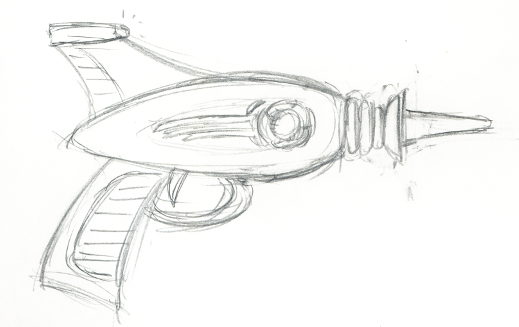
After several weeks of chasing down various pathways, we finally stumbled on a direction that we both liked. This was the sketch that got approved:

The next step was to try to translate this into scale. I brought out every gun-like object I had -- including my hot-melt glue gun -- to try to get a sense of the necessary dimensions of the grip and thence scale from there.


This is not, mind you, a construction drawing. It is merely the first attempt to translate the sketch into a scaled concept that can then be checked for overall balance and practicality.

And, indeed, it flunked the first test:


Based on the look and feel of the first cutout, I adjusted dimensions and transferred to foam-core. The re-sized foam-core cutout felt a lot better, but I needed a little more to really get a sense of it. So; added cheap expanded foam (recycled from the last time someone in the neighborhood had furniture shipped to them:


And carved the foam by hand into an approximation of the right shape:


Well, I was still learning from this mock-up, so it was worth taking it just a little further. Note, however, it is in no way suitable for a final prop, or even for a master to take a mold off. If I had meant to do this, I would have used a spine of MDF, omitted all the turned parts (like the front nozzle, which is meant to be acrylic, or the front dish -- which I am still trying to source), used dense foam and skinned it with Bondo for strength.

Instead this is spackle and filler primer, white glue as a foam sealer and Bondo spot putty in the later stages. It can only take gentle handling.


So several coats of primer and spot putty...built up the dish and insulator rings with Apoxie Sculpt...spray-painted gloss black, then hit it with silver coat. When that is properly dried I'll come back with a few bits of detail paint.

Incidentally, I took that top picture in my kitchen at 10 PM, and somehow my old Oly C3020 auto-balanced on to a fantabulous effect. It was originally a rich sepia that looked like a picture from the turn of the (last) century, but I tweaked the hue in GIMP using a color layer to achieve the very Republic Serial tonality of the above. I'd love to be able to reproduce that effect on demand!

Sunday, March 8, 2015

Are We Multitasking Yet?

(With apologies to Bill Griffith.)

I'm still working serially, but the job slotting in the task manager has been on shorter intervals the past few days. I've been plugging away at three rather different projects, and the moment I get stalled on one, I switch to one of the others.

(Or browse random web comics...I'm not that task-focused!)


I finally got a concept sketch approved for the Ray Gun (more on that next post) and have moved on to mock-up:


In the meantime, the next Holocron is approved for trial cut, but there is a lot of work involved in making the pieces fit together better than the last one:


And I haven't managed to quite let go of the Poser content creation I started back when I was sick. Getting closer to having a few new clothing meshes ready for something...possibly my online store, which could really use more stuff, but rigging clothing is such a pain:


Thursday, March 5, 2015

Multi-threaded, single core

Everything is possible, but everything takes longer than you'd like.

A side effect of the obsessive focus I bring on projects is my inability to sustain that intensity. I'm not really a multi-tasker. Instead I concentrate on one thing for a few days, then move my focus to something else.

It's like doing shows in rep (aka in repertory; two or more plays are done over the same block of time at the same building). And like working in rep, a lot of extra effort goes into loading in and loading out.

In terms of projects, I have the physical clutter of half-done projects, supplies on order or just arrived or being saved for when I'm ready for them, tools and jigs and workspaces that need to be set up for a certain project and I'm leery of breaking them down...and similar clutter of the mental spaces.

I discovered when writing a novel that it took a minimum of an hour to upload enough of even a single scene in order to be able to work on it. To work on the novel in depth it took three or four days before I could really remember where everything was and be able to pick up where I left off.

Add to this, more and more sets of intellectual tools that get rusty. Like trying to remember the hotkey commands in the dozens of pieces of software I need for many of my projects.

Right now I'm shuffling quickly, trying to move along on the latest Holocron orders, move into the drafting stage on the Ray Gun commission...and doing a little mesh work and file reorganizing for Poser content creation.

And, yeah. It's been a while since I looked at those folders. I found some meshes in progress I'd completely forgotten I'd built. That's hours of work, even days of work, that would have gone completely to waste if I hadn't almost accidentally stumbled on them again.

And may, still. I'm pushing hard on everything that even slightly resembles paying work, but this stuff is chump change...what I really need is another gig or two, and the moment that happens, everything else will have to go on the back burner.

Wednesday, March 4, 2015

Zombies of the Heliopause

There's a scene in Sharon McCrumb's comic mystery story Bimbos of the Death Sun (which takes place at a science fiction convention) where one of the characters looks at all the creative effort being put into fanart and cosplay and so forth and wishes that all those people would turn their obvious talents towards "real world" fashion design, commercial art, etc., and earn a better living.

It isn't an uncommon thought. There are two flaws in it. One is that fandom is a small pond; being able to write well enough to get a fanfic following is not the same as being publishable in the wider world. And ditto for all the other skills of fabrication and industrial design on display.

The other is that fans are not blind to the advantages of money. There are many ways fans attempt to make a little cash from their work, ranging from getting paid by other fans to help them with their sewing, to monetizing click-throughs at the host sites where they put their creations.

Anyhow.

I woke up realizing I am an active member at three sites dependent on user-generated traffic; Instructables, Fanfiction dot net, and DeviantArt. Out of these, only Instructables has returned "real world" value for the effort -- in the form of a t-shirt and an electronics kit (which I gave to a niece).

Contrast to this, I don't supply that much "content" directly to the Replica Props Forum (I post a few pictures, but I don't do any work specifically for the needs of that site), but I have made significant cash through my activity there. What little I have in the bank right now is basically my payment from the last set of machined Aliens grenade props.

It is sobering. But then, there is more to life than making money. Much of what we spent effort and money on is gaining social status, contacts, learning new things, seeing new places, learning new skills; everything beyond the lower steps of Maslow's pyramid of human needs (aka food and shelter).

And the online world is no more unreal than the outside world. There have been through the ages many friendships which took place at long distance, through letters, for instance. Social needs and gains are still important even if they are being transacted digitally instead of in meatspace.

But...and here's the morning's big caveat: yesterday I came back from a job along the coastal highway, and I was reminded again of how incredibly scenic a place I live in. And reminded of how little time I've spent lately walking, exploring, sight-seeing, etc. around my own home town.

And I just spent the last few days cooped up inside mostly creating images for an online fan art site. Well, okay...I was too sick to go out on two of those days, and I'm still cash-strapped...but it is a good thing that I've already started to transition towards creating content that can be monetized instead.


(The title of this entry is taken from a short story I was working on, which involved uploaded brains in temporary bodies to work a physics experiment in the remote reaches of our solar system. My main output at Fanfiction dot net of late has been a Tomb Raider/Stargate SG1 cross-over, for which I've done a lot of amusing research. My Instructables have often been linked from this blog, but there will be no link or other outward connection to my Deviant Art work; some of it is a little kinky and that's not something I mean to share through this blog.)

Sunday, March 1, 2015

Gah Software

In Star Wars (the first film, the original film, which is to be known as "Star Wars," period) a small farming homestead purchases a droid that can speak Bocce -- purchases a functional AI because that's easier than learning the computer language some of their old evaporators use.

Meanwhile on Next Generation and later, everyone can use everything that has microcircuits, and there's never even a moment of realizing the docs are all in Klingon or whatever. I think Star Wars gets it a lot closer.

Anyhow.

I've been really sick for a couple of days. And spent it delving into some software I haven't used in far too long. Still learning my way around GIMP, getting better with Inkscape -- and flipping back and forth between those two with great rapidity as I develop the most recent iteration of the Holocron:

This image is watermarked because the art for this one I want to keep exclusive to the client that ordered it.

And I'm pretty much volunteering the design time, but aside from the vector on the center image, it is all re-purposable for the holocron kits I'll be offering soon at the RPF.

I'm going to be able to offer a fair number of customization options right off the rack, plus option to do new design work as I find time.

Perhaps I'll even some time solve the assembly issue. I've seen some Holocron designs that use a staggered outer edge to hide the way the shell has to be assembled: and those would not need to be sanded and painted.


Anyhow. Figured out an option for the DuckLight battery issue and rigged up a quick test with the prototype; hooked the main circuit to regulated 5v, and plugged the Cree into a separate 4-cell battery pack. It seems to deliver almost the output I achieved with an overall regulated 500ma power supply.

So the scheme now is to add a 3.3v LDO to the PCB. It won't be that wasteful of space; I already need to add the filter capacitors to stabilize the ATtiny.

Pity there's no easy way to cram that in to the current PCB so I could do some proper in-place prototyping. But the boards were only ten bucks.


For completely random reasons, I spent most of my sick time messing around with a software I'd started to forget. Poser. Poser 9, to be precise, which saves all the parts of the interface that worked badly in Poser 6, and adds flash-driven menus that work poorly, non-scalable interface fonts, and other nice little details that make it excruciatingly inefficient and frustrating.

It's worse than that. I also flip into Poser 6 when I'm rigging a prop, because it is simpler to work in and makes cleaner files.

And for some stuff, DAZstudio is a little easier. At least the camera is superior. But of course the interface is entirely different, in almost every way it can be.

I'm really not looking forward to having to go back into Carrara, but I have some modeling projects in the pipeline that need it. Well, that or Blender...and I'm still having terrible trouble coming to grips with Blender.

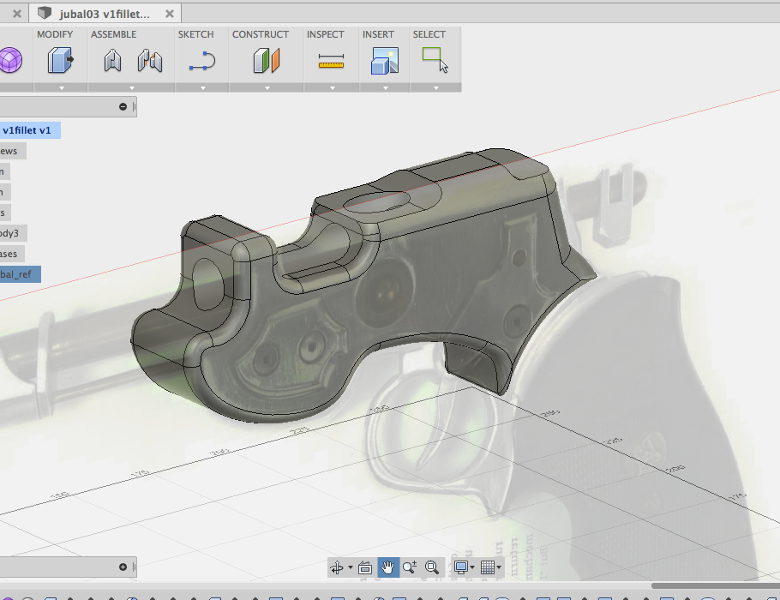
Even Fusion 360. Some of the specific curves and edges I need out of it are far too difficult to
achieve inside the interface. So like pretty much everything else I do, I need to flip the meshes into another application to do some work, then re-import them.

And I just realized it has been several months since I last used that software. They've probably changed the entire thing by now!

At least EagleCAD was a relatively small learning curve, and shouldn't take too long to pick up again...